.jpg)


Posted by:
Category:
Comments:
Post Date:
How to Choose the Right Tariff Meter for the UAE’s Demanding Climate
For engineers, panel builders, and procurement teams in the UAE and wider GCC, selecting the right energy meter is a critical decision. A standard meter tracks total consumption, but a tariff meter is a strategic tool. It doesn't just measure how much power you use; it strategically tracks when you use it—a vital function for managing operational costs under the region's time-of-use utility rates.
How a Tariff Meter Works and Why It Matters in the UAE
A standard energy meter simply adds up total kilowatt-hours. A tariff meter, however, operates like surge pricing for electricity. It is designed to record energy use across different, pre-defined time periods, each with a unique price per kWh. This is a game-changer for any energy management solution Dubai businesses implement, as utilities like DEWA use time-of-use (TOU) rates to manage grid strain, especially during peak summer demand.
This system typically breaks down the day into distinct billing periods:
- Peak Hours: Usually afternoons when air conditioning load is at its maximum. Energy is most expensive during this window.
- Off-Peak Hours: Late at night or early morning when demand is lowest, offering the cheapest energy rates.
- Shoulder Hours: The transitional periods between peak and off-peak with moderate pricing.
By precisely logging consumption in each window, a tariff meter provides the granular data essential for a TOU billing structure, turning a simple measurement device into a powerful cost-control tool.
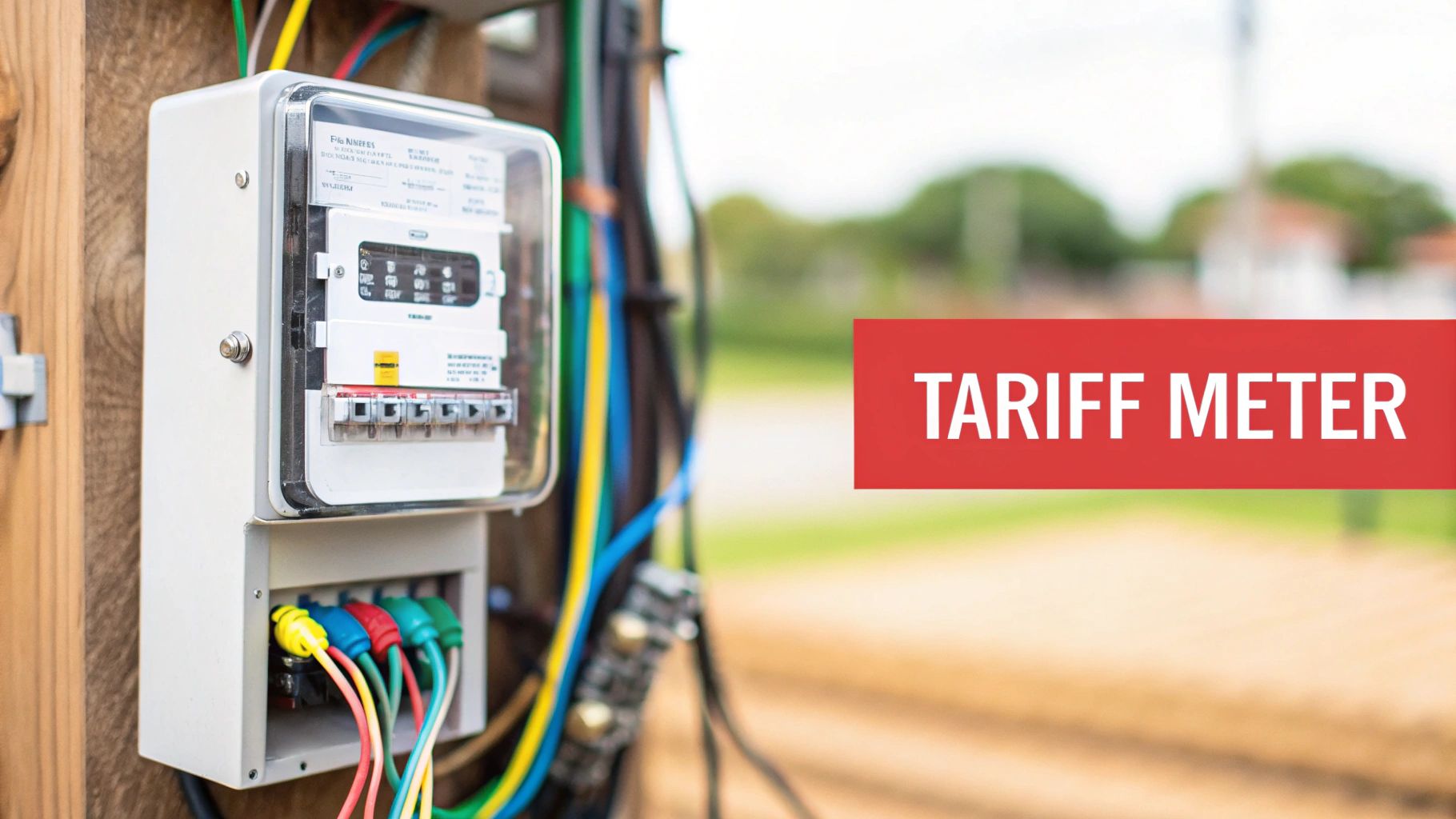
A Strategic Advantage for Businesses in Dubai
For engineers and facility managers, this functionality directly impacts operational expenditure. A facility equipped with a tariff meter can strategically shift energy-intensive processes—such as running large machinery, charging EV fleets, or operating chillers—to off-peak hours. This operational adjustment can significantly reduce monthly utility bills.
The ability to monitor and control consumption based on time-of-day tariffs is no longer a luxury but a core component of an effective energy management solution Dubai businesses rely on. It directly impacts operational expenditure and supports broader sustainability goals.
Compliance and Pinpoint Accuracy
Beyond cost savings, selecting the correct meter ensures compliance and billing accuracy. Utilities across the GCC have stringent requirements for metering equipment to guarantee fair billing. Many projects mandate meters that are not only capable of tariff measurement but are also certified to demanding standards like IEC. For more details, our guide on understanding MID certified meters in the Middle East offers in-depth information. This certification ensures data is reliable, accurate, and accepted by local authorities.
Ultimately, specifying the correct energy meter GCC projects need means selecting an instrument that aligns with local utility tariffs, withstands the harsh climate, and delivers the detailed data required for intelligent energy management.
Choosing Between Single and Multi-Tariff Meters
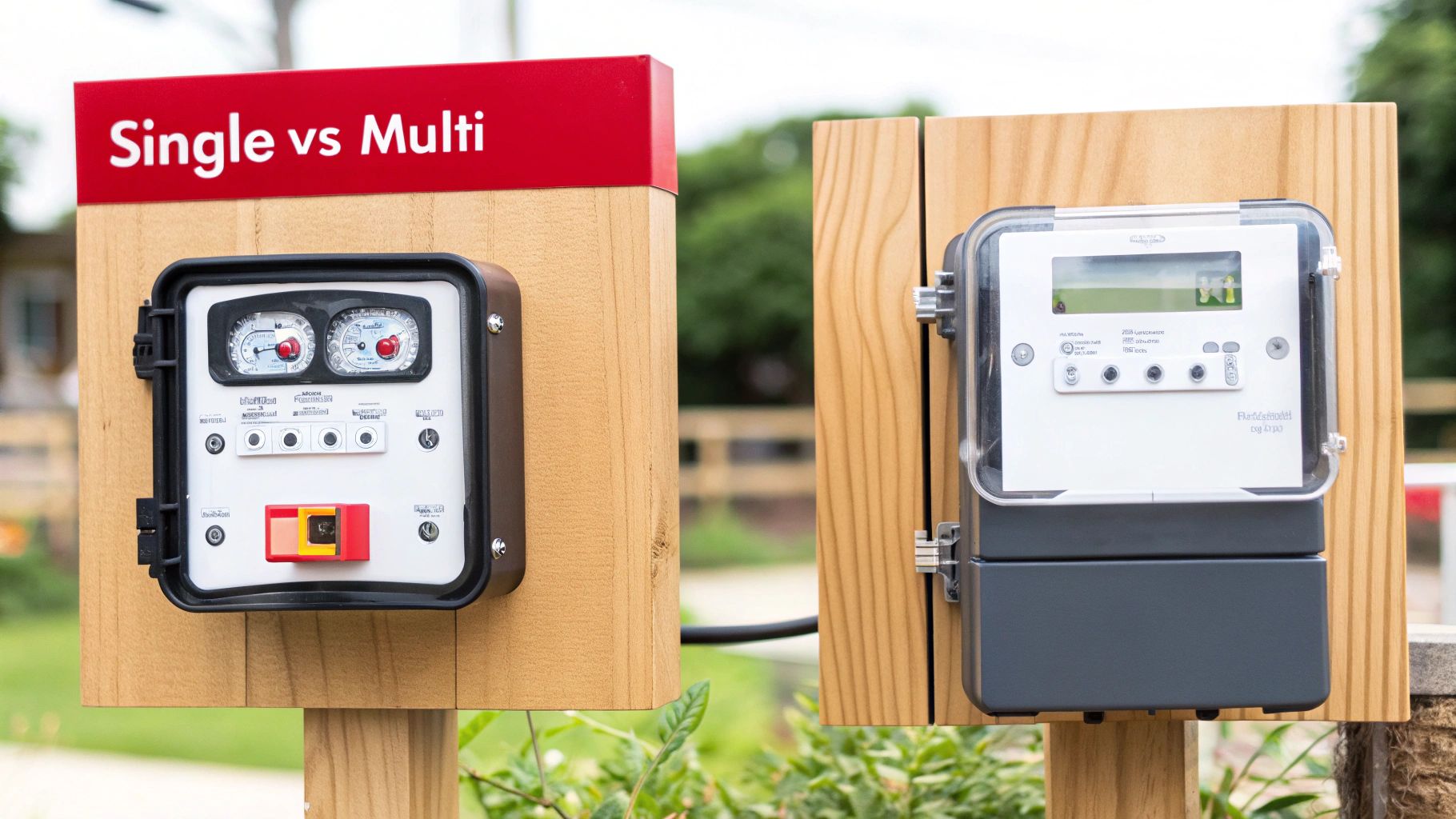
The choice between a single-tariff and a multi-tariff meter is a critical financial decision that hinges on a facility's electricity consumption patterns. One provides simplicity, while the other offers a powerful mechanism for reducing operational costs.
A single-tariff meter is the most straightforward option. It records every kilowatt-hour consumed at a single flat rate, regardless of the time of day. This makes it a practical, no-fuss choice for smaller operations in the UAE with consistent energy demands, such as a retail store or a standard office operating on a fixed 9-to-5 schedule. For these applications, a single-tariff meter provides simple and predictable billing.
The Strategic Advantage of Multi-Tariff Meters
A multi-tariff meter is the essential tool for any business aiming to optimize its energy expenditure. This type of tariff meter tracks electricity use across different time slots—peak, off-peak, and shoulder hours—each with its own price. This capability is invaluable for businesses in the UAE and KSA, where utilities use variable pricing to manage grid load.
Here’s where a multi-tariff energy meter GCC model provides significant value:
- Manufacturing Plants: A factory can schedule its most energy-intensive processes, such as running heavy machinery, for off-peak night hours when electricity is cheapest.
- Commercial Towers: A smart building management system can pre-cool the tower during early morning off-peak hours, reducing the load on chillers during the expensive afternoon peak.
- EV Charging Hubs: Charging stations in Abu Dhabi can offer lower rates for overnight charging, encouraging off-peak usage and alleviating grid pressure.
A Clear Comparison for Decision-Making
For procurement managers and panel builders, the mission is to align the meter's capabilities with the facility's operational profile. The right selection integrates the hardware directly with the business's financial strategy. An effective energy management solution Dubai projects demand starts here.
To simplify this decision, let's compare the key differences.
Feature Comparison: Single-Tariff vs. Multi-Tariff Meters
This table provides a side-by-side comparison to help you determine the best fit for your project's needs in the GCC region.
| Feature | Single-Tariff Meter | Multi-Tariff Meter |
|---|---|---|
| Billing Structure | A single, flat rate for all kWh consumed | Multiple rates based on time-of-day (peak, off-peak) |
| Best-Fit Application | Small facilities with consistent, predictable loads | Large facilities with flexible, high-demand operations |
| Cost-Saving Potential | Minimal; based only on reducing total consumption | Significant; based on shifting load to cheaper periods |
| Operational Complexity | Simple and straightforward to manage | Requires active management and scheduling of loads |
| Ideal for UAE/GCC | Small offices, retail stores, residential complexes | Factories, malls, data centers, EV charging stations |
A single-tariff meter is passive, whereas a multi-tariff meter empowers a facility to actively participate in its energy management. It delivers the crucial data needed to make intelligent operational shifts that directly improve the bottom line, making it a cornerstone of modern electrical components UAE specifications for any forward-thinking project.
Decoding Key Technical Specifications for the GCC Climate
Selecting a tariff meter for the extreme environmental conditions in the UAE and Saudi Arabia requires a deep dive into its technical specifications. The meter must not only be accurate but also resilient enough to survive relentless heat, humidity, and airborne dust. For engineers and panel builders, certain specifications are non-negotiable.
Built for the Heat: Ingress Protection and Operating Temperature
A meter's first line of defense is its enclosure. For a tariff meter installed in a dusty industrial zone or a humid coastal facility, the Ingress Protection (IP) rating is paramount.
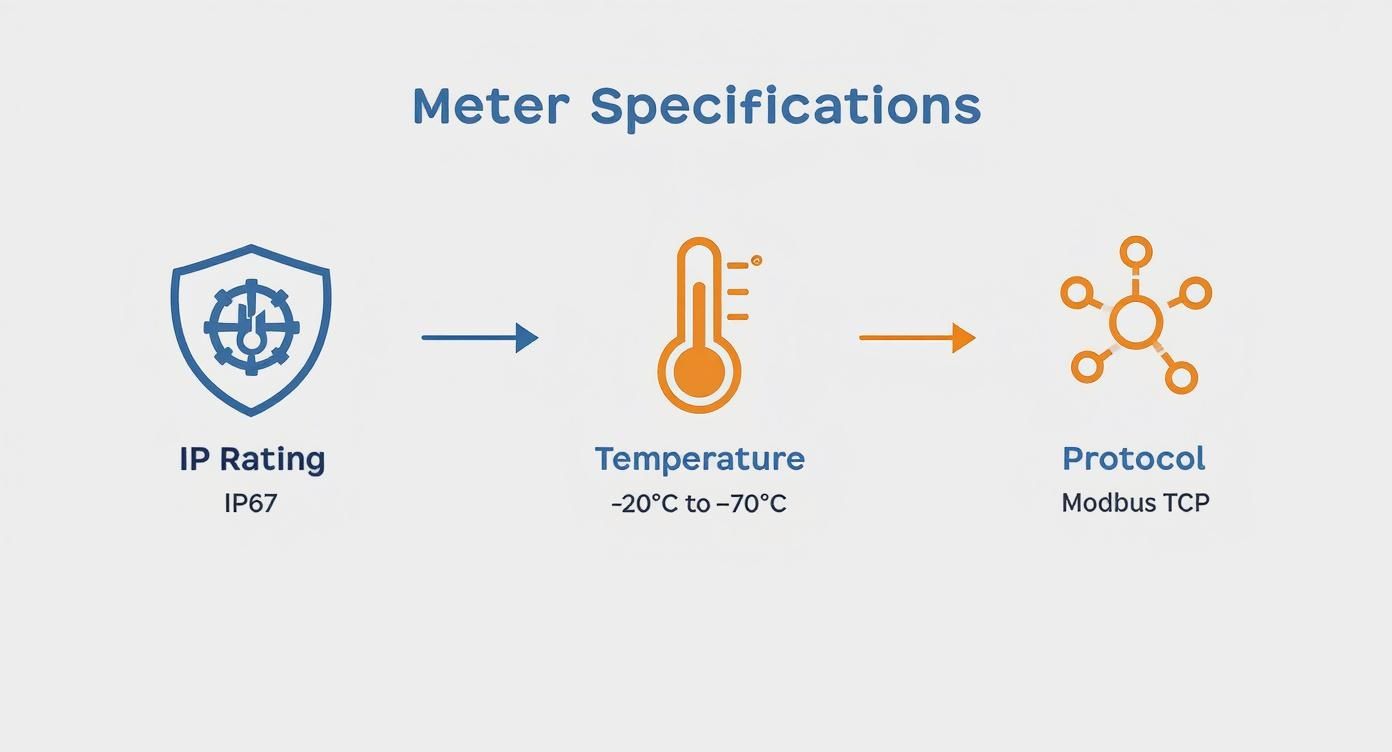
- IP54: This is a solid baseline, offering good protection against dust ingress and water splashes. It is generally sufficient for indoor panel installations.
- IP65 or Higher: For outdoor or harsh indoor environments, IP65 is the minimum requirement. This rating ensures the meter is completely dust-tight and can withstand low-pressure water jets, guaranteeing long-term durability.
Equally critical is the operating temperature range. Ambient temperatures in the UAE regularly exceed 45°C, and temperatures inside a switchgear enclosure can be even higher.
A meter with a wide operating temperature range (e.g., -25°C to +70°C) is a fundamental requirement, not a luxury. It ensures consistent performance and prevents premature failure during peak summer months.
Ensuring Precision: Accuracy Class and Electrical Parameters
Once durability is confirmed, the focus shifts to electrical accuracy. The Accuracy Class, defined by IEC standards, indicates the meter's margin of error. For commercial billing and critical energy monitoring, precision is key.
- Class 1: The standard for most utility and sub-billing applications, with an error margin of ±1%. It provides reliable data for general commercial and industrial use.
- Class 0.5S: For demanding applications like data centers or large industrial plants where small inaccuracies accumulate into significant costs, Class 0.5S offers higher precision at ±0.5%.
Other vital electrical specifications include the nominal voltage rating, which must match the local grid (typically 400/230V), and compatibility with current transformers (CTs). For a deeper look into advanced metering capabilities, you can find valuable information in our guide to power quality meters.
Seamless Integration: Communication Protocols
A modern tariff meter must communicate with larger systems, such as an Energy Management System (EMS) or a Building Management System (BMS). The most common protocol in the GCC region is Modbus RTU over an RS485 connection. It is robust, simple, and widely supported by system integrators. This protocol allows a central system to poll multiple energy meters for real-time data, enabling detailed analysis and automated reporting. Specifying a meter with native Modbus RTU support is a crucial step in future-proofing any energy management solution Dubai projects require.
Getting Tariff Meter Installation and Programming Right
Correct installation is paramount for accurate energy measurement. A simple error, such as a reversed current transformer (CT) connection, can corrupt data and lead to significant financial discrepancies. This section provides practical guidance for panel builders and electricians in the UAE on wiring, commissioning, and programming a tariff meter.
Common Installation Mistakes to Avoid
- Reversed CT Polarity: Ensure CTs are installed with the correct orientation (P1/P2 or K/L) to measure power flow direction accurately.
- Incorrect CT Ratio Programming: The CT ratio programmed in the meter must exactly match the physical CTs installed.
- Loose Connections: All voltage and current connections must be properly torqued to prevent intermittent readings or heat buildup.
The diagram below highlights key specifications to verify before installation.
Step-by-Step Installation Checklist
This structured approach is essential for any energy meter GCC installation.
- De-energize and Verify: Isolate power to the panel and use a multimeter to confirm zero voltage before starting work.
- Mount the Meter: Securely mount the meter on the DIN rail, ensuring adequate ventilation to manage high ambient temperatures in the GCC.
- Connect Voltage References: Wire the phase and neutral voltage inputs to the designated terminals.
- Install and Wire CTs: Clamp CTs around the primary conductors, ensuring the arrow on the housing points toward the load. Connect the secondary wires (S1 and S2) to the corresponding current input terminals on the meter.
- Connect Communication Lines: For integration with an energy management solution Dubai projects require, wire the RS485 communication lines (A and B terminals) using shielded twisted-pair cable to minimize electrical noise.
- Power Up and Commission: After double-checking all connections, re-energize the panel. Verify that the meter's display is active and readings are plausible.
Maintenance Best Practices
A simple maintenance schedule can ensure long-term accuracy and reliability.
- Visual Inspection (Annual): Check for signs of overheating, dust accumulation, or loose connections.
- Data Verification (Bi-Annual): Compare meter readings with utility bills or a calibrated portable meter to check for discrepancies.
- Firmware Updates (As Needed): Check with the manufacturer for any critical firmware updates.
Programming Tariffs and Communication
With the hardware installed, the final step is software configuration.
- Set the Time and Date: This is the foundation of tariff-based measurement. An incorrect clock will skew all time-of-use data.
- Define Tariff Schedules: Program the exact time windows for each tariff period (e.g., Peak: 12:00–18:00, Off-Peak: 22:00–06:00), including separate schedules for weekends and public holidays.
- Configure Communication Parameters: Set a unique Modbus ID (slave address), baud rate, and parity for each tariff meter on the network.
- Set the CT Ratio: Input the precise ratio of the installed current transformers to ensure correct measurement scaling.
By following these installation and programming steps, technicians can ensure every tariff meter delivers accurate and reliable data from day one, which is fundamental for any facility in the UAE seeking to control energy costs.
Getting Tariff Meters Talking to Your Energy Management Systems
A standalone tariff meter is a data collector. Its true value is unlocked when integrated into a larger ecosystem like a Building Management System (BMS), SCADA, or a dedicated Energy Management System (EMS). This integration transforms raw data into actionable intelligence, forming the nerve center of a facility's energy strategy.
Without integration, facility managers are limited to analyzing past utility bills. With it, they gain a live dashboard for real-time operational control.
The Language of Connection: Communication Protocols
The common language for this connection in the UAE and GCC is the Modbus RTU protocol over an RS485 physical link. Its simplicity and robustness make it ideal for industrial environments. A master system (EMS server) can poll multiple slave devices (meters) on a single loop to retrieve critical data points:
- Live power (kW) and demand
- Total energy consumption per tariff (kWh)
- Voltage, current, and power factor
- Peak demand records
This constant data flow is the foundation of any serious energy management solution Dubai facilities need.
From Looking Back to Planning Ahead
Consider a large shopping mall in Dubai with massive and fluctuating energy demands. An integrated system provides x-ray vision into operations. When all sub-meters feed live data into a central BMS, the facility team can pinpoint energy-intensive areas and peak demand times, unlocking advanced control strategies.
By integrating tariff meters with an EMS, facility managers can implement automated load-shedding. When demand approaches a peak-rate threshold, the system can automatically curtail non-essential loads, such as decorative lighting or secondary chillers, to avoid costly demand charges.
This proactive management is what a modern energy meter GCC installation enables.
Real-World Wins From an Integrated System
Integrating meters into a central platform delivers tangible operational and financial benefits. This is a core component of a comprehensive energy management solution.
Key advantages include:
- Automated Reporting: Generate daily, weekly, or monthly energy reports automatically, eliminating manual data collection.
- Energy Leak Detection: Compare consumption trends across similar zones to quickly identify anomalies indicating faulty equipment or wasteful practices.
- Accurate Tenant Sub-Billing: For commercial towers in Abu Dhabi, integrated meters ensure transparent and accurate tenant billing, preventing disputes.
- Predictive Maintenance: An unusual energy spike from an HVAC unit can signal an impending failure, allowing for pre-emptive maintenance and avoiding downtime.
Integrating a tariff meter elevates it from a billing device to an active sensor in a dynamic control system, empowering engineers to reduce costs, enhance efficiency, and maintain operational excellence in the competitive UAE market.
Got Questions About Tariff Meters? We've Got Answers.
Here are answers to common questions from engineers, electricians, and procurement managers across the UAE about tariff meters.
How Does a Tariff Meter Handle Weekends and Public Holidays?
Modern digital tariff meters offer flexible scheduling to match complex operational and utility billing structures.
- Weekday Schedules: Set distinct peak, off-peak, and shoulder periods for standard business days.
- Weekend Schedules: Program a separate, often simpler, schedule for weekends, typically a continuous off-peak rate.
- Holiday Calendars: Advanced meters allow you to pre-load a calendar of public holidays. On these dates, the meter automatically switches to a pre-defined holiday tariff, usually the cheapest off-peak rate.
This programmability ensures billing accuracy reflects a business's actual power usage.
Can One Multi-Tariff Meter Replace a Bunch of Single-Tariff Meters?
In many cases, yes. A single multi-tariff meter at the main incomer can track total facility consumption against the utility's time-of-use tariff. However, if you need to sub-bill tenants or allocate costs to different departments, you will still require individual sub-meters for each load center.
The main tariff meter manages the utility billing strategy, while sub-meters provide the granular data for internal cost allocation. This two-level approach is foundational to any effective energy management solution Dubai facilities implement.
What Is the Lifespan of a Tariff Meter in the GCC Climate?
The lifespan of a tariff meter in the UAE's harsh climate depends on its build quality and installation environment. A high-quality meter from a reputable brand, installed correctly within a well-ventilated, IP-rated enclosure, can be expected to provide 15 to 20 years of reliable service.
Key factors include:
- Operating Temperature Range: Meters rated for higher temperatures (up to +70°C) can better withstand the heat inside electrical enclosures.
- IP Rating: A robust IP rating protects sensitive electronics from dust and humidity.
- Component Quality: Reputable manufacturers use higher-grade components resilient to heat stress and voltage fluctuations.
How Do Import Tariffs Affect the Cost of Meters in the UAE?
The final cost of electrical components UAE distributors offer is influenced by global supply chains and regional trade policies. Import tariffs are factored into the landed cost of goods. According to the World Bank's report on regional tariff rates, the weighted average applied tariff for products in the MEA region is approximately 5.16%.
This means the final price includes the manufacturer's cost, shipping, duties, and local distribution overheads. Partnering with an established local supplier like GoSwitchgear simplifies this process, providing transparent pricing and reliable local stock for your projects.
For all your project needs, from advanced tariff meters to a full range of switchgear components, GoSwitchgear provides the expertise and inventory to support your success in the UAE and GCC. Explore our extensive online catalogue to find the right solutions for your application. Visit us at https://goswitchgear.ae.
Share this post

Related
Posts
A Guide to Choosing AC to DC Converters for UAE & GCC Electrical Systems
Master AC to DC converters with this comprehensive guide for engineers in the UAE & GCC. Learn selection, installation, and...
A Guide to Drill Machine Prices in the UAE for Technical Professionals
Find the best drill machine price in UAE. Our 2026 guide helps contractors and engineers choose the right corded, cordless,...
A Professional’s Guide to Choosing AGM VRLA Batteries in the UAE Climate
Discover why AGM VRLA batteries are the superior power solution for UPS, solar, and industrial systems in the UAE. Get...
How to Choose the Right Lithium Ion Battery Charger for UAE & GCC Projects
Discover how to select the right lithium ion battery charger for UAE projects. This guide covers specs, BMS integration, and...
.jpg)