.jpg)


Posted by:
Category:
Comments:
Post Date:
Selecting Electrical Cable Tray Dimensions for UAE & GCC Projects: A Guide
Choosing the correct electrical cable tray dimensions is a foundational step that ensures project success in the demanding environments of the UAE and GCC. It's more than just fitting cables; it’s about guaranteeing safety, meeting local compliance, and building in capacity for future growth. The three critical measurements—width, depth, and length—dictate everything from cable capacity to the required structural support.
Understanding Core Cable Tray Dimensions in the GCC
For any engineer, panel builder, or electrician working in the UAE, getting these dimensions right is non-negotiable. It is a critical factor for system performance and meeting local regulations in Dubai and Abu Dhabi. Each measurement plays a specific role in creating a robust cable management solution that can withstand the region's climate. Sourcing from a knowledgeable supplier like GoSwitchgear ensures these requirements are met.
This diagram breaks down the three key dimensions—width, depth, and length—that define a tray's physical size and capacity.
This is your starting point. How each of these contributes to the tray's load-bearing ability and overall integrity is fundamental to every calculation that follows.
Standard Dimensions in the UAE and KSA
In the UAE and KSA, a typical steel ladder or perforated cable tray comes in standard lengths of 2,440 mm and 3,000 mm. Widths offer far more variety, usually ranging from a narrow 50 mm up to 1,200 mm.
Common side depth (or height) options are 50 mm, 75 mm, 100 mm, 150 mm, and 300 mm. These metric sizes are designed to align with NEMA VE‐1 tray categories while fitting perfectly with GCC construction practices, where 3-meter modules are the standard. For detailed specifications, it's always best practice to consult standard product catalogues from reputable local suppliers.
To simplify selection, here’s a quick-reference table summarizing the typical dimensional ranges for cable trays in the UAE and wider GCC region.
Standard Cable Tray Dimensions in the UAE/GCC
| Dimension | Common Range (Metric) | Primary Application Focus |
|---|---|---|
| Length | 2,440 mm to 3,000 mm | Aligning with standard structural supports and building layouts. The 3,000 mm length is a regional standard. |
| Width | 50 mm to 1,200 mm | Accommodating a wide spectrum of cable volumes, from single low-voltage runs to dense power cable layouts. |
| Depth/Height | 50 mm to 300 mm | Providing adequate side wall support and cable fill capacity, crucial for heavier cables and vertical runs. |
This table provides a solid baseline for what's standard, helping you select the right tray size based on your project's specific cable routing and load requirements.
Matching Tray Type to Project Dimensions
Selecting the right electrical cable tray dimensions is fundamentally tied to the tray's design. The type you choose—whether Ladder, Perforated, Solid Bottom, or Wire Mesh—comes with its own dimensional guidelines that dictate performance in projects across the UAE and GCC. A tray's physical construction directly impacts cable support, heat management, and installation in tight spaces.
The classic ladder tray, for instance, is the go-to for heavy-duty power cables due to its maximum airflow. In the high ambient temperatures common to the region, effective heat dissipation is a necessity, not a luxury. This is why wide ladder trays are frequently specified for industrial plants and major infrastructure builds in Dubai and Saudi Arabia.
Comparing Trays for UAE and GCC Projects
For engineers in Dubai or system integrators in Abu Dhabi, aligning the tray type with the project requirements during the planning phase is crucial. Each style offers unique advantages defined by its typical dimensional profile.
- Ladder Trays: Unbeatable for heavy power cables. The sturdy rung design supports significant weight over long spans without sagging. Widths of 600mm to 900mm are common for main power distribution in industrial facilities requiring high load capacity and excellent heat management.
- Perforated Trays: The versatile all-rounder, offering a great mix of support and ventilation. Perfect for instrumentation and control cables that need continuous support but still require airflow, making them a staple in mixed-use commercial buildings.
- Solid Bottom Trays: The best choice for protecting sensitive cabling like fiber optic lines or control system wiring needing EMI/RFI shielding. The trade-off is heat retention, so dimensions must be chosen carefully to prevent buildup, often by specifying wider trays or lower fill ratios.
- Wire Mesh Trays: Kings of flexibility. Easily cut and shaped on-site, they are ideal for navigating complex routes with multiple bends. This makes them a favorite for data cabling runs in Dubai's commercial towers, where avoiding existing MEP services is standard practice.
By aligning the tray type with the specific cables and physical constraints, you ensure a reliable, efficient, and fully compliant installation.
How to Select the Correct Cable Tray Width
Choosing the right width for your cable tray is a foundational decision that impacts capacity, safety, and future-proofing. With widths from a slim 50mm to a massive 1200mm, matching the tray to the application is essential. An incorrect choice can lead to overcrowded cables, dangerous overheating, and costly rework.
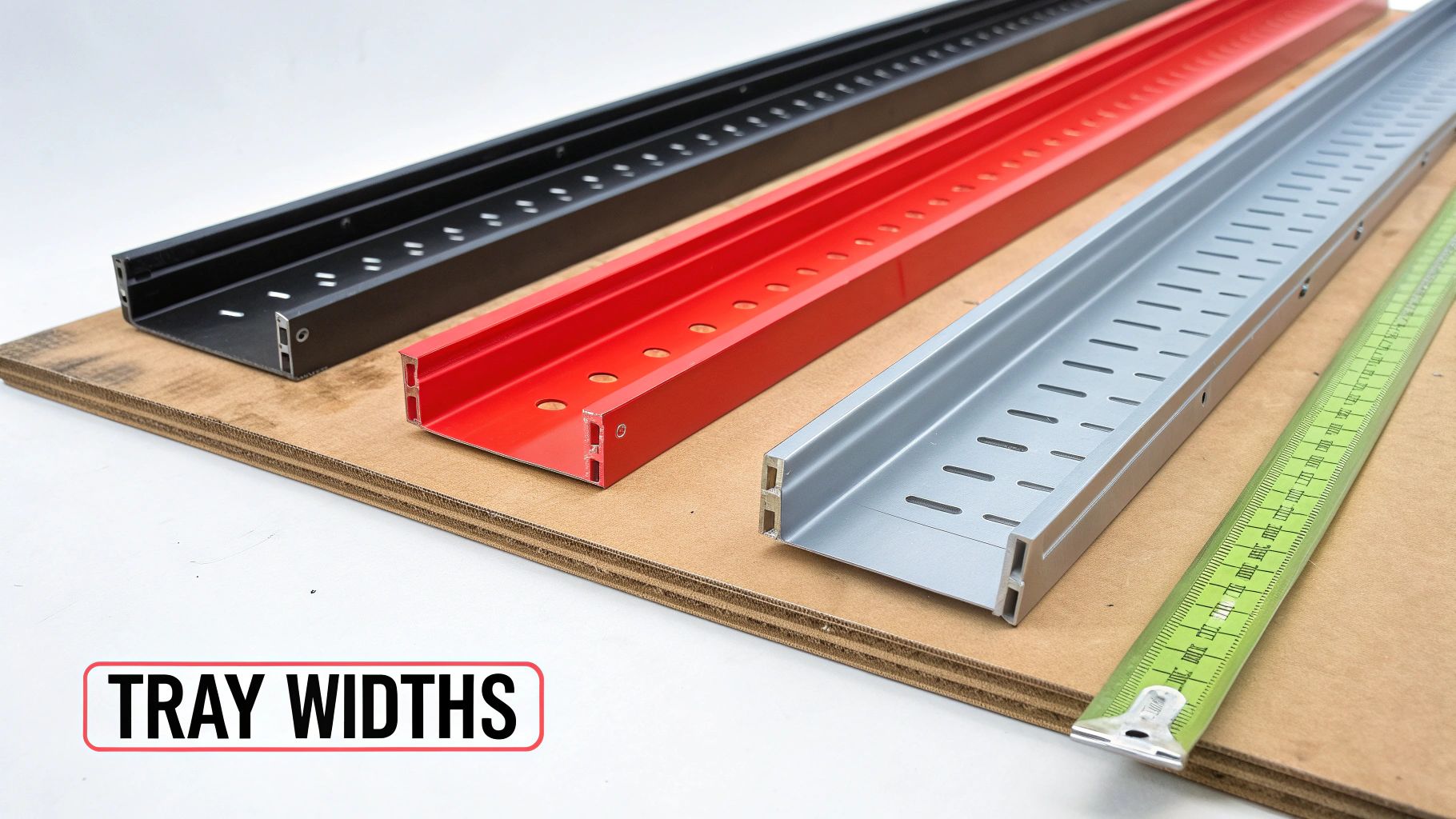
To simplify the process, we can categorize common electrical cable tray dimensions into three tiers based on typical applications found across the UAE and KSA.
Small Width Trays (50mm – 150mm)
This is the go-to range for low-voltage (LV), extra-low voltage (ELV), and control systems. Their compact profile is ideal for neatly routing a smaller number of cables in tight or congested spaces.
- Common Applications: Fire alarm systems, building management system (BMS) wiring, CCTV networks, and instrumentation cabling.
- GCC Example: A 100mm perforated tray is commonly specified in a Dubai hotel corridor to carry fire alarm and emergency lighting circuits, keeping these critical life-safety systems organized and segregated.
Medium Width Trays (200mm – 450mm)
These are the workhorses of the industry, perfect for sub-main power distribution and substantial data cabling runs. They balance high capacity with manageable installation, making them versatile for commercial and light industrial projects.
- Common Applications: Power feeds to distribution boards, running sub-main circuits from an MDB to an SMDB, and managing high-density cabling in data centers.
- GCC Example: In a typical Abu Dhabi commercial tower, a 300mm ladder tray is the standard choice for the electrical riser, carrying sub-main feeder cables to each floor's electrical room.
Large Width Trays (600mm – 1200mm)
For major power distribution, large-format trays are required. These are reserved for heavy, large-diameter power cables. Ladder-type trays are almost always used in this category for their high load capacity and superior ventilation.
- Common Applications: Main incomer cables from transformers to MDBs, generator feeds, and high-capacity industrial process lines.
- GCC Example: An industrial plant in Saudi Arabia would rely on 900mm or 1200mm hot-dip galvanized ladder trays to route main armored cables from the utility substation to the facility’s primary switchgear.
This preference for robust tray systems in large-scale infrastructure is a clear trend. The Middle East's cable management market, valued around USD 945 million, is dominated by cable trays, often comprising over half of all cable supports on major projects. You can explore these market dynamics in the full Ken Research report.
Figuring Out the Right Cable Tray Depth
Beyond width, the vertical size—or depth—of a cable tray is a critical factor in its mechanical strength and thermal performance. Standard depths in the UAE generally range from 50mm to 150mm. Selecting the right one is key to preventing cable sag, maintaining proper bend radii, and ensuring long-term system integrity.
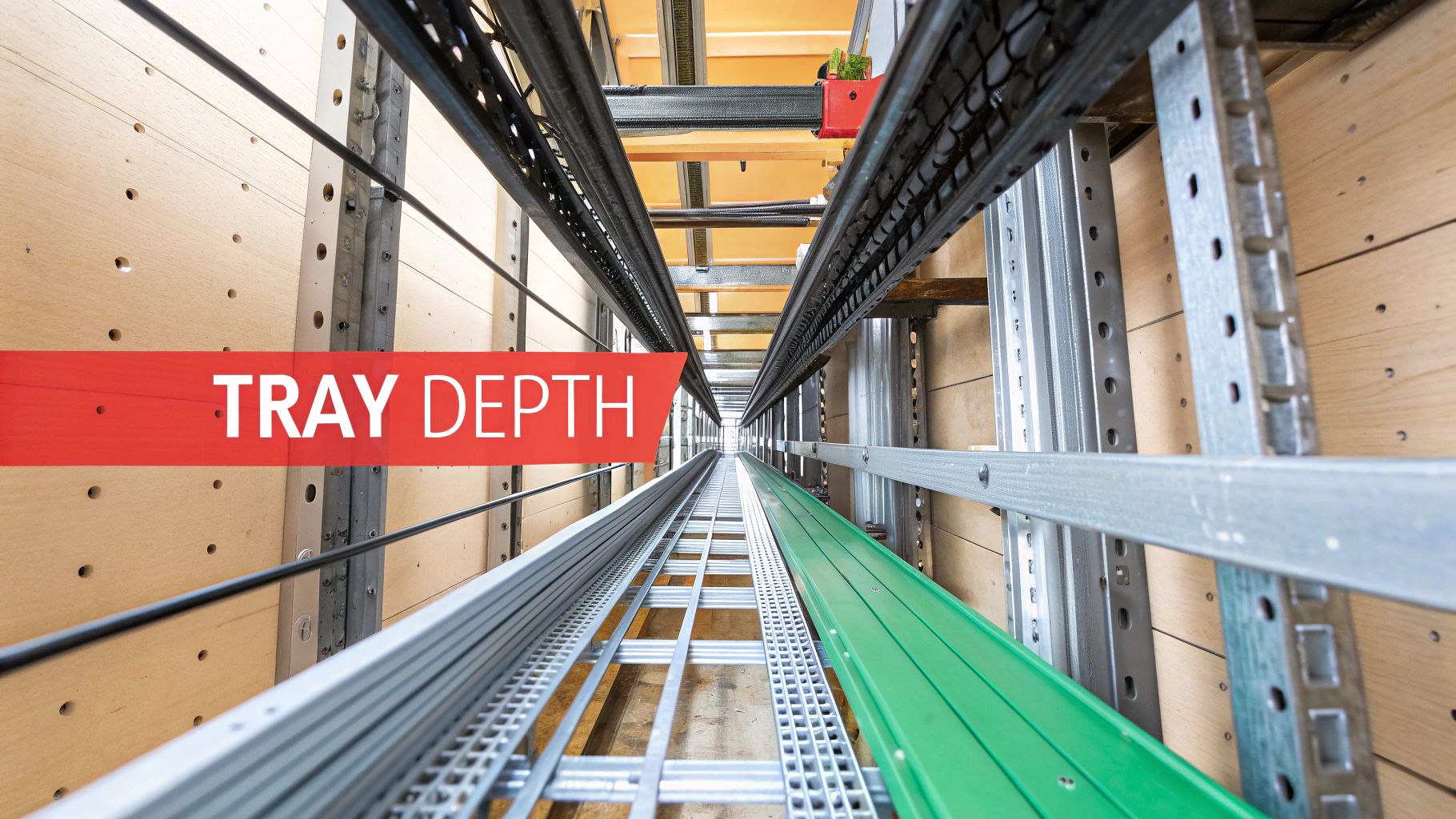
A deeper tray is inherently stronger. This is incredibly important for vertical runs common in the high-rise towers of Dubai and Abu Dhabi, as it helps manage the static weight of cables over significant heights without buckling.
Calculating Depth for Cable Fill and Airflow
The decision on depth is driven by the required cable fill capacity. The calculation is straightforward: sum the cross-sectional area of all planned cables and check this against the fill ratios defined in IEC or NEMA standards. A deeper tray allows for more cables while remaining compliant.
In the GCC, with its high ambient temperatures, depth plays another critical role: thermal management. A deeper tray creates more space for air to circulate, which is essential for dissipating heat and avoiding the need to de-rate conductor capacity.
For high-capacity runs in this region, designers often limit cable fill to 40–50% of the tray's total cross-sectional area. This practice ensures a significant air gap for cooling, a smart move to stay within thermal guidelines in the GCC's demanding climate.
This focus on heat management is a major consideration in local projects. Many decisions about cable tray dimensions across the UAE are shaped by this need. You can find more insights on cable management design in the Middle East to see how this approach directly impacts system reliability and longevity.
Analyzing Load Capacity and Support Spacing
This is where design meets reality. Choosing the right electrical cable tray dimensions is incomplete without connecting them to mechanical strength. A tray's load capacity—how much cable weight it can safely hold—is a direct result of its width, depth, and material thickness. For engineers in the UAE, getting this right is non-negotiable for heavy industrial loads and long cable runs.
A tray’s strength is also critically tied to its support span, the distance between supports. The farther apart the supports, the more stress is placed on that section of the tray. Stretching the span too far risks severe sagging or structural failure. This is why manufacturer's load/span charts are indispensable design tools.
Interpreting Load and Span Data
Every reputable manufacturer provides charts showing the maximum allowable cable load (usually in kg/m) for a specific tray model at different support spans. These charts are the single source of truth for design validation.
For example, a NEMA 20B designated tray is engineered to handle a working load of 37 kg/m with supports 6 metres apart. Crucially, if you reduce the span to 3 metres, the same tray can often carry a much heavier load. The relationship is inverse.
Key Takeaway: Always consult the manufacturer’s specific load/span chart for the exact tray model you are using. Never assume two trays with the same dimensions have the same strength. Minor differences in material thickness or design can have a massive impact on performance.
NEMA Load Classes Explained
The National Electrical Manufacturers Association (NEMA) provides a standardized classification system for cable tray load capacities that is a common reference in the GCC, simplifying selection by packaging load and span combinations.
Here’s how it breaks down:
- Load Class (e.g., 8, 12, 16, 20): This number indicates the recommended span length in feet. A class 20 tray is designed for a 20-foot (approx. 6-metre) span.
- Strength Designation (A, B, C): This letter corresponds to the working load capacity at that span.
- A = 50 lbs/ft (74 kg/m)
- B = 75 lbs/ft (112 kg/m)
- C = 100 lbs/ft (149 kg/m)
Therefore, a NEMA 12A tray can safely support 74 kg/m of cables with supports spaced 12 feet (3.66 metres) apart. This gives engineers in Dubai and Abu Dhabi a fast, reliable shorthand for specifying trays that ensure a safe and robust installation.
How Material Choice Affects Dimensions and Durability
The choice of material for an electrical cable tray is a critical decision that dictates its strength, dimensions, and service life, especially in the demanding environmental conditions across the UAE and GCC. The physical properties of each material influence its required thickness and profile to handle a specific load.
In the high heat, humidity, and dust of the GCC, corrosion is the primary threat. This is why hot-dip galvanized (HDG) steel is the undisputed standard for nearly all outdoor and industrial projects. The process creates a thick, metallurgically bonded zinc coating that provides robust protection against rust, ensuring long-term structural integrity.
Comparing Common Materials
While pre-galvanized steel may be used, it is only suitable for indoor, climate-controlled environments like a commercial tower in Dubai. It lacks the durability needed for exterior installations exposed to heat and humidity.
Aluminum is lightweight and naturally resists corrosion. However, it does not offer the same mechanical strength as steel of the same thickness. To achieve an equivalent load capacity, aluminum trays often require deeper side rails or thicker construction.
A material's weight also impacts the support structure design. Lighter options like aluminum may allow for wider support spans or less substantial steelwork, offering potential installation cost savings. However, for most heavy-duty applications in this region, the superior strength-to-cost ratio of HDG steel makes it the most reliable and cost-effective choice.
Material Selection Guide for UAE Environments
When specifying cable trays for a project in the UAE, you must consider the environment. Intense sun, humidity, and coastal salt spray can degrade the wrong material. This guide compares common options to help you select a material offering the best performance and longevity.
| Material Type | Corrosion Resistance | Weight/Strength Ratio | Typical UAE Application |
|---|---|---|---|
| Hot-Dip Galvanized Steel | Excellent | High Strength, Heavy | Outdoor industrial plants, coastal areas, infrastructure projects. |
| Pre-Galvanized Steel | Good | High Strength, Heavy | Indoor commercial buildings, data centers, climate-controlled areas. |
| Aluminium | Very Good | Moderate Strength, Light | Specialized applications requiring low weight or specific corrosion resistance. |
Ultimately, while alternatives exist, the proven durability and strength of hot-dip galvanized steel make it the default choice for ensuring system reliability in the vast majority of demanding applications across the Gulf region.
Sourcing Your Cable Trays in the UAE
This guide provides a solid foundation for specifying the right electrical cable tray dimensions for your next project. By correctly balancing width, depth, load capacity, and material, you are creating an installation that is compliant, safe, and resilient enough for the GCC climate.
The next step is sourcing high-quality materials from a partner who understands the region's unique demands. A reliable supplier provides products that meet necessary IEC standards and performance benchmarks, from correct hot-dip galvanized finishes to precise NEMA load ratings.
Your Next Step
We invite engineers, contractors, and procurement managers in Dubai, Abu Dhabi, and across the GCC to contact the GoSwitchgear team. We offer expert support and a full lineup of cable management solutions, including trays, ladders, and all necessary accessories.
Let our Dubai-based specialists help you select the precise dimensions and materials for your project, ensuring regulatory compliance and long-term operational excellence.
Our goal is to supply the high-performance electrical components needed for the robust infrastructure that powers our region's growth. When you're ready, reach out to our team for tailored project support.
Frequently Asked Questions
Have questions about electrical cable tray dimensions? Here are quick, practical answers to common queries from engineers and contractors in the UAE and GCC.
How Do I Calculate the Required Width for My Cable Tray?
Calculating the correct tray width involves planning for current needs, future expansion, and local conditions.
First, sum the cross-sectional areas of all cables planned for the tray. Next, apply the appropriate fill factor; a 40% fill factor for power cables is a common best practice. This determines the minimum internal area your tray requires.
From there, you can calculate the minimum width based on your chosen tray depth. Crucially, add a 20-25% cushion for future cable additions. In the UAE, thermal derating is a key consideration due to high ambient temperatures. A wider tray often improves air circulation, which is vital for preventing cable overheating.
What Is the Difference Between NEMA and IEC Standards?
Both NEMA and IEC standards are referenced in GCC project specifications. Understanding the difference is key.
NEMA (National Electrical Manufacturers Association) standards focus heavily on the structural performance of a tray, specifically its load-bearing capability. They use clear load/span classes, such as NEMA 20C, which provide a straightforward benchmark for performance under a specific load over a set distance.
In contrast, IEC standards, particularly IEC 61537, offer a broader, global framework. They cover construction, material requirements, performance testing, and corrosion resistance. While many locally available products are NEMA-compliant, project documents may specify IEC adherence, so always verify the governing standard for your installation.
Can I Mix Different Cable Types in the Same Tray?
Yes, but with strict rules to maintain system integrity. The most important rule is never to run high-voltage power cables adjacent to low-voltage data or communication lines in the same tray without a physical barrier.
To do this correctly, you must install a certified divider fitting, which creates separate, isolated channels within the tray. This separation is essential for preventing electromagnetic interference (EMI), which can disrupt sensitive control and data signals. In modern smart buildings in Dubai and Abu Dhabi, where integrated BMS are standard, preventing EMI is non-negotiable.
For a comprehensive range of cable management solutions tailored to your project's needs, explore the offerings from GoSwitchgear. Find the ideal components for your next installation by visiting https://goswitchgear.ae.
Share this post

Related
Posts
A Guide to Selecting the Right Air Blower Machine for UAE and GCC Industries
Learn how to choose the right air blower machine for your industrial needs. This guide covers types, specs, sizing, and...
Selecting the Right MK Power Socket for UAE & GCC Projects
Choose the right MK power socket for any UAE project. This guide helps engineers and electricians select the best options...
What Is Switchgear? Types, Components & How It Works in Electrical Systems
30 Second Summary Switchgear protects, controls, and isolates electrical equipment in power systems. It includes breakers, relays, fuses, panels, and disconnect switches. Different...
What Is a Current Transformer and Why It Matters for UAE Energy Projects
30 Second Summary A current transformer steps down high electrical current to safe, measurable levels for protection and metering. It plays a...
.jpg)