.jpg)


Posted by:
Category:
Comments:
Post Date:
A Professional Guide to Electrical Sockets for UAE Projects
For engineers, panel builders, and procurement teams in the UAE, specifying the correct electrical components is critical for compliance, safety, and operational longevity. The entire country runs on a single standard: the Type G (BS 1363) socket, with a supply of 230V and 50Hz. Ensuring adherence to this from day one is fundamental for any new build or refit in Dubai, Abu Dhabi, and across the GCC.
Understanding The UAE Standard For Electrical Sockets
Unlike other regions with a confusing mix of socket types, the UAE’s commitment to the British Standard offers a significant advantage for professionals. This standardisation streamlines everything from project planning to procuring electrical components in the UAE, ensuring every plug, socket, and appliance integrates seamlessly with the national grid. The result is a predictable, stable, and incredibly reliable electrical environment built to withstand local conditions.
The Role of Regulatory Authorities
Having a standard is one thing; enforcing it is another. Key regulatory bodies are crucial partners in maintaining the integrity of the UAE's world-class infrastructure. Their oversight ensures all components can handle environmental challenges like heat, humidity, and dust.
- Emirates Authority for Standardisation and Metrology (ESMA): This federal body sets the overarching standards. ESMA ensures any product sold in the UAE meets strict safety, quality, and performance benchmarks, including appropriate IP ratings for the region.
- Dubai Electricity and Water Authority (DEWA): For projects in Dubai, DEWA provides specific guidelines for installation and mandatory approval processes.
- Abu Dhabi Distribution Company (ADDC): In the capital, ADDC governs all electrical installations, setting the rules and regulations.
For professionals on the ground, this regulatory clarity simplifies decision-making. The core requirement is always the same: Type G sockets (BS 1363), running at 230V, 50Hz. It's the non-negotiable starting point for every new installation. You can explore compliant UAE socket specifications on GoSwitchgear.com.
Building on this foundational knowledge ensures your project is compliant from day one, preventing expensive delays and upholding the highest safety standards required in the UAE and wider GCC.
Decoding The Technical Specs Of Type G Sockets
For professionals specifying components for projects in the UAE, understanding the Type G socket goes far beyond its shape. It is a complete safety system, meticulously engineered to match the country's robust electrical grid and demanding climate.
The entire system is built around the UAE's standard domestic supply: 220-230 volts at a 50Hz frequency. This stability is why the Type G socket, with its corresponding 13 AMP three-pin plug, is the mandatory standard. For system integrators, this consistency guarantees reliable, long-term performance for everything from commercial machinery to sensitive industrial equipment. This foundational standard, based on the British design, has shaped the entire electrical infrastructure we work with today. You can get a broader sense of the UAE's history and key figures on GulfNews.com.
Technical Profile of Standard UAE Electrical Sockets
This table outlines the essential specifications and their practical importance for projects across the UAE/KSA region.
| Parameter | Specification | Importance for UAE & GCC Projects |
|---|---|---|
| Voltage Rating | 220-240V AC | Matches the standard mains voltage, ensuring compatibility with all approved equipment without transformers. |
| Current Rating | 13 Amperes (Max) | Provides sufficient capacity for most residential and commercial appliances, from office equipment to industrial tools. |
| Frequency | 50 Hz | Aligns with the national grid's frequency, crucial for the proper operation of motors and electronic timing circuits. |
| Standard | BS 1363 | Guarantees sockets and plugs meet rigorous IEC-aligned safety and quality benchmarks for construction and performance. |
| Fuse Type | BS 1362 (in plug) | Offers localised, appliance-specific overcurrent protection, preventing faults from tripping an entire circuit. |
| Earth Connection | Mandatory | A non-negotiable safety feature providing a path for fault currents, significantly reducing electric shock risk. |
| IP Rating | Varies (e.g., IP20 to IP66) | Critical for addressing local climate challenges (dust, humidity). Higher ratings are essential for industrial or outdoor use. |
Core Safety Features Explained
The BS 1363 standard is engineered for safety, protecting both personnel and high-value equipment. These features are fundamental to the system's integrity.
- Integrated Fuse: Every Type G plug contains its own fuse (3, 5, or 13 amps). This is the first line of defence, providing overcurrent protection directly at the appliance and preventing a localised fault from tripping the main circuit breaker.
- Shuttered Contacts: The live and neutral apertures are shuttered, opening only when the longer earth pin is inserted first. This simple mechanism prevents the insertion of foreign objects, a critical safety feature.
- Polarised Design: The rectangular pins for live, neutral, and earth ensure a single orientation for insertion. This guarantees correct polarity, vital for the safe and proper function of modern electronics.
These built-in protections are a primary reason the British standard was adopted and remains the mandatory specification for electrical sockets in the UAE.
A key design element is the staggered pin length. The earth pin is slightly longer than the live and neutral pins, ensuring an appliance is always earthed before it receives power and remains earthed until after power is disconnected. This design dramatically reduces the risk of electric shock during insertion and removal.
This standardised, safety-focused approach creates an incredibly reliable electrical ecosystem, simplifying diagnostics, maintenance, and installation for engineers and electricians.
Choosing The Right Sockets For Your Application
Selecting the correct socket is a critical decision affecting safety, durability, and operational efficiency. In the demanding climate of the UAE and the wider GCC, not all Type G sockets are created equal. The optimal choice depends entirely on the application, from a high-end residential tower in Dubai to a rugged industrial site in a free zone.
A strategic decision requires understanding the environmental and operational pressures the socket will face. For engineers and procurement teams, this involves assessing material science, Ingress Protection (IP) ratings, and specialised features required by the project.
Residential And Commercial Specifications
For residential projects, aesthetics are a primary consideration. Clients expect sleek, decorative finishes like brushed chrome, matte black, or minimalist white to complement modern interiors.
In commercial spaces such as offices and hotels, priorities shift to functionality and durability. Sockets with integrated USB-A and USB-C ports are now a standard expectation for charging devices. Durability is also paramount; high-grade polycarbonate is an ideal material for high-traffic areas, resisting wear and impact.
Material selection is a critical factor for both residential and commercial applications in the GCC. Polycarbonate offers superior performance over older materials like PVC or urea. It provides high impact resistance and can withstand the UAE's high ambient temperatures without yellowing or becoming brittle, ensuring a longer service life.
Sockets For Demanding Industrial Environments
Industrial sites—factories, workshops, and outdoor installations—present the toughest challenge for electrical sockets in the UAE. These environments are subject to dust, high humidity, and potential water ingress. Here, the Ingress Protection (IP) rating is the most critical specification.
An IP rating consists of two digits: the first indicates protection against solids (dust), and the second against liquids (water).
- IP44 Sockets: Considered splash-proof, these are suitable for locations that may encounter light water spray, such as covered outdoor areas or workshops with moderate moisture.
- IP66 Sockets: Offering robust protection, these sockets are completely sealed against dust and can withstand powerful water jets. They are essential for outdoor installations, food processing wash-down areas, and other environments with significant dust and moisture.
This decision tree helps classify device power needs, guiding initial socket selection.
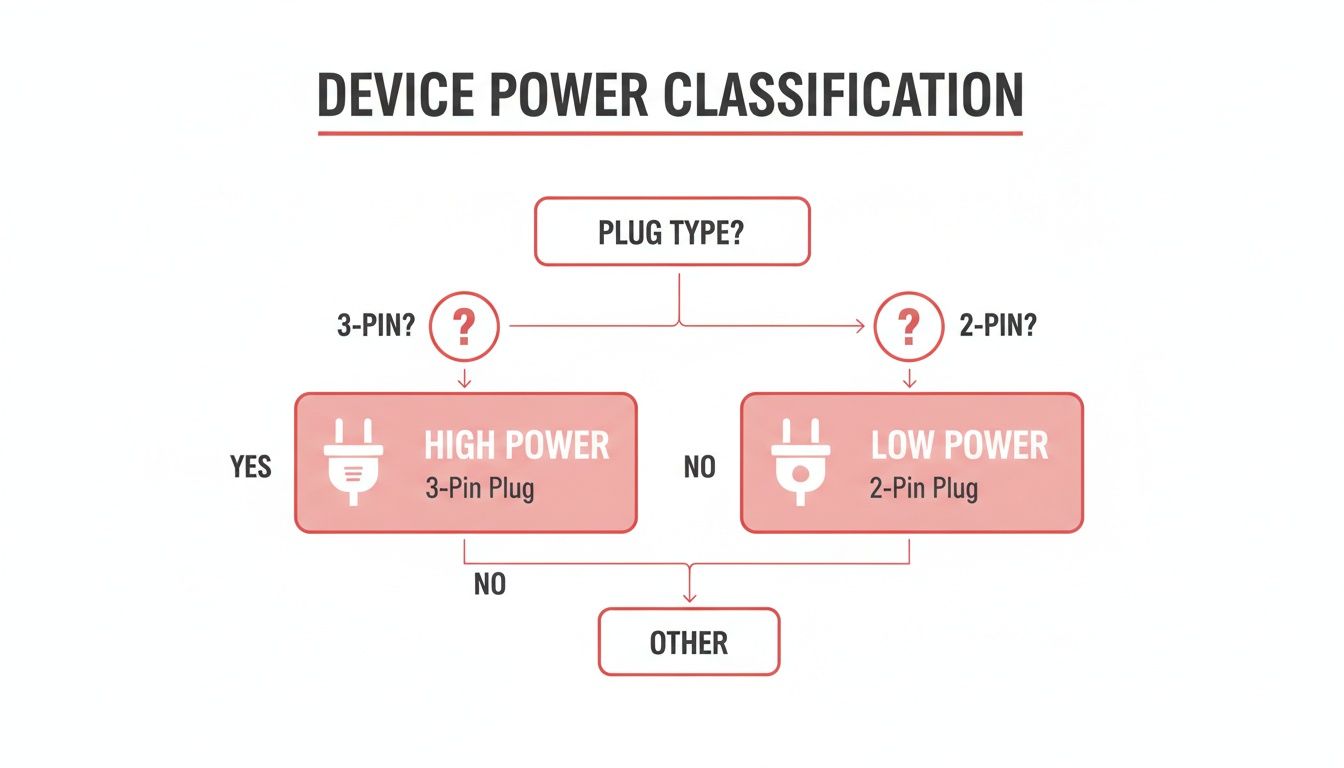
The flowchart highlights a core principle in UAE electrical systems: high-power equipment must use the earthed, three-pin setup for both safety and capacity.
By carefully matching the socket's features—from its finish to its IP rating—to the application's specific needs, you ensure every installation is compliant, safe, and optimised for performance. For a wide range of sockets suited for any application, explore the GoSwitchgear electrical components catalogue.
Installation Best Practices and Common Mistakes To Avoid
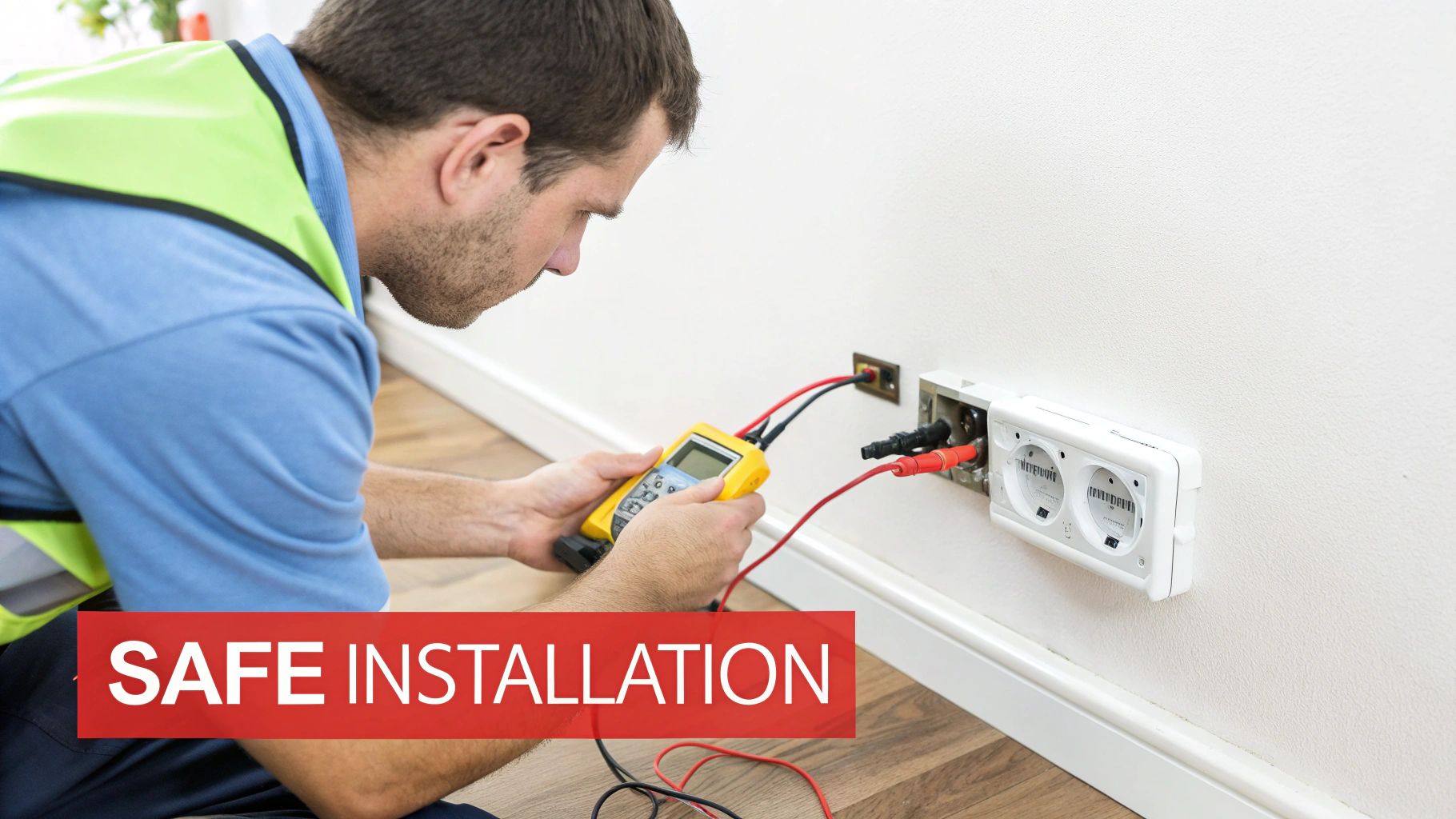
When installing electrical sockets in the UAE, precision is non-negotiable. A compliant installation is essential for passing inspections from authorities like DEWA and ADDC, preventing costly rework and project delays.
The foundation of a reliable installation is correct wiring and guaranteed earthing. Every terminal must have a secure connection with no loose strands, which could lead to short circuits. Proper earthing provides a safe path for fault currents, preventing electric shock. Following a methodical checklist is the best practice to ensure every socket is safe and compliant.
Adhering To Local Mounting And Wiring Regulations
Local utility regulations, particularly from DEWA, are mandatory requirements that set the standard across the Emirates.
- Mounting Heights: Standard socket outlets must be installed at a minimum height of 450 mm from the finished floor level. In kitchens and workshops, the height is typically 150-200 mm above the work surface.
- Back Box Compliance: Use only metal or approved fire-retardant plastic back boxes. The box must be deep enough to accommodate wiring without compressing conductors, which can damage insulation.
- Correct Conductor Sizing: For a standard 13A ring final circuit, the minimum wire size is 2.5 mm² for live, neutral, and earth conductors. Using undersized conductors is a serious fire hazard and a guaranteed inspection failure.
An often-overlooked detail is applying the correct torque on terminal screws. Overtightening can damage the conductor, while insufficient torque creates high resistance and overheating. Always use a calibrated torque screwdriver to meet the manufacturer's specifications.
Common and Costly Installation Mistakes
Even experienced electricians can make mistakes under pressure. Recognising common pitfalls is key to avoiding them and ensuring a successful first-time inspection.
| Common Mistake | Consequence | How to Avoid |
|---|---|---|
| Using Non-Compliant Sockets | Sockets lacking ESMA certification or the Emirates Quality Mark (EQM) pose safety risks and will be flagged during inspection. | Source exclusively from trusted suppliers like GoSwitchgear that provide fully certified products. |
| Inadequate Earthing Continuity | A broken or poor earth connection renders the socket's primary safety feature ineffective, creating a severe shock hazard. | Perform a continuity test on the earth path for every socket as a standard part of your installation quality check. |
| Incorrect Polarity | Swapping live and neutral connections can cause appliance malfunction and creates a significant safety risk for users. | Double-check all connections and use a socket tester to confirm correct polarity before energising the circuit. |
| Improper Wire Termination | Leaving too much exposed copper or failing to fully insert the conductor can lead to arcing and create a fire risk. | Follow best practices for stripping and terminating wires, ensuring a secure and fully insulated connection at every terminal. |
By focusing on these key areas, professionals can ensure every installation meets the high standards demanded across the UAE.
Navigating UAE Compliance Testing And Certification
For any project manager or engineer in the UAE's electrical sector, compliance is the foundation of every successful project. Failure to adhere to regulations can lead to significant project delays, rework costs, and serious legal consequences.
A thorough understanding of the UAE's regulatory framework is non-negotiable. This system ensures that every electrical component, especially a ubiquitous one like a socket, is robust enough for local conditions, including high ambient heat, humidity, and dust—factors that standard international certifications may not fully address.
Key Authorities And Mandatory Marks
Several key organisations oversee the compliance of electrical sockets in the UAE. Understanding their roles helps procurement professionals and engineers quickly identify compliant products.
- Emirates Authority for Standardisation and Metrology (ESMA): As the federal standards body, ESMA develops and enforces national regulations that all products must meet to ensure quality and consumer safety.
- Emirates Quality Mark (EQM): This is ESMA's seal of approval. The EQM logo signifies that a product has undergone rigorous factory audits and third-party testing, confirming it meets all UAE safety and performance standards.
- DEWA and ADDC: Local utilities like the Dubai Electricity and Water Authority (DEWA) and Abu Dhabi Distribution Company (ADDC) have specific installation guidelines and often maintain approved vendor lists to ensure component compatibility with their grids.
When reviewing a product datasheet or inspecting a physical socket, the Emirates Quality Mark (EQM) is the single most important indicator of compliance. It is your guarantee that the product is legally approved for use in the UAE. A socket without this mark is a major red flag.
Guide To UAE Regulatory Bodies And Certifications
This table provides a quick reference to the key authorities and certifications relevant to sourcing electrical components in the UAE.
| Regulatory Body/Certification | Primary Role | What to Look For |
|---|---|---|
| ESMA | The federal body setting national standards for regulated products, including all electrical components. | ESMA sets the framework; compliance is demonstrated through marks like the EQM. |
| Emirates Quality Mark (EQM) | A mandatory certification mark proving a product complies with UAE safety and quality standards. | The official EQM logo printed on the product, its packaging, or the datasheet. This is non-negotiable. |
| DEWA/ADDC | Local utility authorities defining installation guidelines and maintaining lists of approved products. | Confirmation from your supplier that the product is on the DEWA or ADDC approved vendor list for your project location. |
By mandating that all sourced products carry the EQM and are approved by relevant local utilities, you significantly reduce project risk.
Working with a trusted supplier like GoSwitchgear streamlines this entire process. It provides access to a comprehensive inventory of fully certified electrical components, simplifying procurement and ensuring compliance from the outset.
Sourcing Strategies For Traders And Contractors
In the UAE's fast-paced construction sector, a resilient supply chain is the backbone of a successful electrical project. For contractors managing tight deadlines and traders handling high-volume inventory, a reliable source for certified electrical sockets in UAE is a competitive advantage. An effective sourcing strategy reduces delays, guarantees compliance, and improves project profitability.
The right choice for your business will depend on project scale, inventory strategy, and long-term goals. A successful strategy balances cost with resilience, ensuring a dependable supply network.
Comparing Sourcing Models
Procurement teams typically choose between two primary channels: direct from manufacturers or through local distributors and digital marketplaces.
Direct-from-Manufacturer: This route can offer cost savings on very large bulk orders but often involves high minimum order quantities (MOQs), long lead times, and complex logistics, making it unsuitable for most small to medium-sized projects.
Local Distributors and Marketplaces: Partnering with a UAE-based supplier like GoSwitchgear provides immediate access to a wide inventory of certified products from multiple brands. This model eliminates high MOQs, reduces shipping times, and simplifies procurement of all the electrical components UAE projects require.
For the majority of contractors and traders in the GCC, a local distributor or a specialised marketplace provides the ideal balance of cost, speed, and flexibility. This agility allows you to order precisely what you need, when you need it, avoiding stock shortages of critical components like Type G sockets.
Building A Resilient Supply Chain
For contractors on large-scale developments in Dubai or Abu Dhabi, supply chain resilience is paramount. A delay in sourcing a single component can halt an entire site. The solution is to partner with suppliers who offer more than just products.
Your partner should provide:
- Guaranteed Stock Availability: A deep inventory of the components you use regularly.
- Verified Certifications: All products must carry the mandatory Emirates Quality Mark (EQM) and other necessary approvals.
- Technical Support: Access to manufacturer datasheets and expert advice is invaluable for specifying components for diverse applications.
Utilising a centralised platform like the GoSwitchgear electrical components marketplace allows contractors to consolidate their entire procurement process into a single, reliable source. This leads to streamlined orders, reduced administrative overhead, and complete confidence that every product meets the UAE's stringent regulatory standards.
Your Questions About UAE Electrical Sockets, Answered
Practical questions often arise for engineers, electricians, and procurement managers working with electrical systems in the UAE. Here are clear, solution-focused answers to some common queries.
Can I Just Use International Adapters Safely?
Travel adapters are not a permanent or compliant solution for any professional installation. For safety and regulatory compliance, every appliance and piece of equipment used long-term in the UAE must be fitted with a fused, BS 1363 Type G plug.
Using adapters introduces significant risks. They often create poor connections leading to overheating and can bypass essential earthing, creating severe fire and electric shock hazards.
Are There Special Sockets for Outdoor Areas?
Yes. Using a standard indoor socket in an outdoor or wet environment is a serious compliance violation and safety risk. For these locations, you must install sockets with an appropriate Ingress Protection (IP) rating.
- IP44 Sockets: These are splash-proof and suitable for semi-protected areas like covered patios or workshops where they may be exposed to water spray.
- IP66 Sockets: These sockets are fully dust-tight and can withstand powerful water jets. They are the minimum requirement for fully exposed outdoor installations or industrial areas subject to wash-downs.
What's the Difference Between a Fused and Unfused Socket?
In the BS 1363 system used in the UAE, the protective fuse is located within the plug, not the socket outlet. Therefore, the socket itself is unfused.
The socket outlet is connected to a ring final circuit protected by a Miniature Circuit Breaker (MCB) in the distribution board. This design provides two layers of protection: the fuse in the plug (3A, 5A, or 13A) is rated to protect the specific appliance and its flexible cable, while the MCB protects the building's fixed wiring. A fault in one appliance will blow its plug-top fuse without tripping the entire circuit.
Think of it this way: the fuse in the plug provides appliance-level protection, while the circuit breaker in the panel provides circuit-level protection. Both are essential for a safe, robust, and compliant electrical system.
At GoSwitchgear, we make compliance simple. We stock a huge inventory of fully certified electrical components ready for your projects in Dubai, Abu Dhabi, and across the GCC.
Browse our catalogue of approved electrical sockets and accessories on GoSwitchgear.com and ensure your next installation meets the highest standards of safety and quality. For project support in Dubai, contact our team for a quote.
Share this post

Related
Posts
A Guide to Choosing AC to DC Converters for UAE & GCC Electrical Systems
Master AC to DC converters with this comprehensive guide for engineers in the UAE & GCC. Learn selection, installation, and...
A Guide to Drill Machine Prices in the UAE for Technical Professionals
Find the best drill machine price in UAE. Our 2026 guide helps contractors and engineers choose the right corded, cordless,...
A Professional’s Guide to Choosing AGM VRLA Batteries in the UAE Climate
Discover why AGM VRLA batteries are the superior power solution for UPS, solar, and industrial systems in the UAE. Get...
How to Choose the Right Lithium Ion Battery Charger for UAE & GCC Projects
Discover how to select the right lithium ion battery charger for UAE projects. This guide covers specs, BMS integration, and...
.jpg)