.jpg)


Posted by:
Category:
Comments:
Post Date:
A Guide to Selecting Electrical Sockets for UAE & GCC Projects
Specifying electrical sockets for projects in the UAE requires a deep understanding of a single, rigorously enforced standard: the Type G (BS 1363) outlet. The entire country operates on a uniform 230V, 50Hz system, a deliberate choice that provides significant advantages for engineers, panel builders, and procurement teams. This standardization eliminates compatibility issues, streamlining project lifecycles from design to installation.
Understanding The Core Standard For Electrical Sockets In The UAE
For professionals in the UAE's fast-paced electrical and construction sectors, correct component specification is non-negotiable. The exclusive adoption of the Type G socket, rooted in British Standard BS 1363, is the foundation of the nation's electrical safety framework and simplifies project execution from Dubai's high-rises to Abu Dhabi's industrial zones.
This standard is not a guideline; it is a legal requirement enforced by regulatory bodies to ensure that all electrical components, including every power plug in UAE installations, meet stringent safety and quality benchmarks.
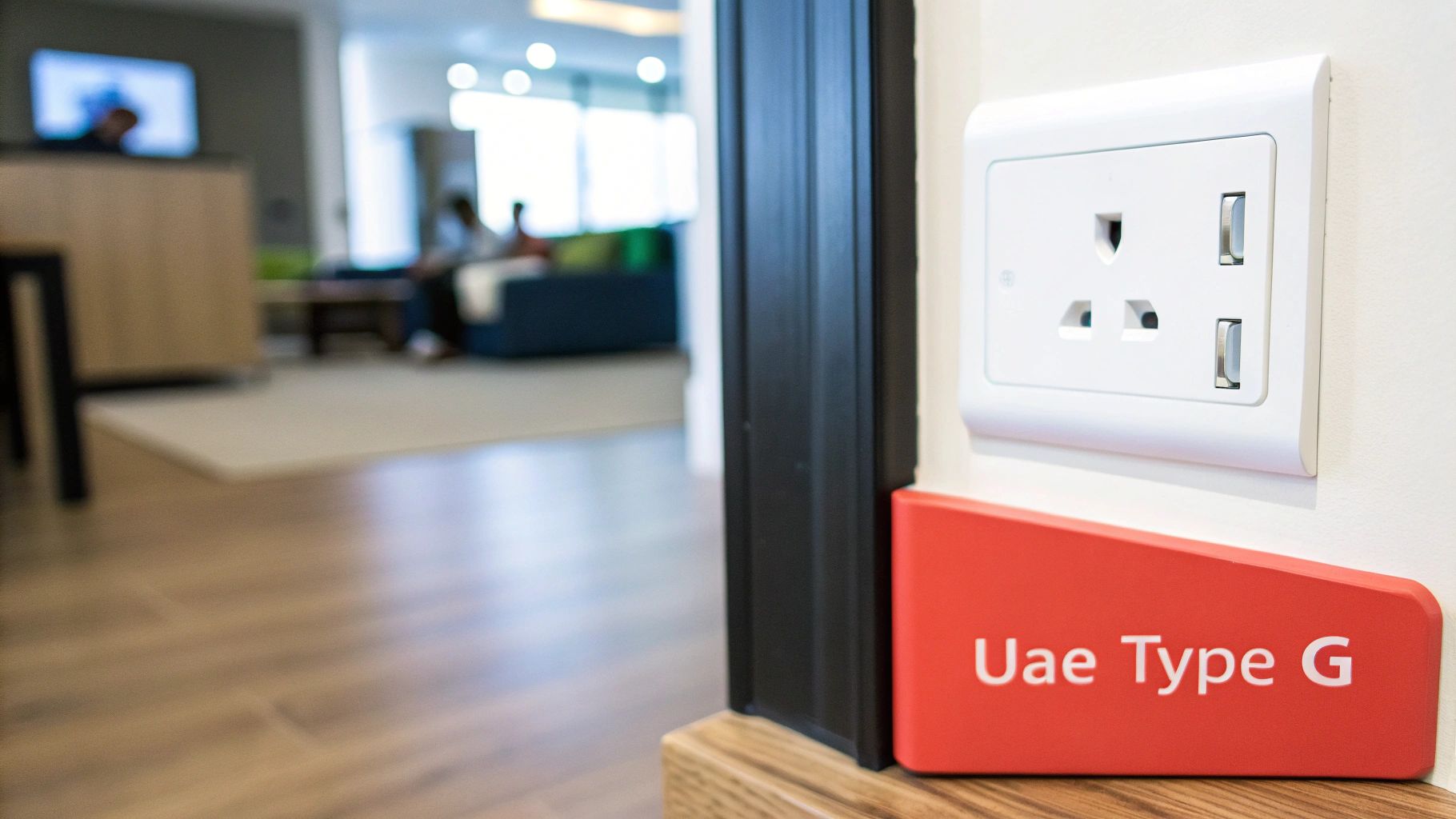
This national uniformity is a critical factor in large-scale developments, driving efficiency, guaranteeing long-term system reliability, and simplifying maintenance schedules across the GCC.
Key Features Of The Type G Standard
The Type G socket is engineered with robust safety features, making it ideal for the demanding commercial, residential, and industrial applications prevalent throughout the UAE and wider GCC region.
- Fused Plugs: A defining feature is the integral fuse (typically 3A, 5A, or 13A) within each plug. This provides localised overcurrent protection directly at the appliance, supplementing the primary circuit protection at the distribution board.
- Shuttered Sockets: The live and neutral pin apertures are mechanically shuttered. These shutters only retract when the longer earth pin is inserted first, a crucial design element that prevents accidental contact with live components.
- Polarised Design: The rectangular pin configuration ensures a plug can only be inserted one way. This guarantees correct line, neutral, and earth connections, preventing hazardous polarity reversal issues.
For panel builders and electricians on site, this standardized environment reduces installation variables. It fosters a predictable, repeatable process and ensures that compliant electrical components UAE-sourced from suppliers like GoSwitchgear will integrate seamlessly into any project.
Regulatory Oversight And Compliance
A clear understanding of the core technical and regulatory requirements is essential for project success. The following table summarises the key specifications for a compliant electrical socket in the UAE.
UAE Electrical Socket Specifications At A Glance
| Specification | Standard Requirement | Relevance For UAE Projects |
|---|---|---|
| Socket Type | Type G (BS 1363) | The sole approved standard, ensuring universal compatibility. |
| Voltage Rating | 230V AC | Standard mains voltage across all Emirates. |
| Frequency | 50Hz | Standard grid frequency; critical for motors and electronics. |
| Current Rating | 13A Maximum | Sockets are rated for a maximum load of 13 Amperes. |
| Plug Fuse | Mandatory (3A, 5A, 13A) | Key safety feature protecting the appliance cord from overcurrent. |
| Safety Shutters | Required on Live/Neutral | Prevents insertion of foreign objects and accidental contact. |
| Installation Height | 450mm from FFL | Minimum height from Finished Floor Level for standard installations. |
| Regulatory Bodies | ESMA, DEWA, ADDC | Key authorities enforcing standards and providing project approvals. |
Adherence to these specifications is rigorously monitored by authorities such as the Emirates Authority for Standardization and Metrology (ESMA), Dubai Electricity and Water Authority (DEWA), and the Abu Dhabi Distribution Company (ADDC).
This British-derived standard became the norm during the post-oil boom construction era, a forward-thinking decision that has effectively supported the nation's massive growth in power consumption from 50 TWh in 2000 to over 130 TWh by 2020.
You can explore more about regional electrical standards and their impact on modern electrical design.
Navigating Regulatory Compliance With ESMA, DEWA, And ADDC
For engineers and procurement teams specifying electrical components in the UAE, navigating the local regulatory landscape is as critical as understanding the technical specifications. Compliance is a multi-layered framework enforced by federal and local authorities to ensure every component can withstand the region's demanding operational conditions, including high ambient temperatures and humidity.
At the federal level, the Emirates Authority for Standardization and Metrology (ESMA) establishes the quality and safety benchmarks for all regulated products entering the UAE market. For electrical sockets, ESMA's requirements are clear and non-negotiable.
This stringent focus on quality has significantly elevated electrical safety standards across the Emirates, mitigating risks associated with substandard or counterfeit products.
The Emirates Quality Mark Is The Gold Standard
The single most critical certification for electrical sockets uae is the Emirates Quality Mark (EQM). This is not an optional endorsement; it is a mandatory legal requirement for most regulated electrical products. The EQM serves as definitive proof that a product has undergone rigorous testing and that its manufacturing process complies with ESMA's stringent quality management standards.
For procurement teams and system integrators, the EQM is the ultimate seal of approval. Sourcing electrical components in the UAE necessitates verifying the EQM on every item. Failure to do so will result in failed inspections, leading to costly project delays, rework, and potential penalties.
Any socket installed in a UAE project, from a Dubai skyscraper to an Abu Dhabi industrial facility, must bear the EQM. It is the only way to confirm compliance with national standards, suitability for the local climate, and adherence to all safety protocols.
Meeting DEWA And ADDC Utility Requirements
While ESMA governs product standards, local utility authorities dictate installation practices. In Dubai, the Dubai Electricity and Water Authority (DEWA) oversees all electrical installations. In Abu Dhabi, the Abu Dhabi Distribution Company (ADDC) holds this responsibility.
These utilities maintain detailed wiring regulations and pre-approval processes that all contractors must follow precisely. Their rules extend beyond socket type to cover specific installation methodologies, including:
- Earth Leakage Protection: Strict mandates for the use of Residual Current Devices (RCDs) or RCBOs on circuits supplying socket outlets.
- Circuit Load Calculations: Clear guidelines on the maximum number of sockets permissible on a single final circuit to prevent overloading.
- Approved Vendor Lists: DEWA and ADDC often maintain lists of approved manufacturers and specific models that have been pre-vetted for compliance.
Achieving compliance for UAE electrical sockets requires mastering the regulations from ESMA, DEWA, and ADDC. The EQM is the undisputed gold standard, with ESMA basing its benchmarks on standards like BS 1363. These federal rules work in tandem with local utility guidelines to ensure sockets can handle the region’s climate, making IP ratings for dust and humidity crucial, especially for coastal facilities or solar projects.
To avoid project complications, it is essential to source components that are both EQM-certified and aligned with DEWA or ADDC guidelines. Partnering with a trusted supplier like GoSwitchgear eliminates the guesswork, ensuring every socket we provide is fully compliant, certified, and ready for installation in any project across the UAE.
Decoding Technical Specifications For GCC Projects
While Type G compliance is the starting point, engineers and panel builders across the GCC know that project success lies in the technical details. Selecting the right electrical sockets in the UAE involves matching component capabilities to the harsh realities of the local environment.
Specifying appropriate current ratings, Ingress Protection (IP), and Impact Resistance (IK) is a fundamental step in engineering resilient electrical systems capable of withstanding the region's high ambient temperatures, humidity, and pervasive construction dust found in Dubai and Abu Dhabi.
Understanding Current Ratings 13A vs 16A
A socket's current rating defines the maximum electrical load it can safely handle. In the UAE, two primary ratings are common: 13A and 16A.
- 13A Sockets: The standard for most residential and commercial applications under the BS 1363 system. It is ideal for powering standard office equipment, IT peripherals, and small appliances. The integrated plug-top fuse adds a critical layer of localised overcurrent protection.
- 16A Sockets: These are typically circular "Commando" style sockets (conforming to IEC 60309) designed for higher-demand applications. They are specified in industrial workshops, data centres, and commercial kitchens to power heavy machinery or high-load equipment requiring a dedicated power supply.
Mismatched ratings can lead to overloaded circuits, nuisance tripping, and significant fire hazards. A thorough load assessment during the design phase is critical to ensure correct socket specification.
This diagram breaks down the key regulatory players overseeing socket compliance in the UAE.
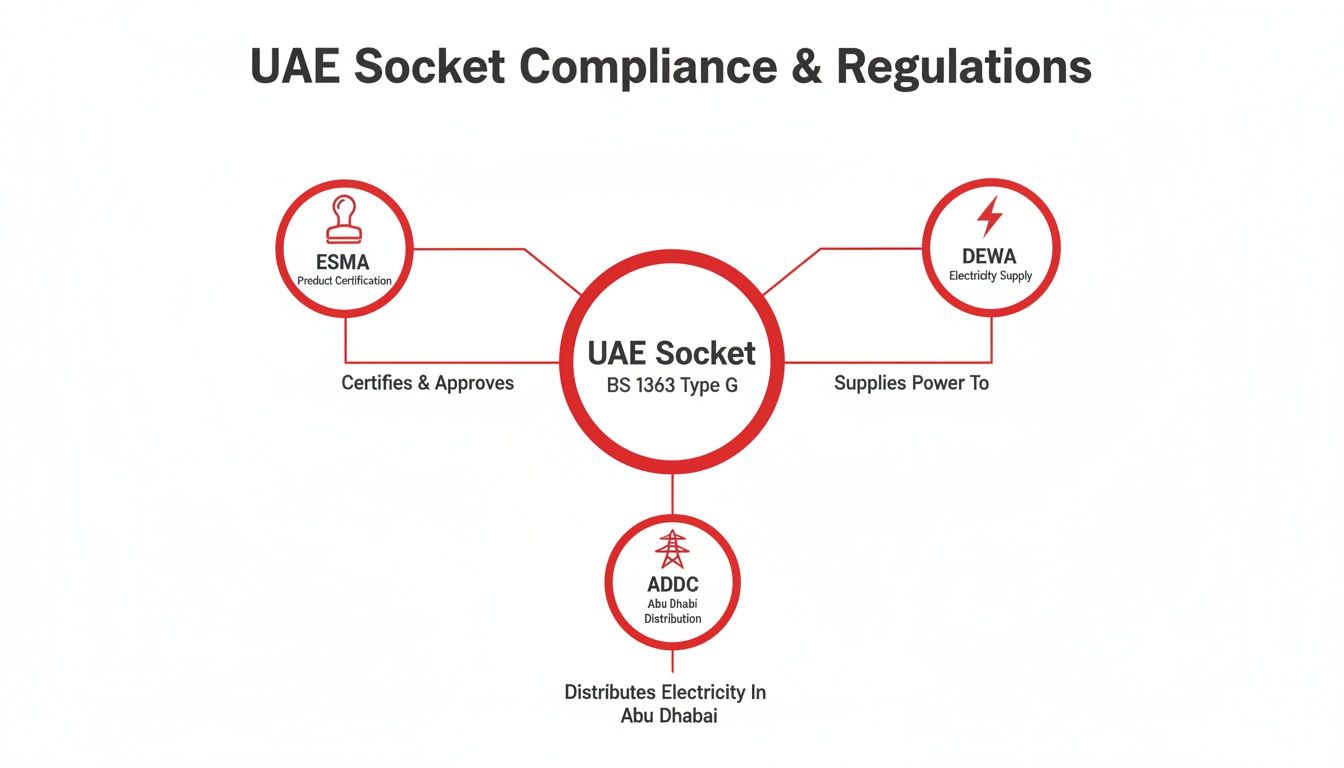
It illustrates how national standards from ESMA are integrated with the specific installation rules from local utilities like DEWA and ADDC.
Surviving The Elements With IP Ratings
For any project in the GCC, Ingress Protection (IP) ratings are a non-negotiable specification. Defined by IEC 60529, an IP rating indicates an enclosure's sealing effectiveness against the intrusion of solids (like dust) and liquids.
The first digit (0-6) measures protection against solid objects, while the second (0-9) measures protection against liquids. In the UAE's dusty and humid climate, a higher IP rating is essential for outdoor or industrial installations.
While an indoor office socket may only require an IP20 rating, an outdoor socket for a public kiosk or an industrial workshop in Jebel Ali requires a much higher rating to prevent ingress of dust and moisture.
Withstanding Mechanical Stress With IK Ratings
While IP ratings address environmental protection, Impact Resistance (IK) ratings quantify an enclosure's durability against mechanical impact. This rating is critical for sockets installed in high-traffic areas such as public spaces, workshops, and factories where they are susceptible to accidental impact.
Defined by IEC 62262, the IK scale ranges from IK00 (no protection) to IK10 (able to withstand a 20-joule impact). A high IK rating ensures the internal components remain protected and functional, preventing electrical failures and maintaining safety.
For panel builders and facility managers, specifying the correct IP and IK ratings is a direct investment in system longevity, reducing maintenance calls and downtime while ensuring compliance with regional operational standards.
IP And IK Ratings Explained For UAE Environments
This reference table helps match socket specifications to their intended application environment within the UAE.
| Rating | Protection Against (Solids/Liquids or Impact) | Typical Application In UAE (e.g., Indoor Office, Outdoor Kiosk, Industrial Workshop) |
|---|---|---|
| IP44 | Solids >1mm, splashing water from any direction | Protected outdoor areas like balconies, covered walkways, or bathrooms. |
| IP65 | Totally dust-tight, low-pressure water jets | Outdoor kiosks, car parks, and dusty industrial areas where cleaning involves hosing down. |
| IP66 | Totally dust-tight, powerful water jets | Exposed external locations, marine environments, or industrial wash-down areas. |
| IK07 | Impact of 2 joules | Public areas with moderate traffic, such as schools, hospitals, and retail spaces. |
| IK08 | Impact of 5 joules | High-traffic public areas, car parks, and industrial environments with a risk of moderate impact. |
| IK10 | Impact of 20 joules | Heavy industrial workshops, transport hubs, and public areas prone to vandalism. |
By carefully decoding these technical specifications, engineers and procurement teams can confidently source electrical sockets in the UAE that are not just compliant but perfectly suited for the demands of any GCC project. It is about selecting a product engineered to endure its operational environment.
A Practical Guide to Socket Types for Modern UAE Projects
Choosing the correct electrical socket is a fundamental engineering decision that impacts the safety, functionality, and future-readiness of a building. For projects in dynamic hubs like Dubai and Abu Dhabi, specifications now extend beyond the standard Type G outlet to include a range of solutions, from heavy-duty industrial power to integrated smart building controls.
Matching the socket to its application is critical. A socket suitable for a climate-controlled office will fail in a dusty, outdoor industrial environment, leading to hazardous conditions and costly downtime. Here is a breakdown of essential socket categories for modern UAE projects.
Standard Single and Double Gang Sockets
These are the workhorses of general power distribution. The familiar single and double gang BS 1363 sockets are the standard for most commercial and residential buildings. Designed for 13A loads, they are ideal for office equipment, kitchen appliances, and general power needs.
When sourcing, prioritise durable materials like high-grade polycarbonate that can withstand daily use. It is non-negotiable to work with reputable manufacturers who guarantee full compliance with ESMA regulations for project approvals in the UAE.
Industrial Sockets IEC 60309
For powering heavy machinery in factories, data centres, or workshops, the standard Type G socket is insufficient. IEC 60309 sockets, also known as "Commando" or CEE sockets, are engineered for safety under heavy electrical loads and feature a secure locking mechanism to prevent accidental disconnection.
These sockets are colour-coded by voltage and have unique pin configurations, a safety feature that prevents connecting equipment to an incorrect power source. In the UAE, they are essential for:
- Powering heavy machinery: Critical for manufacturing plants and industrial zones.
- Temporary power supplies: The standard on construction sites and for large-scale events.
- Data centres: Providing reliable power to server racks and critical cooling systems.
Handling higher currents (from 16A to 125A) and offering superior IP and IK ratings, these sockets are the only viable solution for harsh industrial environments.
Modular and Integrated Sockets
The modern workspace in Dubai demands seamless connectivity. Modular sockets are becoming the standard in high-end commercial fit-outs, hotels, and conference facilities. These systems allow for the integration of multiple services into a single, clean faceplate.
A single modular unit can combine a standard power outlet, USB-A and USB-C charging ports, an RJ45 data jack, and an HDMI connection. This design eliminates cable clutter and delivers the integrated connectivity modern clients expect. Specifying modular solutions adds significant value and aligns projects with contemporary design trends.
Weatherproof and Outdoor Sockets
Any socket installed outdoors in the UAE must contend with extreme heat, humidity, dust, and moisture. Weatherproof sockets with a high Ingress Protection (IP) rating are non-negotiable for these applications.
An IP66-rated socket, for example, provides complete protection against dust ingress and can withstand powerful water jets, making it ideal for gardens, patios, outdoor kitchens, and public areas. These units are constructed with robust, sealed enclosures and UV-stabilised plastics that resist degradation under constant sun exposure. Using an incorrectly specified socket outdoors is a common cause of electrical faults and a serious safety hazard. Learn more about the power plug in UAE and its specific applications.
Smart Sockets for Energy Management
With energy efficiency being a key focus of the energy management solution Dubai and GCC markets, smart sockets are playing an increasingly important role in modern buildings. These devices can be controlled via a smartphone app or integrated into a Building Management System (BMS).
Key advantages include:
- Remote Control: Switch devices on or off from any location.
- Scheduling: Automate operation of lights, HVAC units, and other equipment to reduce energy waste.
- Energy Monitoring: Access real-time data on the power consumption of connected devices.
For facility managers, smart electrical sockets in the UAE provide a powerful tool for control and data analysis, helping to reduce operational costs and support the sustainability goals central to the UAE's long-term vision.
Best Practices For Socket Installation And Maintenance
For electricians and maintenance engineers in the UAE, the quality of an installation is measured by the precision of the work. Proper installation and maintenance of electrical sockets are critical for safety, regulatory compliance, and long-term system reliability. Adhering to best practices mitigates risks and ensures every socket performs as designed throughout its operational life.
From correct mounting heights to proper termination torque, each step contributes to a robust and compliant electrical system.
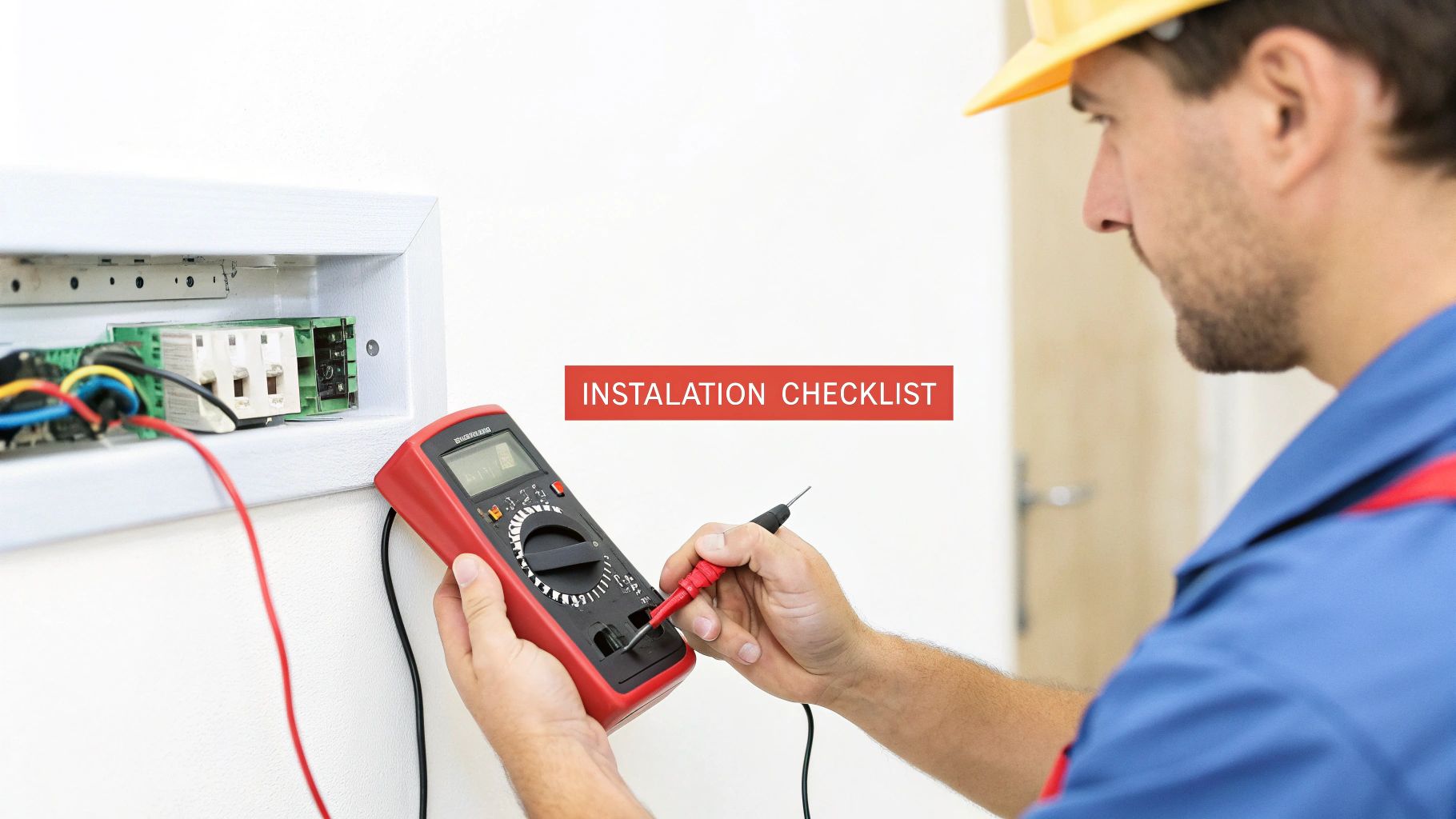
This meticulous approach is vital in the GCC's harsh environments, where dust and humidity accelerate component degradation, making procedural adherence non-negotiable.
How to Install: A Checklist for UAE Compliance
A flawless installation that meets DEWA and ADDC standards requires a methodical approach. Cutting corners leads to failed inspections and costly rework.
- Verify Mounting Heights: The standard in the UAE is a minimum mounting height of 450mm from the Finished Floor Level (FFL). Specialised applications, such as accessible floor boxes, may have different requirements. You can explore a range of compliant GoSwitchgear floor socket boxes for these scenarios.
- Ensure Proper Wiring Techniques: Use the correct wire gauge for the circuit's load and adhere strictly to the UAE colour code: Brown for Live, Blue for Neutral, and Green/Yellow for Earth.
- Secure Cable Termination: Strip only enough insulation to achieve a solid connection at the terminal. Ensure no stray copper strands are exposed and tighten terminal screws to the manufacturer's recommended torque setting to prevent overheating.
- Confirm Earthing Continuity: This is the most critical safety check. Use a multimeter to verify a low-resistance path from the socket's earth terminal back to the main distribution board's earth bar. A robust earth connection is paramount.
Common Installation Mistakes To Avoid
Even experienced electricians can make errors under pressure. A pre-energization check can prevent common issues that cause inspection failures and create safety hazards.
- Incorrect Polarity: Reversing live and neutral conductors is a serious fault. Always double-check connections.
- Loose Terminations: Insufficiently tightened terminal screws are a primary cause of arcing and electrical fires. Use a torque screwdriver for accuracy.
- Over-stripping Wires: Exposing excessive copper within the back box increases the risk of a short circuit.
- Damaging the Faceplate: Over-tightening faceplate screws can crack the plastic, compromising the socket's integrity and appearance.
A proactive quality control audit using this checklist can save significant time and expense, facilitating a first-time pass for DEWA or ADDC inspections.
Preventative Maintenance Schedule for the GCC Climate
The UAE's climate is harsh on electrical components. Dust, humidity, and saline coastal air demand a structured maintenance plan to ensure the longevity and safety of electrical sockets in the UAE.
Recommended Maintenance Schedule:
- Annual Visual Inspection: Conduct an annual walk-through to inspect all accessible sockets for signs of damage, such as cracks, discolouration, or overheating. Ensure faceplates are secure.
- Bi-Annual Functionality Test: Every two years, use a socket tester to verify correct wiring and test the functionality of the associated RCD protection. This can identify latent faults before they become critical.
- Periodic Cleaning: In dusty environments like workshops, regular cleaning is necessary. Use a dry cloth to remove dust accumulation that can cause tracking or overheating. Never apply liquids or chemical sprays directly to a socket.
By combining precise installation with a consistent maintenance routine, you ensure every socket remains a safe, reliable, and compliant component of the building's infrastructure.
How to Streamline Sourcing And Procurement In The UAE
For purchasing managers and traders, sourcing compliant electrical sockets in UAE projects involves navigating a complex landscape of verification and lead-time management. In dynamic markets like Dubai and Abu Dhabi, ensuring every component has a valid Emirates Quality Mark (EQM) is a significant challenge.
A specialised digital marketplace like GoSwitchgear transforms this process. By aggregating certified products from trusted manufacturers into a single platform, we eliminate the risk and administrative burden of compliance verification.
Our platform provides immediate access to technical datasheets, competitive pricing, and local technical support. This centralised approach allows you to source everything from standard outlets to specialised industrial sockets efficiently, all from one reliable hub. For businesses in the trades, consistent project flow is equally critical, and effective digital marketing strategies for electricians can help maintain a full project pipeline.
This focus on compliance is built on regulations that have shaped the market for over a decade. In 2012, ESMA mandated the BS 1363-5 standard, a critical step to eliminate unsafe 2-pin plugs and adaptors that posed serious fire risks.
When you partner with a curated platform, your procurement team gains a strategic advantage, ensuring every project is equipped with fully compliant and certified electrical components.
Explore our catalogue of Schneider plugs and sockets to see how we can support your project’s specific requirements.
Frequently Asked Questions
Specifying electrical components in the UAE can be complex. Here are clear, concise answers to common questions from engineers, electricians, and procurement teams to ensure your projects in Dubai, Abu Dhabi, and across the GCC are safe and compliant.
What Is The Mandatory Electrical Socket Type In The UAE And Why?
The only mandated socket type across the UAE is the Type G (BS 1363) socket, operating at 230V and 50Hz. This standard was enforced by ESMA to eliminate the safety hazards posed by a mix of non-standard plugs and uncertified adaptors.
This unification created a safe and reliable electrical infrastructure. Key safety features include a mandatory fuse in every plug and shuttered live and neutral socket apertures to prevent accidental contact.
How Can I Verify If A Socket Is Approved For Use In Dubai?
To verify that a socket is approved for use in a Dubai project, you must confirm it bears the Emirates Quality Mark (EQM). This official certification from ESMA should be clearly visible on the product or its packaging.
Additionally, all installed components must comply with DEWA's specific wiring regulations and standards. Sourcing from a trusted local supplier like GoSwitchgear ensures all products are pre-vetted for EQM certification and are fully compliant with local utility requirements.
Which IP Rating Is Best For Outdoor Electrical Sockets In The UAE?
For most outdoor applications in the UAE, a minimum IP rating of IP65 is recommended. This provides robust protection against the fine, wind-blown dust common in the region and withstands low-pressure water jets from rain or irrigation systems.
For locations exposed to more significant water ingress, such as industrial wash-down areas, marine facilities, or poolside installations, it is best practice to upgrade to an IP66 rating. An IP66 enclosure can withstand powerful water jets, ensuring superior long-term reliability in these demanding environments.
The final selection must be based on a site-specific risk assessment to ensure the safety and longevity of your electrical sockets uae installation.
At GoSwitchgear, we simplify the procurement of fully compliant electrical components for projects across the UAE. Our platform features an extensive catalogue of certified sockets, switches, and accessories from leading brands, all supported by our local expertise.
Contact us for project support in Dubai. Explore our range to ensure your next project is built to the highest standards of safety and quality. Visit GoSwitchgear to learn more.
Share this post

Related
Posts
A Guide to Choosing AC to DC Converters for UAE & GCC Electrical Systems
Master AC to DC converters with this comprehensive guide for engineers in the UAE & GCC. Learn selection, installation, and...
A Guide to Drill Machine Prices in the UAE for Technical Professionals
Find the best drill machine price in UAE. Our 2026 guide helps contractors and engineers choose the right corded, cordless,...
A Professional’s Guide to Choosing AGM VRLA Batteries in the UAE Climate
Discover why AGM VRLA batteries are the superior power solution for UPS, solar, and industrial systems in the UAE. Get...
How to Choose the Right Lithium Ion Battery Charger for UAE & GCC Projects
Discover how to select the right lithium ion battery charger for UAE projects. This guide covers specs, BMS integration, and...
.jpg)