.jpg)


Posted by:
Category:
Comments:
Post Date:
Choosing the Right Fluke Clamp Metre for UAE & GCC Projects
For engineers, panel builders, and electricians in the UAE and GCC, precision and safety are non-negotiable. A high-quality Fluke clamp metre is an indispensable tool, offering a non-contact method to measure high currents in live circuits without shutdowns. This guide provides practical insights for selecting the right model for our demanding regional climate.
Why a Solid Fluke Clamp Meter Isn't Just Nice to Have—It's Essential in the GCC
In the demanding industrial environments of the UAE and KSA, "close enough" isn't an option. The quality of your tools directly impacts project timelines, client uptime, and most critically, your personal safety. Working on live systems in Dubai or Abu Dhabi presents unique challenges, from scorching heat that can affect accuracy to pervasive dust that can compromise sensitive electronics.
This is where a robust and reliable Fluke clamp metre demonstrates its true value. While a standard multimeter is essential for voltage or resistance checks, measuring current often requires breaking a circuit—a process that is both time-consuming and hazardous. The clamp metre elegantly solves this by measuring current without direct contact, making it a vital tool for daily troubleshooting and maintenance.
Key Advantages in the GCC Context
- Enhanced Safety: By eliminating the need to cut wires or probe live circuits for current readings, you significantly reduce the risk of arc flash and electric shock. This is a critical safety upgrade for any technician.
- Operational Continuity: Instantly identify load imbalances, verify breaker performance, or measure a motor's inrush current without taking critical systems offline. This prevents costly downtime, a major concern for facilities across the GCC.
- Built for Our Climate: Fluke tools are engineered for durability. They are designed to withstand the harsh conditions of a typical job site in the UAE, including extreme heat and humidity, ensuring reliable performance every time. High IP ratings are crucial.
A measurement you can trust is the first step to solving any problem. In the fast-paced construction and maintenance sectors of the GCC, a tool that delivers fast, accurate, and safe readings isn't a luxury—it's the foundation of professional work.
Selecting the right energy management solution Dubai professionals depend on begins with equipping your team with the proper instruments. This guide will explore the specific features, real-world applications, and best practices that make the Fluke clamp metre the preferred choice for projects involving electrical components UAE-wide. As your trusted partner, GoSwitchgear ensures you have access to the best equipment and the expertise to use it effectively.
How Clamp Meters Measure Current Without Contact
Ever wondered how a Fluke clamp metre can tell you exactly how much current is flowing through a wire, all without you having to cut or disconnect a single thing? It’s a neat trick, and it’s all thanks to a fundamental physics principle called electromagnetic induction.
Here’s a simple way to picture it: anytime electricity flows through a conductor, it creates an invisible magnetic field around it. Think of it like dropping a pebble into a still pond. The current is the pebble, and the magnetic field is the series of ripples expanding outwards. The stronger the current, the bigger and more powerful those magnetic "ripples" become.
The jaws of a clamp meter aren't just for gripping. Inside, they house a precision-engineered ferrite iron core that’s designed to do one thing really well: concentrate those magnetic field lines. Nestled within this core are highly sensitive coils. When you clamp the jaws around a live wire, that magnetic field flows through the core and induces a tiny, proportional current in the sensing coils. The meter's brain then takes this small induced current, runs the numbers, and displays a precise amperage reading right on the screen.
This is the magic behind non-contact measurement, and it's what makes these tools so incredibly practical for professionals on busy industrial sites across the UAE.
This infographic breaks down the core tenets that make a Fluke clamp meter an indispensable tool, focusing on its precision, safety, and durability.
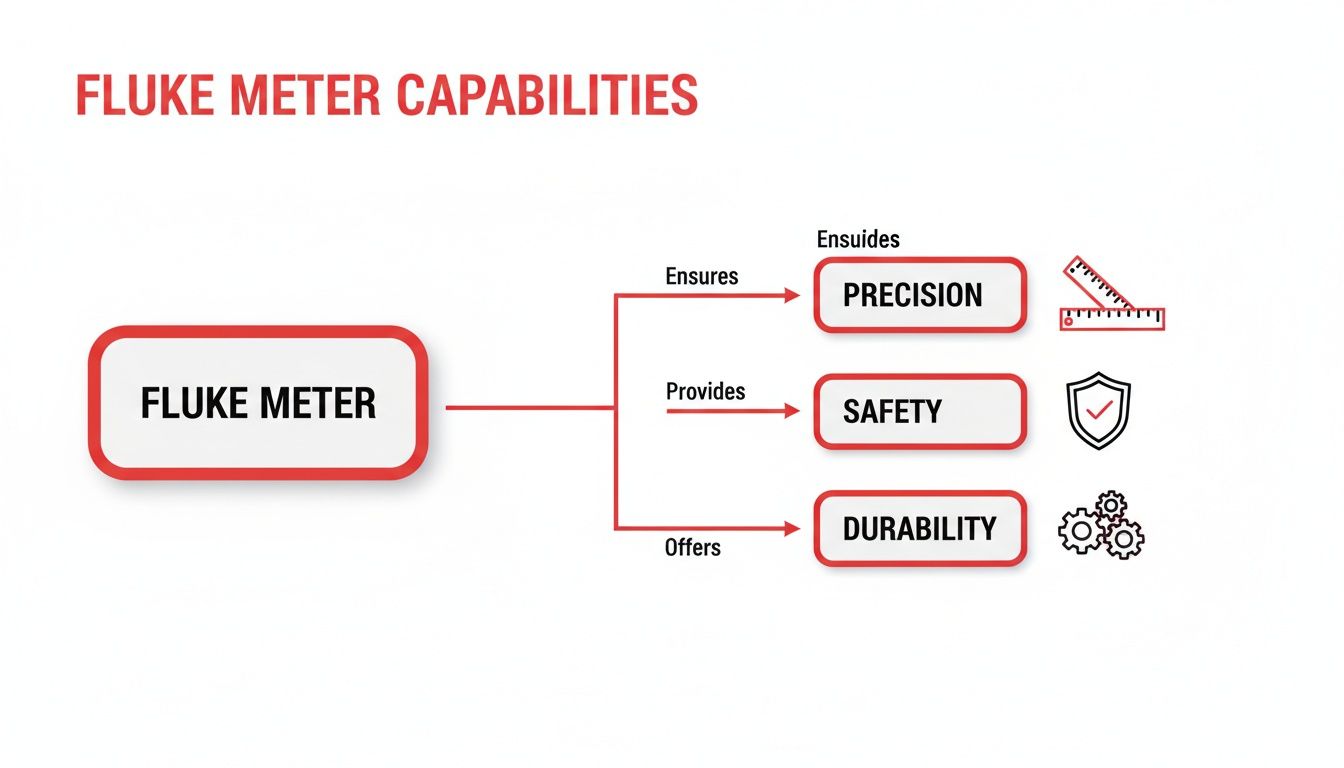
As you can see, these three pillars work in concert to deliver a reliable measurement every single time, which is non-negotiable in the demanding environments we work in here in the GCC.
Distinguishing Between AC and DC Measurement
While the underlying principle is the same, there’s a bit of a technological fork in the road when it comes to measuring Alternating Current (AC) versus Direct Current (DC).
AC measurement is relatively straightforward. Because AC current is constantly changing direction, it creates a dynamic, fluctuating magnetic field. A standard current transformer inside the clamp's jaws can easily pick up on this fluctuation and translate it into a reading.
DC current, on the other hand, is a steady, one-way street. It produces a static, unchanging magnetic field, which won't induce a current in a standard coil. To crack this nut, Fluke clamp meters built for DC measurement use a clever piece of tech called a Hall effect sensor.
A Hall effect sensor is a special type of transducer that changes its voltage output when it's exposed to a magnetic field. By placing one of these sensors in the clamp's core, the meter can accurately detect the strength of the static magnetic field from DC current and convert it into a measurement.
This distinction is crucial for technicians in the UAE, especially with the boom in solar PV systems, battery banks, and variable frequency drives (VFDs)—all of which are DC-heavy. Knowing the technology under the hood helps you appreciate the versatility engineered into every Fluke clamp meter. It’s this combination of solid physics and smart engineering that lets you safely and efficiently measure current without ever interrupting the circuit, whether you're troubleshooting an HVAC unit in Dubai or commissioning a solar farm out in Abu Dhabi.
Decoding the Features That Matter Most in the GCC
When you're looking at the specs for a modern Fluke clamp metre, it's easy to get lost in the details. But for professionals working on sites across the UAE and GCC, a few key features make all the difference in performance, safety, and whether the tool will last. Let's be honest, not all features are equally important, and knowing which ones actually help in our unique climate is what separates a good purchase from a great investment. The right tool doesn't just give you a number; it helps you solve problems quickly and get home safely.
For anyone dealing with modern electrical systems, there's one feature that's non-negotiable: True RMS (Root Mean Square).
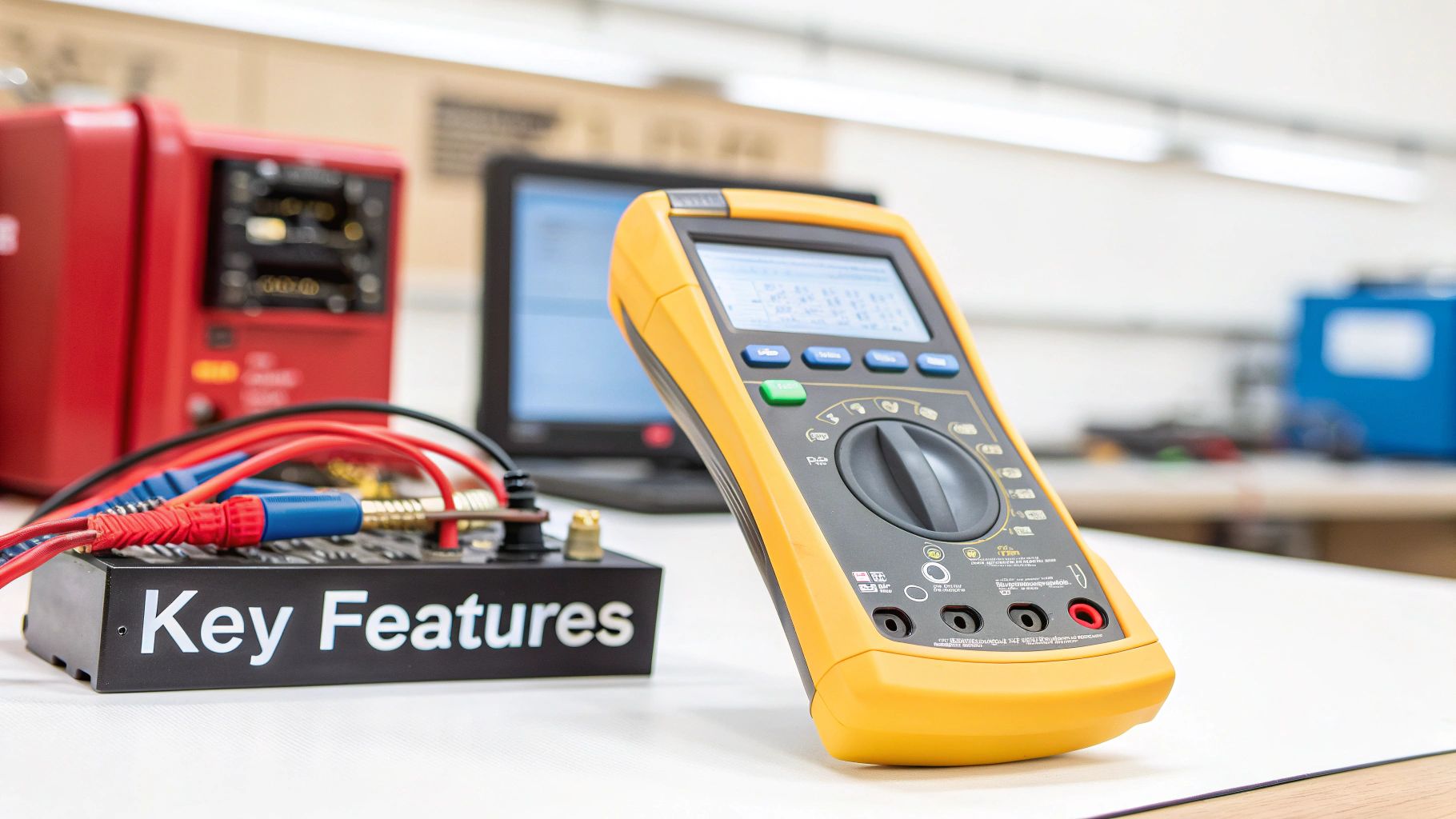
The Critical Role of True RMS Accuracy
Here’s the deal: a lot of older, more basic meters are what we call "average responding." They work perfectly fine on clean, pure sinusoidal AC waveforms. The problem is, facilities in Dubai and Abu Dhabi are anything but clean. They're packed with non-linear loads—think variable frequency drives (VFDs), electronic ballasts in lighting, and entire server rooms full of computer power supplies.
These devices completely distort the AC waveform, creating electrical "noise" that throws an average-responding meter for a loop. This can lead to readings that are off by as much as 40%. That’s not just a small error; it's a dangerous one.
A True RMS clamp metre, like the Fluke 325 or Fluke 376 FC, is built differently. It has the smarts inside to accurately measure these messy, distorted waveforms. This means the current readings you see on the screen are the real deal, which is absolutely critical for proper load balancing, effective troubleshooting, and preventing dangerously overloaded circuits.
Essential Specifications for the GCC Environment
Beyond True RMS, a few other specs will make or break a tool's usefulness in our region. When you or your procurement team are looking at a Fluke clamp metre, these are the things to zero in on:
- AC/DC Voltage and Current Ranges: Ensure the meter can handle the loads common in your applications. For industrial maintenance, models measuring up to 600 A or 1000 A are standard. The ability to measure both AC and DC is essential for versatility across building wiring to solar PV systems.
- Jaw Size and Design: This simple physical attribute dictates what you can measure. A slim jaw profile is invaluable when accessing a single conductor within a crowded electrical panel—a common scenario in the field.
- IP Rating (Ingress Protection): This is non-negotiable for the GCC. The IP rating indicates the meter's resistance to dust and moisture. An IP42 rating or higher, compliant with IEC 60529, is crucial to protect your investment from fine construction dust and high humidity, directly impacting the tool's operational lifespan.
Safety Ratings and Advanced Functions
Safety is paramount. The CAT (Category) safety rating, defined by IEC 61010 standards, should be the first specification you verify. It indicates the electrical environments where the meter can safely operate by withstanding transient voltage spikes.
CAT III 600 V / CAT IV 300 V ratings are the minimum acceptable standard for working on industrial switchgear, distribution panels, or three-phase commercial systems in the UAE. Using a lower-rated tool in these environments poses a significant safety risk.
Beyond core safety specifications, several advanced functions can enhance job efficiency and safety:
- Inrush Current Measurement: This feature is invaluable for professionals working with motors and compressors. It captures the momentary current surge during startup, helping to diagnose whether a fault is electrical or mechanical.
- Fluke Connect® Compatibility: This technology is a game-changer for safety. It allows the clamp metre to transmit readings wirelessly to a smartphone or tablet. Technicians can de-energize a panel, attach the meter, close the cabinet, re-energize the system, and read measurements from a safe distance, well outside the arc-flash boundary.
Choosing a Fluke clamp metre is an investment in precision and safety. By focusing on True RMS, appropriate current ranges, a robust IP rating, and the correct CAT safety rating, professionals across the GCC can ensure measurement integrity and personal safety. Sourcing from a trusted local supplier like GoSwitchgear guarantees authentic models, such as the Fluke 325 True-RMS Clamp Meter, backed by essential local support and warranty.
Real-World Applications for UAE Industries
Connecting advanced features to everyday jobs is where a Fluke clamp meter really shows its worth. For the pros working across the UAE’s key industries, this tool isn't just for taking readings; it’s about solving specific, high-stakes problems safely and efficiently.
From busy construction sites in Dubai to critical infrastructure in Abu Dhabi, its practical uses are woven into the fabric of modern electrical work. Let's dig into the real, tangible ways this device gets used across different sectors. These aren't just textbook examples—they're everyday tasks where getting it right the first time is everything.
For Switchgear and Panel Builders
If you build the backbone of our electrical distribution systems, a Fluke clamp meter is a constant companion, from the first fabrication to the final commissioning. It’s the tool you trust to verify the quality and safety of your work.
Here’s where it comes in:
- Load Balancing Verification: Before a panel goes live, you absolutely have to know the load is evenly split across all three phases. A clamp meter gives you a quick, non-contact way to check each phase conductor, ensuring no single phase is dangerously overloaded. This simple check prevents a world of future problems like overheating and nuisance tripping.
- Verifying Circuit Breaker Trip Currents: Technicians use the inrush current function to make sure motors and other big loads are matched with the right circuit breakers. It’s how you confirm the breaker will hold during a normal start-up but will trip when there’s a genuine fault.
- Commissioning New Installations: During that final sign-off, a clamp meter provides the definitive proof that every circuit is pulling the current it's supposed to. This isn't just good practice; it's a crucial step for documenting system performance and ensuring you meet local utility regulations here in the UAE.
For Facility Maintenance and Management
Facility engineers are the first responders for keeping complex buildings running. For them, a Fluke clamp meter is all about speed and accuracy—diagnosing faults fast to minimize downtime and keep operational costs in check.
A few common troubleshooting scenarios:
- Diagnosing HVAC System Faults: Is a compressor motor pulling way too much current? Is a fan motor about to give up? By clamping the supply lines, maintenance teams can instantly see if a motor is struggling, pointing them directly to the source of an HVAC failure. No guesswork needed.
- Identifying Parasitic Loads: In big facilities, those tiny, continuous "ghost" loads can add up to a shocking amount of energy waste. A sensitive clamp meter helps track down circuits that are drawing current when they should be off, pinpointing the source of energy leaks.
- Troubleshooting Motor Control Centers (MCCs): When a motor won't start, a clamp meter is the fastest way to tell if you have an electrical problem (like single-phasing) or a mechanical one (like a seized bearing). The current draw on each phase tells the story.
For facility managers, the ability to quickly and accurately diagnose electrical issues is fundamental. A reliable clamp meter translates directly into faster repairs, reduced energy consumption, and improved operational resilience for the entire building.
In the Booming Solar PV Industry
With the UAE's massive push into renewables, solar PV installations are everywhere. For the specialized technicians working in this field, a DC-capable Fluke clamp meter isn't just useful—it's absolutely indispensable for performance and safety.
Solar-specific jobs include:
- Measuring Individual PV String Currents: Inside a combiner box, technicians clamp each string's conductor to confirm it's producing the right amount of current. If one string's reading is way off, you immediately know you have a problem, whether it's dirty panels, a bad connection, or a failed module.
- Verifying Inverter Performance: This is a key health check. By measuring the DC input current from the array and comparing it to the AC output, engineers can confirm the inverter is operating at its stated efficiency. For a closer look at this process, you can explore our guide on how clamp meters are used for solar PV diagnostics.
- Ensuring Safety at Combiner Boxes: DC systems have their own unique dangers. A clamp meter allows a technician to verify that a circuit is truly dead before starting work. It's a non-negotiable safety step that prevents dangerous arc flashes.
Mastering Safe Measurement Techniques on the Job
When you’re working with live electricity in demanding environments like those across the UAE and the wider GCC, safety isn't just a priority—it's the entire foundation of a successful job. Using your Fluke clamp meter correctly is a non-negotiable skill. It’s what protects you, your colleagues, and the expensive equipment you're servicing. Mastering these techniques builds the confidence you need to get every reading right, without the risk.
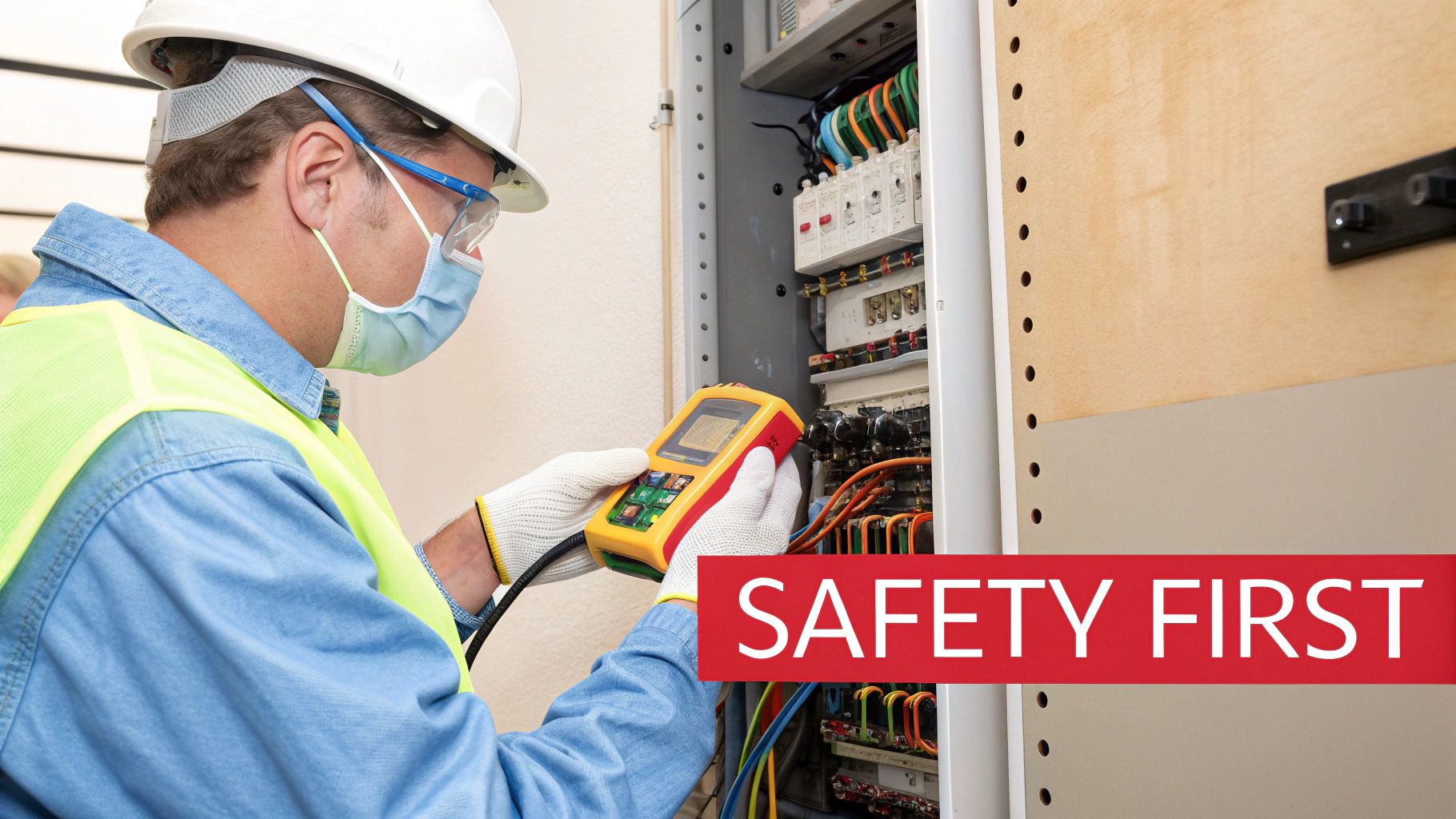
This process should become second nature, a methodical routine you follow every single time. It starts well before you even approach the panel and only ends when your tools are safely put away.
Your Step-by-Step Safety Protocol
Following a consistent procedure eliminates guesswork and dramatically reduces the chance of human error. Think of these steps as your mental checklist for every single measurement.
Inspect Your Gear First: Before you do anything else, give your meter, test leads, and probes a thorough visual inspection. Look for any signs of damage like cracks in the casing or frayed insulation. Do the same for your Personal Protective Equipment (PPE)—make sure your gloves and eyewear are in perfect condition.
Select the Correct Function: Turn the dial on your Fluke clamp meter to the right measurement function (like A~ for AC current) before you get anywhere near a conductor. Fumbling with settings while you’re inches from a live panel is just asking for trouble.
Proper Jaw Placement: This is where it all comes together. Open the jaws and clamp them around a single conductor only. The meter works by measuring the magnetic field generated by the current in one wire. If you clamp around a cable bundle with both phase and neutral conductors, their opposing magnetic fields will cancel each other out, giving you a reading of zero. That's a dangerous mistake.
Center the Conductor: For the most accurate reading, make sure the wire is positioned right in the center of the jaws, where the markings indicate. This aligns the conductor perfectly with the meter's internal sensor.
Interpret the Reading: Once the reading on the display stabilizes, note the value. If you're using a model with Fluke Connect®, you can step back to a safe distance and view the measurement on your smartphone, well clear of the arc flash boundary.
For professionals who want to go deeper, nothing beats formal training. We strongly recommend exploring courses like our introduction to electrical safety fundamentals to reinforce these best practices.
Common Mistakes to Avoid
Even the most seasoned electricians can slip up when they're rushed. Knowing the common pitfalls is the best way to steer clear of them.
- Wrong CAT Rating: Never, ever use a meter with a CAT rating that’s too low for the environment. A CAT II meter is completely unsafe for a three-phase industrial distribution panel; that job requires at least a CAT III or CAT IV rated tool.
- Clamping Multiple Wires: As mentioned, clamping phase and neutral together will give you a false reading of zero. This could trick you into thinking a circuit is dead when it’s very much live.
- Leaving Test Leads Plugged In: When you're measuring current with the clamp, your test leads should be disconnected from the meter. Leaving them connected while you work creates an unnecessary and avoidable safety hazard.
By making these safety protocols an integral part of your daily routine, you ensure that your Fluke clamp meter remains a powerful tool for precision and problem-solving—not a source of risk.
Picking the Right Fluke Clamp Meter with GoSwitchgear
Alright, this is where it all comes together. Choosing the right meter isn't just about grabbing one off the shelf; it's about picking a reliable partner that will keep you safe and your measurements precise, day in and day out. Whether you’re an HVAC tech troubleshooting a chiller unit or a panel builder commissioning a new switchgear assembly, matching the tool to your actual job is what matters most.
This goes way beyond just comparing spec sheets. It’s about truly understanding the unique demands of working in Dubai, Abu Dhabi, or anywhere else in the GCC. The right Fluke clamp meter is built to handle our climate and has the exact features you’ll rely on.
A Quick Recap of What to Look For
To make sure you get the perfect fit, let's quickly run through the most important factors for any professional working in our region:
- Your Main Gig: Are you deep in industrial maintenance dealing with massive currents? Or are you focused on HVAC diagnostics where temperature and microamp readings are everything? Your daily tasks will point you to the right features.
- Measurement Needs: Do you need AC/DC current? Is True-RMS a must-have for dealing with non-linear loads? Make sure the amperage range covers what you typically see on the job.
- On-Site Realities: A high IP rating for dust and moisture isn't just a nice-to-have; it's essential for a tool that's going to last on job sites across the UAE.
- Safety First, Always: Never compromise here. Double-check that the meter has the correct CAT safety rating (like CAT III 600V / CAT IV 300V) for the environments you’ll be in.
The GoSwitchgear Advantage
When you work with a trusted local supplier like GoSwitchgear, you're getting more than just a product. We’re not just a storefront; think of us as your local technical resource, committed to backing up professionals across the UAE.
By choosing GoSwitchgear, you're investing in local expertise and solid support. We give you direct access to 100% authentic Fluke products, ensuring you get a genuine tool backed by a proper local warranty and after-sales service you can actually reach.
This local presence is a huge deal. It means you get straightforward advice on regional compliance and standards. Our team gets the specific challenges that electricians and engineers face in the GCC and can give you tailored advice to select the perfect energy meter GCC projects demand. Fluke Corporation is a powerhouse in a global market that's projected to grow at a CAGR of 7.8%, which tells you just how critical these precision tools are becoming. For professionals in the UAE, having a reliable local source for these advanced instruments is key to staying ahead. Learn more about the clamp meter market dynamics.
Your work demands nothing less than total accuracy and reliability. Don't settle. Take a look at our handpicked selection of Fluke clamp metres online, or better yet, give our expert team a call for some one-on-one advice for your project. We're here and ready to support your next job in Dubai, Abu Dhabi, and beyond.
Got Questions? We've Got Answers
Here are some quick, clear answers to the questions we hear most often from professionals here in the UAE. We want to help you pick the right Fluke clamp meter and use it with confidence.
Do I Need a Clamp Meter and a Multimeter?
For any serious electrical work, yes, you really need both. Think of them as two different tools for two different jobs. Your digital multimeter (DMM) is your go-to for precision work—measuring voltage, resistance, and smaller currents where you can make direct contact with test leads.
But when you're dealing with high current, you can't just break the circuit. That's where a Fluke clamp meter is indispensable. It lets you measure that current safely without ever disconnecting a wire. Having both in your bag means you’ve got a complete diagnostic toolkit, ready for anything you'll face in the field.
Can a Fluke Clamp Meter Measure Both AC and DC Current?
Many of the newer Fluke models can, but it's not a given. You absolutely have to check the specs before you buy.
Models that can handle DC are crucial for anyone working with solar PV systems, battery banks, or VFDs—all of which are becoming more and more common across the GCC region. These tools typically use a Hall effect sensor to get the job done.
How Often Should I Calibrate My Clamp Meter?
Calibration isn't just a suggestion; it's essential for keeping your readings accurate and reliable. That's what keeps you safe and compliant.
As a general rule, Fluke recommends getting your meter calibrated once a year. However, if you drop it or it gets exposed to the extreme heat and dust we see on UAE job sites, it's a good idea to get its accuracy checked right away.
What Is the Most Important Safety Feature to Look For?
Without a doubt, it's the CAT (Category) safety rating. This isn't something you can compromise on. If you're doing industrial or commercial work on panels and switchgear in places like Dubai or Abu Dhabi, you need a meter rated for at least CAT III 600V.
This rating is your assurance that the meter can handle the sudden voltage spikes that are common in these environments, protecting you from dangerous arc flash events. Using an underrated tool is a major safety risk you can't afford to take.
For expert advice on choosing the perfect Fluke clamp meter for your work, you can always trust the local experts at GoSwitchgear. Explore our full range of Fluke testing instruments and get project support today.
Share this post

Related
Posts
A Guide to Choosing AC to DC Converters for UAE & GCC Electrical Systems
Master AC to DC converters with this comprehensive guide for engineers in the UAE & GCC. Learn selection, installation, and...
A Guide to Drill Machine Prices in the UAE for Technical Professionals
Find the best drill machine price in UAE. Our 2026 guide helps contractors and engineers choose the right corded, cordless,...
A Professional’s Guide to Choosing AGM VRLA Batteries in the UAE Climate
Discover why AGM VRLA batteries are the superior power solution for UPS, solar, and industrial systems in the UAE. Get...
How to Choose the Right Lithium Ion Battery Charger for UAE & GCC Projects
Discover how to select the right lithium ion battery charger for UAE projects. This guide covers specs, BMS integration, and...
.jpg)