.jpg)


Posted by:
Category:
Comments:
Post Date:
How to Choose the Right APC Uninterruptible Power Supply in the UAE
For engineers, panel builders, and procurement teams in the UAE's demanding commercial and industrial sectors, a stable power supply is non-negotiable. An APC uninterruptible power supply isn't just backup power; it's a strategic safeguard for critical infrastructure, ensuring operational continuity against grid instability and harsh environmental conditions.
Why a Reliable APC UPS is a Business Necessity in the UAE
In the fast-paced hubs of Dubai and Abu Dhabi, consistent, clean power is the lifeblood of any operation. A power outage is a direct threat to productivity, data integrity, and the bottom line. Even a minor grid fluctuation can corrupt sensitive data, halt a manufacturing line, or disable critical healthcare systems, leading to severe financial fallout.
The unique climate of the UAE and the wider GCC adds another layer of complexity. Intense ambient heat and pervasive dust place constant strain on electrical components, making a stable power supply more critical than ever. This is where an APC uninterruptible power supply becomes essential infrastructure. It not only provides backup power but also conditions it, creating a clean, stable source that isolates valuable equipment from surges, sags, and complete blackouts.
The True Cost of Downtime in the GCC
The financial impact of unplanned downtime is staggering across critical sectors:
- Data Centres: A momentary power loss can lead to hours of recovery, data corruption, and physical damage to server hardware.
- Manufacturing: An unexpected shutdown can spoil production batches, damage machinery, and create costly supply chain delays.
- Healthcare Facilities: For life-support systems and diagnostic equipment, uninterruptible power is a non-negotiable safety requirement.
Investing in an APC UPS is fundamentally an investment in risk management. It provides the crucial buffer needed to perform a safe, orderly shutdown or to bridge the gap until backup generators activate, preserving both assets and operational momentum.
A reliable UPS is a cornerstone of any robust business continuity planning. By integrating a dependable energy management solution Dubai businesses trust, you build a foundation of resilience. Selecting the right APC UPS from GoSwitchgear is your first step toward safeguarding your operations.
Matching APC UPS Topologies to Your Application Needs
Selecting the right APC uninterruptible power supply requires understanding its core technology—the topology. For engineers and panel builders in the UAE, this decision directly impacts operational resilience. Each type—Standby, Line-Interactive, and Online Double-Conversion—offers a distinct level of protection against power issues. Matching the topology to the application ensures you invest in the precise protection your equipment needs without overspending on unnecessary features.
Standby (Offline) UPS: The Essential Safeguard
The Standby UPS (or Offline UPS) is the most straightforward and cost-effective form of power protection. Under normal conditions, it passes utility power directly to connected devices while offering basic surge protection. When it detects a significant voltage drop or outage, a transfer switch activates the internal battery. This switch occurs within 5-12ms, fast enough for most PCs and non-critical peripherals.
- Best For: Individual workstations, point-of-sale (POS) systems, and basic networking hardware.
- Key Advantage: High efficiency and low cost, as the battery is used only when necessary.
- Limitation: It does not actively correct minor voltage fluctuations, which are passed to the load.
This makes the Standby UPS ideal for protecting individual computers where the primary concern is data loss during a blackout, but it is unsuitable for sensitive electronics requiring a constantly conditioned power supply.
This diagram shows how a reliable APC UPS acts as a critical shield, protecting your operations from both the unpredictable local power grid and the challenges of our climate to keep your business running.
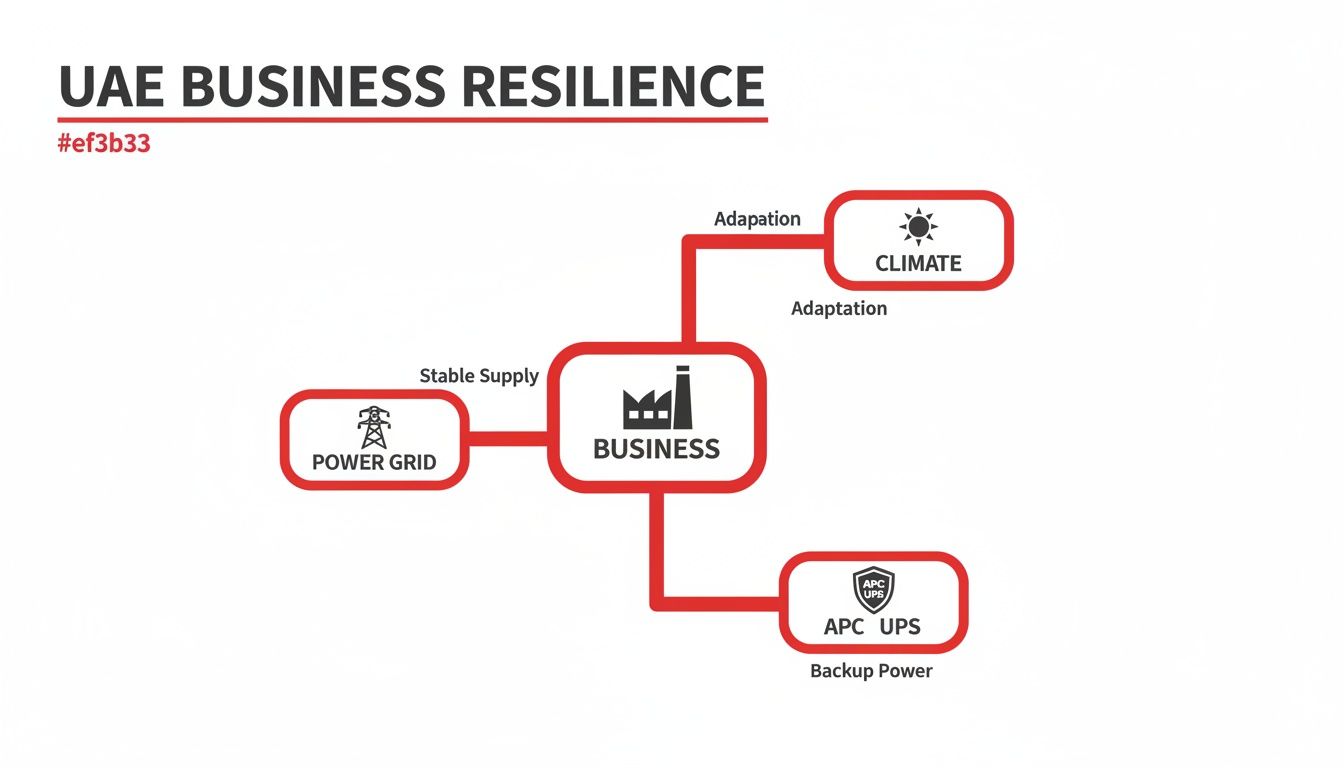
As the visual makes clear, for any business in this region, staying resilient means actively managing these external threats with the right protective gear.
Line-Interactive UPS: The Smart Regulator
A Line-Interactive UPS represents a significant upgrade, acting as a smart power regulator that corrects common power issues without draining its battery. This topology is well-suited for GCC grid conditions, where minor voltage sags and swells are common. An integrated autotransformer corrects undervoltage (brownouts) and overvoltage conditions, delivering a stable output to your equipment. The battery is reserved for complete blackouts, extending its service life.
A Line-Interactive UPS is the workhorse for most business needs. It strikes the perfect balance between performance, efficiency, and cost, making it the go-to choice for protecting servers, network closets, and sensitive control panel electronics.
This topology is ideal for applications where clean, regulated power is critical, but the zero-transfer-time protection of an Online model is not required.
Online Double-Conversion UPS: The Digital Fortress
For mission-critical systems where even a millisecond of power interruption is unacceptable, the Online Double-Conversion UPS is the only viable solution. It acts as a digital fortress, completely isolating sensitive equipment from raw utility power. It constantly converts incoming AC power to DC to charge the battery, then converts it back to perfectly clean AC power for the load. This "double-conversion" process results in zero transfer time during a power failure because the inverter is always online.
Key features of this top-tier system include:
- Total Isolation: It regenerates a perfect sine wave output, free from grid noise, frequency variations, or voltage swings.
- Unbroken Power: The critical load always runs on pure, inverter-generated power for maximum reliability.
- Ultimate Protection: This is the highest level of protection available, essential for data centres, critical industrial controls, medical equipment, and any system where downtime is not an option.
While this topology offers unmatched protection, it has a higher cost and slightly lower efficiency due to constant power conversion. For a facility in Dubai with sensitive servers or advanced automation, investing in an APC uninterruptible power supply with this technology is a non-negotiable insurance policy.
Comparing Key Features of APC UPS Topologies
To facilitate an informed decision, this table provides a side-by-side comparison of the protection levels, efficiency, and ideal use cases for each APC UPS topology.
| Feature | Standby (Offline) UPS | Line-Interactive UPS | Online (Double-Conversion) UPS |
|---|---|---|---|
| Protection Level | Basic: Protects against blackouts, surges, and spikes. | Intermediate: Corrects voltage sags and swells without using the battery. | Highest: Complete isolation from raw utility power, providing perfect power quality. |
| Transfer Time | 5-12 ms | 2-10 ms (but rarely transfers to battery) | Zero (0 ms) |
| Voltage Regulation | None; passes utility voltage directly to the load. | Yes; uses an autotransformer to buck (trim) or boost voltage. | Continuous; regenerates a perfect sine wave output regardless of input quality. |
| Efficiency | Very High (~98%) | High (~96%) | Good (~90-95%) |
| Cost | Low | Medium | High |
| Ideal Use Cases | Desktops, POS systems, non-critical network devices. | Small business servers, network closets, telecom equipment, control panels. | Data centres, medical equipment, critical industrial controls, any mission-critical system. |
| Key Benefit | Most affordable and efficient solution for basic protection. | Balances cost, efficiency, and robust protection for most business applications. | Unmatched protection for sensitive and critical equipment where downtime is not an option. |
This comparison should help clarify which topology aligns best with your equipment's sensitivity and operational reliability demands.
How to Correctly Size Your APC UPS for Load and Runtime
For any engineer or panel builder in the UAE, correctly sizing an APC uninterruptible power supply is a critical task. Undersizing the unit guarantees system failure during an outage, leaving critical loads exposed. Grossly oversizing it wastes valuable project capital. Proper UPS sizing involves two key steps: precisely calculating your total power load and determining the required runtime.
Calculating Your Total Power Load
The first step is a thorough load audit of every piece of equipment that will draw power from the UPS. This includes servers, monitors, network switches, and any auxiliary hardware. Precision is essential.
Locate two key specifications on the nameplate or technical datasheet of each device:
- Watts (W): The real power a device consumes to perform its function.
- Volt-Amperes (VA): The apparent power, calculated as voltage multiplied by current. For modern IT gear with a switch-mode power supply (SMPS), the VA rating is always higher than the Watt rating.
The difference between these figures is the Power Factor (PF) (PF = Watts / VA). Most modern IT equipment has a PF between 0.9 and 1.0. Sizing a UPS based only on Watts will lead to an overloaded system, as the UPS must supply the full apparent power (VA).
Conducting a Practical Load Audit
Create a list of all devices and their maximum power draw in both Watts and VA, then sum each column to get your totals. For example, a small network closet in a Dubai office might look like this:
| Equipment | Power Draw (Watts) | Power Draw (VA) |
|---|---|---|
| Server 1 | 450 W | 500 VA |
| Network Switch | 100 W | 110 VA |
| NAS Storage Device | 80 W | 90 VA |
| Total Connected Load | 630 W | 700 VA |
Once you have your total load, it is best practice to build in a buffer for future growth. Size the UPS so your current load uses approximately 75-80% of its total capacity. This provides a 20-25% cushion for future expansion. In the example above, a 1000VA / 900W APC UPS would be an appropriate fit.
Determining Your Required Runtime
After calculating the load, the next question is runtime: how long does the power need to stay on during an outage? Runtime requirements vary based on the system's function and your facility's backup strategy.
For most projects in the GCC, two main scenarios apply:
Graceful Shutdown (5-10 minutes): For many IT applications, the primary goal is to provide enough time to safely shut down servers and save data, preventing file corruption. A runtime of 5 to 10 minutes is typically sufficient.
Generator Bridging (30+ minutes): In mission-critical facilities like data centres or industrial plants with backup generators, the UPS must bridge the gap until the generator starts and stabilizes. This can require a runtime of 30 minutes or more to ensure a seamless transition.
The data centre UPS market in the Middle East and Africa reflects this need for extended backup times, projected to grow from USD 162.8 million in 2023 to USD 299.4 million by 2030. This growth is driven by demand for high-capacity systems offering backup times of 30-60 minutes. You can explore these trends in this detailed market analysis of the data centre UPS market.
To achieve longer runtimes, select a UPS model with a larger internal battery or one that supports external battery modules (EBMs). EBMs can be daisy-chained to provide hours of runtime, offering scalability. By carefully calculating both load and runtime, you can confidently select an APC uninterruptible power supply from GoSwitchgear that meets your operational needs.
Installation Best Practices for the Demanding GCC Climate
Installing an APC uninterruptible power supply in the UAE requires a strategic approach that accounts for the region's harsh environmental realities—intense heat, high humidity, and pervasive dust. A proper installation is crucial for long-term reliability and performance.
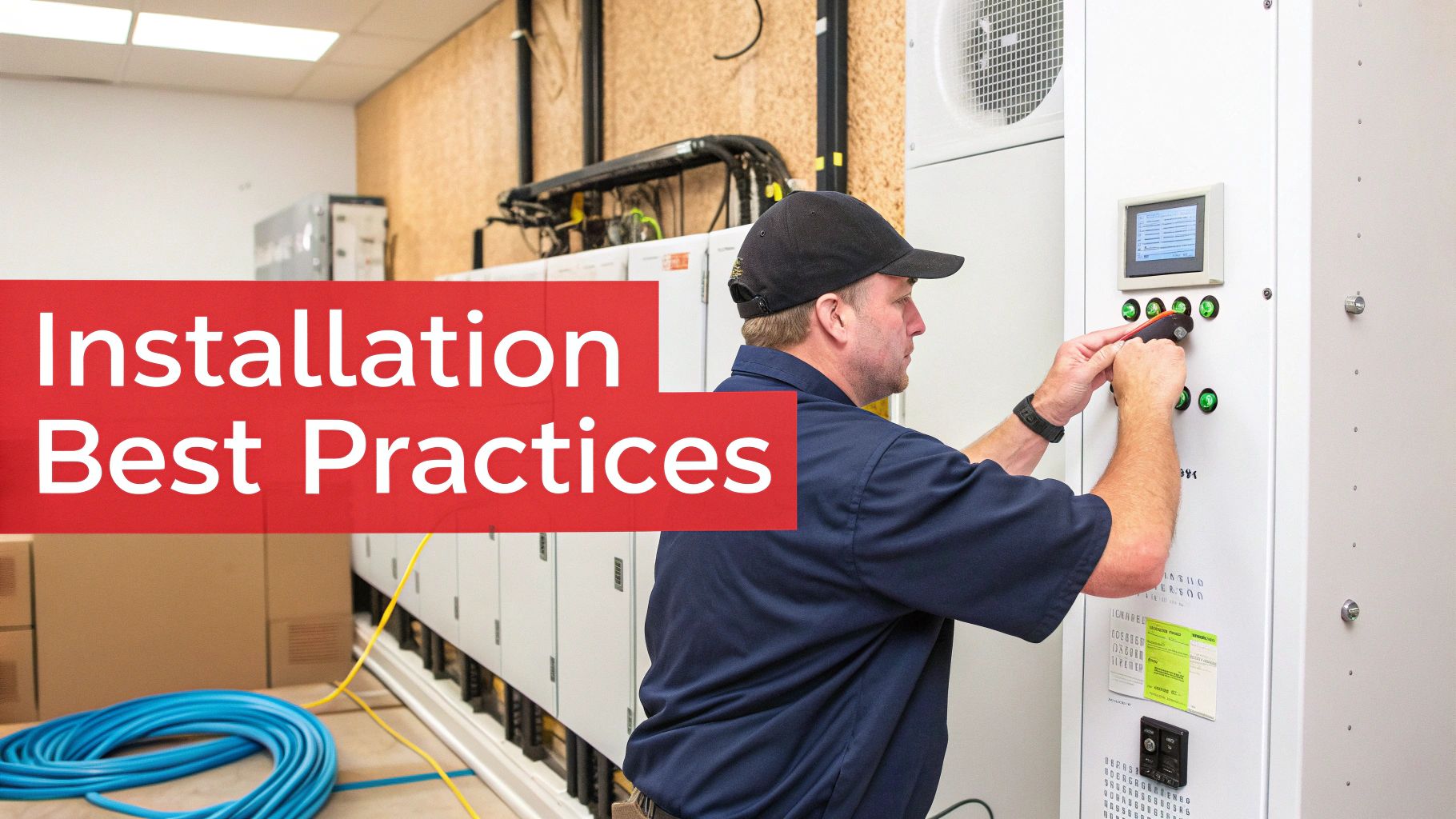
Ignoring these environmental factors can lead to premature battery failure and poor system performance. A well-planned installation ensures the UPS delivers its rated capacity and lifespan, protecting your critical loads.
Thermal Management is Priority Number One
The single greatest factor affecting a UPS's lifespan in the GCC is its operating temperature. For every 8-10°C increase above the ideal 25°C, the service life of a VRLA battery is reduced by half. Effective thermal management is therefore essential.
- Climate Control: Electrical rooms must have proper climate control to maintain a stable ambient temperature.
- Ventilation: Ensure sufficient clearance around the UPS unit for unrestricted airflow. Avoid cramming units into tight closets or blocking vents, as this leads to overheating and component failure. For enclosed panels, integrating a quality panel cooling fan is critical for heat dissipation.
Electrical and Physical Installation Guidelines
Adhering to electrical best practices is fundamental for safety and performance. A solid installation ensures the APC UPS operates efficiently.
- Dedicated Circuits: Always connect the UPS to a dedicated circuit from the distribution board. Sharing a circuit with heavy loads can introduce electrical noise and cause nuisance tripping.
- Proper Grounding: A reliable earth connection is non-negotiable for safety and effective surge protection. Ensure grounding meets local regulations from authorities like DEWA or ADDC.
- Correct Wire Sizing: Use wiring appropriately gauged for the UPS's maximum current draw. Undersized wiring is a fire hazard and causes performance-crippling voltage drops.
- Physical Stability: Place the UPS on a level, stable surface capable of supporting its weight. For rackmount units, use the provided mounting rails and secure them properly.
A correctly installed UPS is a silent guardian. An incorrectly installed one is a liability. The installation process is as important as the quality of the unit itself.
Environmental Protection and Site Selection
The operational environment in many UAE industrial zones presents challenges beyond heat. Dust and humidity can cause short circuits and corrosion.
- IP Ratings: For dusty or damp environments, such as workshops or industrial facilities, select an APC UPS with an appropriate Ingress Protection (IP) rating to shield internal components.
- Location: Install the UPS in the cleanest, driest location available. Avoid areas near open windows, water sources, or high-traffic zones.
- Regular Cleaning: As part of a maintenance schedule, keep the UPS exterior and ventilation ports free of dust and debris to maintain optimal cooling.
The Middle East and Africa UPS market, valued at USD 3.06 billion in 2022, underscores the critical role of these systems in regions with power stability challenges. High-capacity APC UPS models are popular in manufacturing and IT due to their robust design and remote management capabilities, which are essential for monitoring equipment in harsh environments. You can dive deeper into these trends in this comprehensive UPS market report.
Leveraging APC PowerChute for Intelligent Monitoring
A modern APC UPS is an intelligent power management hub. To maximize its value, move beyond a simple plug-and-play approach and utilize its advanced monitoring and management capabilities. For engineers managing facilities across Dubai, Abu Dhabi, or KSA, remote visibility is a necessity. APC's Network Management Cards (NMCs) turn your UPS into a network-aware device, accessible from anywhere.
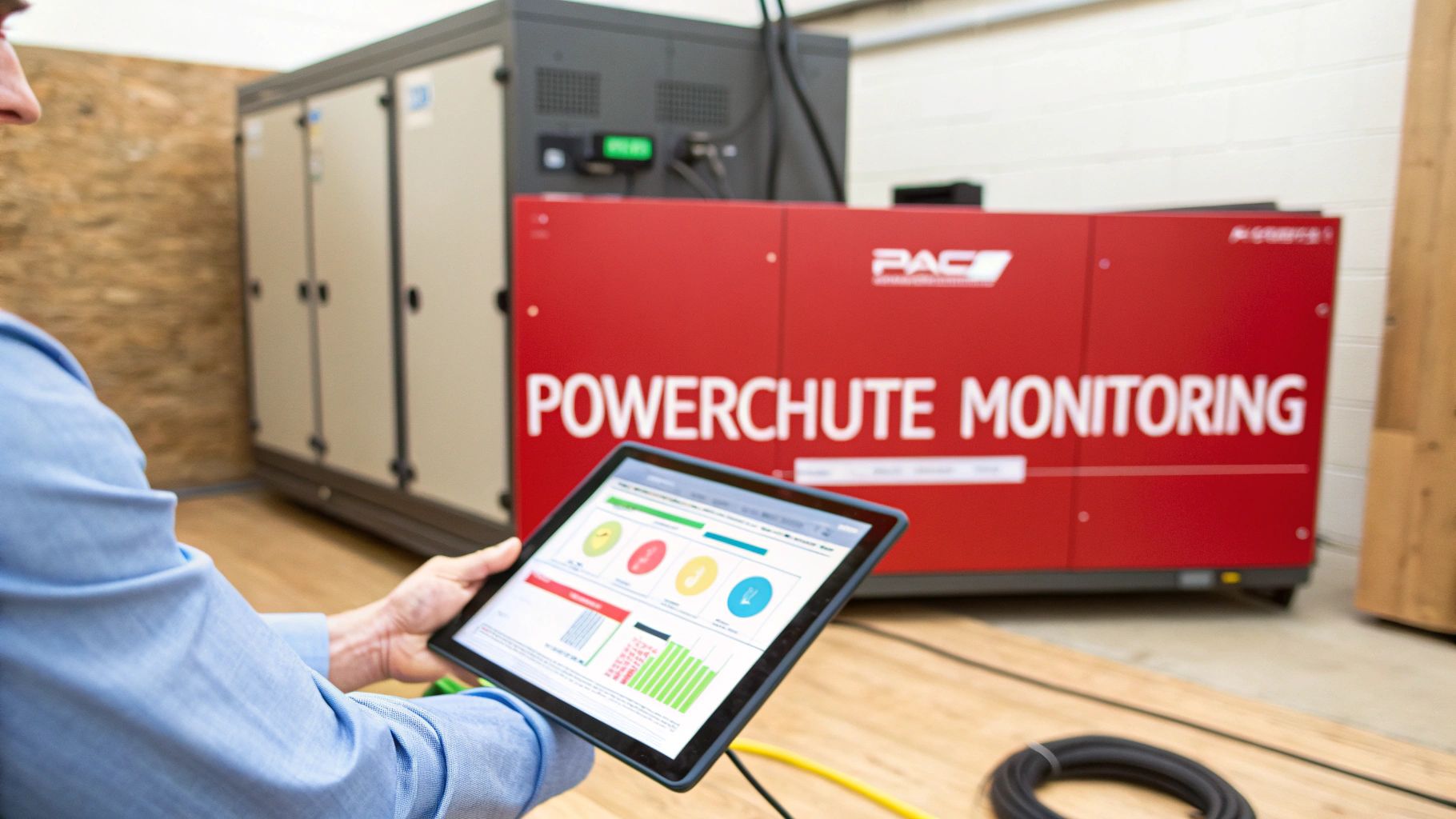
Remote Control and Visibility with Network Management Cards
A Network Management Card (NMC) provides your APC UPS with an IP address, enabling remote monitoring and management. This allows facility managers and IT teams to:
- Monitor Real-Time Status: Check battery health, load percentage, and input voltage from a single dashboard.
- Receive Automated Alerts: Configure email or SNMP notifications for power events like outages, low battery warnings, or over-temperature conditions.
- Manage Centrally: Oversee a fleet of UPS units across multiple sites from one interface.
An NMC transforms your power infrastructure from a black box into a transparent, manageable asset.
Preventing Data Corruption with PowerChute Software
During an extended power outage, the greatest risk is often data corruption from an abrupt server crash. APC’s PowerChute software prevents this by initiating an automated, graceful shutdown. When the UPS battery reaches a critical level, PowerChute communicates with connected servers to:
- Safely close all open files.
- Shut down operating systems in the correct sequence.
- Power off the equipment in an orderly manner.
This automated process maintains data integrity, turning a potential disaster into a controlled event. For any UAE business running critical applications, PowerChute is essential for protecting digital assets.
This level of intelligent control is a key driver of APC's market leadership. The uninterrupted power supply market in the Middle East and Africa, valued at US$ 620.76 million in 2023, is projected to reach US$ 860.90 million by 2031, driven by innovations like the APC Smart-UPS Modular Ultra. You can learn more about the UPS market forecast to see these regional dynamics.
Integrating with Building Management Systems
For a holistic view of facility health, your APC uninterruptible power supply can be integrated with a Building Management System (BMS) using standard protocols like Modbus or SNMP. This allows the UPS to feed vital data into the same platform used for monitoring HVAC, security, and other core systems. This integration elevates your UPS into a key component of the overall energy management solution Dubai teams rely on, enabling data-driven maintenance and enhanced operational resilience. Our experts at GoSwitchgear can help you explore this integration; learn more about our energy monitoring and data management solutions.
Your GoSwitchgear Checklist for Procuring the Right APC UPS
Translate technical knowledge into a smart procurement decision with this pre-purchase checklist. Answering these questions will ensure the APC uninterruptible power supply you select is perfectly aligned with your project requirements in the UAE.
Core Procurement Checklist
- Have you confirmed your total load? Calculate the total power draw in both Watts and VA for all connected equipment, then add a 20-25% buffer for future expansion.
- What is your required runtime? Determine if you need enough time for a graceful shutdown (5-10 minutes) or to bridge the gap until a generator starts (30+ minutes). This decision will define your battery configuration.
- Which topology is required? A cost-effective Line-Interactive unit is sufficient for many servers, but mission-critical systems demand the complete isolation of an Online Double-Conversion model.
- What form factor is needed? Decide between a floor-standing tower unit or a rackmount model that fits into an existing server enclosure. Plan your physical space accordingly.
- What are the environmental conditions? Consider the ambient temperature of the installation site, as high heat shortens battery life. For dusty or humid locations, verify the unit's IP rating.
- How will you manage and monitor it? If remote access is required, ensure you include a Network Management Card (NMC) to enable remote monitoring and automated shutdowns with PowerChute software.
When you're ready to proceed, the GoSwitchgear team in Dubai is here to assist. As leading electrical equipment suppliers in Dubai, we provide the expert consultation and local support your projects across the UAE demand.
Got Questions About APC UPS Systems in the UAE? We've Got Answers.
When specifying an APC uninterruptible power supply for a project in the UAE and wider GCC, several practical questions arise. Here are answers to the most common queries from engineers, panel builders, and facility managers.
Battery Replacement in High Temperatures
How often should UPS batteries be replaced in the UAE's climate?
The high ambient temperatures in the GCC accelerate battery degradation. While a standard VRLA battery is typically rated for a three- to five-year lifespan, operating consistently above the ideal 25°C can reduce this by up to 50%.
Best Practice: We recommend a proactive replacement schedule of every two to three years for units in typical electrical rooms in Dubai or Abu Dhabi. This prevents unexpected failures during a critical power event. Regularly monitor battery health status via your APC management software for early degradation warnings.
APC Smart-UPS Versus Back-UPS Models
What is the difference between APC Smart-UPS and Back-UPS models?
The distinction lies in their intended application and level of protection.
- APC Back-UPS: Designed for basic power protection for single PCs, POS terminals, and other non-critical devices. They typically use a standby topology.
- APC Smart-UPS: Professional-grade units built for servers, storage arrays, and networking equipment. They feature a line-interactive design, provide pure sine wave output for sensitive electronics, offer superior voltage regulation, and include slots for Network Management Cards (NMCs) for remote monitoring.
For any commercial or industrial application in the region, a Smart-UPS is the professional standard, delivering the reliability and manageability required to protect critical business assets.
Strategic Oversizing for Future Growth
Is it advisable to purchase a larger APC UPS than currently needed?
Yes, this is a highly recommended best practice. Size your apc uninterruptible power supply so your current load is approximately 75-80% of its total capacity. This provides a 20-25% buffer for future equipment additions without requiring a complete UPS replacement.
This approach also improves efficiency and can extend the life of internal components. For facilities expecting significant or unpredictable growth, consider a modular APC UPS like the Symmetra series, which allows you to scale capacity by adding power and battery modules.
Finally, responsible asset management includes end-of-life planning. Knowing how to securely recycle lead-acid UPS batteries is crucial for environmental compliance in the UAE.
At GoSwitchgear, we provide the expert guidance needed to select, install, and maintain the ideal APC UPS for your application. Our Dubai-based team is ready to support your projects with local inventory and deep technical expertise.
Contact GoSwitchgear for a consultation on your power protection needs.
Share this post

Related
Posts
How to Choose the Right Electrical Companies in Dubai: A 2026 Guide for Engineers & Procurement Teams
Discover how to choose electrical companies in dubai in 2026, vetting contractors, DEWA compliance, and quality components for safer projects.

Selecting the Right Computer Server Rack for UAE & GCC Data Centers
A practical guide for engineers in the UAE and GCC. Learn how to select the right computer server rack, considering...
Destructive vs. Non-Destructive Testing: A Guide for Electrical Projects in the UAE
Explore destructive test and non destructive test methods. Learn when to use each for electrical component quality and safety assurance...
Mastering the Lockout and Tagout Procedure: A Safety Guide for UAE & GCC Engineers
Master the lockout and tagout procedure with actionable steps, compliance tips, and practical safety guidance.
.jpg)