.jpg)


Posted by:
Category:
Comments:
Post Date:
Choosing the Right Clamp Meter for UAE & GCC Projects
In the UAE's demanding industrial and commercial sectors, electrical professionals need tools that guarantee safety and efficiency. A clamp meter is indispensable, allowing engineers and electricians to measure current on live circuits without costly shutdowns. For panel builders, maintenance teams, and procurement managers in Dubai and across the GCC, selecting the right device is critical for operational continuity and accurate diagnostics.
Why a Professional Clamp Meter is Essential in the UAE
Working on a live electrical panel, especially in the heat and dust of the UAE, presents unique challenges. For electricians, panel builders, and procurement teams, getting an accurate current reading without disrupting critical systems is a core requirement for safety and efficiency. This is where a robust clamp meter, a key part of any professional toolkit of electrical components UAE suppliers provide, becomes non-negotiable.
Unlike a traditional multimeter that requires breaking the circuit, a clamp meter uses its jaws to sense the magnetic field from current flowing through a wire. This non-contact approach is a game-changer for professionals working across the GCC.
Key Benefits for UAE and GCC Professionals
- Enhanced Safety: Eliminating direct contact with live conductors drastically reduces the risk of arc flash and electric shock. This is paramount when working with high-energy switchgear in Dubai or industrial control panels in Abu Dhabi, aligning with best practices in electrical risk management.
- Zero Downtime: You can check current on vital machinery, HVAC systems, and data center power feeds without interruption. This prevents costly shutdowns and preserves productivity, a crucial factor for any energy management solution Dubai depends on.
- Rapid Diagnostics: An overloaded circuit, unbalanced load, or faulty component can be identified in seconds. This speed is vital for maintenance teams managing large facilities where every minute counts.
- Versatility: Modern clamp meters combine current clamping with multimeter functions, allowing measurement of voltage, resistance, and continuity in a single tool.
A clamp meter is more than a measurement tool; it's a diagnostic instrument providing immediate insights into an electrical system's health, helping prevent failures before they occur.
While a clamp meter is a go-to for daily tasks, a comprehensive toolkit includes specialized equipment. For instance, ensuring the safety of high-voltage switchgear operations often requires specialized electrical safety tools like SF6 gas analysers. Ultimately, equipping your team with the right clamp meter from a trusted supplier like GoSwitchgear is a direct investment in efficiency and safety.
How Clamp Meters Safely Measure Live Circuits
A clamp meter measures current in a live wire without direct contact by applying a fundamental physics principle. This capability makes it a safer, faster alternative to older methods that involved cutting into wires.
The process is based on electromagnetic induction. Any wire with current generates a magnetic field. The clamp meter's jaws act as a sensor to measure this field's strength. When clamped around a single conductor, the meter measures the magnetic field, which is directly proportional to the current. The meter's internal circuitry instantly translates this reading into a precise amperage value on the display.
The Technology Behind The Measurement
Two main sensor technologies are used in clamp meters for the UAE and GCC markets.
Current Transformer (CT) for AC: For Alternating Current (AC), most clamp meters use a current transformer. The ferrite iron jaws are wrapped with fine copper wire. The fluctuating magnetic field of an AC conductor induces a smaller, proportional current in these windings, which the meter scales up to display the actual amperage.
Hall Effect Sensor for AC and DC: Measuring Direct Current (DC) requires a different approach, as its steady magnetic field cannot be detected by a standard CT. A Hall Effect sensor, placed in a gap within the jaws, generates a voltage proportional to the magnetic field strength. This allows the meter to measure both AC and DC, making it essential for working with solar PV systems, battery banks, or an SMPS power supply.
A key takeaway for procurement teams in Dubai is to verify if a clamp meter includes a Hall Effect sensor. This feature is critical for technicians working on diverse energy systems, from traditional AC switchgear to advanced DC microgrids.
Why Non-Invasive Measurement Is A Game Changer
The ability to measure current without shutting down a circuit is a massive leap in safety and efficiency. For a fully loaded electrical panel in a commercial tower in Abu Dhabi, killing power for a test is often impractical and risky.
The non-invasive method of a clamp meter:
- Eliminates Arc Flash Risk: By keeping hands and probes away from live terminals, technicians dramatically lower their exposure.
- Prevents Operational Downtime: Critical systems like HVAC and server rooms can be tested without interruption.
- Speeds Up Troubleshooting: Spotting issues like an overloaded circuit takes seconds, making maintenance cycles highly efficient.
This blend of safety and speed is why the clamp meter is an indispensable tool for electrical professionals in the region.
Matching The Clamp Meter Type To Your Job
Selecting the right clamp meter is not a one-size-fits-all decision. Using the wrong instrument for a job in the UAE can lead to inaccurate readings, wasted time, and equipment damage. Understanding the core types is the first step to ensuring you have the right tool, whether for routine maintenance in a Dubai high-rise or commissioning a new solar farm near Abu Dhabi.
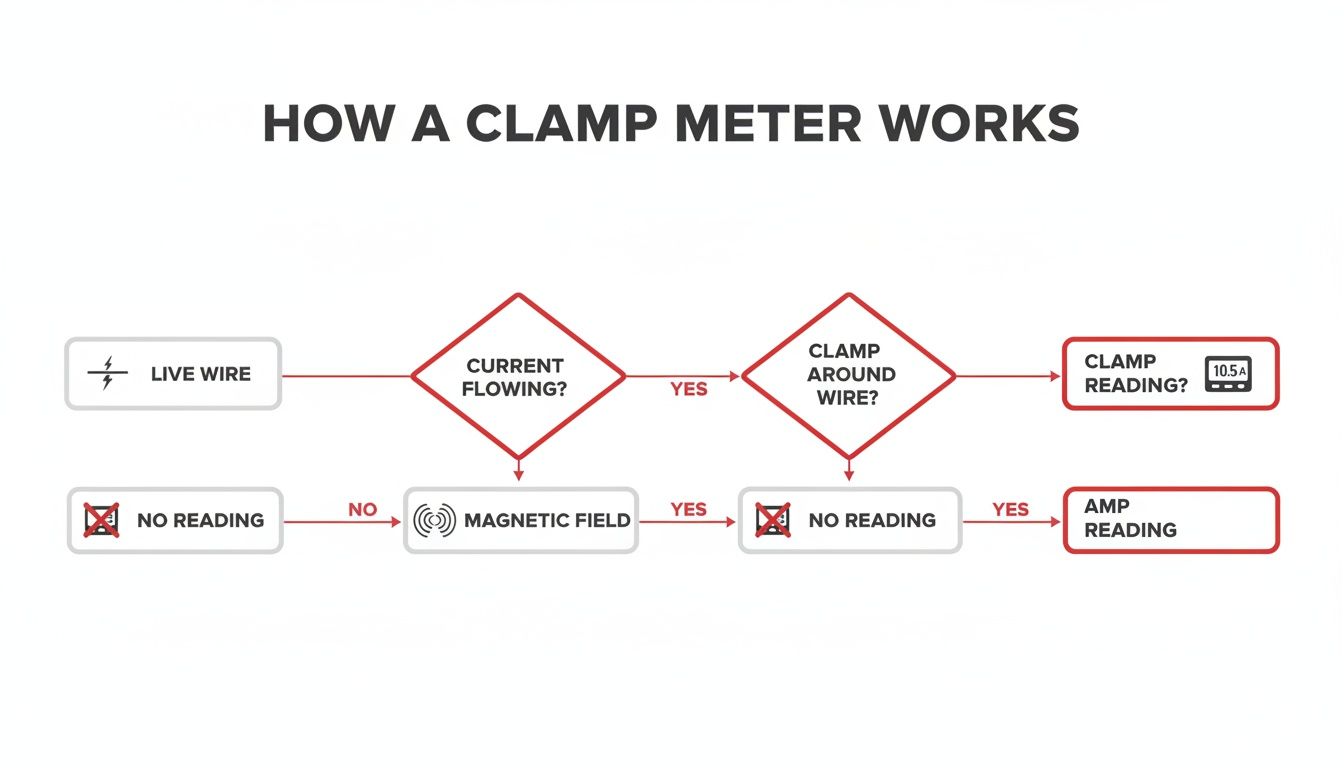
This non-contact method is a significant advantage for keeping operations running in busy facilities.
AC And DC Clamp Meters
The first decision point is whether the meter needs to measure Alternating Current (AC), Direct Current (DC), or both.
- AC Clamp Meters: These are the workhorses for measuring current in standard building wiring, motors, and grid-powered equipment. They operate on the current transformer principle and are generally more budget-friendly.
- AC/DC Clamp Meters: These versatile tools use a Hall Effect sensor to measure both AC and DC current. This dual capability is essential for modern applications like solar PV systems, battery storage, EV charging stations, and industrial circuits with DC power.
For any professional in the GCC working on renewables or advanced automation, an AC/DC clamp meter is a must-have.
The Critical Role Of True RMS (TRMS)
Modern electrical systems, with their Variable Frequency Drives (VFDs), LED lighting, and switch-mode power supplies, often have "dirty" power with distorted electrical waveforms. A standard, non-TRMS clamp meter is only calibrated for perfect sine waves and can produce readings up to 40% inaccurate on distorted circuits.
A True RMS (TRMS) clamp meter uses advanced electronics to accurately calculate the "true root mean square" value of any waveform. For any panel builder or maintenance engineer in the UAE, a TRMS meter is the only way to get trustworthy readings.
Specialized Clamp Meters For Advanced Diagnostics
For some jobs, standard current measurement is not enough. While you can learn more about basic differences in our article comparing a multimeter vs. a clamp meter, these advanced clamp meters offer unique capabilities.
- Power Quality Analyzers: These diagnostic powerhouses detect complex issues like harmonics, power factor problems, and voltage sags, invaluable for energy audits and troubleshooting persistent equipment failures.
- Earth Leakage Clamp Meters: These high-sensitivity meters detect tiny currents (in the milliamp range) leaking to ground, which is critical for identifying potential shock hazards and verifying grounding system integrity in switchgear and solar arrays.
Comparison Of Clamp Meter Types And Their Primary Applications
This table helps you match the instrument to your day-to-day tasks.
| Clamp Meter Type | Primary Measurement | Key Feature | Common Application In GCC |
|---|---|---|---|
| AC Clamp Meter | Alternating Current (AC) | Simple and affordable for standard grid power. | Routine electrical checks in commercial and residential buildings. |
| AC/DC Clamp Meter | AC and Direct Current (DC) | Hall Effect sensor for both AC/DC measurement. | Solar panel installations, battery systems, EV charging stations. |
| True RMS (TRMS) Meter | Accurate AC Voltage/Current | Measures true value of non-sinusoidal waveforms. | Troubleshooting circuits with VFDs, LEDs, and electronics. |
| Power Quality Analyzer | Harmonics, Power Factor | Advanced diagnostics for power system health. | Energy audits, diagnosing equipment failures in industrial plants. |
| Earth Leakage Meter | Milliamp-level Leakage Current | High sensitivity for detecting small ground fault currents. | Safety testing and verifying grounding in switchgear and panels. |
Whether performing basic checks or deep analysis, this guide will help you select a clamp meter that delivers accurate, safe, and reliable results.
Decoding Technical Specs For The GCC Climate
Working in the extreme heat, humidity, and dust of the UAE and KSA requires tools that are exceptionally tough. When selecting a clamp meter, digging into technical specifications is essential for ensuring performance, longevity, and safety.
Non-Negotiable Safety CAT Ratings
The most critical specification is the safety rating. Defined by the International Electrotechnical Commission (IEC) 61010 standard, these "CAT" (Category) ratings indicate where a meter can be safely used, protecting against transient overvoltage events.
- CAT II: For single-phase, plug-in loads like appliances and portable tools.
- CAT III: For three-phase distribution systems, including commercial lighting, switchgear, and industrial motors. This is the absolute minimum rating for professional work in the UAE.
- CAT IV: For the highest-risk zone at the source of a low-voltage installation, such as utility service entrances and main conductors.
For a panel builder in Dubai or a technician in Abu Dhabi, a meter rated CAT III 600V or higher is a fundamental safety requirement. Using an underrated meter in a high-energy environment can lead to catastrophic failure and serious injury.
Surviving The Environment With IP Ratings
The GCC climate is harsh on equipment. An Ingress Protection (IP) rating indicates a tool's durability against dust and moisture.
An IP rating has two digits:
- First Digit (Solids): Rates protection against solids. A rating of 5 means the device is "dust protected."
- Second Digit (Liquids): Rates protection against moisture. A rating of 4 means it’s protected from splashing water.
A clamp meter with an IP54 rating is well-suited for a Riyadh construction site or a Dubai industrial facility, ensuring airborne dust and moisture do not compromise its internal components. This is a key consideration for any high-quality energy meter GCC projects require.
Accuracy, Resolution, And Jaw Size
Beyond safety and durability, three other specifications determine a clamp meter's usability.
- Accuracy: How close the reading is to the true value, typically shown as a percentage like ±2%. Lower percentages indicate better accuracy.
- Resolution: The smallest change the meter can detect (e.g., 0.01A or 1mA). High resolution is needed for troubleshooting low-current circuits.
- Jaw Size: A practical consideration. A larger jaw opening is needed for thick industrial cables, while a smaller, tapered jaw is better for crowded control panels.
By carefully evaluating these specs, procurement managers and engineers across the GCC can choose a clamp meter that handles the demanding work environment and delivers safe, accurate measurements.
Real-World Clamp Meter Uses In The UAE
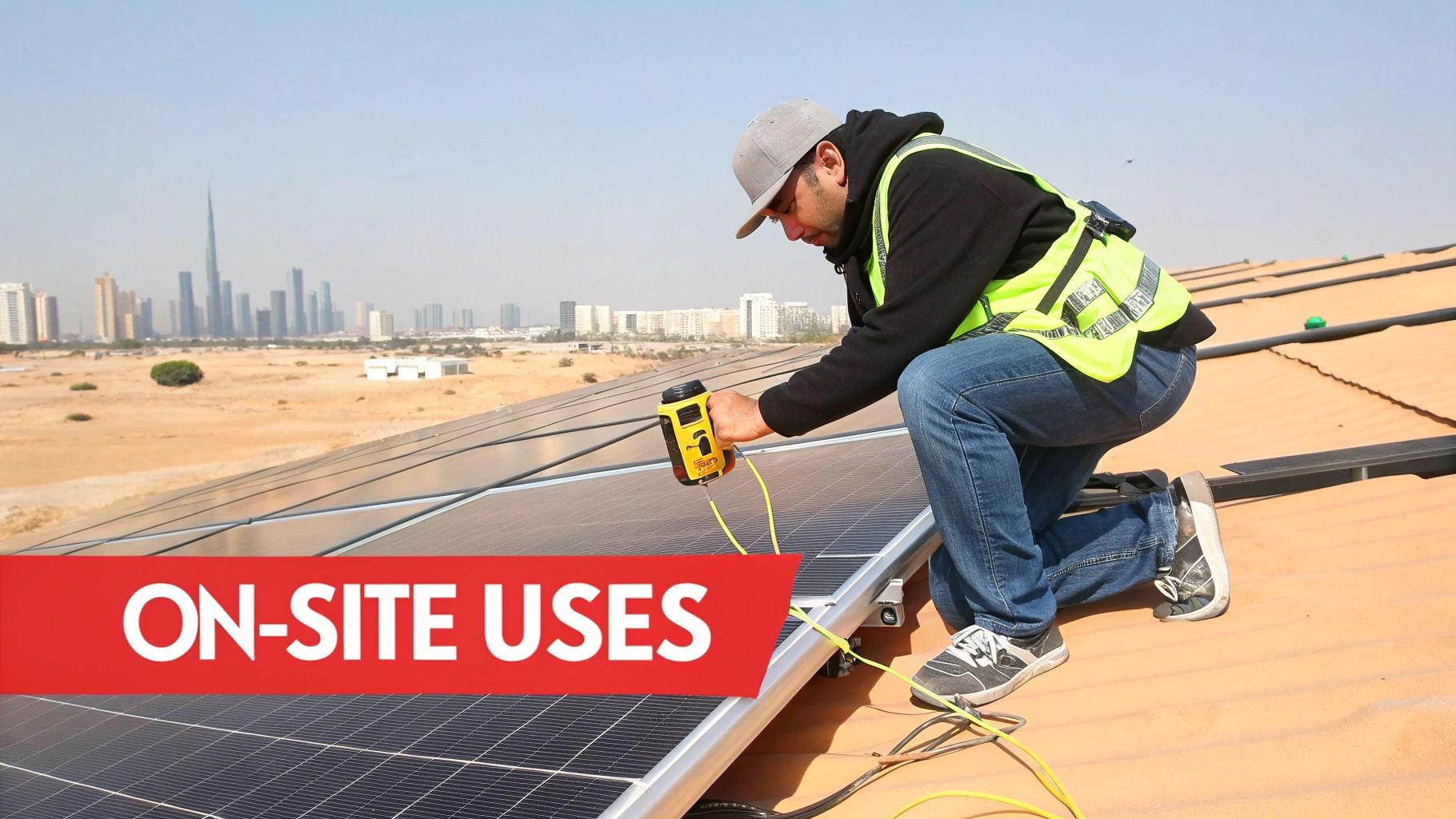
The true test of a clamp meter is its performance in the field. Across the UAE's demanding project sites, this tool becomes a problem-solving powerhouse, providing the instant data needed to keep operations running safely and smoothly.
Scenario 1: Load Balancing a Switchgear Assembly In Dubai
A panel builder in Jebel Ali must ensure the electrical load is balanced across all three phases of a new switchgear assembly. An imbalance can lead to overheating, inefficient motor operation, and premature equipment failure.
Using a True RMS clamp meter with a Min/Max hold function, the builder measures each phase conductor under a simulated peak load:
- Phase A: Reads 185A
- Phase B: Reads 190A
- Phase C: Reads 215A
The meter flags a serious imbalance on Phase C, allowing the team to reconfigure circuits before handover. This quick, non-contact check prevents future problems, ensures compliance with DEWA standards, and saves hours of potential rework.
Scenario 2: Diagnosing an HVAC Compressor Failure In Abu Dhabi
An HVAC technician is called to a commercial tower in Abu Dhabi where a rooftop chiller unit keeps tripping its breaker on startup. The technician uses a clamp meter with an inrush current function to capture the massive current surge during motor startup.
He clamps the motor's power line and initiates startup. The meter freezes the peak reading at 450A, significantly higher than the motor's rated Lock-Rotor Amps (LRA) of 380A. This confirms a mechanical issue, not an electrical fault, providing a definitive diagnosis in minutes.
The inrush current function is a game-changer for motor diagnostics, providing hard proof of startup stress and differentiating between electrical and mechanical faults.
Scenario 3: Troubleshooting a Solar PV Inverter Near Riyadh
On a solar farm near Riyadh, an engineer investigates an underperforming string of panels. She uses an AC/DC clamp meter to measure the DC current flowing from the string to the inverter. After zeroing the meter to cancel stray magnetic fields, she measures the suspect string at 7.2A. An adjacent healthy string reads 8.5A.
This simple comparison confirms the problem is isolated to that string, allowing her to focus her troubleshooting efforts. For a deeper dive, see our guide on using clamp meters for solar PV diagnostics. Professionals like ACDI Energy Services rely on such precise data for diagnostics and efficiency audits.
These real-world examples demonstrate why the clamp meter is a cornerstone of modern electrical work in the GCC.
Your GoSwitchgear Clamp Meter Buying Checklist
Choosing the right clamp meter is an investment in safety, accuracy, and efficiency. For engineers and procurement teams in the UAE, this checklist helps ensure you select the right tool for the demanding environments across the GCC.
1. Safety and Environmental Suitability
Safety and durability are paramount, especially in the region's tough conditions.
- What's the CAT Rating? For switchgear, industrial machinery, or commercial panels, CAT III 600V is the minimum. For utility-side work, CAT IV is required.
- How's the IP Rating? An IP54 rating offers solid protection against dust and moisture on sites in Dubai or humid coastal facilities, a key feature for durable energy meters.
2. Performance and Measurement Needs
Match the meter's capabilities to your electrical systems.
- Do You Really Need True RMS (TRMS)? If you work with VFDs, LED lighting, or other non-linear loads, yes. A TRMS meter is essential for accurate readings from distorted AC waveforms.
- Is AC/DC Capability a Must-Have? For solar PV, battery storage, and EV charging projects across the UAE and KSA, an AC/DC clamp meter is necessary.
- What Jaw Size is Practical? Balance the need for jaws that fit around large industrial conductors with the need for a smaller, tapered jaw for crowded panels.
3. Accuracy and Specialized Functions
Select features that enhance diagnostic capabilities.
- Is the Accuracy and Resolution Good Enough? For low-current control circuits, high resolution (e.g., 1mA) is needed. Ensure the accuracy (e.g., ±1.5%) meets your diagnostic standards.
- Which Special Functions Will You Actually Use? An inrush current function is invaluable for motor diagnostics. A Min/Max hold feature helps catch intermittent fluctuations. An energy management solution Dubai often relies on these advanced capabilities.
Using this checklist ensures you procure the right tool, empowering your team to work safer and smarter.
If you need personalized advice for your projects in the UAE, the expert team at GoSwitchgear is ready to help.
Frequently Asked Questions About Clamp Meters
For electrical professionals in the UAE, getting straight answers to practical questions is key to choosing and using the right clamp meter safely.
What Is The Main Difference Between A Clamp Meter And A Multimeter?
The primary difference is how they measure current. A multimeter must become part of the circuit, requiring a shutdown and physical connection. A clamp meter is non-invasive; you simply clamp its jaws around a single wire for an instant current reading without interrupting power. While most modern clamp meters include multimeter functions, their main advantage is this non-contact current measurement.
How Often Should I Calibrate My Clamp Meter In The GCC?
In the challenging GCC climate, annual calibration is the industry best practice. The combination of heat, humidity, and dust can cause internal components to drift, affecting accuracy. For critical jobs in sectors like oil and gas or utilities, a six-month calibration cycle is often required. Always follow manufacturer recommendations and project-specific requirements.
Can I Use A Clamp Meter To Measure DC Current From Solar Panels?
Yes, but you must use the right type of clamp meter. A basic AC-only model will not work. To measure DC output from solar panels or battery banks, you need an AC/DC clamp meter with a Hall Effect sensor.
Follow these steps for an accurate DC measurement:
- Set the dial to DC Amps (DCA).
- Before clamping, press the "Zero" or "REL" button to cancel out stray magnetic fields.
- Clamp the jaws around a single conductor (positive or negative, not both).
This process ensures a precise measurement of your solar array's current production.
Conclusion: Equip Your Team for Success
For engineers, panel builders, and electricians in Dubai, Abu Dhabi, and across the GCC, the right clamp meter is more than a tool—it's a cornerstone of safe, efficient, and reliable electrical work. By prioritizing safety ratings (CAT III/IV), environmental durability (IP54), and essential features like True RMS and AC/DC capability, you equip your team to handle the region's unique challenges. A quality clamp meter from a trusted supplier of electrical components UAE businesses rely on, like GoSwitchgear, is a direct investment in project success and operational excellence.
For expert guidance and to explore our range of professional clamp meters tailored for the demands of the UAE and KSA markets, contact our team for project support in Dubai.
Share this post

Related
Posts
Selecting the Right Circuit Breaker Types for UAE & GCC Projects
Explore a complete guide to circuit breaker types (MCB, MCCB, ACB, VCB). Learn how to select the right breaker for...
What Is Switchgear and Why It’s Essential for Power Systems in the UAE & GCC
Learn what is switchgear from this expert guide for UAE engineers. We explain its components, types, and how it protects...
Optimizing Energy Meter Selection for UAE & GCC Projects
The ultimate guide for UAE engineers on selecting the right HDMI Type A to C solutions for AV systems and...
Mastering EV Infrastructure: How to Choose the Right Car Charging Adapters for UAE & GCC Projects
Your expert guide to car charging adapters in the UAE. Learn how to select, install, and specify the right adapters...
.jpg)