.jpg)


Posted by:
Category:
Comments:
Post Date:
Electric Car Charger Installation: An Engineer’s Guide for the UAE & GCC
Successful electric car charger installation in the UAE demands more than connecting wires. It requires meticulous planning, selecting components resilient enough for the GCC climate, and strict adherence to local utility standards. For engineers, panel builders, and procurement teams, mastering this process from site assessment to commissioning is critical for delivering safe, reliable, and compliant energy management solutions in Dubai and beyond.
Meeting the UAE's Growing Demand for EV Charging
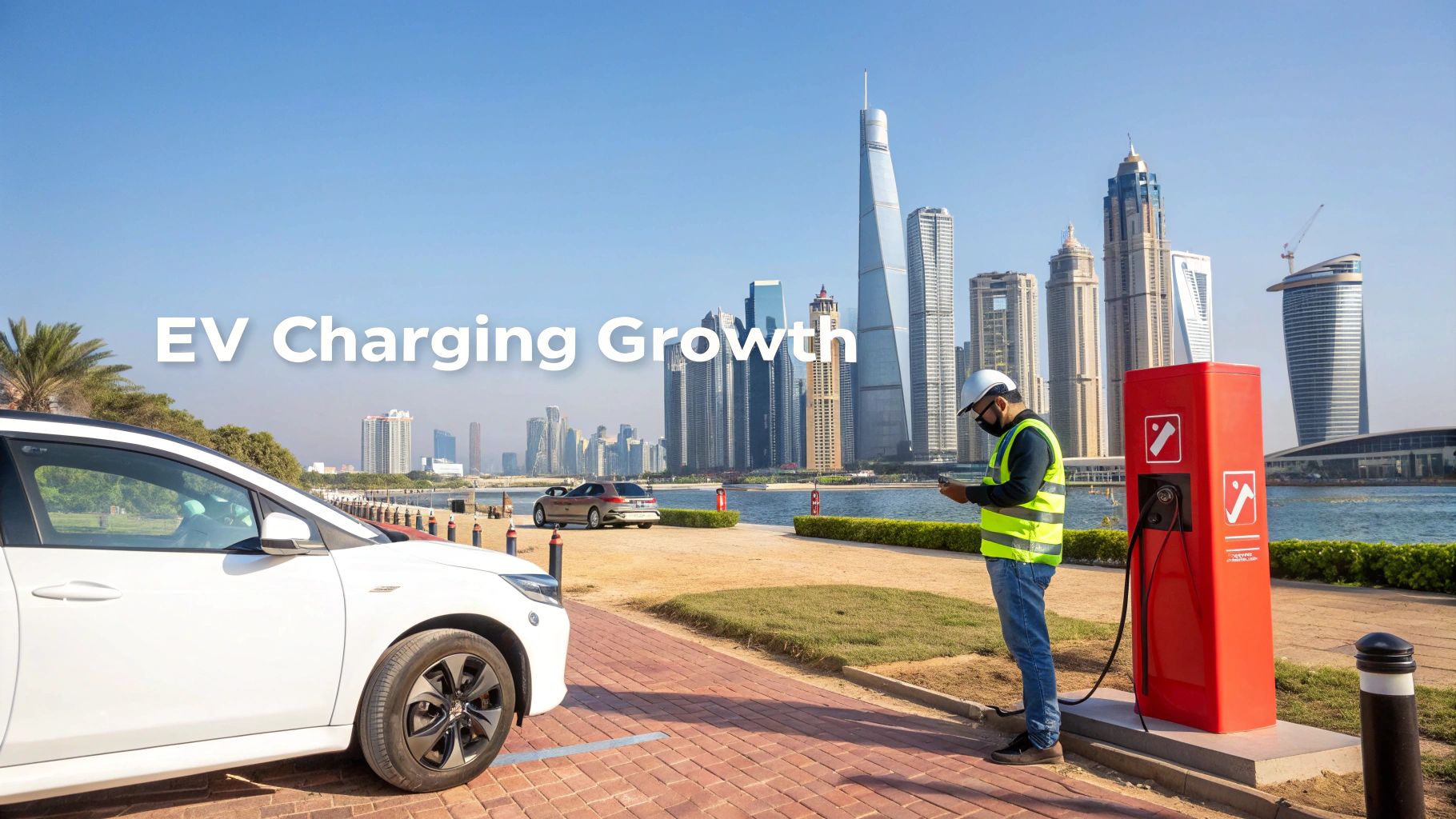
The rapid adoption of electric vehicles across the UAE and KSA is creating significant opportunities for skilled electrical professionals. This growth, particularly in hubs like Dubai and Abu Dhabi, is driving demand for new charging infrastructure in residential towers, commercial facilities, and public spaces.
For engineers, electricians, and procurement teams, this expansion presents unique technical challenges specific to the GCC region. A successful EV charger installation requires a deep, practical understanding of local environmental conditions and regulatory frameworks to ensure long-term performance and safety.
Key Considerations for GCC Installations
Professionals in this field must navigate several critical factors to deliver charging solutions that are safe, compliant, and durable.
- Extreme Climate Resilience: Electrical components must withstand extreme heat, humidity, and dust without performance degradation. High-temperature ratings and appropriate IP ratings (e.g., IP65) are non-negotiable for any electrical components UAE projects utilize.
- Utility Compliance: Every aspect of the installation must align with the strict standards of local authorities like DEWA in Dubai or SEC in Saudi Arabia. This impacts component selection, installation methods, and final testing protocols.
- Future-Proofing: EV technology is constantly evolving. The infrastructure built today must be scalable and adaptable to accommodate higher power demands and advanced energy management systems in the future.
The Middle East EV charging market, valued at approximately USD 250 million in 2022, is projected to reach USD 1.4 billion by 2030. This exponential growth signals a massive increase in demand for both quality installation services and high-grade electrical components. You can explore EV charging market trends and expert insights from the GCC region for more context.
This guide provides the practical expertise needed to address these challenges, walking you through the entire process from initial site assessment to final commissioning.
Performing a Thorough Pre-Installation Site Assessment
Before any hardware is ordered, a meticulous site assessment is essential. This initial step is non-negotiable in the UAE and wider GCC, as it uncovers potential roadblocks within a building's electrical infrastructure that could lead to costly delays and significant safety hazards.
A proper assessment is a technical deep dive into the facility's electrical system, beginning at the Main Distribution Board (MDB). The primary objective is to confirm that the existing system can safely handle the new, continuous load of one or more EV chargers without compromising the power supply to the rest of the building.
Evaluating the Existing Electrical Infrastructure
The first step is to determine the MDB's total capacity and current peak load. This requires collaboration with the facility manager to obtain electrical single-line diagrams and historical consumption data.
Key points to inspect at the MDB include:
- Total Rated Capacity: Visually confirm the ampere rating of the main incoming breaker.
- Available Spare Ways: Ensure there is sufficient physical space in the panel for the new breakers feeding the EV charging circuits, such as a DIN rail isolator.
- Condition of Busbars and Wiring: Inspect for any signs of overheating, corrosion, or degradation—common concerns in the high-humidity climate of the GCC.
A common mistake is simply adding the charger's load to the existing peak demand. A professional assessment requires a forward-looking load calculation, especially for multi-charger installations in commercial settings like a Dubai office tower or an Abu Dhabi hotel.
Performing Accurate Load Calculations
This is the core of the site assessment. The electrical load calculation determines if the building's supply has sufficient spare capacity. EV charging represents a continuous load, placing a sustained demand on the system that differs significantly from intermittent loads of other equipment.
To perform an accurate assessment, follow these steps:
- Measure the Current Peak Load: Use a clamp meter at the MDB during the facility's peak operational hours to get a real-world measurement of demand.
- Calculate the New Total Load: Add the full rated load of the planned EV charger(s) to the measured peak load. For multiple chargers, a diversity factor may be applicable, but always consult local utility guidelines (e.g., DEWA) for permissible values.
- Apply a Safety Margin: The calculated new total load should not exceed 80% of the main breaker's rated capacity. This 20% buffer is crucial for preventing overloads and allowing for future expansion.
For a more detailed methodology, our guide on electrical load calculation provides specific steps for designing a safe and compliant system.
Choosing Resilient Electrical Components for GCC Conditions
The success of any electric car charger installation in the demanding climate of the UAE and GCC hinges on component quality. Hardware that performs well in milder climates can fail prematurely when exposed to intense heat, humidity, and airborne dust. For engineers and electricians in Dubai and Abu Dhabi, selecting the right electrical components is about ensuring long-term safety and reliability.
Prioritize hardware specifically engineered for harsh environments. Sourcing from a trusted supplier like GoSwitchgear provides access to components vetted for these conditions. Your checklist must include devices with superior thermal performance and robust physical protection against dust and moisture (high IP ratings).
Essential Protection Devices for EV Charging Circuits
A well-designed EV charging circuit relies on a coordinated team of protection devices: Miniature Circuit Breakers (MCBs), Residual Current Devices (RCDs), and Surge Protection Devices (SPDs).
Miniature Circuit Breakers (MCBs): The first line of defense against overcurrents and short circuits. For the continuous, heavy load of EV charging, a C-type trip curve MCB is required. It handles the initial inrush current without nuisance tripping while providing necessary protection. The MCB must be derated for high ambient temperatures as per IEC 60898 guidelines.
Residual Current Devices (RCDs): These devices are critical for protecting individuals from electric shock by detecting earth fault currents. Their selection is vital for EV chargers, as the vehicle's inverter can introduce DC leakage currents into the AC system.
Surge Protection Devices (SPDs): An SPD is non-negotiable for protecting the sensitive electronics in both the charger and the vehicle. It guards against voltage spikes from lightning or grid switching events, preventing costly damage.
These protective devices require a stable power source. For complex installations with control logic, a high-quality SMPS power supply is essential. Learn more about selecting the right power supply in the UAE to ensure consistent performance.
Demystifying RCD Selection: Type A vs. Type B
Choosing between a Type A and Type B RCD is a critical design decision. While many modern chargers include built-in 6mA DC fault detection, relying solely on this feature may not meet local regulations or offer the highest level of safety.
A Type A RCD detects standard AC and pulsating DC fault currents. However, it can be "blinded" by smooth DC fault currents above 6mA, which can be generated by an EV's power electronics. This blinds the RCD, preventing it from tripping during a subsequent AC fault.
A Type B RCD is the definitive energy management solution Dubai professionals should specify. It is designed to detect AC, pulsating DC, and smooth DC fault currents, offering comprehensive protection under all fault conditions and ensuring compliance with the strictest IEC standards.
RCD Selection Guide for EV Charger Installations
This table compares the RCD types to guide specification and procurement for EV charger installations, which are an increasingly common type of energy meter GCC projects require.
| RCD Type | Protection Against | Typical Application | Compliance Note |
|---|---|---|---|
| Type A | AC and Pulsating DC Faults | Standard circuits, or EV chargers with certified internal 6mA DC protection. | Permissible only if the charger's datasheet confirms DC fault detection as per IEC 62955. Always verify with manufacturer data. |
| Type B | AC, Pulsating DC, and Smooth DC Faults | The gold standard for all EV charger installations, especially where internal protection is unverified or for maximum safety assurance. | Guarantees the highest level of safety and compliance with IEC 61851-1 for EV charging systems. |
While a Type A RCD may be permissible in specific scenarios, specifying a Type B RCD eliminates uncertainty and ensures the highest level of protection against all potential electrical faults.
Proven Techniques for Wiring, Mounting, and Panel Integration
With the planning complete, the physical electric car charger installation begins. This stage demands precision to create a safe, reliable, and durable system, particularly in the challenging GCC climate. Every detail, from cable sizing to terminal torque, is critical.
A common performance-killing mistake is improper cable sizing. For a standard 7kW Level 2 charger on a short run, a 6mm² cable is often sufficient. However, for longer runs—such as in a large Dubai commercial property where the panel is over 30 metres from the parking bay—voltage drop becomes a significant issue. In these cases, upgrading to a 10mm² cable is necessary to prevent overheating and ensure the charger delivers its rated power.
Secure Mounting in High-Traffic and Outdoor Areas
Mounting the charger must account for potential vehicle impacts and relentless environmental stress.
Follow these best practices for installations in car parks or outdoor areas:
- Use Robust Fixings: Always use corrosion-resistant stainless steel anchor bolts or concrete screws appropriate for the mounting surface.
- Install Protective Bollards: In areas with vehicle traffic, installing steel bollards in front of the charger is a low-cost measure to prevent expensive accidental damage.
- Ensure Proper Enclosure Sealing: To combat dust and moisture ingress, seal every cable entry on the charger and its control panel with a correctly sized, IP65 or higher-rated cable gland. This is a non-negotiable step in the UAE.
Panel Integration and Protection Device Layout
The dedicated distribution board (DB) for the EV charger is the heart of the safety system. A clean, logical layout is essential for safe operation, easy maintenance, and efficient troubleshooting.
This diagram illustrates the mandatory protection sequence.
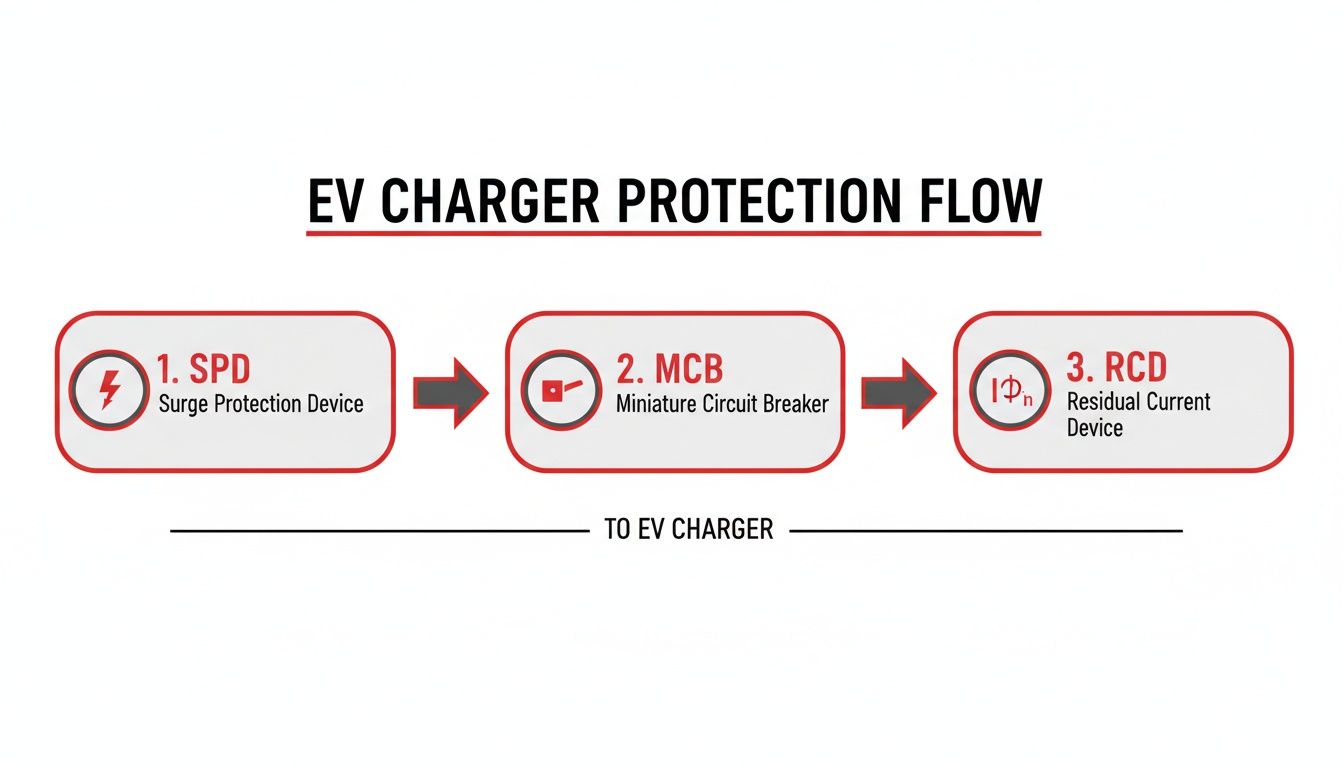
Power flows sequentially through the SPD (surges), MCB (overcurrents), and RCD (earth faults), creating layered protection for both the user and the equipment.
Arrange components in the panel to follow this logical power flow (e.g., top-to-bottom or left-to-right). The main isolator should be first, followed by the SPD, MCB, and finally the RCD feeding the charger.
A crucial best practice is to use a torque screwdriver. Under-tightened connections create high resistance and are a significant fire risk. Over-tightening can damage the terminal or conductor. Always use a calibrated torque screwdriver and adhere to the manufacturer's specifications for every connection.
Finally, label every breaker, terminal, and cable clearly and durably, matching the electrical drawings. This transforms future maintenance from a complex problem into a straightforward task.
A Guide to Commissioning Testing and Final Handover
The commissioning and testing protocol is the final, critical stage of a professional electric car charger installation. This phase verifies that the system is safe, fully compliant with UAE standards, and ready for client use. Skipping these tests introduces serious liability and compromises long-term reliability.
The process involves a strict series of electrical tests to validate the integrity of the installation. The results of each test must be recorded in compliance and handover documentation, confirming that all protective devices function as designed.
Essential Electrical Safety Tests
Before energizing the charger, a sequence of 'dead' and 'live' tests must be conducted to validate the circuit's safety from the DB to the charger terminals.
Key tests include:
- Insulation Resistance Test: This test verifies the integrity of cable insulation between conductors. A low reading indicates damaged cabling, a serious fire hazard. Learn more about the specific procedures and acceptable readings for an insulation resistance test.
- Earth Loop Impedance (Zs) Test: This confirms that in the event of a fault, sufficient current will flow to trip the protective device in time. A high Zs reading indicates a poor earth connection, rendering protective devices ineffective.
- RCD Trip Time & Current Test: This is arguably the most important test for user safety. A controlled fault current is injected to confirm the RCD disconnects power within the milliseconds specified by IEC standards, protecting users from potentially fatal electric shock.
Documenting these test results is mandatory. A formal commissioning certificate with the recorded values for each test serves as proof of a compliant, professional installation for both the client and regulatory bodies like DEWA.
Functional Checks and Client Handover
After confirming electrical safety, conduct functional testing. Simulate a charging session using a dedicated EV charger tester or an actual electric vehicle to verify that the charger communicates correctly, initiates charging smoothly, and terminates the session safely.
The final handover to the client should include a clear demonstration of the charger's operation, an explanation of status indicators, and a review of safety features. Provide the client with the commissioning certificate and user manual to ensure they are confident and well-informed.
A Few Common Questions About EV Charger Installations
Engineers, electricians, and project managers across the UAE and GCC often have specific questions during an electric car charger installation. Here are answers to some of the most frequent queries.
What Are the Main Regulatory Standards in Dubai?
In Dubai, all installations must strictly adhere to the Dubai Electricity and Water Authority (DEWA) "Regulations for Electrical Installations" and their specific guidelines for EV charging equipment.
Additionally, components must meet relevant International Electrotechnical Commission (IEC) standards, primarily IEC 61851, which covers the EV charging system. Using DEWA-approved contractors and materials ensures a smooth inspection and connection process.
Is a Type B RCD Always Necessary?
While not universally mandatory, using a Type B RCD is strongly recommended as a best practice for maximum safety.
Some newer EV chargers feature built-in 6mA DC fault current detection. If the charger's datasheet explicitly confirms this feature and compliance with IEC 62955, a Type A RCD may be permissible. However, if this cannot be verified, a Type B RCD is the only way to ensure complete protection against smooth DC residual currents. It is the safest and most future-proof option.
How Should I Calculate Power for Multiple Chargers?
For commercial sites with multiple chargers, simply summing the maximum load of each unit is impractical. A load diversity calculation is required.
First, determine the building's total available power. Then, apply a diversity factor based on the expected concurrent usage. For an office car park, you might estimate that only 40-60% of chargers will be active simultaneously during peak hours. This calculation is critical for sizing the main feeder cable and determining if a load management system or a supply upgrade is needed. Always consult local utility guidelines for permissible diversity factors.
At GoSwitchgear, we provide the robust, compliant electrical components UAE professionals need for flawless EV charging projects. From Type B RCDs to surge protection and all the necessary energy meters, our inventory is tailored for the demands of the GCC region.
Share this post

Related
Posts
How to Choose the Right Power Cord Extension for UAE Industries & Construction
Your guide to selecting a safe, compliant, and durable power cord extension in the UAE. Learn key specs, ratings, and...

How to Choose the Right Lock Out Tag Out Locks for UAE & GCC Industries
Master workplace safety with our guide to lock out tag out locks. Learn types, standards, and best practices for engineers...
Selecting and Implementing Emergency & Exit Lights in the UAE & GCC
Explore emergency & exit lights in 2026: codes, placement, and maintenance tips to boost safety and compliance.
A Professional’s Guide to Specifying the Ariston Water Heater 80 Liters in the UAE
Discover the essential specs, installation best practices, and maintenance needs for the Ariston water heater 80 liters, tailored for UAE...
.jpg)