.jpg)


Posted by:
Category:
Comments:
Post Date:
Choosing the Right Fluke Clamp Meter for UAE & GCC Professionals
For any electrical professional working in the UAE and the wider GCC, a Fluke clamp meter isn't just another tool—it’s a lifeline. In a region defined by extreme heat, demanding infrastructure, and zero tolerance for downtime, these devices provide the safe, non-contact measurements needed to keep complex electrical systems running flawlessly.
The Indispensable Tool for UAE Electrical Systems
Working conditions in the UAE and GCC are tough. Between extreme heat, pervasive dust, and complex electrical infrastructures, engineers, panel builders, and electricians cannot afford to use second-rate tools. Reliable and safe measurement equipment is a necessity, and this is where Fluke clamp meters shine, delivering performance tailored for the region's challenges.
The pace of development across Dubai, Abu Dhabi, and KSA means electrical systems are more sophisticated than ever. In high-rise towers with intricate energy management systems and massive industrial plants, the ability to pinpoint an electrical issue quickly and accurately is critical to avoiding costly downtime.
Fluke clamp meters are built for the GCC climate. Their high IP ratings mean they are designed to keep out dust and humidity, ensuring consistent, trustworthy readings when other tools might fail under pressure.
This built-in resilience is why Fluke has become the industry standard. Choosing a Fluke isn't just a preference; it's a strategic decision to boost efficiency and safeguard expensive assets. The market reflects this, with regional demand driven by sectors like switchgear assembly and energy management solutions in Dubai. This growth aligns with the region's massive infrastructure and renewable energy projects. You can dive deeper into these trends in this report on industrial digital clamp meter trends.
Here at GoSwitchgear, we understand these local challenges. That’s why we stock a full range of Fluke clamp meters, ensuring you have the right tool for any job—whether you're a panel builder in Dubai or running facility maintenance in Abu Dhabi.
How Clamp Meters Pull Off Non-Contact Measurements
The core benefit of a Fluke clamp meter is its ability to measure current safely and quickly, without ever having to cut wires or shut down a circuit. This process hinges on a principle called electromagnetic induction, and understanding it is key to appreciating why these tools are so reliable for electrical professionals in the UAE.
Every wire carrying a current generates a surrounding magnetic field. Fluke clamp meters are designed to "read" this field with exceptional precision. The hinged jaw contains carefully wound ferrite cores that act as a current transformer.
When you clamp the jaw around a single live wire, these cores concentrate the wire's magnetic field. The meter instantly translates the field's intensity into a precise amperage reading on its digital display, providing the data needed for an effective energy management solution.
Measuring Both AC and DC Currents
Electromagnetic induction is perfect for alternating current (AC), but it does not work for direct current (DC), as a steady DC flow doesn't create the changing magnetic field needed for a reading.
To solve this, advanced Fluke models integrate a highly sensitive Hall Effect sensor into the jaw. This technology can detect the static magnetic field produced by DC current, making the meter a versatile workhorse.
This dual-technology approach is essential for any technician in the UAE and GCC working on:
- Solar Power Systems: Measuring DC output from photovoltaic panels.
- Battery Storage Units: Diagnosing current flow in energy storage solutions.
- Electric Vehicle (EV) Charging Stations: Servicing DC components in fast-charging infrastructure.
- Industrial Control Panels: Troubleshooting DC control circuits without causing expensive downtime.
This capability is crucial given the unique electrical landscape professionals in the region navigate daily.
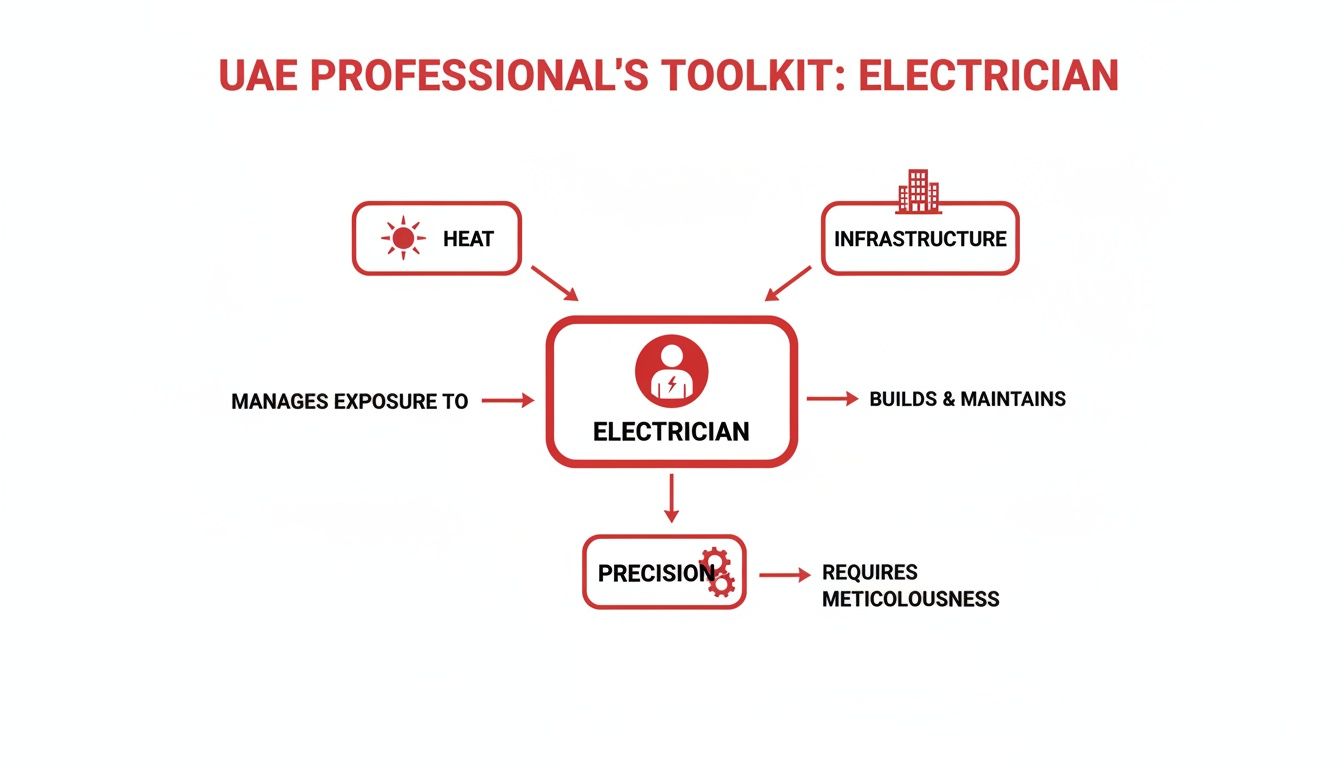
As the infographic shows, factors like intense heat, modern infrastructure, and the absolute demand for precision shape the toolkit for an electrician in the UAE.
The Importance of Clamping Just One Wire
Here’s a critical best practice: for an accurate measurement, you must clamp only one conductor at a time. Clamping around a multi-core cable with both live and neutral wires will cause their opposing magnetic fields to cancel each other out, resulting in a zero reading.
By mastering the simple act of isolating a single conductor, you leverage the sophisticated engineering within your Fluke clamp meter to get fast, reliable, and safe readings every time. This foundational skill separates accurate diagnostics from frustrating guesswork.
This simple rule highlights the smart, user-focused design of Fluke tools. The technology is complex, but the process is straightforward and, most importantly, safe.
To better understand how this tool fits into your kit, see how it compares to other devices in our guide on the differences between a multimeter and a clamp meter.
Decoding the Features That Matter Most in the UAE
While every Fluke clamp meter is robust, certain features are mission-critical for working in the UAE and the wider GCC. The electrical landscapes in Dubai, Abu Dhabi, and KSA are packed with modern, complex systems where basic measurements are no longer sufficient.
Understanding these advanced functions is what distinguishes a good technician from a great one. These aren't just specs on a datasheet; they are your tools for solving real-world problems in high-rise towers, industrial plants, and large commercial centers.
Let's break down the features that truly matter for professionals in the region.
True-RMS: The Only Way to Measure Modern Loads
Clean sine waves are a rarity in today's facilities. Electrical systems are filled with non-linear loads—variable frequency drives (VFDs), computer power supplies (like an SMPS power supply), and large-scale LED lighting grids. These components distort the AC waveform, creating significant electrical "noise."
Using an old, average-responding meter on these systems can result in readings that are off by as much as 40%. This margin of error leads to incorrect diagnoses, unnecessary parts replacement, and costly callbacks.
A True-RMS (Root Mean Square) clamp meter is non-negotiable for any serious professional in the region. It provides the true heating value of any AC waveform, delivering reliable data essential for maintaining a modern smart building or industrial plant in Dubai.
Inrush Current: Pinpointing Motor Startup Problems
Large motors are ubiquitous, especially in the HVAC systems battling the GCC's climate. When these motors start, they draw a massive surge of inrush current, which can be many times the normal running load and a common cause of nuisance tripping.
The inrush function on a Fluke clamp meter is designed to capture this split-second surge precisely. For a panel builder or maintenance engineer, this is an invaluable diagnostic tool for:
- Verifying Motor Health: Confirming startup current is within specified limits.
- Sizing Protection Correctly: Ensuring breakers and fuses can handle the initial surge without unnecessary tripping.
- Troubleshooting Nuisance Trips: Differentiating between a faulty motor and an undersized breaker.
Jaw Size and Shape: Getting the Right Fit for the Job
Working inside a packed industrial switchgear panel in Dubai requires the right tool for the space. The physical size of your clamp meter's jaw is a critical feature.
A jaw that’s too small won't fit around large feeder cables or busbars. Conversely, a jaw that's too large can be clumsy in tight spaces. Fluke offers a range of jaw sizes and shapes to fit any job, from compact jaws for tight spots to large ones for industrial feeders. The right fit ensures a secure, accurate reading without a struggle.
Fluke Clamp Meter Feature Application Guide for UAE Professionals
This quick-reference table connects key Fluke features to common challenges faced by electricians and engineers across the GCC.
| Feature | What It Measures | Primary Application in the UAE/GCC | Recommended Fluke Series |
|---|---|---|---|
| True-RMS | The actual effective value of distorted AC voltage and current. | Accurately measuring loads from VFDs, LED lighting, and switch-mode power supplies found in modern buildings. | Fluke 370 FC Series |
| Inrush Current | The peak current surge during motor or equipment startup. | Diagnosing nuisance trips and verifying the health of large HVAC motors, pumps, and compressors. | Fluke 376 FC, 381 |
| Flexible Probe | High AC current in tight or awkwardly shaped conductors. | Measuring current in crowded switchgear panels or on large, parallel conductors where a rigid jaw won't fit. | Fluke 370 FC Series |
| AC/DC Current | Both alternating and direct current measurements up to 1000A or more. | Troubleshooting DC motors, battery banks, UPS systems, and solar power installations common in the GCC region. | Fluke 375 FC, 376 FC |
| LoZ (Low Z) | Voltage on circuits with potential "ghost" voltages. | Differentiating between stray voltage and a truly energized circuit, preventing misdiagnosis in complex control panels. | Fluke 376 FC, 381 |
| CAT IV Rating | Provides the highest level of transient voltage protection. | Safely working at the service entrance, on utility lines, or anywhere with a direct connection to the power grid. | Fluke 376 FC, 381 |
This table helps you quickly identify the best tool for your specific electrical environment, ensuring you have the right capability for the job.
CAT Ratings: Your First Line of Defense
The single most important feature of any test tool is its safety rating. The CAT (Category) rating indicates the electrical environment the meter can safely handle, specifically its ability to withstand a high-voltage transient—a sudden, dangerous energy spike. Using a meter with the wrong CAT rating is a massive, unnecessary risk.
For any professional working in the UAE, these ratings are crucial:
- CAT III: This is your workhorse rating for three-phase distribution systems like commercial lighting panels, industrial switchgear, and large motors. A CAT III 600V or 1000V rating is the absolute minimum for most jobs.
- CAT IV: This is the highest level of protection, designed for measurements taken at the source of the installation, including service entrances and utility meters.
Always choose a clamp meter with a CAT rating that meets or exceeds the demands of your worksite. Our team at GoSwitchgear can help you select a tool compliant with local standards and, most importantly, keeps you safe.
Finding Your Fit: A Guide to the Fluke Clamp Meter Series
Picking the right tool is the first step to getting the job done safely and accurately. With so many fluke clamp meters available, we've created this breakdown for procurement teams and field professionals across the UAE to make an informed decision.
GoSwitchgear stocks Fluke's core product families, each designed for specific applications—from simple daily checks to in-depth diagnostics in Dubai's most advanced facilities. Understanding the differences is key to a smart purchase.
Let's examine the models most relevant to the GCC market.
The Fluke 320 Series: The Everyday Workhorse
For routine electrical tasks, the Fluke 320 Series is the undisputed champion. It’s compact, tough, and reliable—the perfect meter for commercial and light industrial electricians who need a go-to tool for frontline troubleshooting.
The 320 series provides solid, True-RMS measurements for basic current and voltage checks. It's straightforward and built to last.
Models like the Fluke 323, 324, and 325 are found in tool bags across the region for good reason. They handle essential tasks like verifying loads and checking circuit continuity during routine maintenance.
- Ideal User: Residential and commercial electricians, facility maintenance technicians.
- Common Applications in the UAE: Verifying circuit loads in residential towers, troubleshooting HVAC control circuits, and general electrical maintenance.
- Key Strength: Simplicity and reliability in a durable, ergonomic package.
This series is the best entry point into the Fluke ecosystem for professional-grade performance in daily work.
The Fluke 370 FC Series: Advanced Diagnostics with Fluke Connect
When a simple reading isn't enough, the Fluke 370 FC Series is the solution. These meters are built for professionals working on complex systems in industrial plants, data centers, and the smart buildings emerging across the GCC. The key feature is Fluke Connect®, a wireless system that transmits measurements directly to a smartphone or tablet.
This is a major leap in safety and efficiency. A technician can clamp the meter inside a high-energy panel, close the door, and monitor readings from a safe distance. It's also ideal for data logging to identify intermittent faults in sophisticated control systems. In fact, adoption of Fluke's 376 FC True RMS Clamp Meter increased among UAE facility managers due to its wireless capability for troubleshooting in high-rise buildings. Read more about the growth of industrial digital clamp meters.
For panel builders and system integrators in Dubai and Abu Dhabi, the Fluke 370 FC series is invaluable. It enables remote monitoring and data sharing, which streamlines commissioning and makes collaborative troubleshooting safer and more effective.
The series also includes models with the iFlex® flexible current probe, a lifesaver for measuring large or awkwardly shaped conductors where a rigid jaw won't fit. Explore our complete collection of advanced Fluke clamp meters to find the right model for your diagnostic needs.
The Fluke 902 FC HVAC Clamp Meter: A Specialist's Tool
The HVAC industry in the UAE presents unique challenges that demand specialized tools. The Fluke 902 FC True-RMS HVAC Clamp Meter was designed specifically for these demands, combining standard clamp meter functions with features every HVAC technician needs.
With this single tool, you can diagnose and repair HVAC systems faster by measuring:
- AC/DC Current and Voltage: For motors, compressors, and control circuits.
- Resistance and Continuity: To verify component health.
- Temperature: Using a K-type thermocouple for quick air and surface readings.
- Capacitance: To test motor start and run capacitors.
- Microamps (µA): A critical measurement for testing flame sensors.
Like the 370 FC series, the 902 FC features Fluke Connect®, allowing technicians to document findings and generate professional reports from the field. For anyone maintaining the vital climate control systems in the GCC, the 902 FC is a must-have.
Mastering Safe and Accurate Measurement Techniques
Owning a top-tier Fluke clamp meter is a great start, but using it safely and accurately is what truly protects you and the equipment you work on. In the high-energy environments common across the GCC—from industrial switchgear in Dubai to commercial panels in Abu Dhabi—a disciplined approach to measurement is non-negotiable.
Treat every measurement as a deliberate, safety-first procedure. Before clamping onto a conductor, a pre-use inspection is mandatory. Check for cracks in the housing, nicks or frays in the test leads, and ensure probe insulation is fully intact. A damaged tool is a dangerous tool.
Your Step-by-Step Measurement Protocol
Follow this structured process to prevent common errors and reinforce safe habits on site.
- Select the Right Function: Turn the rotary dial to the correct measurement type (e.g., A~ for AC current) before connecting to the circuit.
- Verify Lead Connection: When measuring voltage or resistance, ensure test leads are plugged firmly into the correct input jacks (usually COM and V/Ω).
- Clamp a Single Conductor: For current readings, open the jaw and clamp it around only one conductor.
- Observe the Reading: Note the measurement on the display. Use the Min/Max or logging functions on advanced models for intermittent faults.
- Follow the “Test Before You Touch” Rule: Always use your meter to verify that a circuit is fully de-energized before starting any physical work.
This methodical approach minimizes risk and ensures reliable diagnostic data. For a deeper dive, read our guide on best practices for electrical system testing with digital clamp meters.
Avoiding Dangerous On-Site Mistakes
Even seasoned professionals can make mistakes under pressure. Awareness of these common but critical errors is the first step to avoiding them.
The most dangerous mistake you can make is complacency. Always, always assume a circuit is live until you have personally verified it is de-energized. This single principle can prevent serious electrical accidents.
Here are frequent missteps to keep in mind:
- Using the Wrong CAT-Rated Meter: Never use a CAT II meter for a job in a CAT III environment. Mismatching the rating exposes you to serious arc flash risks.
- Neglecting Personal Protective Equipment (PPE): Your insulated gloves, safety glasses, and other appropriate PPE are your last line of defense.
- Measuring Resistance on a Live Circuit: Attempting to measure resistance on an energized circuit can damage your meter and poses a significant safety hazard.
To ensure every measurement is safe and accurate, follow strict electrical safety standards. The guidelines in the NFPA 70E electrical safety standards provide an excellent framework for creating a safe work environment.
Working in the GCC? Your Clamp Meter Needs Special Care
The work environment in the UAE and across the GCC is tough on tools. Intense heat, high humidity, and fine dust can threaten the accuracy and lifespan of a precision instrument like your Fluke clamp meter.
Proper care is fundamental to protecting your investment and ensuring every measurement is accurate. Neglecting maintenance risks bad readings, incorrect diagnoses, and serious safety hazards.
Calibration is like a scheduled service for your meter. Constant use and environmental stress can cause its performance to drift. Calibration checks your meter against a highly accurate, traceable standard, bringing it back into alignment with manufacturer specifications and ensuring compliance with local utility regulations.
For any company in Dubai or Abu Dhabi operating under ISO 9001, traceable calibration is a hard requirement to prove your measurement tools are accurate.
Your Practical Maintenance Checklist
Build these simple habits to combat the harsh GCC climate.
- Keep Those Jaws Spotless: Dust and grime on the jaw surfaces can prevent perfect closure and throw off your current readings. A quick wipe with a clean, dry cloth is all it takes.
- Give it a Quick Once-Over: Before each job, inspect the meter's housing for cracks and check test leads for frayed wires or damaged insulation.
- Don't Skimp on Batteries: The heat drains batteries quickly. Use high-quality batteries and replace them at the first low-battery warning.
- Store It Right: Return your meter to its protective case after use to shield it from sun, dust, and moisture.
Why Local, Accredited Calibration is a Non-Negotiable
While you can handle daily care, formal calibration must be done by professionals. Fluke recommends a one-year calibration interval, but for tools used heavily in the GCC's punishing environment, more frequent checks are advisable.
Using an accredited local calibration lab in the UAE is critical. It guarantees your Fluke clamp meter is tested against traceable national and international standards. The resulting certificate is your proof of accuracy—essential for audits, quality control, and compliance with IEC and GCC standards.
This disciplined approach to maintenance ensures your Fluke clamp meter remains a reliable, accurate, and safe tool for years to come, even in the most demanding conditions.
Your Partner for Reliable Electrical Testing
Choosing the right Fluke clamp meter is about matching features to your daily job, mastering safe techniques, and providing proper care. Get these right, and you have an accurate, safe tool that will last for years.
At GoSwitchgear, we are more than just a supplier; we are your dedicated partner in electrical reliability, serving professionals across Dubai, Abu Dhabi, and the entire GCC. Our team is ready to support your projects with real-world procurement advice and technical guidance.
Ready to find your next workhorse? Explore our complete range of Fluke clamp meters and get the right tool for your professional needs in the UAE.
Contact our Dubai team today to discuss your project requirements and select the perfect instrument for the job, ensuring you have the performance and safety you need to succeed.
Got Questions About Fluke Clamp Meters? We’ve Got Answers.
To help you make the right calls in the field, we've compiled answers to the questions our team at GoSwitchgear hears most often about Fluke clamp meters. This is your quick-reference guide with technical know-how for professionals working across the UAE and GCC.
What’s the Real Difference Between a True-RMS and an Average-Responding Clamp Meter?
A True-RMS clamp meter—standard on most modern Fluke models—provides accurate measurements on any AC waveform, whether it's a clean sine wave or a distorted one common in facilities with VFDs, computer power supplies, and LED lighting.
An older, average-responding meter is only accurate on a perfect sine wave. On a distorted waveform, its reading could be off by as much as 40%, leading to a completely wrong diagnosis. For any professional in the commercial or industrial sectors of Dubai and Abu Dhabi, a True-RMS meter is essential.
How Often Should I Get My Fluke Clamp Meter Calibrated in the UAE?
Fluke’s general recommendation is a one-year calibration cycle. However, for the "typical" conditions in the GCC, a more frequent interval is a smart move.
The climate in the GCC is anything but typical. With constant high heat, humidity, and fine dust, a six-month interval is advisable for critical tools you rely on daily to maintain accuracy and compliance.
Regular calibration ensures traceability to national standards, a common requirement for companies with an ISO 9001 quality program or those needing to comply with local utility regulations.
Can I Just Clamp Around a Multi-Core Cable to Get a Current Reading?
No. A clamp meter cannot provide a correct reading if clamped around an entire multi-core cable. It works by sensing the magnetic field from the current flowing through a single conductor.
In a standard AC cable, the opposing currents in the live and neutral wires create magnetic fields that cancel each other out, resulting in a zero reading. To get a proper measurement, you must isolate and clamp around a single conductor.
Why Do Technicians Talk So Much About the CAT Safety Rating?
The CAT (Category) rating is arguably the most important safety feature on your meter. It indicates the electrical environment the meter can handle and its ability to withstand high-voltage transients—sudden, dangerous energy spikes.
Using the wrong meter for the job can lead to catastrophic failure and serious injury. For professionals in the UAE, the rules are simple:
- CAT III: This is your minimum for working on distribution panels, busbars, and three-phase commercial or industrial switchgear. A meter rated for at least CAT III 600V is the baseline.
- CAT IV: If you're working near the utility side or the service entrance of a building, this rating is required. A CAT IV 600V / CAT III 1000V rating offers maximum protection.
Always match the CAT rating to your worksite to ensure your safety.
At GoSwitchgear, we’re here to equip you with the tools and expertise you need to get the job done right. Our team is ready to help you choose the perfect Fluke clamp meter for your specific work in the UAE.
Check out our full lineup of advanced electrical testing equipment at https://goswitchgear.ae and step up your diagnostic game today.
Share this post

Related
Posts
A Guide to Choosing AC to DC Converters for UAE & GCC Electrical Systems
Master AC to DC converters with this comprehensive guide for engineers in the UAE & GCC. Learn selection, installation, and...
A Guide to Drill Machine Prices in the UAE for Technical Professionals
Find the best drill machine price in UAE. Our 2026 guide helps contractors and engineers choose the right corded, cordless,...
A Professional’s Guide to Choosing AGM VRLA Batteries in the UAE Climate
Discover why AGM VRLA batteries are the superior power solution for UPS, solar, and industrial systems in the UAE. Get...
How to Choose the Right Lithium Ion Battery Charger for UAE & GCC Projects
Discover how to select the right lithium ion battery charger for UAE projects. This guide covers specs, BMS integration, and...
.jpg)