

Choosing the Right Fluke Current Clamp Meter for UAE Projects
For engineers, panel builders, and electricians across the UAE and GCC, precision is non-negotiable. In environments from Dubai's high-rises to Abu Dhabi's industrial zones, inaccurate electrical measurements introduce unacceptable risks. A Fluke current clamp meter is the professional standard for diagnosing, maintaining, and commissioning electrical systems safely and accurately—without breaking the circuit.
Why a Fluke Current Clamp Meter is the Professional’s Choice in the GCC
In the demanding electrical environments of the UAE and the wider GCC, guesswork is not an option. The performance of a commercial tower’s power system or an industrial plant's switchgear relies on precise data. This is where a Fluke current clamp meter proves its value, becoming an indispensable tool for any serious electrician.
Its primary function is to measure current flowing through a conductor without direct contact, eliminating the need to shut down power. This non-intrusive method is a major advantage in live environments, enabling rapid diagnostics and routine maintenance with minimal disruption.
Built for Regional Demands: Heat, Dust, and Humidity
The climate in the UAE presents unique challenges. The intense heat, humidity, and pervasive dust can compromise the performance of standard tools. Fluke meters are engineered with rugged designs and high IP ratings to withstand these conditions and deliver reliable performance, which is critical for electrical components UAE professionals rely on.
This durability is essential for professionals who need their equipment to function flawlessly on-site. Key features include:
- High-Impact Casing: Protects internal components from drops and impacts common on busy construction and industrial sites.
- Temperature Tolerance: Designed to operate accurately in the high ambient temperatures characteristic of the GCC region.
- Sealed Components: Offers robust protection against dust ingress, a constant challenge in both urban and industrial zones from Dubai to Riyadh.
Enhancing Safety and Efficiency
A Fluke clamp meter is more than a measurement tool; it's a critical piece of safety equipment. By eliminating the need to cut wires or probe live terminals, it significantly reduces the risk of arc flash and electric shock. This aligns with modern safety protocols, which we detail in our guide on comprehensive electrical risk management.
For panel builders and maintenance engineers in the UAE, the ability to quickly identify an overloaded circuit or check motor current draw without a full shutdown is invaluable. This not only saves time but also prevents costly operational downtime, safeguarding project profitability and efficiency.
Ultimately, selecting a Fluke meter is an investment in accuracy, safety, and long-term reliability. It provides the confidence needed to commission an installation, troubleshoot complex faults, and maintain the critical electrical infrastructure that powers our region.
The table below outlines common scenarios where a Fluke clamp meter is an essential tool for electrical professionals in the GCC.
Key Applications of Fluke Clamp Meters in the GCC
| Application Area | Primary Task | Key Benefit in UAE Context |
|---|---|---|
| Panel Building & Switchgear | Verifying circuit loads and balancing phases. | Ensures systems meet local utility regulations and operate within safe limits, preventing overloads. |
| Industrial Maintenance | Troubleshooting motor starter and drive issues. | Quickly diagnoses faulty components in high-temperature industrial settings without halting production. |
| Solar & PV Systems | Measuring inverter output and string currents. | Confirms performance of renewable energy assets and helps locate underperforming panels efficiently. |
| HVAC Systems | Checking compressor and fan motor current draw. | Enables proactive maintenance to prevent system failures, critical in the GCC's climate. |
| Facility Management | Conducting energy audits and load studies. | Identifies opportunities for energy savings, a key goal for sustainability initiatives in Dubai and Abu Dhabi. |
These applications underscore the versatility of the Fluke clamp meter as a core component of any energy management solution Dubai projects require.
How a Fluke Clamp Meter Measures Current Safely
The technology behind a Fluke current clamp meter relies on a fundamental principle of physics: electromagnetic induction. This allows for safe, non-contact measurement of current in live circuits.
Every wire carrying an electrical current generates a magnetic field. The strength of this field is directly proportional to the amount of current. When the jaws of a Fluke meter are clamped around a single conductor, they act as a current transformer. The ferrite iron jaws, wound with coils, capture and concentrate this magnetic field, inducing a small, proportional current within the meter's internal circuitry. The meter's processor then instantly converts this signal into an accurate amperage reading on the display—all without direct metal-to-metal contact.
AC vs DC Measurement Technology
Different types of current require different measurement technologies. This distinction is crucial for professionals working on diverse projects across the UAE.
- AC Current Measurement: This uses the standard current transformer principle. The constantly changing magnetic field of the Alternating Current (AC) induces a measurable current in the meter's windings.
- DC Current Measurement: Measuring Direct Current (DC), common in solar PV systems and battery storage, requires a more advanced Hall Effect sensor. This sensor, located in the jaw tips, detects the steady magnetic field produced by DC current and generates a voltage proportional to its strength, which is then converted into an amperage reading.
For any professional in the UAE, from a technician working on a commercial AC system in Dubai to an engineer commissioning a DC solar farm in Abu Dhabi, a versatile fluke current clamp meter capable of measuring both AC and DC is essential.
This diagram illustrates how a Fluke meter streamlines diagnostics, simplifies workflows, and enhances on-site safety for electrical professionals.
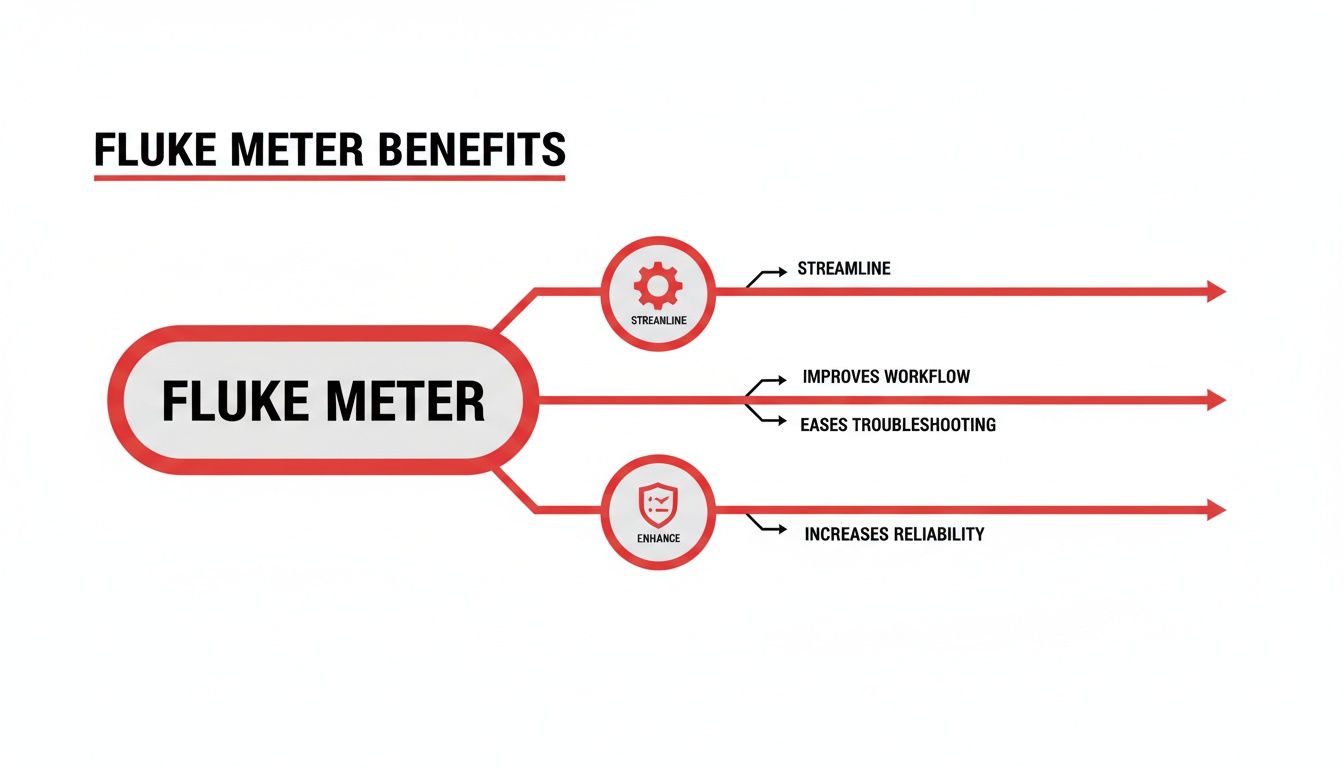
As the graphic highlights, the true value of the tool extends beyond measurement—it's about improving overall job efficiency and safety.
Why True RMS Is a Must-Have for Modern UAE Systems
Modern electrical systems are filled with non-linear loads such as Variable Frequency Drives (VFDs), LED lighting, and switch-mode power supplies (SMPS power supply). These devices distort the standard AC sine wave, creating complex and "noisy" electrical signals.
Using a standard "average-responding" meter on these distorted waveforms will produce inaccurate readings, often off by as much as 40%. This can lead to incorrect diagnoses, unnecessary component replacement, and significant safety risks.
This is why True RMS (Root Mean Square) technology is now a requirement, not a feature. A True RMS Fluke clamp meter is engineered to accurately measure the true heating value of any AC waveform, regardless of distortion. It provides the correct reading every time, reflecting the actual power being used.
For any electrician or engineer working on modern infrastructure across the GCC, a True RMS meter is a fundamental tool for accurate diagnostics and compliance with local standards.
Choosing the Right Fluke for Your Specific Job
Selecting the right Fluke current clamp meter from the GoSwitchgear catalogue involves matching its technical specifications to the real-world demands of your projects in the UAE. This means considering everything from circuit loads and conductor sizes to the harsh on-site conditions.
Choosing the wrong model can lead to inaccurate measurements and safety hazards. Making an informed choice ensures you work faster, safer, and with greater confidence. Here are the key specifications to consider.
Matching AC/DC Current Range to Your Application
The meter's current range determines the maximum current it can measure accurately. This is the first specification to check.
For example, a facility manager in Dubai inspecting an HVAC system will need a meter that can handle up to 600A AC for large compressor motors. An engineer working on a solar PV project in Abu Dhabi, however, will need a model with a high DC current rating, often 1000A DC or more, to measure inverter outputs.
Consider your daily applications:
- Residential & Commercial: Typically involves loads up to 400A AC.
- Industrial & Switchgear: Requires a range from 600A to 1000A AC/DC for large motors and feeders.
- Solar & EV Charging: High DC measurement capability is mandatory.
Fluke leads the AC/DC clamp meter market in the Middle East & Africa. The global market is projected to exceed $2 billion by 2028, with the GCC region expected to capture a significant 12-15% of that revenue by 2032. Fluke's precision, with resolutions down to 1A and ±2% accuracy, aligns perfectly with the stringent standards of UAE utility providers. You can explore these market trends and projections.
Jaw Size and Panel Accessibility
The jaw size determines the maximum conductor diameter the meter can accommodate. In the compact electrical panels and switchgear common in UAE installations, space is often limited.
A large jaw opening (e.g., over 34mm) is ideal for thick feeder cables in industrial plants. However, a smaller, tapered jaw is often more practical for navigating crowded control cabinets.
Installation Tip: Before purchasing, measure the diameter of the largest conductors you typically work with. Select a jaw size that accommodates them while remaining nimble enough for everyday tasks.
Understanding CAT Safety Ratings (IEC 61010)
The CAT (Category) rating is the most critical specification for user safety. It indicates the meter's ability to withstand transient voltage spikes, which are common in industrial and power distribution systems. Compliance with IEC standards is crucial in the UAE.
- CAT III: Essential for distribution-level circuits, including three-phase commercial lighting, busbars, and switchgear. This is the minimum rating for most professional electricians in the UAE.
- CAT IV: Required for measurements at the source of the low-voltage installation, such as utility service drops and electricity meters. This is a must-have for anyone working on or near the primary power supply.
Always select a meter with a CAT rating that meets or exceeds the requirements of your work environment. Using an underrated meter poses a severe safety risk.
Feature Comparison: Key Fluke Clamp Meter Models
This table compares popular Fluke models available through GoSwitchgear in the UAE, each designed for specific applications.
| Fluke Model | Max Current (AC/DC) | Key Feature | Best For (UAE Application) |
|---|---|---|---|
| Fluke 376 FC | 1000A AC/DC (2500A with iFlex) | Fluke Connect® wireless connectivity & Inrush measurement | Industrial electricians, motor diagnostics, and remote monitoring in large facilities. |
| Fluke 325 | 400A AC, 400A DC | True RMS, Temperature, and Capacitance measurement | Commercial and residential electricians needing a versatile, all-around diagnostic tool. |
| Fluke 902 FC | 600A AC | True RMS HVAC measurements (µA, Temp, Capacitance) | HVAC technicians requiring a rugged meter for system troubleshooting in high ambient temperatures. |
| Fluke 345 | 1400A AC, 2000A DC | Power Quality Analyzer (Harmonics, Power, V/A/Hz) | Power quality specialists and high-current industrial engineers analyzing complex electrical systems. |
Advanced Features for Specialised Tasks
- Inrush Current: Essential for diagnosing motor and compressor startup issues, helping to identify potential problems with starting circuits or incorrectly sized breakers.
- IP Ratings: The Ingress Protection rating indicates resistance to dust and water. In the dusty and humid conditions of the UAE, a meter with at least an IP42 rating is a wise investment for longevity.
- Fluke Connect®: Wireless connectivity allows for remote data logging and monitoring via smartphone, which is invaluable for troubleshooting intermittent faults or working in hazardous areas.
By carefully evaluating these specifications against your job requirements, you can select the perfect fluke current clamp meter for your needs in the UAE.
Getting Hands-On: A Practical Guide to Using Your Fluke Clamp Meter
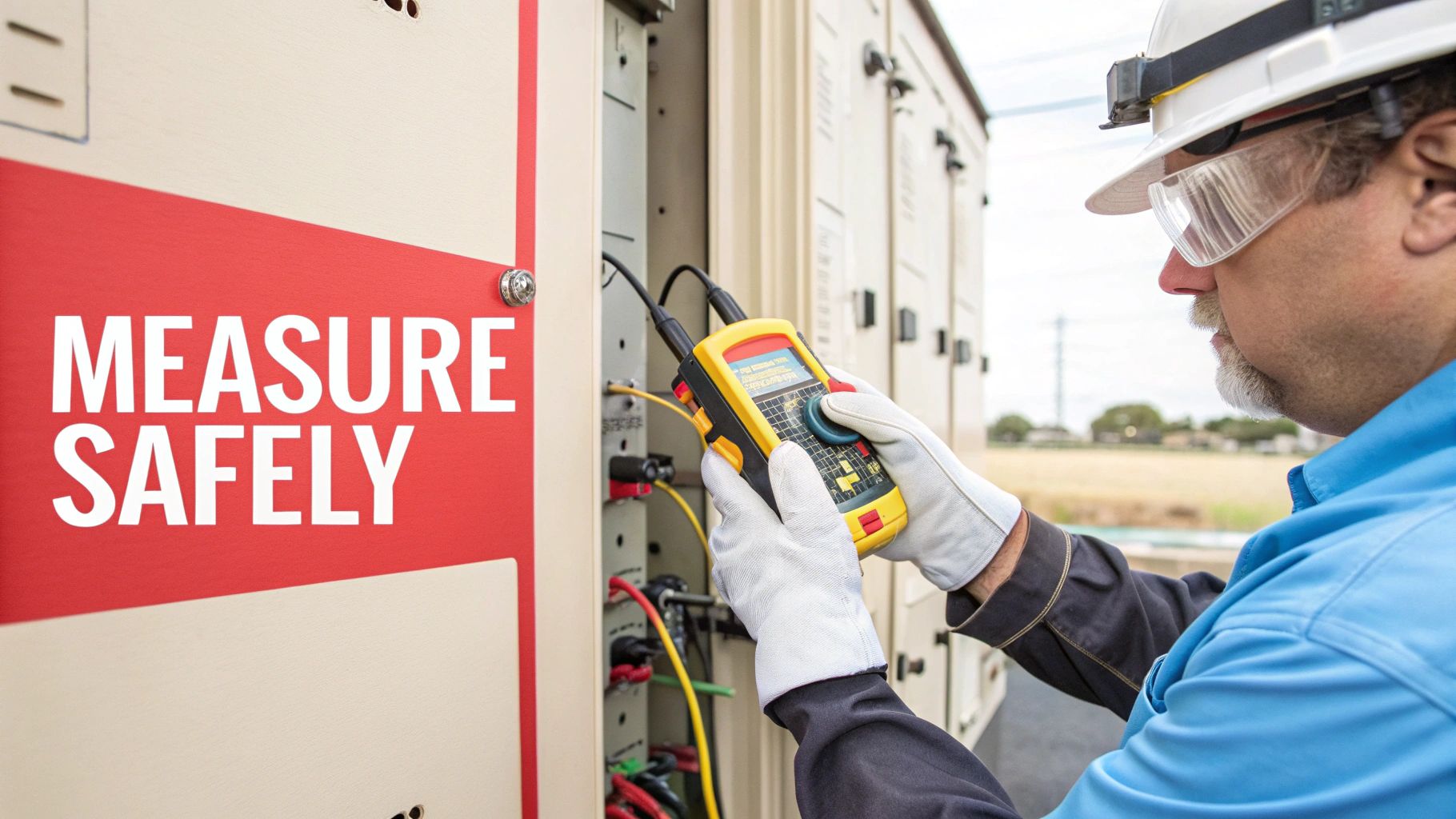
Mastering the use of your Fluke current clamp meter on a busy job site in Dubai or Abu Dhabi is essential for accurate and safe diagnostics. This practical guide provides clear, actionable steps.
Before any measurement, safety is paramount. Always wear appropriate Personal Protective Equipment (PPE), including insulated gloves and safety glasses. Perform a quick visual inspection of the meter and test leads for any damage. This is a non-negotiable first step.
Step-by-Step Current Measurement: Best Practices
Following a consistent procedure ensures reliable results and protects both you and the equipment.
- Select Function: Turn the rotary dial to the correct current setting: A~ for AC current or A⎓ for DC current.
- Open Jaws: Squeeze the lever to open the spring-loaded jaws.
- Clamp a Single Conductor: This is critical. Enclose the jaws around only one wire. Clamping a multi-core cable (live and neutral) will result in a zero reading as the magnetic fields cancel each other out.
- Ensure Full Jaw Closure: Allow the jaws to snap shut completely. A small air gap can cause inaccurate readings. A solid click confirms proper closure.
- Read Measurement: Observe the value on the display. Use the "Hold" button to freeze the reading if it fluctuates, making it easier to record.
Common Installation Mistakes to Avoid
- Clamping Multiple Wires: This will always result in an incorrect reading. Isolate a single conductor.
- Misaligned Jaws: Ensure the jaws are fully closed and aligned. Gaps will skew the magnetic field and the measurement.
- Ignoring the CAT Rating: Never use a meter in an environment that exceeds its CAT safety rating. This is a critical safety failure.
Real-World Applications Here in the UAE
- Identifying Circuit Overloads: Clamp the main feeder cable in a distribution panel. If the measured current approaches or exceeds the breaker's rating, you have identified a potential overload requiring immediate action.
- Diagnosing Motor Startup Current: Use the "Inrush" function on compatible Fluke models to capture the initial current surge when a motor starts. This is vital for diagnosing starting issues in industrial plants.
- Load Balancing in Three-Phase Systems: Measure the current on each phase (L1, L2, L3) individually. Significant differences indicate an unbalanced load, which reduces efficiency and can damage equipment over time.
The digital clamp meter market, led by Fluke, is expanding rapidly. While the global CAGR is 4.21%, the UAE and Middle East are experiencing growth of around 7% annually, driven by solar projects and infrastructure upgrades. Innovations like the Fluke 377 FC's non-contact voltage feature have reportedly reduced arc flash risks by up to 50% in some Abu Dhabi switchgear assemblies. For more details, see the full research on digital clamp meter forecasts.
Keeping Your Fluke Meter Accurate for the Long Haul
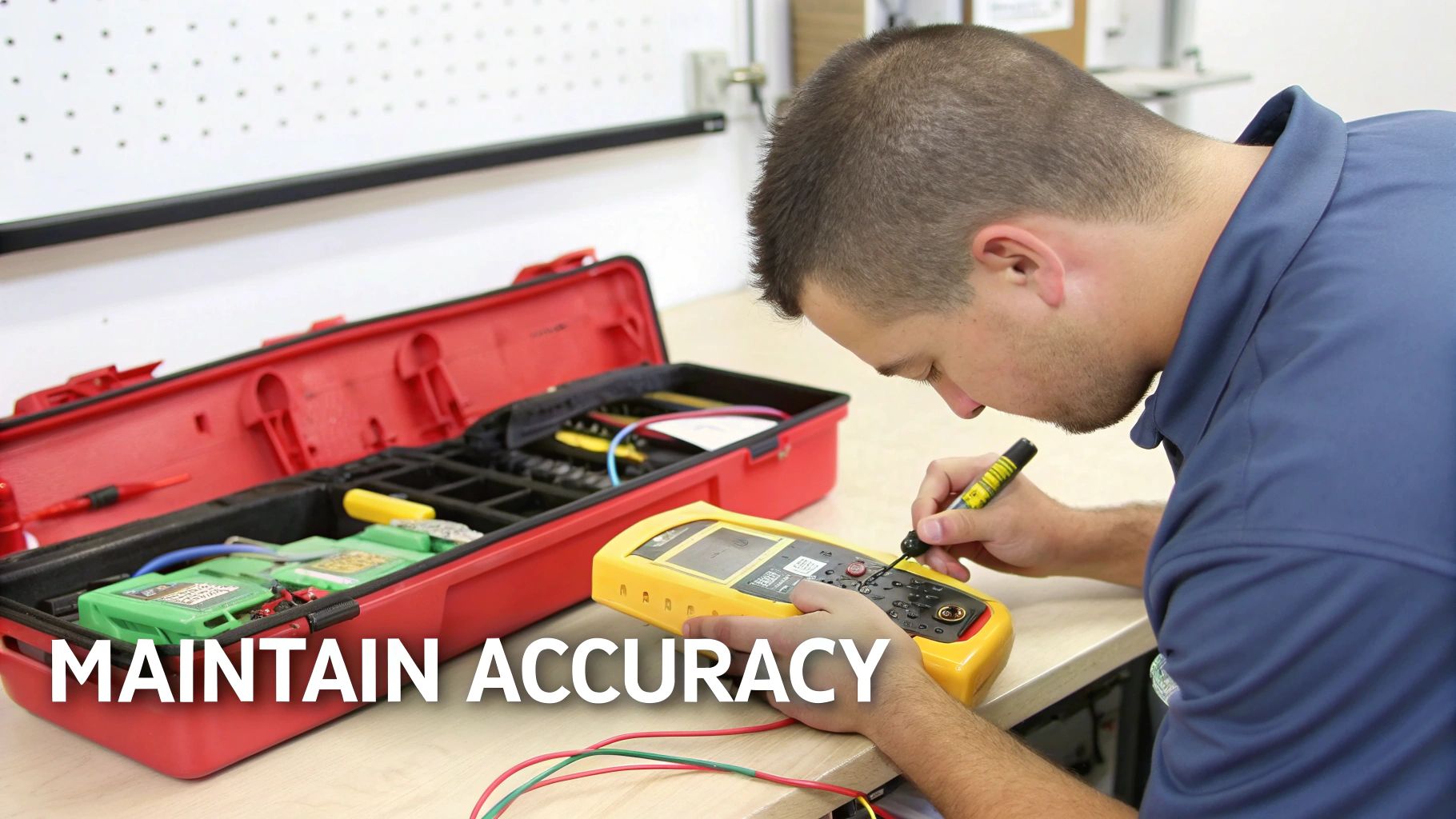
A Fluke current clamp meter is a significant professional investment. Protecting it, especially in the harsh environmental conditions of the UAE and GCC, is essential for maintaining its accuracy and longevity.
Proper maintenance ensures every reading is reliable. The combination of intense heat, humidity, and fine dust on job sites from Dubai to Riyadh can be detrimental to sensitive electronics. A consistent care routine is your best defence.
The Absolute Necessity of Annual Calibration
For professionals adhering to UAE or KSA standards, annual calibration is a critical compliance requirement. Calibration verifies that your meter's measurements are accurate against a traceable standard.
Over time, even rugged instruments can drift from their factory specifications. This yearly check-up guarantees accuracy and provides the documentation needed for project sign-offs, quality audits, and compliance with local utility regulations (e.g., DEWA, ADDC). Without it, you risk making critical errors based on faulty data.
Maintenance Schedule: Best Practices for Meter Care in the GCC Climate
- Daily: After use, wipe the meter's casing with a dry, lint-free cloth to remove dust.
- Weekly: Inspect test leads for cracks, fraying, or bent probes. Damaged leads are a safety hazard and must be replaced immediately.
- As Needed: Use a cloth lightly dampened with a mild detergent and water to clean stubborn grime. Never allow moisture to enter the meter's jacks.
- Storage: Always store your fluke current clamp meter in its protective case in a cool, dry place, away from direct sunlight and extreme temperatures.
- Battery Management: Replace batteries promptly when the low-battery indicator appears. Weak batteries are a common cause of inaccurate readings.
A well-maintained tool is a reliable tool. A few minutes spent on inspection and cleaning protects your investment and your professional reputation.
Quick Fixes for Common Issues
| Issue | Possible Cause | Solution |
|---|---|---|
| No Reading or Blank Screen | Dead or poorly connected batteries. | Install a fresh set of batteries, ensuring correct polarity. |
| Inaccurate or Erratic Readings | Low batteries, dirty jaw tips, or an air gap in the jaws. | Replace batteries, clean jaw surfaces, and ensure the jaws close completely with a solid click. |
| Wrong Function Selected | The rotary dial is set to the wrong measurement type. | Confirm the dial is set correctly (A~ for AC, A⎓ for DC) before clamping the conductor. |
Getting Your Fluke Clamp Meter from GoSwitchgear
Once you have identified the required specifications, partnering with a trusted local supplier is the next step. For professionals in the UAE, GoSwitchgear offers more than just a product; we provide a supply chain solution tailored to the regional electrical industry.
Our technical support and logistical efficiency are designed to meet the needs of engineers, panel builders, and procurement teams. With dedicated branches in Dubai and Abu Dhabi, we are strategically positioned to serve the UAE’s major commercial and industrial hubs.
Your Local Advantage in Dubai and Abu Dhabi
Project delays are costly. Waiting for equipment to ship from overseas is not a viable option for time-sensitive projects. GoSwitchgear eliminates these delays by maintaining a comprehensive local inventory of in-demand Fluke current clamp meter models.
Our local presence offers:
- Rapid Delivery: Fast dispatch to sites across Dubai, Abu Dhabi, and the wider UAE.
- Expert Support: Our team understands the specific challenges and standards of the GCC region, providing relevant, practical advice.
- Genuine Products: Every Fluke meter is authentic and backed by the manufacturer’s warranty, ensuring peace of mind.
The Middle East's electrical equipment market was valued at USD 32,003.05 million in 2024 and is growing at a 6.7% CAGR, driven by large-scale infrastructure projects. GoSwitchgear is a key supplier for these projects, providing the precision tools required. For more details, see this Middle East electrical equipment market report.
A Partnership for Professional Success
Choosing GoSwitchgear equips your team with the best tools without logistical challenges. We manage the sourcing, allowing you to focus on project execution. Our procurement process is streamlined, with competitive pricing and direct access to essential equipment.
By stocking a complete range of tools, from versatile all-rounders like energy meters to specialized instruments like the 1000A AC Clamp Meter M266F, we ensure you have the right tool for any job.
Frequently Asked Questions
Here are answers to common questions from technicians and engineers across the UAE and GCC regarding their Fluke current clamp meters.
What’s the Real Difference Between a Standard Clamp Meter and a True RMS Fluke?
A standard, or 'average-responding', clamp meter is calibrated for pure AC sine waves. However, modern electrical systems in the UAE are dominated by non-linear loads like VFDs, computers, and LED lighting, which create distorted electrical signals.
Using an average-responding meter on these circuits can lead to reading errors of up to 40%. A True RMS (Root Mean Square) Fluke clamp meter is designed for these real-world conditions. It accurately calculates the true effective value of any waveform, providing the reliable data necessary for correct diagnosis and safe operation.
How Often Should I Get My Fluke Current Clamp Meter Calibrated in the UAE?
Annual calibration is the standard for professional work in the UAE. It is a critical requirement for maintaining compliance with local quality and safety standards. The region's harsh environment can cause instrument drift over time.
Yearly calibration at an authorized service center ensures your measurements are precise and traceable to national standards. In sectors like oil and gas, construction, and facilities management across the GCC, this is often a mandatory requirement for project sign-offs and maintenance records.
"For professionals in the UAE, annual calibration is not just a best practice; it is a fundamental requirement for maintaining the integrity and safety of electrical systems. It ensures that every measurement you rely on is verifiably accurate, which is critical for compliance and project success."
Can I Just Clamp Around a Multi-Core Cable to Get a Current Reading?
No. A clamp meter is designed to measure the current in a single conductor.
In a multi-core cable, the magnetic fields from the live and neutral currents flow in opposite directions and cancel each other out, resulting in a reading of or near zero. To obtain an accurate measurement, you must isolate and clamp around a single conductor, such as the live wire.
For expert guidance and to explore the full range of Fluke clamp meters built for the demands of the UAE market, trust GoSwitchgear. Reach our Dubai team for project support or request a quote for Abu Dhabi projects.
Discover our comprehensive catalogue and find the right tool for your application.




.jpg)
Leave a Reply