.jpg)


Posted by:
Category:
Comments:
Post Date:
A Practical Guide to Choosing and Using an Insulation Tester in the UAE
In the demanding climate of the UAE and GCC, the integrity of electrical insulation is not just a technical detail—it's a critical factor for operational safety and continuity. An insulation tester, often called a megohmmeter, is an essential diagnostic tool for engineers and electricians to assess the health of cables, motors, and switchgear, preventing failures before they happen.
Why Insulation Testing is Critical in the GCC Climate
In the relentless climate of the UAE and across the GCC, electrical insulation is constantly under attack from heat, dust, and humidity. For any engineer, panel builder, or facility manager in Dubai or Abu Dhabi, understanding how this harsh environment degrades insulation is fundamental to preventing costly downtime and ensuring workplace safety.
The Harsh Reality of Environmental Stress
The triple threat of extreme heat, pervasive dust, and high humidity creates a uniquely punishing environment for electrical systems. These elements accelerate the breakdown of insulating materials much faster than in temperate climates.
- Extreme Heat: High ambient temperatures, common in the UAE, cause polymers in insulation to become brittle and crack, creating pathways for current leakage.
- Abrasive Dust: The fine, airborne dust prevalent in KSA and the UAE settles on equipment, absorbs moisture, and forms conductive paths that compromise insulation effectiveness.
- Corrosive Humidity: Moisture ingress is a primary cause of insulation failure. It significantly lowers a material's dielectric strength, increasing the risk of short circuits and dangerous arc flashes. Selecting the right insulation materials for electrical applications with high IP ratings is crucial for longevity.
From Proactive Maintenance to Business Continuity
Regularly using an insulation tester shifts your maintenance strategy from reactive repairs to proactive, predictive care. It empowers technicians in Dubai to identify and rectify insulation weaknesses before they escalate. This is non-negotiable for critical infrastructure where failure is not an option, such as ensuring essential equipment like power generators remains electrically sound.
In the scorching heat of the UAE, where temperatures routinely soar above 45°C, electrical insulation faces relentless degradation. Untested insulation fails 30% faster in dusty, humid conditions, contributing to significant operational losses.
By establishing a routine testing schedule, facilities can build a historical data log for their equipment. This data-driven approach, a core component of modern energy management solutions in Dubai, helps predict failures, schedule maintenance efficiently, and protect your bottom line by avoiding unplanned shutdowns in a high-rise tower, industrial plant, or solar farm.
An insulation tester is a direct investment in the reliability and safety of your electrical components in the UAE.
How an Insulation Tester Actually Works
At its core, an insulation tester works by applying a specific, high DC voltage to a de-energized circuit or piece of equipment. Think of insulation as the wall of a high-pressure pipe, designed to prevent leaks. In electrical systems, these "leaks" are minute amounts of current escaping where they shouldn't.
The tester injects a stable DC voltage—from 250V for low-voltage circuits to 5kV or more for heavy-duty transformers and motors—while simultaneously measuring the tiny leakage current. Using Ohm's Law (Resistance = Voltage / Current), it instantly calculates the insulation's resistance. Because healthy insulation allows almost no current through, resistance values are measured in millions of ohms, or megohms (MΩ).
Beyond a Simple Spot Check
A single megohm reading provides a quick snapshot of insulation health. However, for critical equipment found in the UAE's industrial zones, a deeper diagnosis is needed. Advanced, time-based tests reveal how insulation behaves under sustained electrical stress, offering insights that a one-off reading cannot. This is how you uncover hidden issues like moisture ingress or contamination from dust—constant challenges in the humid and often dusty GCC climate.
Understanding DAR and PI
Two of the most powerful diagnostic tools a modern insulation tester offers are the Dielectric Absorption Ratio (DAR) and the Polarisation Index (PI).
Dielectric Absorption Ratio (DAR): This ratio is calculated by dividing a resistance reading taken at 60 seconds by a reading taken at 30 seconds. In good insulation, resistance should climb as the material absorbs the electrical charge. A low DAR value is a red flag for issues like moisture.
Polarisation Index (PI): This is a longer, 10-minute test that compares the resistance reading at one minute to the reading at ten minutes. A healthy PI value indicates the insulation is clean, dry, and polarizing correctly under voltage stress.
A low Polarisation Index (PI) reading is a serious warning sign. It often means that moisture or surface contaminants have created leakage paths, compromising the insulation and dramatically increasing the risk of a sudden failure.
By logging DAR and PI values for specific assets over time, maintenance teams in Dubai or Abu Dhabi can spot slow degradation long before it causes a catastrophic outage. This elevates the insulation tester from a simple tool to a powerful diagnostic system for any serious electrical maintenance program.
Choosing the Right Insulation Tester for Your Job
Selecting the right insulation tester is a critical decision for procurement teams and engineers in the GCC. The tool needed for low-voltage control circuits in a Dubai high-rise differs significantly from one required for a high-voltage transformer in an Abu Dhabi industrial plant. Making the right choice ensures accuracy, safety, and budget efficiency.
This guide breaks down critical specifications like test voltage and resistance range, tying them directly to real-world applications in the UAE to help you make confident purchasing decisions.
Matching Test Voltage to the Application
The tester's maximum test voltage is the most critical specification. Using the wrong voltage can yield useless readings or damage the equipment. A solid rule of thumb, backed by industry standards, is to use a test voltage at least double the equipment's normal operating voltage.
- Low-Voltage Systems (up to 1000V): For commercial wiring, control panels, and small motors, a tester offering 250V, 500V, and 1000V (1kV) is the standard. A 500V test is ideal for the 230/400V circuits common across the region.
- Medium-Voltage Systems (1kV to 35kV): For switchgear, larger industrial motors, and distribution transformers, an insulation tester that can deliver up to 5kV is essential to properly stress the insulation.
- High-Voltage Systems (>35kV): For transmission lines, power transformers, and substation equipment, specialized high-voltage testers generating 10kV, 15kV, or more are required.
Key Features for GCC Field Conditions
Beyond voltage, equipment used in the UAE and KSA must withstand a harsh environment. Ruggedness and smart diagnostic features are crucial. When specifying a new tester, look for these features:
- IP Rating (Ingress Protection): An IP54 rating or higher is essential. This certification ensures protection against dust ingress and water splashes, making it suitable for dusty construction sites or humid plant rooms.
- Timed Test Functions (DAR/PI): For motors, generators, or transformers, automatic Dielectric Absorption Ratio (DAR) and Polarisation Index (PI) tests are non-negotiable for diagnosing moisture and contamination.
- Temperature Compensation: High ambient temperatures in the GCC significantly impact insulation resistance readings. A tester with a temperature probe and automatic compensation corrects measurements to a standard baseline (e.g., 40°C), enabling accurate trend analysis.
For anyone dealing with high-value, complex assets, a basic megohmmeter just doesn't cut it. To truly understand the condition of your critical machinery, you need an instrument capable of running advanced diagnostic tests. For a deeper look at this, our comprehensive high-voltage insulation testers guide provides much more detail.
Insulation Tester Selection Guide for Common UAE Applications
This quick-reference table aligns common GCC electrical applications with recommended tester specifications, helping procurement teams source the right tool for their needs.
| Application | Typical System Voltage | Recommended Test Voltage | Key Features Required |
|---|---|---|---|
| LV Control Panels & Circuits | 230V / 400V | 500V - 1000V DC | Handheld, IP54 rating, clear digital display, basic resistance measurement. |
| Electric Motors & Generators | 400V - 6.6kV | 1000V - 5kV DC | Automatic DAR & PI calculation, temperature compensation, data storage for trending. |
| Switchgear & Busbars | 400V - 33kV | 1kV - 10kV DC | Guard terminal, variable test voltage, robust IP rating (IP54+), compliance with local utility regulations. |
| Solar PV Systems | 600V - 1500V DC | 1000V - 2500V DC | High DC voltage capability, PV-specific test modes, high resistance range. |
| Power & Distribution Transformers | 11kV - 132kV | 5kV - 15kV DC | Advanced diagnostics (PI, DAR, SV, DD), high charging current, PC interface, IEC compliance. |
By matching the insulation tester to the real demands of the job, you are making a smart investment in the accuracy, safety, and long-term reliability of your critical electrical assets in the UAE.
Performing a Safe and Accurate Insulation Test
Executing an insulation resistance test is a non-negotiable skill for any electrical professional in the UAE. It is a methodical process where safety is the absolute priority. This section provides a step-by-step framework for conducting a safe and reliable test on a job site in Dubai, Abu Dhabi, or elsewhere in the GCC.
Best Practices: Pre-Test Safety is Paramount
Before using your insulation tester, ensure the circuit or equipment is completely isolated and de-energized. Rushing this critical preparation phase is a recipe for disaster.
Common Installation Mistakes to Avoid:
- Incomplete De-energization: Failing to disconnect all power sources. Always verify zero voltage at the point of test.
- Ignoring LOTO: Not following Lock-Out/Tag-Out (LOTO) procedures, which is a mandatory safety standard on any professional site.
- Skipping Visual Inspection: Overlooking obvious damage, burn marks, or contamination that could affect the test.
- Assuming a Dead Circuit: Always use a calibrated voltmeter to confirm zero voltage between all conductors and from each conductor to ground.
The Step-by-Step Test Procedure
Once the equipment is safely isolated, you can proceed with the test. Accurate results depend on correct connections and selecting the appropriate test voltage based on IEC standards or manufacturer specifications.
This process flow illustrates how an insulation tester is used across different equipment types.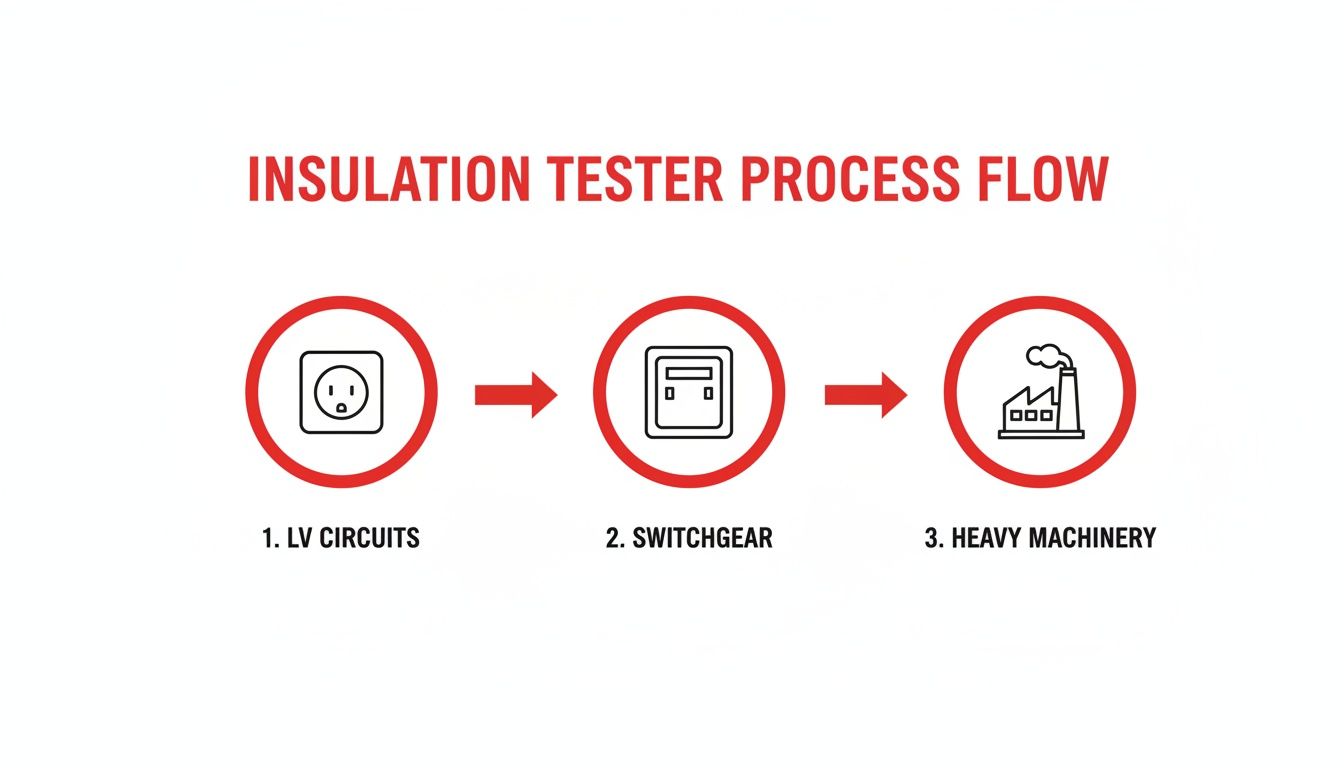
The fundamental principle remains the same, but test parameters must be adapted for each specific application.
How to Install Test Leads Correctly
A typical insulation tester has three leads:
- Line (L): Connects to the conductor being tested.
- Earth (E): Connects to the system's earth or ground point.
- Guard (G): This often-overlooked connection is critical for eliminating the effect of surface leakage current, ensuring the tester only measures current leaking through the insulation. This is vital for accurate readings on high-voltage bushings or long cable runs where surface contamination is common.
Executing the Test
Select the DC test voltage based on the equipment's nameplate rating (typically double the operating voltage). Apply the voltage for the required duration—one minute for a spot test or up to ten minutes for a Polarisation Index (PI) test.
Safety does not end when the test button is released. The most overlooked danger in insulation testing is the stored electrical charge left in the equipment after the test voltage is removed.
Post-Test Discharge: A Critical Final Step
After the test, the equipment's capacitance can hold a potentially lethal charge. Modern insulation testers feature an automatic discharge function, but it is best practice to verify with a voltmeter that the equipment is fully discharged before handling any connections. For a complete overview, see our detailed guide on the insulation resistance test.
For high-voltage systems using SF6 gas, understanding advanced methods like analysing dielectric breakdown is essential for a complete assessment.
By integrating these safety and procedural checks into every test, your insulation tester will provide reliable, actionable data while ensuring team safety.
Translating Test Data Into Actionable Insights
An insulation tester provides data; your expertise turns those numbers into smart maintenance decisions. For professionals in Dubai and Abu Dhabi, interpreting megohm readings is key to preempting failures, ensuring site safety, and maintaining the uptime of high-value assets.
This skill transforms a technician from a data collector into an expert who drives a proactive maintenance strategy.
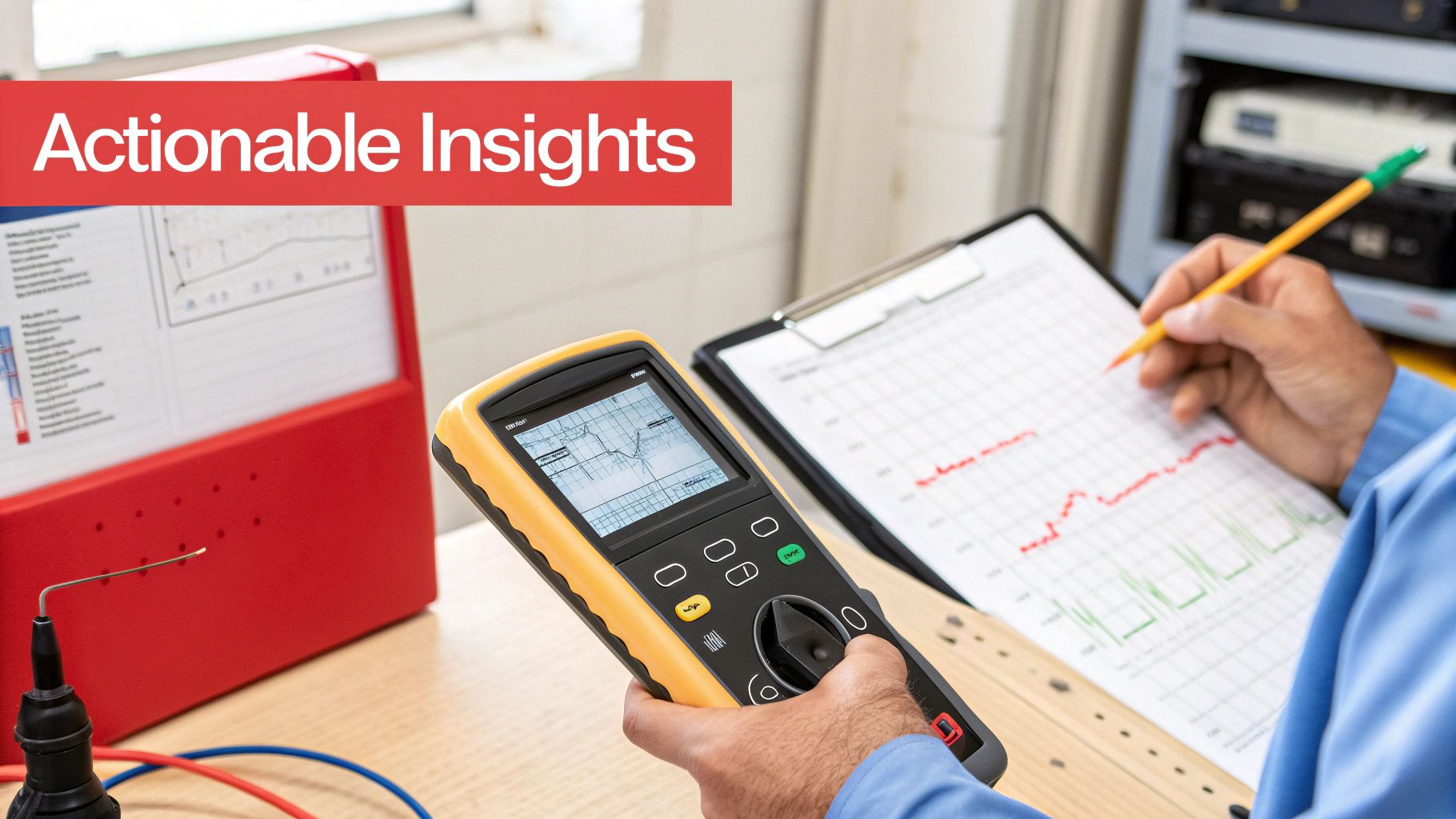
The value of a basic megohm (MΩ) reading is realized when compared against industry standards and historical data for that specific piece of equipment.
Benchmarking Against Industry Standards
Organizations like the International Electrical Testing Association (NETA) and the IEC provide guidelines for evaluating insulation condition. In the UAE and KSA, temperature correction is mandatory. A reading that appears poor at 45°C might be acceptable when corrected to a standard 20°C baseline. This is why an insulation tester with built-in temperature compensation is invaluable in our climate.
A classic rule of thumb is the "one-megohm rule": insulation resistance should be at least 1 MΩ for every 1,000 volts of operating voltage, plus a baseline of 1 MΩ. For a 400V motor, the minimum would be 1.4 MΩ. However, always defer to NETA or manufacturer specifications for definitive values.
Interpreting Advanced Diagnostic Results
For critical assets, advanced diagnostics like DAR and PI provide deeper insights.
- Low DAR Value (below 1.25): This strongly suggests surface contamination or moisture ingress, a common issue in the coastal regions of the GCC. Leakage current is traveling across the dirty or damp surface rather than through the insulation.
- Low PI Value (below 2.0): This often indicates a more severe problem, such as moisture absorbed deep within the insulation. It signals that the insulation can no longer polarize correctly, significantly increasing the risk of failure.
These timed tests are essential for detecting slow degradation caused by environmental stress, allowing for scheduled maintenance before a fault occurs.
A Practical Troubleshooting Framework
When an insulation tester provides a questionable reading, use a structured approach to identify the root cause. The table below, based on NETA standards, helps translate test values into a clear action plan.
Interpreting Insulation Resistance Test Values (Based on NETA ATS-2017)
| Equipment Voltage Rating | Minimum Insulation Resistance (MΩ) | Recommended Action |
|---|---|---|
| Up to 1000V | 100 MΩ | Good: Equipment is healthy. Log the result and continue routine monitoring. |
| 2.4kV | 500 MΩ | Marginal: Investigate further. Clean and re-test. Increase testing frequency. |
| 5kV | 1,000 MΩ (1 GΩ) | Unacceptable: Isolate immediately. Do not energize. Requires corrective action or replacement. |
| 15kV | 5,000 MΩ (5 GΩ) | Investigate: Values below minimum require immediate attention. |
This framework enables technicians to move swiftly from data collection to decisive action, ensuring safety and reliability. By combining standardized benchmarks with advanced diagnostics, you can build a comprehensive health profile for your equipment, transitioning from reactive repairs to a truly predictive maintenance program.
Maintenance Schedule: Keeping Your Tester in Top Shape
Your insulation tester is a critical safety instrument and a significant investment in your operational reliability in the UAE. A disciplined maintenance and calibration routine is essential to protect this investment and ensure it delivers trustworthy results every time, especially given the harsh field conditions in the GCC.
Maintenance Best Practices for Longevity
A simple pre- and post-use inspection can prevent most common issues.
- Inspect Test Leads and Probes: Check for wear, cracks, or loose connections. Damaged leads are a primary source of inaccurate readings and a significant safety hazard.
- Check Battery Health: Weak batteries can fail to deliver the required test voltage, leading to falsely low resistance readings. Always start with fully charged or fresh batteries.
- Cleanliness and Storage: After use, wipe the instrument to remove dust and store it in its protective case in a clean, dry location away from extreme site temperatures found in Dubai or Abu Dhabi.
This consistent routine protects the sensitive internal electronics from dust and humidity.
Why Annual Calibration Isn't Optional
While daily checks ensure physical integrity, annual calibration maintains accuracy. Calibration verifies your tester's measurements against a certified standard. This is often a mandatory requirement for projects in the UAE and wider GCC.
Local authorities and major clients like DEWA frequently require valid calibration certificates for all test equipment used on their sites. This ensures your data is both technically and legally compliant.
An uncalibrated insulation tester is a massive liability. It could lead you to misdiagnose a problem, replace healthy equipment, or, far worse, miss a critical insulation fault that jeopardizes safety and assets.
Annual calibration from a certified lab is the baseline standard across the GCC. Using a certified, reliable instrument from a trusted supplier like GoSwitchgear is essential for meeting regulations and upholding professional standards. Your reputation depends on the accuracy of your tools.
Your Questions About Insulation Testing, Answered
Here are answers to common questions from electrical professionals in the UAE and GCC about using an insulation tester.
Can I Just Use My Multimeter Instead of an Insulation Tester?
No. A standard multimeter uses a very low voltage to check resistance, which is insufficient to stress insulation and detect subtle weaknesses. An insulation tester applies a high DC voltage (from 250V to over 5kV) specifically to identify leakage currents that a multimeter cannot.
What's the Difference Between an Insulation Tester and a Hipot Tester?
They both test insulation but serve different purposes.
- An insulation tester (megohmmeter) is a diagnostic tool. It measures insulation resistance (in MΩ) to assess its condition as part of a predictive maintenance program.
- A Hipot (High Potential) tester performs a stress test. It applies a much higher voltage to verify that the insulation can withstand it without breaking down. This is a pass/fail test, often used in manufacturing for quality assurance.
How Often Should I Be Testing Insulation?
This depends on equipment criticality and the operating environment. Given the harsh climate in the GCC, annual testing is a solid baseline for important assets. For equipment in extremely dusty, humid, or high-temperature locations, testing every six months is a prudent strategy to enhance safety and reliability.
Key Takeaway: The power of regular testing lies in building a historical trend. By logging results over time, you can detect gradual degradation and schedule maintenance before a minor issue escalates into a catastrophic failure.
Whether you need a straightforward insulation tester for routine checks or an advanced diagnostic instrument for critical assets, GoSwitchgear provides a complete selection from leading global brands. Our solutions are backed by local expertise to support your projects in Dubai, Abu Dhabi, and across the GCC.
Reach our Dubai team to discuss your requirements or request a quote for your Abu Dhabi projects. Explore our full range of electrical testing instruments and components at https://goswitchgear.ae.
Share this post

Related
Posts
What Is Switchgear and Why It’s Essential for Power Systems in the UAE & GCC
Learn what is switchgear from this expert guide for UAE engineers. We explain its components, types, and how it protects...
Optimizing Energy Meter Selection for UAE & GCC Projects
The ultimate guide for UAE engineers on selecting the right HDMI Type A to C solutions for AV systems and...
Mastering EV Infrastructure: How to Choose the Right Car Charging Adapters for UAE & GCC Projects
Your expert guide to car charging adapters in the UAE. Learn how to select, install, and specify the right adapters...
Selecting the Right Ceiling Exhaust Fan for UAE & GCC Industrial Applications
Learn how to select the right ceiling exhaust fan for UAE projects. This guide covers CFM, sizing, and installation for...
.jpg)