

Choosing the Right LED Panel Light for UAE & GCC Projects: An Engineer’s Guide
For engineers, electricians, and procurement teams working across the UAE and GCC, replacing outdated fluorescent troffers with a modern LED panel light is a critical performance and efficiency upgrade. Facing high operational costs and relentless maintenance cycles, specifying the right lighting solution is key to project success in demanding commercial and industrial environments. This guide offers practical, locally relevant insights for your decision-making.
Why LED Panel Lights Are a Strategic Upgrade in the GCC
In the competitive commercial hubs of Dubai, Abu Dhabi, and across the wider GCC, every dirham saved on operational costs is a victory. Traditional fluorescent lighting presents persistent issues: flickering tubes, uneven brightness, and escalating energy bills. This leads to a costly cycle of replacing ballasts and tubes, increasing downtime and long-term expenses.
The LED panel light directly addresses these challenges. Engineered to deliver uniform, high-quality illumination without the hum, flicker, or warm-up delay of legacy technology, they provide an immediate improvement in lighting quality, creating a more comfortable and productive workspace.
Engineered for the UAE and GCC Climate
The region's unique climate—intense heat, humidity, and airborne dust—poses a significant threat to conventional lighting. Fluorescent tubes are prone to premature failure in high ambient temperatures, while dust accumulation rapidly diminishes their light output, adding another maintenance burden.
Modern LED panels are designed to perform reliably in these conditions:
- Superior Thermal Management: A high-quality LED panel light incorporates an effective heat sink to draw thermal energy away from sensitive components. This ensures stable performance and extends the fixture's lifespan, a crucial factor in the UAE's high-temperature environment.
- Sealed for Durability: Many panels feature high IP (Ingress Protection) ratings, indicating they are sealed against dust and moisture ingress. This makes them an ideal choice for facilities in the UAE where reliability and cleanliness are paramount.
The Bottom-Line Benefits for Your Project
The decision to upgrade is backed by clear financial and operational logic. An LED panel light consumes significantly less power, often reducing lighting-related electricity costs by 50-60%. With a typical operational lifespan exceeding 50,000 hours, routine maintenance calls become a rarity, freeing up facility management teams for more critical tasks.
For procurement managers and engineers in the UAE, the question isn't if an upgrade is necessary, but how to execute it correctly. A successful lighting solution is achieved by mastering technical specifications, understanding local installation requirements, and ensuring compliance with regional standards.
Deconstructing the Technology Behind LED Panels
To appreciate why an LED panel light is a superior solution, it's essential to understand its internal components. A quality panel is a precisely engineered system designed for optimal performance, particularly in the demanding climates of the UAE and GCC.
The technology can be visualized as a multi-layered "light sandwich," where each component has a specific function. Working in unison, these layers produce the smooth, uniform illumination characteristic of modern LED lighting.
The Core Components: A Light Sandwich
The system begins with the LED chips, the core light source. The quality of these semiconductor chips determines the panel's efficiency (lumens per watt), lifespan, and color rendering accuracy.
- LED Chips: The fundamental light sources. Premium chips deliver higher efficacy and color fidelity.
- Light Guide Plate (LGP): In edge-lit designs, this specialized acrylic sheet distributes light from side-mounted LEDs evenly across the panel surface. A high-quality LGP resists yellowing over time, a common failure point in lower-grade panels.
- Diffuser: Positioned over the LGP, the diffuser softens the light, eliminating hotspots and ensuring a glare-free, uniform output.
- Reflector Film: Located at the back of the assembly, this film redirects stray light forward, maximizing the panel's overall efficiency.
Edge-Lit Versus Back-Lit Designs
The placement of the LED chips defines two primary panel architectures, each with distinct advantages for projects in Dubai and beyond.
Edge-Lit Panels: LEDs are positioned along the panel's perimeter, directing light into the LGP. This design enables an ultra-thin profile, making it a popular choice for modern offices and commercial spaces where aesthetics are a priority. Effective heat dissipation is critical for longevity.
Back-Lit Panels: LEDs are arranged in a grid directly behind the diffuser, eliminating the need for an LGP. This configuration often results in higher efficiency and superior thermal management. While slightly thicker, back-lit panels are known for their reliability and are frequently specified when long-term performance is the primary objective.
This infographic neatly summarizes the core benefits this technology brings to the table, solving major headaches for facility managers.
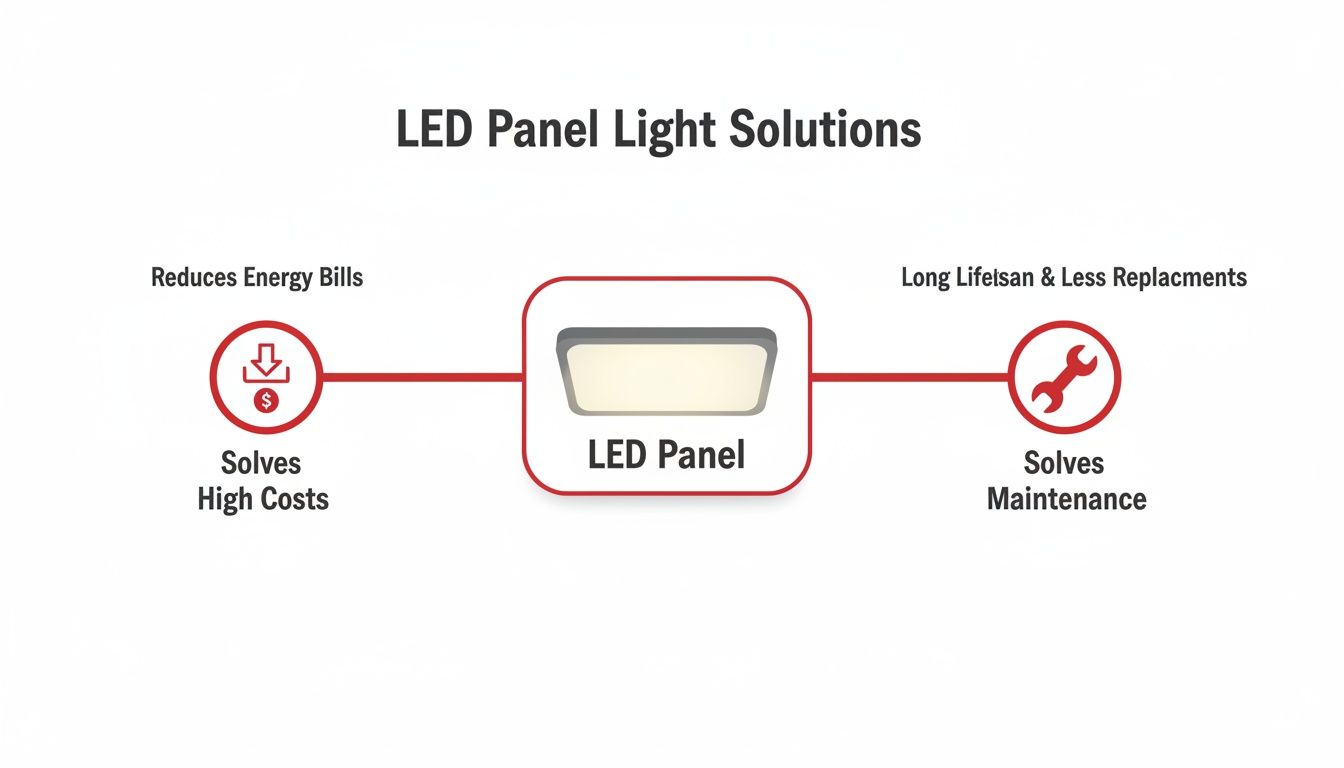
As you can see, the technology directly tackles both the high running costs and the constant maintenance grind that come with older lighting systems.
The Unsung Hero: The LED Driver
The external driver is arguably the most critical component of an LED panel light system, particularly for survival in the UAE's climate. This unit converts the building's AC mains power to the low-voltage DC power required by the LEDs. Specifying a low-quality driver is a recipe for premature failure.
A panel's lifespan is only as long as its driver's. In the high ambient temperatures of the GCC, a poorly made driver is the first component to fail, causing flickering or complete fixture failure.
Key driver specifications to check:
- Constant Current vs. Constant Voltage: Most professional-grade LED panels utilize a constant current driver. This ensures a stable current supply to the LEDs, maintaining consistent brightness and protecting the chips from damaging power fluctuations.
- Dimming Protocols: For advanced lighting control, drivers can support various dimming methods. 0-10V dimming is a common analogue standard, while DALI (Digital Addressable Lighting Interface) provides granular digital control over individual fixtures, making it ideal for integration into building management systems.
- Power Factor (PF): Look for a Power Factor of >0.9. This indicates how efficiently the driver uses electricity. A high PF minimizes wasted energy, contributing to lower utility costs. Sourcing high-quality electrical components UAE from reputable suppliers, like those in the GoSwitchgear electrical components UAE catalogue, is essential for reliable performance.
The Business Case for Upgrading in the GCC
For facility managers and procurement teams in the GCC, every capital expenditure decision must be justified by its return on investment. While the technical merits of an LED panel light are clear, the business case for upgrading is even more compelling.
Transitioning from legacy fluorescent systems is a strategic financial move that directly impacts the bottom line through significant cost reduction and operational improvements.
Immediate, Drastic Energy Savings
The most immediate impact is a substantial reduction in energy consumption. A typical LED panel light uses 50-60% less energy than the fluorescent troffer it replaces. Scaled across a large facility—a shopping mall in Dubai, an office tower in Abu Dhabi, or a logistics center in Saudi Arabia—these savings translate into a significant reduction in monthly utility bills.
This efficiency aligns with the region's strategic objectives. Widespread adoption of LED technology is a key component of initiatives like the UAE Energy Strategy 2050, which aims to increase clean energy's contribution and reduce energy consumption by 40%. This makes your upgrade an energy management solution Dubai businesses can be proud of.
Slash Maintenance and Boost Uptime
The operational benefits are equally significant. A quality LED panel light with a lifespan of 50,000+ hours transforms maintenance workflows. For 24/7 operations such as hospitals, data centers, and airports, lighting failures are disruptive and costly.
The routine tasks associated with fluorescent lighting—replacing tubes, ballasts, and starters—are virtually eliminated for years. This reduces labor costs, parts procurement, and operational downtime, allowing maintenance teams to focus on higher-value activities.
Enhance Productivity and Safety
The quality of light has a direct impact on occupant well-being and productivity. LED panels provide superior illumination with a high Colour Rendering Index (CRI), ensuring colors appear accurate and vibrant. This visual clarity reduces eye strain and can improve concentration, a tangible benefit for engineers, designers, and office workers.
From a safety standpoint, the advantages are clear:
- No Hazardous Materials: Unlike fluorescent tubes, which contain toxic mercury, LEDs are free of hazardous materials, simplifying disposal and creating a safer facility.
- Reduced Fire Risk: LEDs operate at much lower temperatures than traditional lighting, significantly reducing the risk of fire in confined ceiling plenums.
- Instant, Reliable Light: LED panels provide full, stable brightness instantly, with no warm-up period. This enhances safety in areas requiring immediate illumination.
By upgrading, you're not just purchasing a light fixture. You're investing in an energy management solution Dubai facilities need—one that reduces operating costs while creating a safer, more productive environment.
The Regional Market Is All-In
This is a market-wide transformation. The commercial LED panel light market in the UAE is expanding rapidly, fueled by mega-projects and smart city initiatives. Across the Middle East, particularly in the UAE and Saudi Arabia, demand is surging.
Consider Dubai's Crescent City Connection LED retrofit project. An investment of USD 20 million yielded 40-60% energy savings compared to the previous fluorescent system. This was achieved because modern LED systems use 50-60% less energy and have lifespans exceeding 50,000 hours, drastically cutting maintenance overheads. You can explore market trends further in this detailed report from Intel Market Research.
The message from developers and businesses across the region is clear: investing in a modern LED panel light is a smart, future-proof decision with a rapid and measurable payback.
Your Specification Checklist for Sourcing the Right Panel
Selecting the correct LED panel light requires a detailed technical evaluation to match the product to the application environment. For engineers and procurement teams in Dubai or the industrial hubs of Saudi Arabia, a comprehensive specification checklist is essential for project success.
Getting these specifications right from the outset prevents costly rework and ensures the lighting system performs optimally for its entire lifespan. The process begins with physical attributes and mounting requirements, as a miscalculation here can lead to significant installation challenges.
Physical Attributes and Mounting Options
First, confirm the required dimensions. Most LED panels are designed for direct replacement of fluorescent fixtures in standard grid ceilings.
- Standard Sizes: The most common sizes in the UAE market are 600×600 mm and 1200×600 mm, which fit standard ceiling grids.
- Mounting Styles: The ceiling type dictates the appropriate installation method.
- Recessed: Provides a clean, flush finish within a T-bar grid ceiling. This is the standard for modern offices across the GCC.
- Surface-Mounted: A mounting frame allows the panel to be installed on a solid (e.g., concrete or plasterboard) ceiling.
- Suspended: Using wire kits, panels can be hung from high ceilings to provide focused illumination over specific areas.
Environmental Resilience and Certifications
In the GCC, environmental factors like dust and humidity cannot be overlooked. Specifying a panel without adequate protection will lead to premature failure.
Ingress Protection (IP) ratings are critical. An IP rating's two digits indicate protection against solids (first digit) and liquids (second digit).
For most indoor commercial spaces in Dubai, an IP40 rating is sufficient. However, for more demanding environments such as kitchens, workshops, or semi-exposed areas, specify IP44 or higher to protect against moisture and fine dust.
Equally important are certifications that guarantee safety and quality. Ensure the chosen LED panel light complies with:
- IEC Standards: International Electrotechnical Commission benchmarks for safety and performance.
- GCC Conformity Marking (G-Mark): A mandatory mark for low-voltage electrical equipment sold in the energy meter GCC region, confirming compliance with regional safety and EMC regulations.
Matching Panel Type to the Application
The lighting requirements for an office differ significantly from those of a hospital or warehouse. The intended application must guide the performance specifications.
The growth of the LED panel light market in the GCC is linked to national initiatives like Saudi Vision 2030 and the UAE Energy Strategy 2050. Market intelligence projects that the real estate boom will add over 1.40% to the indoor LED compound annual growth rate, with new installations expanding at 7.30% through 2030. For professionals sourcing from suppliers like GoSwitchgear, demonstrating that a panel meets stringent local energy codes is vital for securing major projects. You can discover more insights about the Middle East LED market for more on this trend.
For offices and schools, the Unified Glare Rating (UGR) is a critical specification. A UGR<19 is the standard for comfortable working environments, as excessive glare causes eye strain and reduces productivity.
The following table compares key specifications for different applications in the UAE and GCC.
LED Panel Light Specification Comparison for GCC Applications
This table serves as a quick reference to help you select the right LED panel light by comparing specs for different common applications in the region.
| Specification | Office/Commercial Space | Industrial/Warehouse | Healthcare/Education | Key Consideration for UAE/GCC |
|---|---|---|---|---|
| Colour Temp (CCT) | 4000K (Neutral White) | 5000K-6000K (Cool White/Daylight) | 4000K-5000K (Neutral to Cool White) | Choose CCT based on activity; cooler for alertness, neutral for comfort. |
| Colour Rendering (CRI) | >80 | >70 | >90 | High CRI is crucial for colour-critical tasks. |
| UGR Rating | <19 | N/A (Focus on lumens) | <19 | Low UGR is essential for visual comfort in workspaces. |
| IP Rating | IP40 | IP44 or higher | IP44 | Higher ratings are needed for dusty or damp locations. |
| Dimming Capability | DALI or 0-10V | Optional (On/Off is common) | DALI for smart control | Dimming adds energy savings and user control. |
Dedicating time to match these specifications to the application ensures you are investing in a lighting solution that enhances the space, complies with regional standards, and delivers long-term value.
Installation Best Practices and Common Mistakes to Avoid
A premium LED panel light performs only as well as it is installed. For electricians and panel builders on projects in Dubai and across the UAE, a correct-first-time installation is paramount to ensuring performance, safety, and longevity.
A flawed installation can lead to flickering, premature failure, or inefficient operation, resulting in costly return visits and rework.
The process must begin with safety. Always de-energize the circuit at the breaker before beginning work and verify the absence of voltage with a tester. This is a non-negotiable step to protect both the installer and the panel's sensitive electronics.
Mastering Mounting Techniques
The installation method depends on the ceiling type. Each requires a specific approach for a secure and professional finish.
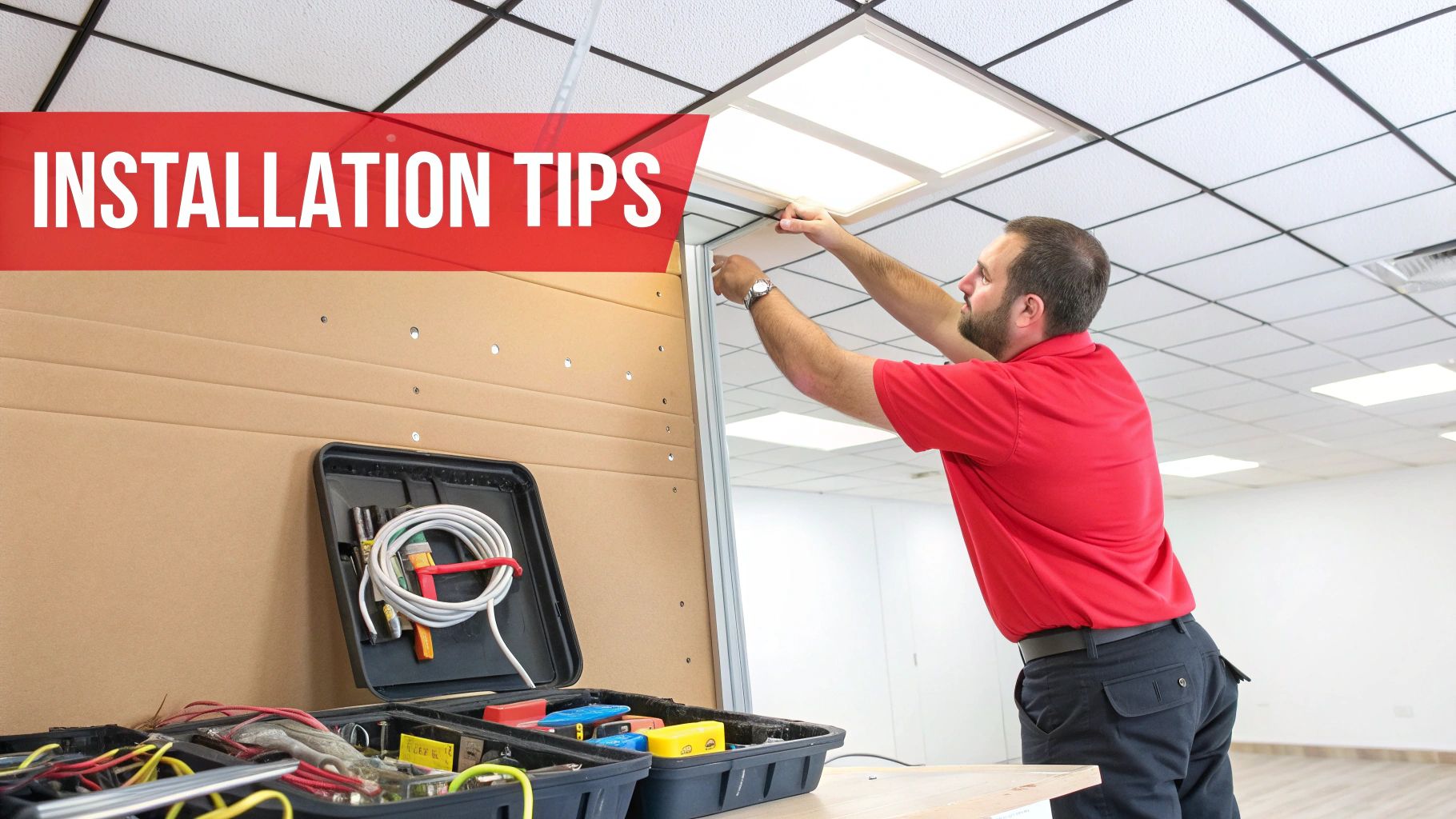
- Recessed Installation (T-Bar Grid Ceilings): The standard for modern offices. Simply remove the acoustic ceiling tile and place the LED panel light into the grid. Position the driver on top, ensuring adequate space for air circulation to prevent overheating.
- Surface-Mounted Installation (Solid Ceilings): For solid concrete or plasterboard ceilings, a mounting frame is required. Securely fix the assembled frame to the ceiling, wire the driver, slide the panel into the frame, and attach the final side to secure it.
- Suspended Installation (High Ceilings): A suspension kit with steel wires and mounting anchors is used for high ceilings. Attach anchors securely to the ceiling structure, connect the wires to the panel, and adjust to achieve the desired height and a level orientation.
Common Installation Mistakes to Avoid
Even experienced technicians can make errors. Be aware of these common pitfalls to ensure every LED panel light performs correctly.
- Mismatching the Driver and Panel: Never use a driver not supplied with the panel. Each driver is specifically matched to the panel's voltage and current requirements. An incorrect driver will cause poor performance, flickering, or permanent damage to the LED chips.
- Poor Wiring Connections: Loose connections are a primary cause of flickering and intermittent failure. Use appropriate connectors and ensure all connections are secure and properly insulated to prevent short circuits.
- Ignoring Heat Dissipation: In the GCC's climate, thermal management is crucial. Avoid placing the driver directly on the back of the panel, as this traps heat. Instead, position it on the ceiling grid or another adjacent surface to allow for proper airflow.
- Overlooking Proper Grounding: Failing to connect the earth wire is a serious safety violation. Proper grounding is essential for protection against electric shock and is a mandatory requirement under local UAE regulations.
A flawless installation is the final, critical step in delivering a high-performance lighting solution. Taking the time to follow these best practices ensures that the energy savings and long lifespan promised by the technology are fully realised.
This focus on quality installation is a big reason the market is growing across the region. The Middle East and Africa indoor LED lighting market was valued at USD 6.3 billion in 2025 and is projected to hit USD 8.65 billion by 2032, with government policies pushing the transition forward. You can read the full research about these market dynamics for a deeper dive.
Finding the Right Partner for Your Lighting Project in the UAE
As we've covered, the modern LED panel light is the premier choice for projects across the UAE, offering a powerful combination of efficiency, longevity, and superior illumination. However, maximizing your return on investment depends on more than just selecting a good panel; it requires precise specification—from CCT and CRI to the correct IP rating—and a flawless installation.
This leads to the final, crucial step: partnering with a supplier who understands the local market and its technical demands.
Your Go-To Technical Partner in the GCC
At GoSwitchgear, we are more than just a supplier of electrical components UAE; we are your technical partner. We understand that specifying the right lighting involves navigating complex datasheets and ensuring alignment with regional standards. Our team is equipped to support you through every stage of this process.
For those planning bigger moves, like setting up a local operation or building strategic partnerships for large-scale lighting projects, it's worth checking out this detailed guide on how to start a business in the UAE. It offers some great insights into the local business landscape.
Choosing the right components is only half the battle. To really succeed in the competitive UAE market, you need a supply partner who brings more than just products to the table—you need deep technical expertise and dedicated local support.
We invite you to explore our extensive catalogue of high-performance LED panel light solutions, each selected to meet the unique challenges of the GCC climate. Our technical specialists are available for project consultations, specification support, and logistical coordination to ensure your projects are completed on schedule and to the highest standards.
From initial design to final commissioning, GoSwitchgear is the partner you need to deliver superior lighting solutions in Dubai, Abu Dhabi, and across the region.
Frequently Asked Questions About LED Panel Lights
Here are answers to common questions encountered by professionals in the field, providing the practical information needed to select and install the right LED panel light for projects in the UAE and GCC.
What Is the Real-World Lifespan of an LED Panel in the UAE Heat?
This is a critical consideration for any project in our region. While panels are often rated for 50,000 hours, this figure is typically based on testing in controlled laboratory conditions. In the UAE, real-world lifespan depends on two factors: thermal management and driver quality.
A premium LED panel light with a robust aluminum heat sink and a high-quality isolated driver will perform much closer to its rated lifespan. A lower-cost panel with inadequate heat dissipation will experience accelerated LED degradation. Most often, the driver is the first component to fail under sustained thermal stress.
For any project in Dubai or Abu Dhabi, always request thermal performance data to verify a panel's suitability for the local climate.
Can I Directly Replace Old Fluorescent Troffers with LED Panels?
Yes, but it is not a simple plug-and-play replacement. Physically, the 600x600mm panel size is designed to fit directly into standard T-bar grid ceilings, making the mechanical swap straightforward. The electrical work, however, is critical.
The existing fluorescent ballast and starter must be bypassed or, preferably, removed entirely. The new LED panel light is powered by a dedicated driver that must be wired directly to the mains supply. Connecting the new driver to the old ballast will cause immediate failure of the panel and driver.
Crucial Tip: Safety is paramount. Always de-energize the circuit and confirm the old fluorescent components are completely disconnected before wiring the new LED driver.
Are Dimmable LED Panels Worth the Extra Cost?
For most commercial applications, the answer is a definitive yes. While the initial cost is higher, the investment provides returns in multiple ways.
- Enhanced Energy Savings: When paired with daylight harvesting sensors, dimmable systems automatically reduce light output when sufficient natural light is present, significantly lowering energy consumption.
- Improved Occupant Comfort: Providing users with control over their lighting environment has been proven to enhance comfort and productivity. This is a valuable feature for modern meeting rooms, private offices, and collaborative workspaces.
- Future-Proofing the Installation: Installing dimmable panels, particularly those using the DALI protocol, prepares the building for future integration into a broader smart building management system (BMS).
The initial premium for a dimmable LED panel light is quickly offset by reduced energy costs and a more flexible, user-centric environment, making it the intelligent choice for modern projects in the GCC.
For expert project support and access to a curated selection of high-performance LED panel lights engineered for the UAE climate, GoSwitchgear is your trusted partner.





.jpg)
Leave a Reply