.jpg)


Posted by:
Category:
Comments:
Post Date:
A Practical Guide to Pressure Sensors and Transducers in the UAE Climate
For engineers and panel builders across the UAE and GCC, the terms 'pressure sensor' and 'pressure transducer' are often used interchangeably. However, for designing a reliable system that withstands our region’s demanding climate, understanding the crucial difference is key to operational success.
A pressure sensor is the core sensing element that physically detects force. A pressure transducer is the complete assembly, integrating the sensor with signal conditioning electronics to provide a standardised, robust electrical output, such as the industry-standard 4-20mA signal. This distinction is critical for ensuring data integrity in high-temperature, high-interference industrial environments common in Dubai and across the GCC.
Why the Difference Matters for UAE & GCC Projects
Choosing the wrong component can lead to signal degradation, inaccurate readings, and system failure, especially in the high heat, dust, and humidity characteristic of the UAE. A pressure sensor’s raw millivolt output is vulnerable to electrical noise, while a transducer’s conditioned signal ensures reliability.
Think of it this way: the sensor is the nerve ending feeling the pressure. The transducer is the entire nervous system that converts this feeling into a stable signal for the brain of your operation—the PLC or control system. This clean, actionable data is what modern automation depends on.
Meeting Local Demands
The demand for precise pressure measurement is accelerating in the region, driven by the UAE's push into smart infrastructure and industrial automation. According to market research on pressure sensor trends in the Middle East, the market is set for significant growth, underscoring the need for durable components.
For projects in Dubai, Abu Dhabi, or KSA, several factors are non-negotiable when selecting pressure sensors and transducers:
- Signal Integrity: A transducer's 4-20mA output is far more resilient to electrical noise from VFDs and motors than a sensor's raw millivolt signal. In a crowded control panel, this means data you can trust.
- Environmental Resilience: Components must withstand extreme heat and humidity. A transducer with a high IP rating (e.g., IP65 or higher) is essential to protect sensitive electronics from dust and moisture ingress.
- System Compatibility: Transducers provide a standardised output that integrates seamlessly with PLCs and other control hardware, simplifying system design and commissioning.
By understanding this fundamental difference, you can specify components that guarantee long-term performance and reliability for any system built in the challenging GCC environment.
How Different Pressure Sensors Actually Work
To select the right pressure sensor for a project, understanding the underlying technology is essential. Each operational principle offers distinct advantages, making certain types better suited for specific applications—from a petrochemical plant in Saudi Arabia to a sophisticated HVAC system in a Dubai skyscraper.
At its core, a pressure sensor converts physical force from a liquid or gas into an electrical signal. The method of conversion defines the sensor type and dictates its performance characteristics, such as sensitivity, ruggedness, and cost.
Think of it like this: the sensor is the nerve ending that feels the pressure, while the transducer is the part that translates that feeling into a clear signal the brain (your control system) can act on.
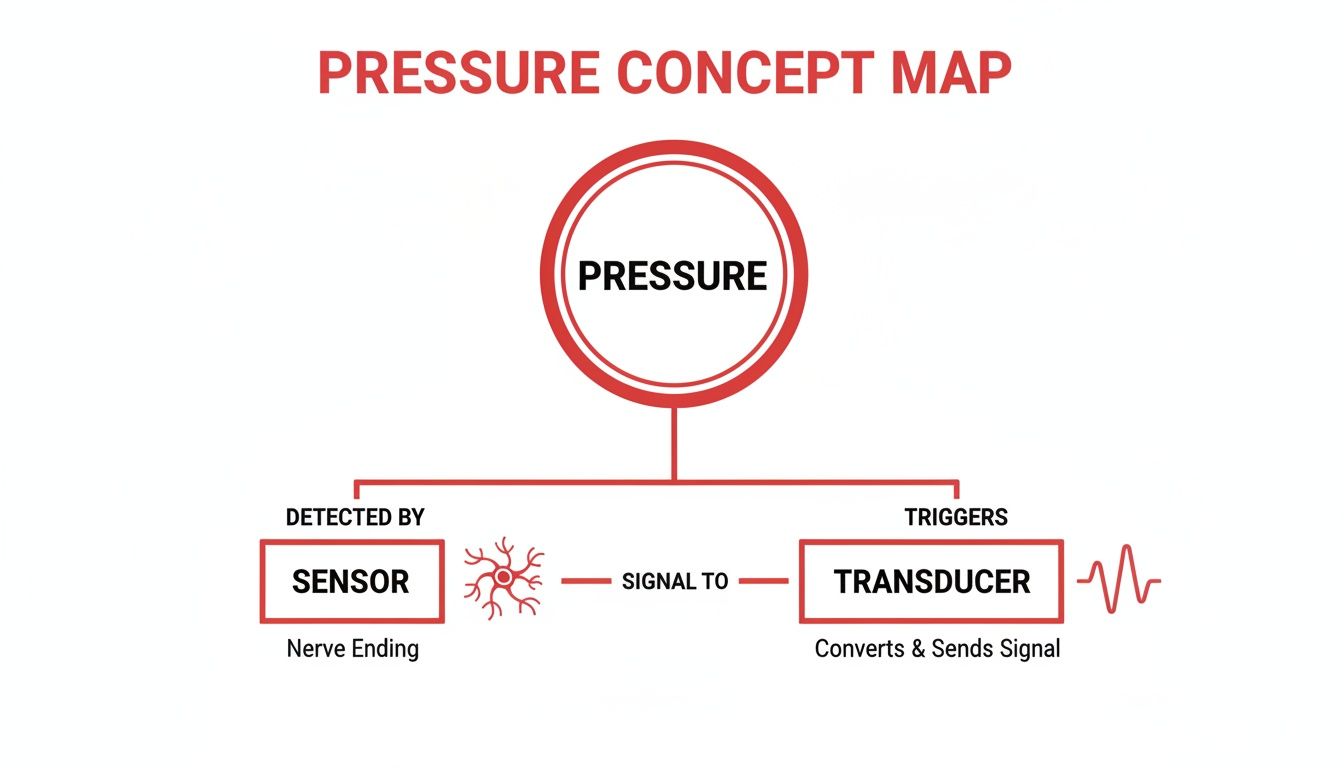
This difference is key for system integrators. The transducer’s conditioned signal is what ensures the data stays clean and reliable, even when sent over long cables in a noisy industrial plant.
Core Sensing Technologies
Engineers in the GCC will usually run into three main types of sensing technology. Each has its own strengths, making it the perfect choice for certain applications.
For most panel building, process automation, and switchgear projects, piezoresistive pressure sensors and transducers are the go-to. They hit that sweet spot of accuracy, durability, and cost-effectiveness that most industrial applications demand. The table below breaks down the most common technologies you'll encounter.
Comparing Common Pressure Sensor Types for GCC Applications
For engineers and panel builders, selecting the appropriate sensor technology is the first critical step. This table compares the most prevalent types, their working principles, and where you're most likely to see them in action across the UAE and wider GCC.
| Sensor Type | Measurement Principle | Typical Application in UAE/GCC | Key Advantage |
|---|---|---|---|
| Piezoresistive (Strain Gauge) | Pressure flexes a diaphragm, changing the electrical resistance of attached strain gauges. | General industrial use: water pumps, hydraulic systems, process control in oil & gas facilities. | Robust, reliable, and cost-effective for a wide range of pressures. |
| Capacitive | Pressure changes the distance between two capacitor plates, altering their capacitance. | HVAC systems for airflow monitoring, cleanrooms, and low-pressure gas measurement. | Extremely sensitive and ideal for measuring very low pressures with high accuracy. |
| Piezoelectric | Special crystals generate a voltage when mechanically stressed by pressure. | Dynamic pressure measurement: engine combustion analysis, blast monitoring, high-frequency hydraulics. | Excellent for capturing fast-changing or high-frequency pressure events. |
While capacitive and piezoelectric sensors have their specific niches, the piezoresistive (strain gauge) type remains the workhorse for the majority of industrial and commercial projects in the region.
Understanding Pressure Measurement Types
Beyond the internal tech, pressure sensors and transducers are also classified by what they measure against. This reference pressure is absolutely critical for making sure the data you get is actually useful for your application.
In an industrial plant, choosing the wrong pressure type isn't a small mistake—it can lead to major operational errors. Using a gauge sensor to monitor a vacuum process, for example, will give you completely misleading data because it won't account for daily changes in atmospheric pressure.
Let’s break down the four main types with some practical UAE examples:
- Gauge Pressure (psig): This is the most common type, measuring pressure relative to local atmospheric pressure. A prime example is checking tyre pressure. In a Dubai facility, it's used for monitoring water pump output or compressed air lines.
- Absolute Pressure (psia): This measures pressure relative to a perfect vacuum (zero pressure), unaffected by altitude or weather. It is crucial for vacuum pump monitoring in industrial zones or for precise refrigerant pressure management in HVAC systems.
- Differential Pressure (psid): This measures the pressure difference between two points. A classic application in the GCC is monitoring filters in an Air Handling Unit (AHU). As the filter clogs with dust, the pressure difference increases, signaling the BMS that maintenance is required.
- Sealed Gauge Pressure (psis): This is a gauge sensor sealed with a fixed reference pressure (usually standard atmospheric pressure at sea level). It's used where venting to the atmosphere is impossible, such as in submersible equipment for desalination plants.
Market data confirms the importance of these distinctions. The oil & gas sector's demand for precision, particularly for absolute pressure sensors, highlights the need for high-performance components like those supplied by GoSwitchgear. For more details, see these insights on growth drivers in the Middle East's pressure transmitter market.
Decoding Datasheets for the GCC Climate
For any system integrator or panel builder in the UAE and KSA, a datasheet isn’t just a page of numbers; it's a blueprint for reliability. Our region's extreme heat, corrosive humidity, and pervasive dust mean that a few key specifications determine whether a component will survive its first summer or provide years of reliable service.
Choosing the right pressure sensors and transducers starts with evaluating their performance against the unique challenges of the GCC. A sensor that performs flawlessly in a mild European climate could easily fail in an outdoor panel in Dubai. Nailing the specifications upfront prevents costly overpressure events, poor process control, and premature equipment failure.
Pressure Range and Overpressure Protection
First, check the pressure range, which defines the minimum and maximum pressures the device can accurately measure. Select a range that closely matches your application’s normal operating pressure for optimal signal resolution.
However, the overpressure rating is often more critical in our environment. Industrial systems can experience sudden pressure spikes from events like valve closures (water hammer). A sensor without adequate overpressure protection—look for at least 2x the maximum operating pressure—is vulnerable to rupture, leading to downtime and safety hazards.
Accuracy and Long-Term Stability
Accuracy, typically expressed as a percentage of full scale (%FS), indicates how close the sensor’s reading is to the true pressure. The difference between 0.5%FS and 0.25%FS can be significant for precise process control in applications like chemical dosing or HVAC chiller management.
Equally important is long-term stability (drift). The constant thermal stress from the GCC’s high ambient heat can cause sensors to lose calibration over time. Look for components with excellent long-term stability specifications to minimize maintenance and ensure consistent performance.
A datasheet might boast about a sensor's accuracy at a comfortable 25°C. For a panel sitting in the UAE sun, the real-world accuracy is what it can do at 50°C or higher. Always check the temperature compensation range to ensure the device doesn't lie to you when it gets hot.
Output Signal: 4-20mA vs. Voltage
The output signal transmits the pressure reading to your control system. The two primary types are voltage (e.g., 0-5V) and current (4-20mA).
For nearly any industrial application in Dubai and the wider GCC, the 4-20mA current loop is the superior choice for several reasons:
- Noise Immunity: It is highly resistant to electrical interference from VFDs, motors, and other switchgear components in control panels.
- Long-Distance Transmission: The signal remains stable over long cable runs without voltage drop, a significant advantage in large facilities.
- Built-in Diagnostics: A 0mA reading immediately indicates a broken wire or sensor failure, simplifying troubleshooting for maintenance teams.
Voltage outputs are generally suitable for short-distance connections within a single piece of equipment or in low-noise lab environments.
Material Compatibility and Ingress Protection
The physical construction of pressure sensors and transducers determines their survival in the Gulf.
- Wetted Parts: These are the materials in direct contact with the process fluid. For desalination plants or coastal projects, 316L stainless steel or more exotic alloys are necessary to resist corrosion from saltwater and humid air.
- Ingress Protection (IP) Rating: This two-digit code is non-negotiable. The first digit rates for solids (dust), and the second for liquids. For outdoor panels or dusty factory floors, IP65 is the absolute minimum, ensuring the device is dust-tight and can withstand water jets. For more demanding applications, IP67 or IP68 may be required.
The GCC's industrial growth, especially in the energy sector, is driving demand for such rugged components. This trend highlights the need for specialized, high-performance parts—like those from GoSwitchgear—that are engineered for local conditions.
Finding the Right Sensor for Your Industry
Choosing the right pressure sensors and transducers is a critical decision that directly impacts operational reliability, safety, and efficiency. For engineers and panel builders in the UAE, the application and environment are paramount. A transducer for an HVAC system in a Dubai skyscraper faces different challenges than one monitoring gas pressure in a switchgear assembly.
By understanding the unique demands of your industry, you can select a device that is truly fit-for-purpose, ensuring better performance, reduced maintenance, and the prevention of costly failures.
Switchgear and Panel Building
Inside control panels and switchgear units, space is limited and electrical noise is a constant challenge. The primary application is monitoring the pressure of insulating gas—typically Sulphur Hexafluoride (SF6)—which is vital for preventing arc faults in medium and high-voltage switchgear.
A loss of SF6 pressure can lead to catastrophic failure. This application demands sensors with exceptional long-term stability and a compact design suitable for crowded enclosures.
Key Integration Tips for Panel Builders:
- Signal Shielding: In an environment with high electromagnetic interference (EMI), a 4-20mA signal is essential. Use shielded twisted-pair cables for transducer wiring to maintain signal integrity.
- Proper Grounding: To prevent ground loops that introduce noise, ground the cable shield at one end only, typically at the control system side.
- Vibration Isolation: If the sensor is mounted near heavy contactors or transformers, use vibration-dampening mounts to protect its internal components and ensure accurate readings.
HVAC and Building Management Systems (BMS)
In the GCC’s commercial towers and residential complexes, HVAC systems are vital. Pressure transducers ensure these systems operate efficiently by monitoring chiller water pressure, refrigerant levels, and airflow in ventilation ducts.
Differential pressure transducers are crucial for monitoring air filter conditions. As a filter clogs with dust, the pressure drop increases, signaling the BMS that replacement is needed. This simple measurement improves air quality and prevents fans from overworking, saving significant energy.
Water and Wastewater Treatment
Water treatment and desalination are critical industries in the UAE and KSA, relying heavily on precise pressure measurement. Sensors are used to monitor pump outlet pressures, manage filtration backwash cycles, and control levels in storage tanks.
Given the corrosive nature of saline or chemically treated water, material selection is paramount.
In water treatment applications, specifying a transducer with a 316L stainless steel wetted part is not an option—it's a requirement for survival. The wrong material will quickly corrode in the harsh media, leading to premature failure and potential leaks.
Additionally, transducers with high IP ratings like IP67 or IP68 are often required for submersible equipment or in areas subject to frequent washdowns. For more information, industry publications offer valuable water technology insights.
Renewable Energy Systems
As the UAE expands its renewable energy infrastructure, pressure sensors and transducers play a crucial role. In large-scale solar farms, they monitor the hydraulic systems that control solar panel tracking mechanisms, ensuring optimal alignment with the sun.
In these remote and exposed installations, reliability is essential. Components must withstand extreme temperature swings from cool desert nights to intense midday heat. Selecting sensors with a wide compensated temperature range and a robust, sealed housing is critical for long-term, maintenance-free operation. Explore our full range of automation components to find solutions built for these harsh environments.
Installation and Maintenance Best Practices
Even the highest quality pressure transducer is only as effective as its installation. For engineers and facility managers in the UAE, proper setup is the first line of defense against inaccurate readings and premature failure, ensuring long service life and reliability under the demanding conditions of the GCC climate.
Proper Installation Techniques
A successful installation involves creating an optimal operating environment for the sensor. Attention to detail can significantly impact performance.
How to Install Pressure Transducers Correctly:
- Select the Right Location: Avoid mounting transducers directly on sources of heavy vibration, such as large motors or pumps, to protect sensitive internal components.
- Ensure Correct Orientation: Always consult the manufacturer’s datasheet for the recommended mounting orientation. Some sensors must be installed vertically to prevent sediment or condensation from accumulating on the diaphragm.
- Use Isolation Valves: Install a block-and-bleed valve assembly between the process line and the transducer. This allows for safe isolation during calibration or replacement without shutting down the entire process.
- Verify Torque Specifications: Use a torque wrench to tighten the transducer to the manufacturer's specified values. Over-tightening can deform the diaphragm, while under-tightening can lead to leaks.
Common Installation Mistakes to Avoid
Knowing what not to do is as important as knowing what to do. Many sensor failures are caused by simple, preventable setup errors.
A frequent mistake is improper wiring, especially with 4-20mA signals. Incorrectly grounding a shielded cable can introduce more electrical noise than it prevents, completely undermining the signal's integrity and leading to erratic readings at the PLC.
Watch out for these common slip-ups:
- Mounting Near Heat Sources: Keep sensors away from high-temperature pipes or equipment to prevent electronic drift and material degradation.
- Neglecting Drip Loops: In outdoor or humid installations, create a "drip loop" in the cable before it enters the transducer to prevent moisture from wicking into the electrical connection.
- Improper Cable Shielding: In noisy environments, ground the shielded cable at one end only (usually the control system side) to avoid creating a ground loop that acts as an antenna for interference.
Maintenance Schedule for GCC Conditions
A proactive maintenance strategy is essential for long-term accuracy and compliance with standards like ISO 9001. A clear schedule for calibration and inspection helps identify potential issues before they become critical failures. Learn more about developing a robust strategy in our guide to predictive vs. preventive maintenance.
| Frequency | Task | Rationale for UAE/GCC |
|---|---|---|
| Annual (Minimum) | Full Calibration | Verifies accuracy against a known standard and allows for adjustment of any drift. This is a baseline best practice. |
| Semi-Annual | Visual Inspection | Check for corrosion, physical damage, or loose connections. Coastal humidity and airborne dust accelerate these issues. |
| Quarterly | Zero/Span Check | A quick verification for critical instruments to ensure they haven't drifted, especially those exposed to extreme temperature swings. |
For sensors in particularly harsh environments, increase the frequency of these checks. A hands-on approach to maintaining your pressure sensors and transducers ensures they remain a reliable part of your control system.
Your Go-To Procurement Checklist for Dubai and KSA
Choosing the right pressure sensors and transducers in the GCC requires a framework that ensures compliance, reliability, and long-term value. This checklist helps procurement teams and engineers ask the right questions to select components that are truly fit-for-purpose in our demanding local environment.
Verification and Compliance
Technical and regulatory compliance is the first step. Getting this wrong can introduce non-compliant hardware, leading to safety risks or operational failures.
- Essential Certifications: Ensure the instrument has the required certifications. For the oil and gas sector, ATEX or IECEx certification for hazardous areas is mandatory. For general industrial use, look for CE marking and RoHS compliance.
- Material Traceability: Request material traceability certificates, especially for wetted parts. In desalination or petrochemical plants, you need proof that materials like 316L stainless steel are genuine to prevent corrosion.
- Calibration Certificates: Confirm that the device ships with a factory calibration certificate traceable to a known standard. This is vital for quality management systems like ISO 9001.
Supplier and Support Assessment
The quality of your supplier is as important as the component itself. In the fast-paced markets of the UAE and KSA, local support, clear communication, and reliable logistics are critical.
A low price tag means nothing if the supplier has zero local support. When a critical transducer fails on-site in Abu Dhabi, you need a partner who can provide immediate technical help and a quick replacement—not a company that's an ocean and a dozen time zones away.
Key Questions for Your Supplier:
- Local Warranty and Support: What is the warranty process, and is it managed locally? A supplier with a team in Dubai can resolve issues much faster.
- Lead Times and Stock: What are the realistic lead times for delivery to your site in the UAE or KSA? Ask about local stock of common models to shorten project timelines.
- Technical Expertise: Can the supplier’s team provide application support? A knowledgeable partner like GoSwitchgear will help you select the optimal pressure sensors and transducers, preventing over- or under-specification.
Procurement Checklist Table
This table summarizes the essential checks for any buyer in the UAE and GCC.
| Checklist Item | Key Consideration | Why It Matters in the GCC |
|---|---|---|
| Regulatory Compliance | Are ATEX/IECEx certifications present for hazardous areas? Is there CE marking for general use? | The region's dominant oil & gas and industrial sectors mandate strict safety standards. Non-compliance is a non-starter. |
| Material Verification | Request material traceability certificates for wetted parts (e.g., 316L SS, Hastelloy). | High salinity and corrosive process fluids in desalination and petrochemical industries demand proven material integrity. |
| Accuracy & Calibration | Does it include a traceable factory calibration certificate? Is the accuracy sufficient for the process? | Guarantees performance out of the box and is essential for quality control systems (ISO 9001) common in local industries. |
| Supplier's Local Presence | Does the supplier have a physical office or support team in the UAE or KSA? | On-the-ground support means faster troubleshooting, quicker replacements, and no international shipping delays for warranty claims. |
| Stock & Lead Times | Confirm local stock availability for standard models and realistic delivery timelines. | Project timelines in the GCC are often aggressive. Local stock can be the difference between meeting and missing a deadline. |
| Technical Support | Can the supplier's engineers provide expert advice on selection and integration? | A knowledgeable partner prevents costly mistakes like over-specifying or choosing incompatible materials for the application. |
| Environmental Ratings | Does the Ingress Protection (IP) rating match the installation environment (e.g., IP67 for dusty, wet areas)? | From dusty construction sites to humid coastal plants, the device must be sealed to survive the harsh local conditions. |
By following these steps, you build confidence in both the product and the partner, ensuring you source a robust, reliable system engineered to last in the unique conditions of the GCC.
Frequently Asked Questions
Here are some of the most common queries we hear from engineers, technicians, and procurement managers working with pressure instruments across the UAE and the wider GCC region.
What's the Real Difference Between a Pressure Transmitter and a Pressure Transducer?
While the terms are often used interchangeably, there is a key technical distinction.
A pressure transducer is the core component that converts pressure into a raw electrical signal, typically in millivolts (mV).
A pressure transmitter is a complete assembly that includes a transducer, but adds signal conditioning electronics to amplify and convert the raw signal into a standardized output like 4-20mA or 0-10V.
For nearly any industrial application in the UAE, especially over long distances or in noisy environments, a pressure transmitter is the recommended choice due to its superior signal reliability.
How often Should I Calibrate My Pressure Sensors in a Hot Climate Like the UAE's?
Annual calibration is the minimum best practice for critical processes.
However, given the extreme temperature swings and dusty conditions in the GCC, we strongly recommend a 6-month calibration cycle for sensors in outdoor or particularly harsh environments. This proactive approach ensures accuracy and helps prevent costly process disruptions. Always refer to the manufacturer’s recommendations and site-specific regulations.
Which Output Signal is Best for My Control Panel Project: 4-20mA or 0-10V?
For industrial control panels in Dubai and across the region, the 4-20mA signal is the undisputed champion.
The 4-20mA current loop is inherently much tougher against the electrical noise buzzing around inside a typical panel from motors, contactors, and VFDs.
A current signal is more robust against distortion and can be transmitted over longer distances without signal drop. Furthermore, it offers built-in diagnostics: a 0mA reading immediately signals a broken wire or sensor failure, simplifying troubleshooting. A 0-10V signal is better suited for short-range connections in low-noise environments.
Need expert support choosing the ideal pressure sensors and transducers for your project in the UAE? The GoSwitchgear team in Dubai is ready to provide technical guidance and project support.
Browse Our Full Range of Automation Components and Instruments
Share this post

Related
Posts
A Guide to Choosing AC to DC Converters for UAE & GCC Electrical Systems
Master AC to DC converters with this comprehensive guide for engineers in the UAE & GCC. Learn selection, installation, and...
A Guide to Drill Machine Prices in the UAE for Technical Professionals
Find the best drill machine price in UAE. Our 2026 guide helps contractors and engineers choose the right corded, cordless,...
A Professional’s Guide to Choosing AGM VRLA Batteries in the UAE Climate
Discover why AGM VRLA batteries are the superior power solution for UPS, solar, and industrial systems in the UAE. Get...
How to Choose the Right Lithium Ion Battery Charger for UAE & GCC Projects
Discover how to select the right lithium ion battery charger for UAE projects. This guide covers specs, BMS integration, and...
.jpg)