.jpg)


Posted by:
Category:
Comments:
Post Date:
Selecting the Right PVC Electrical Conduit Pipe for UAE & GCC Projects
For engineers, electricians, and procurement teams across the UAE and GCC, protecting electrical wiring from our harsh climate is a critical mission. In this environment, PVC electrical conduit pipe is the definitive solution, offering robust resistance to the heat, humidity, and corrosive dust that define the region and ensuring long-term project safety and compliance.
Why PVC Conduit is Essential for Electrical Systems in the UAE
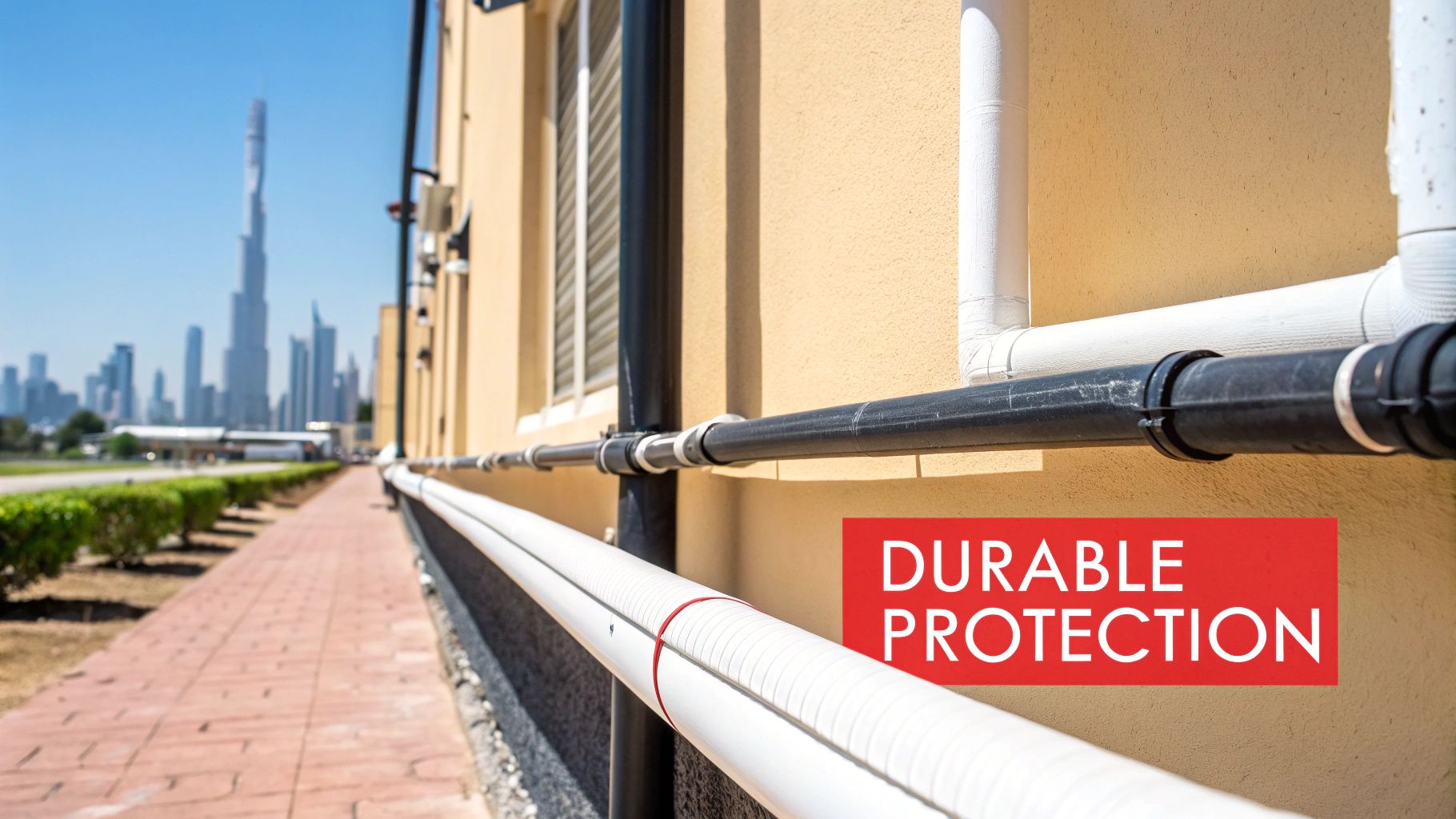
As an electrical contractor or panel builder in the UAE, you understand that selecting the right cable management solution is foundational to project success. The region's unique environmental challenges—intense heat, high humidity, and airborne dust—can rapidly degrade inferior materials, leading to system failures and significant safety hazards.
This is where PVC electrical conduit pipe demonstrates its value. Unlike metal alternatives susceptible to rust and corrosion, PVC is inherently inert, making it the ideal choice for exposed or underground installations. Its non-conductive properties also add a vital layer of safety, significantly reducing the risk of electrical shock and enhancing overall site safety.
Powering Regional Growth and Safety
The widespread adoption of PVC conduit is a direct response to the region's massive construction boom. The GCC PVC pipes market, a significant portion of which is for electrical applications, was valued at USD 1.78 billion in 2024 and is projected to reach USD 2.63 billion by 2033. This growth is driven by ambitious urban development in Dubai, Abu Dhabi, and across Saudi Arabia, all demanding reliable electrical infrastructure. For a detailed breakdown, see this in-depth PVC pipe market analysis.
For professionals at GoSwitchgear, this translates into tangible benefits for our clients:
- Enhanced Durability: Our PVC solutions guarantee long-term system integrity without the risk of corrosion.
- Cost-Effectiveness: It provides a budget-friendly solution for large-scale projects without compromising on quality or compliance.
- Compliance Assurance: Using our certified PVC conduit ensures adherence to stringent local and international electrical safety standards.
Explore our selection of high-quality PVC electrical tubing and fittings to ensure your next project is built to withstand the demanding GCC climate.
Decoding PVC Conduit Types and Material Strengths
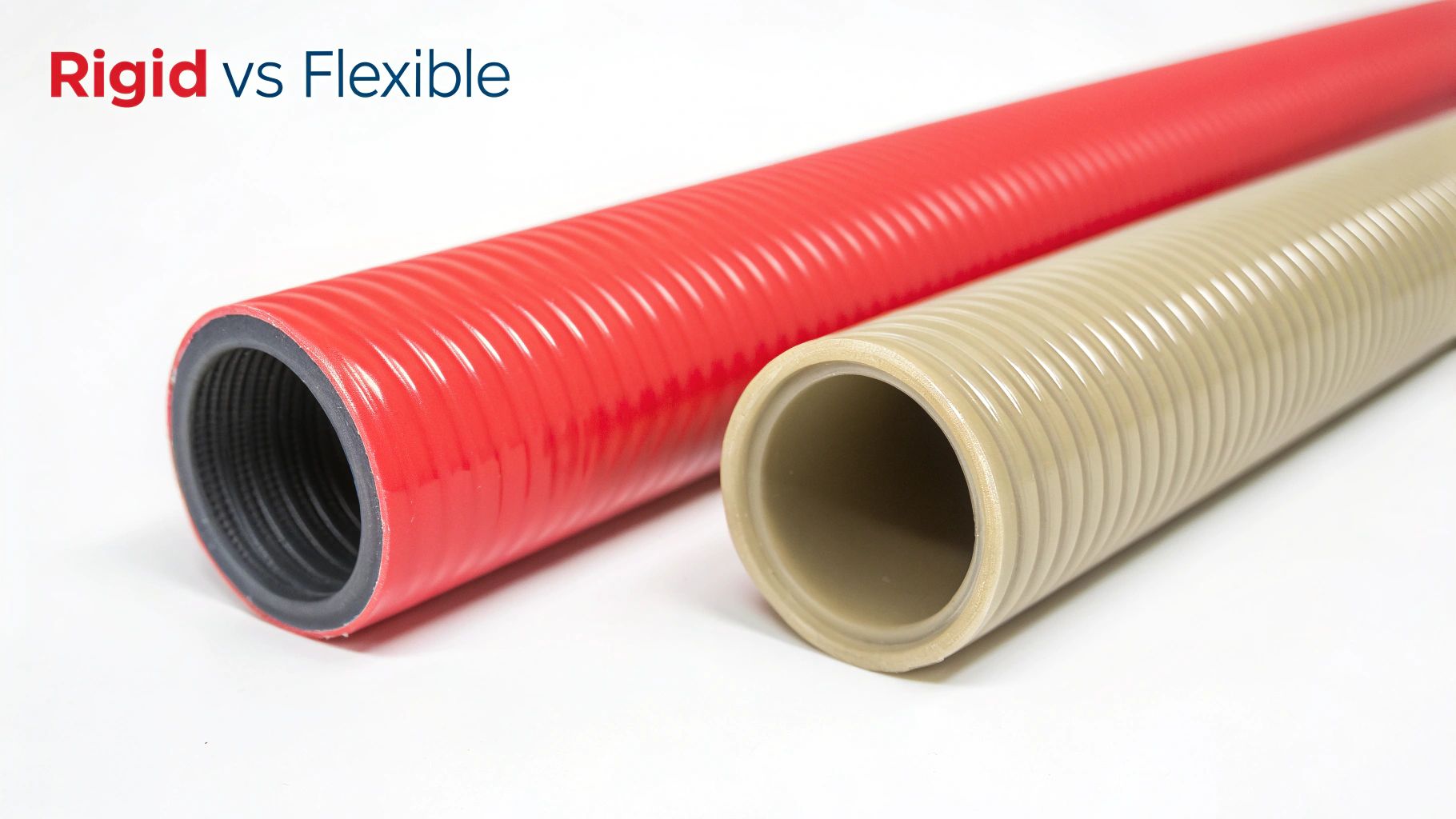
Choosing the right pvc electrical conduit pipe is a foundational decision. Success starts with understanding the core types available, as each variant is engineered to meet specific challenges encountered daily across the UAE and GCC. Electrical conduits are broadly categorized into rigid and flexible types, each serving a distinct purpose.
Rigid PVC, often referred to as UPVC (Unplasticized Polyvinyl Chloride), acts as the structural backbone of an electrical system. It is the workhorse for long, straight runs requiring high mechanical strength and impact protection. This makes it ideal for exposed installations along walls and ceilings or for underground burial where it must withstand the pressure of backfill.
Conversely, flexible PVC conduit is the problem-solver for complex routes. It is designed to navigate tight corners, connect to vibrating machinery, or traverse congested spaces where bending rigid pipe is impractical. Its corrugated design allows for easy shaping without compromising the integrity of the wiring inside.
Material Properties Built for the GCC Climate
PVC's material properties make it an excellent match for the harsh environmental conditions in Dubai, Abu Dhabi, and the wider region. Where metal alternatives like GI conduits can corrode, PVC offers long-term reliability. For a comparison, our guide on GI electrical conduits provides further insight.
Here’s why PVC is a superior contender in the local climate:
- Corrosion and Chemical Immunity: PVC naturally resists rust, acidic soil, and a wide array of chemicals, a critical advantage in coastal or industrial zones like JAFZA.
- UV Resistance: For outdoor applications exposed to intense sun, specialized UV-stabilized PVC conduits are essential. These formulations prevent the material from becoming brittle and cracking over years of exposure.
- Self-Extinguishing Fire Properties: Standard PVC is fire-retardant. If a flame source is removed, the material will not continue to burn—a critical safety feature for any building in the UAE.
Advanced Formulations for Enhanced Safety
For projects with stringent safety standards, such as hospitals, airports, or data centres, advanced PVC formulations offer enhanced protection.
Low Smoke Zero Halogen (LSZH) conduits are a prime example. In the event of a fire, these conduits emit minimal smoke and no toxic halogen gases. This improves visibility for evacuation and protects occupants and sensitive electronic equipment from corrosive fumes.
This focus on material science ensures a PVC conduit solution exists for virtually every application. Matching the right material to the project's specific safety, durability, and compliance needs guarantees a reliable and long-lasting electrical infrastructure.
Meeting Electrical Standards in the UAE and Saudi Arabia
For any project across the GCC, compliance is non-negotiable. Adhering to electrical standards is the critical step that guarantees the safety, reliability, and legal approval of an installation. When specifying pvc electrical conduit pipe, every engineer and procurement manager must be fluent in the relevant codes.
The primary standards in the region are IEC 61386 and its British equivalent, BS EN 61386. These standards provide a detailed breakdown of a product's performance under specific conditions.
Compliance is crucial for gaining approvals from authorities like the Dubai Electricity and Water Authority (DEWA) or the Saudi Electricity Company (SEC). Specifying a non-compliant product is a direct route to costly project delays, rework, and failed inspections.
Translating Key Conduit Ratings
Understanding the classification codes within these standards is key. Each digit in the classification string reveals a specific performance characteristic.
For projects in the UAE and Saudi Arabia, these ratings are paramount:
- Compression Resistance: The first digit indicates the force the conduit can withstand before deforming. A higher number signifies greater strength, essential for conduits buried in concrete or in high-traffic areas.
- Impact Resistance: The second digit measures the conduit's ability to handle impacts, particularly at low temperatures. This ensures the pipe remains durable during installation and throughout its service life.
- Temperature Range: The third and fourth digits define the minimum and maximum safe operating temperatures. This is a non-negotiable specification in the GCC's extreme climate.
The rapid growth in regional infrastructure makes these standards more important than ever. The GCC's PVC pipes market is set to climb from USD 1.78 billion in 2024 to USD 2.63 billion by 2033. This expansion is fueled by mega-projects that depend on strict adherence to safety and quality. For more on market dynamics, explore this comprehensive industry report.
To ensure all systems are up to code, using a commercial property due diligence checklist can help verify compliance across all building systems.
At GoSwitchgear, we ensure our entire range of PVC electrical conduit pipe meets or exceeds these critical standards, providing total peace of mind that your project is compliant and built to last.
How to Select the Right PVC Conduit for Your Project
Choosing the correct PVC electrical conduit pipe is a critical decision that impacts a project's timeline, budget, and long-term safety. A mismatch can lead to compliance failures, premature degradation, or costly rework. For projects in the UAE and GCC, the selection must account for unique environmental stresses and local regulations.
The right choice depends on an application-first approach. The demands for an indoor office space differ significantly from an outdoor solar farm or an underground industrial plant.
This is particularly true in Saudi Arabia, where Vision 2030 projects are driving massive demand. The Middle East & Africa electrical conduit market is growing at a CAGR of 8.4%, largely due to PVC's impressive 50-year lifespan in harsh desert conditions. A deeper look at how regional projects shape the market is available in this detailed industry analysis.
Matching Conduit to Application
Here are the most common scenarios in the region and the ideal conduit for each:
- Indoor Commercial Installations: Standard rigid PVC (UPVC) is suitable for concealed wiring in walls, ceilings, or plenums in offices, malls, or hotels. It offers excellent mechanical protection and fire-retardant properties cost-effectively.
- Outdoor Exposed Installations: For conduits on rooftops or exterior walls, UV-stabilized PVC is mandatory. This specialized blend prevents the pipe from becoming brittle and cracking under constant solar radiation.
- Underground and Direct Burial: For underground applications, heavy-duty or Schedule 80 rigid PVC is required to handle the compressive forces of soil and backfill. Its immunity to moisture makes it superior to metal in these environments.
- Industrial and Solar Projects: These demanding environments often require a hybrid approach. Rigid, UV-stabilized PVC is used for long, straight runs, while flexible electrical conduit options are necessary for connecting to vibrating equipment or navigating tight spaces.
This quick selection matrix simplifies choosing the best conduit for common GCC applications.
PVC Conduit Selection Matrix for GCC Applications
This table outlines recommended conduit types based on installation environment, key specifications, and real-world examples.
| Application Environment | Recommended Conduit Type | Key Specification to Check | Example Project |
|---|---|---|---|
| Indoor (Concealed) | Standard Rigid PVC (UPVC) | Fire Retardancy (BS EN 61386), Medium Duty | Office fit-out in a Dubai high-rise |
| Outdoor (Exposed to Sun) | UV-Stabilized Rigid PVC | UV Resistance, High-Temperature Rating | Rooftop solar panel array in Abu Dhabi |
| Underground (Direct Burial) | Heavy-Duty Rigid PVC (Sch 80) | High Compression Strength (e.g., 4000N) | Underground cabling for a new villa community |
| Industrial (Mixed Use) | UV-Stabilized PVC & Flexible | Impact Resistance, Chemical Resistance, IP Rating | Power distribution in a JAFZA warehouse |
Using this matrix as a guide ensures an informed decision based on environmental demands.
Key Specifications to Verify
Beyond selecting the type, verifying specifications is crucial for a compliant and robust installation.
A project's success often hinges on details. Verifying IP ratings for water and dust ingress, checking compression strength for buried applications, and ensuring compliance with local utility standards like DEWA or SEC are the final checks that guarantee a safe, durable, and successful installation.
This decision tree visualizes the compliance path for projects in the UAE or Saudi Arabia.
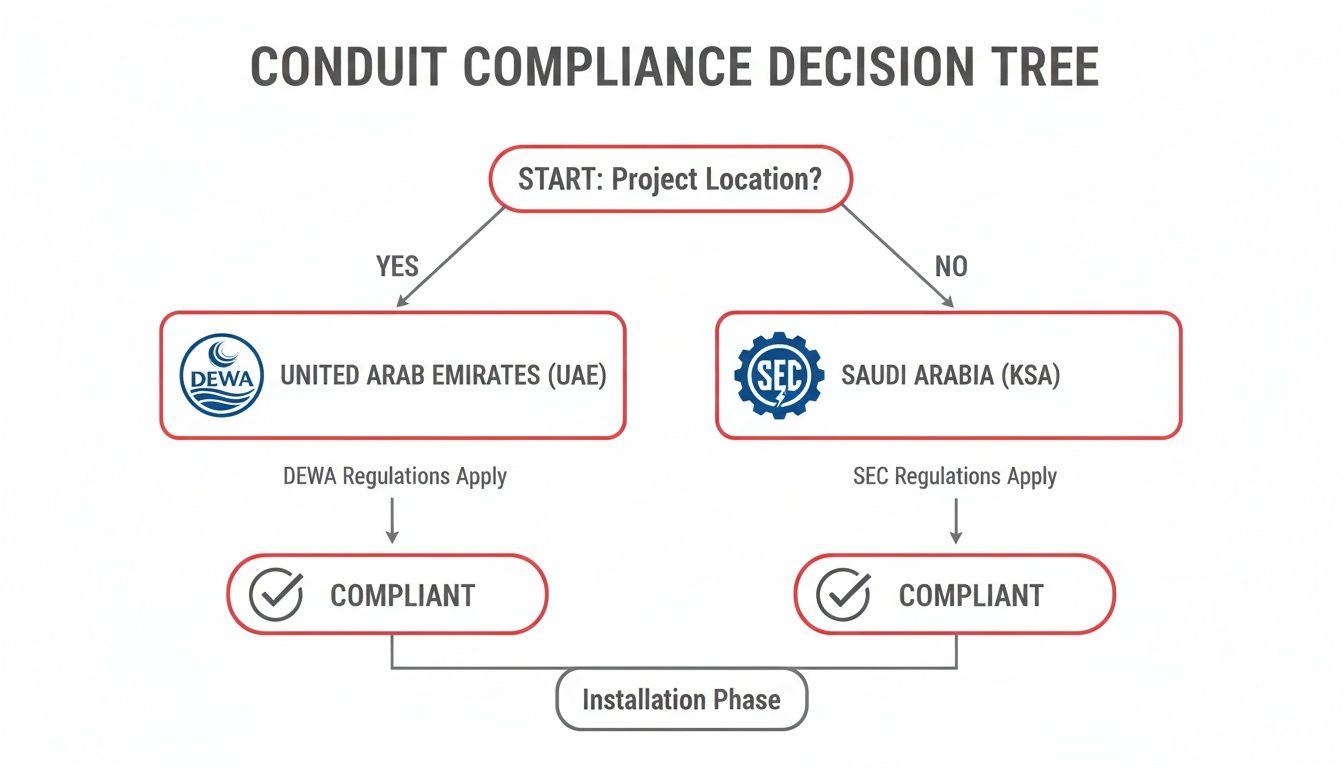
The first step is always to identify the local authority’s requirements. By carefully matching the conduit to the application and verifying its specs against local standards, you engineer an electrical system that is built to last.
Installation Best Practices for Lasting Performance
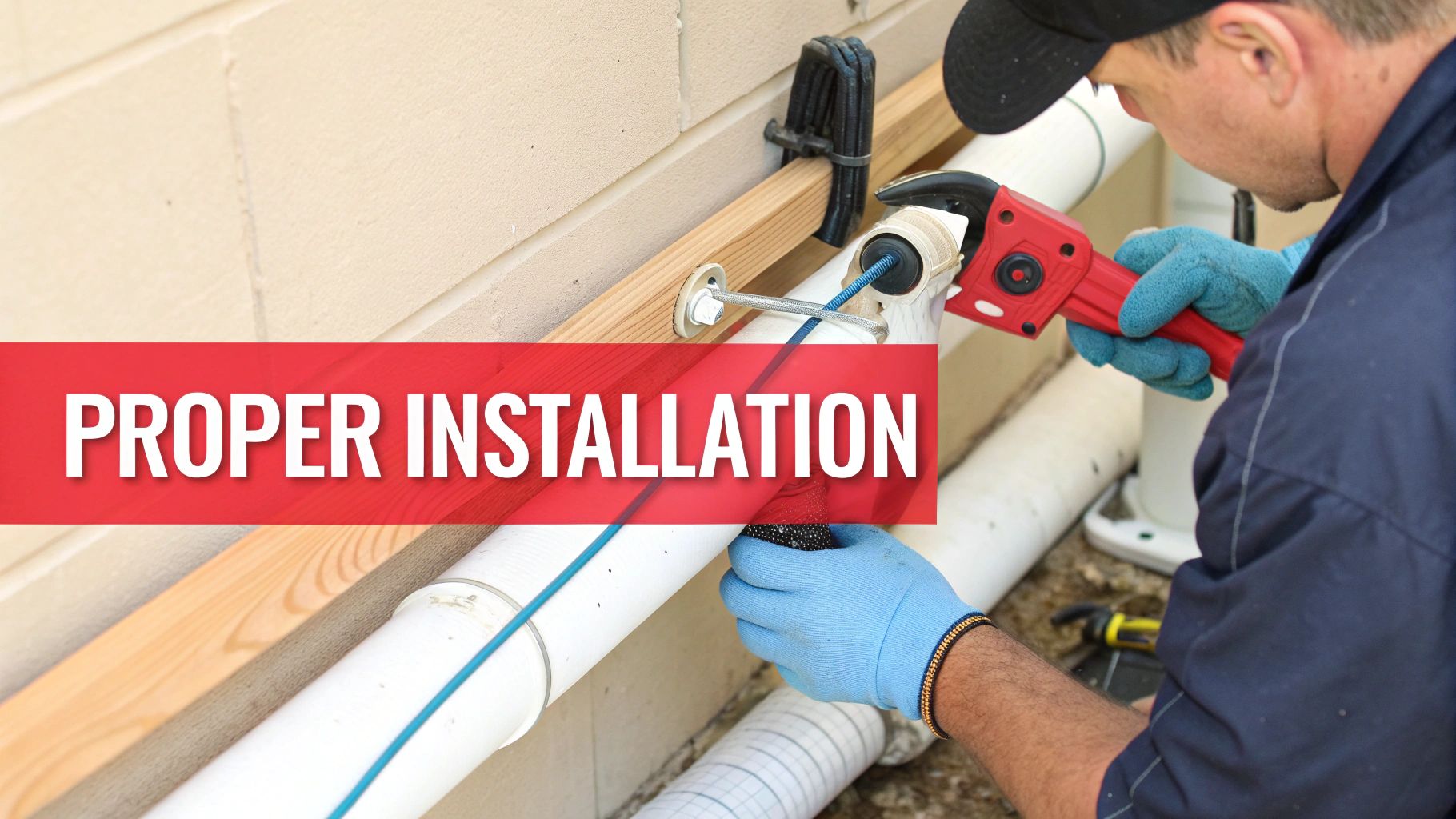
A high-performance electrical system depends not only on quality components but also on expert installation. Proper handling and assembly of pvc electrical conduit pipe are critical for preventing failures, ensuring compliance, and protecting wiring, especially in the demanding UAE climate.
Mastering the Fundamentals of Conduit Assembly
Clean, precise connections are the foundation of a robust conduit system. Each joint must be perfectly sealed to prevent ingress of moisture, dust, and corrosive agents.
Follow these key steps for professional, lasting results:
- Make Clean Cuts: Use a purpose-built PVC cutter or a fine-toothed saw to achieve a square, clean cut for optimal solvent welding.
- Deburr Every Edge: Remove plastic burrs from the inside and outside edges with a deburring tool or utility knife to prevent damage to wire insulation during pulling.
- Apply Primer and Solvent Cement: Use a primer to clean and soften the PVC surfaces, then apply an even coat of solvent cement to both the pipe end and the fitting interior.
- Join and Hold: Push the pipe into the fitting with a slight twist to distribute the cement evenly. Hold firmly for at least 30 seconds to allow the solvent weld to set properly.
Adapting to the GCC Climate: Thermal Expansion and Support
The significant temperature fluctuations in the GCC cause PVC to expand and contract. Ignoring this thermal movement can lead to buckled conduits, stressed joints, and broken fittings.
For any outdoor run of pvc electrical conduit pipe longer than 8 metres (approx. 25 feet), installing expansion fittings is essential to accommodate thermal movement and prevent system damage.
Proper support spacing is equally important. In high heat, inadequately supported PVC will sag, creating low points where moisture can collect. Per local guidelines, support spacing for smaller PVC conduits should not exceed 1 metre (approx. 3 feet). This prevents sagging and maintains the structural integrity of the installation.
Common Installation Mistakes to Avoid
Even experienced professionals can make errors that compromise a system. Engaging qualified electricians who understand the nuances of compliant and safe installation is vital.
Watch for these common mistakes:
- Improper Gluing: Insufficient cement creates a weak joint, while excessive cement can cause an internal blockage.
- Exceeding Bend Radii: Forcing a tight bend stresses the pipe and complicates wire pulling. Use factory-made bends or a proper heating tool for gradual sweeps.
- Inadequate Support: Failing to provide sufficient support, especially in high-temperature areas like Dubai or Riyadh, will inevitably lead to sagging and system failure.
By focusing on these best practices—clean cuts, proper welding, thermal expansion management, and adequate support—you ensure a secure, compliant, and durable installation.
Frequently Asked Questions About PVC Electrical Conduits
When specifying or installing pvc electrical conduit pipe, practical questions often arise. Here are field-tested answers to common queries from professionals across the UAE to keep your project compliant and safe.
Do I Really Need UV-Stabilized Conduit for All Outdoor UAE Projects?
Yes, absolutely. For any conduit exposed to direct sunlight, using a UV-stabilized version is non-negotiable. Standard PVC will become brittle and crack over time due to the intense solar radiation in the GCC.
For any rooftop installation or exterior wall run, specifying UV-rated PVC is critical for the longevity of the electrical system and the protection of the wiring within.
What Is the Difference Between Schedule 40 and Schedule 80 PVC?
The primary difference is wall thickness, which determines the conduit's mechanical strength and impact resistance.
- Schedule 40 PVC: The standard choice for most commercial and residential applications where conduit is concealed within walls or ceilings. It provides adequate protection for general use.
- Schedule 80 PVC: Features a thicker wall for superior strength and impact resistance. It is specified for demanding industrial environments, areas with heavy vehicle traffic, or exposed locations where physical damage is a risk.
For instance, near a loading dock in JAFZA, Schedule 80 is the correct and safer specification.
Key Takeaway: Schedule 40 is for general, protected applications, while Schedule 80 is the heavy-duty option for areas with a risk of physical impact. Using the incorrect schedule can lead to crushed conduits and compromised circuits.
How Do I Calculate Safe Wire Fill Capacity?
Correctly calculating wire fill is crucial for preventing conductor overheating and ensuring compliance with DEWA and other local regulations. The rule of thumb is that the total cross-sectional area of all conductors inside a conduit should not exceed 40% of the conduit's internal cross-sectional area.
This 40% limit provides sufficient air space for heat dissipation and facilitates easier wire pulling without damaging insulation.
To calculate it:
- Sum the total cross-sectional area of all wires (found on manufacturer datasheets).
- Find the internal area for the chosen pvc electrical conduit pipe size.
- Ensure the total wire area is less than 40% of the conduit's internal area.
Always leave extra capacity for future additions. Overfilling a conduit is a common and dangerous mistake that can lead to system failures.
Your Partner for Compliant Electrical Projects in the UAE
Choosing the right PVC electrical conduit pipe is a fundamental decision for the success and safety of any electrical project in the GCC. Prioritizing high-quality, compliant products is an investment in long-term durability and performance that can withstand our demanding climate. It is the foundation for building a robust, safe, and regionally compliant infrastructure.
At GoSwitchgear, we understand the specific challenges and stringent requirements of projects across the UAE. Our inventory is curated to offer solutions that not only meet but exceed specifications for compression strength, impact resistance, and thermal stability.
Building with Confidence
We invite you to explore our comprehensive range of PVC conduits and fittings. Our teams in Dubai and Abu Dhabi are more than just suppliers; they are your project partners, ready to provide expert technical support and streamline procurement to ensure you get the right materials on time. Contact us for project support and let's work together to power your next project with the confidence that comes from full compliance.
For a complete selection of compliant electrical components, trust GoSwitchgear. Explore our full range of products to support your projects across the UAE and GCC.
Share this post

Related
Posts
What Is Switchgear? Types, Components & How It Works in Electrical Systems
30 Second Summary Switchgear protects, controls, and isolates electrical equipment in power systems. It includes breakers, relays, fuses, panels, and disconnect switches. Different...
What Is a Current Transformer and Why It Matters for UAE Energy Projects
30 Second Summary A current transformer steps down high electrical current to safe, measurable levels for protection and metering. It plays a...
A Practical Guide to Choosing Cable Tray Manufacturers in UAE
Find trusted cable tray manufacturers in UAE. This guide helps you compare materials, standards, and choose the best supplier for...
How to Choose the Right Flow Rate Sensor for Water in the UAE
Your expert guide to selecting the right flow rate sensor water in the UAE. Compare technologies and learn best practices...
.jpg)