.jpg)


Posted by:
Category:
Comments:
Post Date:
A Guide to Solar Inverter Price in UAE for Engineers & Procurement Teams
When budgeting for a solar project in the UAE, the solar inverter price in UAE is a primary consideration, typically falling between AED 500 to AED 1,500 per kilowatt (kW). However, this is merely a starting point. The final cost is heavily influenced by inverter type, brand, capacity, and critical technical specifications required for the demanding GCC climate.
Decoding Solar Inverter Costs in a Growing Market
For engineers, procurement teams, and panel builders in the UAE and wider GCC, a comprehensive understanding of the solar inverter market is essential for project success. The inverter's price is a strategic investment that directly impacts the solar plant's performance, reliability, and long-term financial returns. As the core component converting DC power to usable AC power, its quality is non-negotiable.
The UAE's strategic push towards clean energy has cultivated a dynamic market, influencing equipment availability, technology trends, and pricing. Key factors shaping the final quote include:
- Technology Type: The choice between a string, hybrid, or off-grid model depends on project requirements and significantly affects cost.
- Brand and Origin: Premium European brands often have a higher initial cost, which may be justified by superior warranties, higher efficiency, and robust build quality suited for the local climate.
- System Capacity: Economies of scale apply, with the price per kilowatt typically decreasing for larger commercial or utility-scale projects.
Market Growth and Its Impact on Pricing
The UAE's solar sector is experiencing exponential growth, directly impacting component pricing. Projections indicate a steep rise in market revenue, signaling strong demand and continued investment in renewable infrastructure. This competitive environment affects stock levels and the adoption rate of new, efficient technologies.
This chart illustrates the projected growth for the UAE's solar inverter market revenue through 2030.
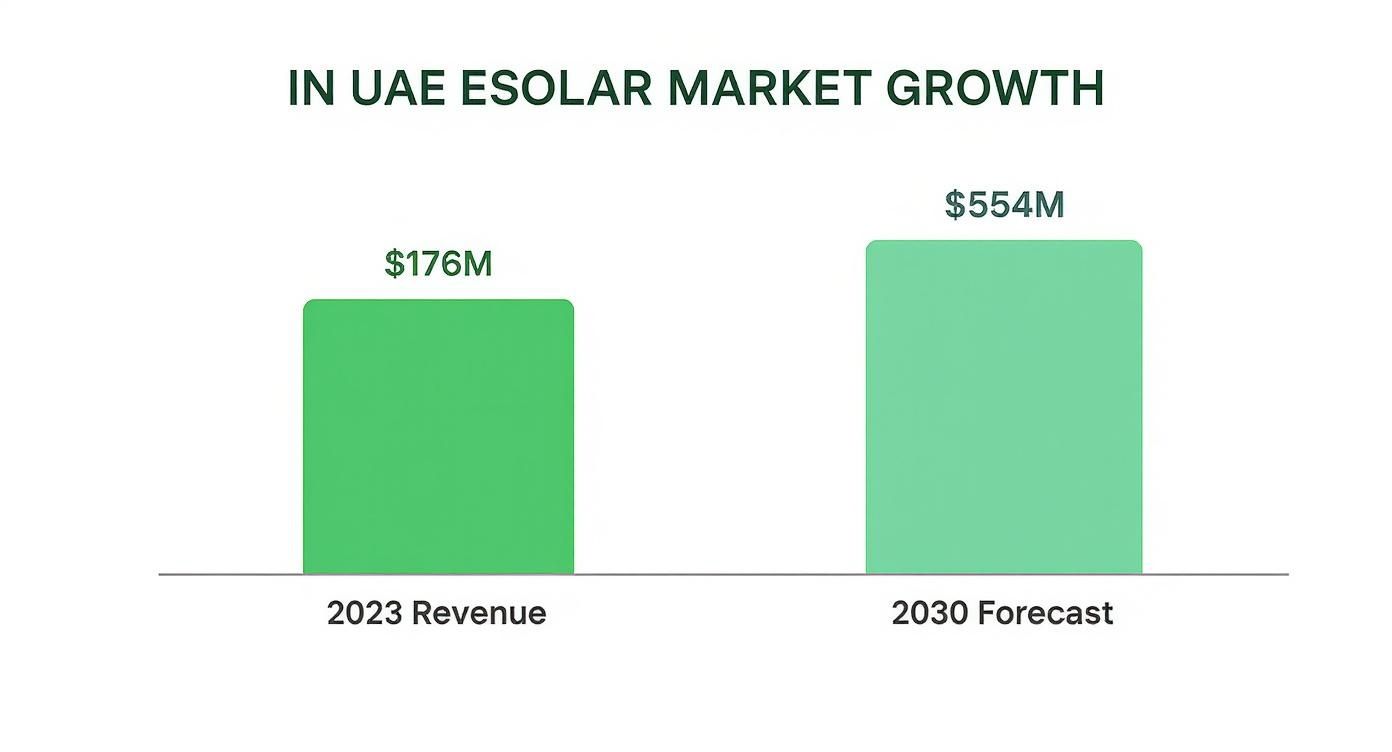
The UAE solar inverter market was valued at USD 175.6 million in 2023 and is projected to reach USD 554.4 million by 2030, driven by initiatives like the UAE Energy Strategy 2050. You can read the full research about the UAE PV inverter market for more detail.
A strategic procurement decision must extend beyond the initial sticker price to include installation costs, Balance of System (BOS) components, and long-term value derived from efficiency and warranty terms. This guide will deconstruct the true solar inverter price in UAE to support informed decision-making.
How Inverter Types Impact Your Project Costs
Selecting the right solar inverter technology in the UAE directly influences the upfront solar inverter price in UAE, system performance, and long-term ROI. For engineers and procurement teams, understanding the functional differences between inverter types is fundamental to aligning project goals with budgetary constraints. The choice depends on site-specific needs, from a residential villa in Dubai to a large industrial facility in Abu Dhabi.
String Inverters: The Industry Standard
String inverters are the most common and cost-effective solution for many solar projects across the GCC. They operate by connecting multiple solar panels in a series ("string") to a single, centralized inverter.
- Best Use Case: Ideal for large, unobstructed areas with uniform sun exposure, such as warehouse rooftops or ground-mounted solar farms.
- Advantages: Lower initial cost, simpler installation, and straightforward maintenance.
- Limitations: The entire string's performance is limited by the least productive panel. Shade or soiling on one panel can significantly reduce the output of the entire string.
Hybrid Inverters: The Versatile Energy Management Solution
Hybrid inverters represent a significant advancement, combining the functions of a standard grid-tied inverter with a battery inverter. This makes them the central component for modern energy management solution Dubai projects focused on energy independence.
- Energy Storage Management: They intelligently store excess solar energy in batteries for use at night or during grid outages.
- Peak Shaving: For commercial clients in Dubai and Abu Dhabi, the inverter can discharge battery power during peak demand hours, reducing costly electricity bills.
- Grid Independence: Provides seamless backup power during outages, ensuring critical systems remain operational.
The higher price of a hybrid inverter is justified by its versatility and resilience, making it a strategic investment for projects where self-consumption and power security are priorities. Our guide on solar PV components offers more detail on building these advanced systems.
Microinverters and Power Optimisers: Precision for Complex Sites
For installations with partial shading, multiple roof orientations, or varying panel angles, microinverters and DC power optimisers are the optimal solution.
- Microinverters: Installed on each panel, converting DC to AC at the source.
- Power Optimisers: Condition DC power from each panel before sending it to a central string inverter.
Both technologies ensure that the performance of one panel does not affect others, maximizing energy yield. While the initial cost per watt is higher, the long-term ROI in challenging environments can be substantial due to increased energy production.
For projects with complex roof layouts, the higher initial cost of microinverters can be offset by a 5-25% increase in energy production over the system's lifetime compared to traditional string inverters.
Off-Grid Inverters: Powering Remote Operations in the GCC
Engineered for locations without grid access, off-grid inverters are robust units designed for complete energy self-sufficiency. They are always paired with large battery banks and often a backup generator.
Their design prioritizes extreme reliability and advanced battery management, making them more expensive than grid-tied equivalents. They are the essential solution for remote industrial sites, agricultural farms, and desert camps throughout the GCC.
Key Factors That Drive Inverter Pricing in the UAE
When evaluating solar inverter quotes, procurement teams and engineers must look beyond the core technology. Several factors influence the final price, determining real-world performance, reliability in the demanding GCC climate, and overall lifetime value. These elements are critical for making a sound financial decision.
Brand Reputation and Country of Origin
While inverters from established European manufacturers often command a higher price due to long track records and R&D investment, the market has evolved. Many high-quality, certified inverters from Asian manufacturers offer excellent value. The focus should be on performance data, certifications, and, most importantly, local market presence and support within the UAE.
Warranty and Local Support Services
An inverter's warranty is a critical component of its value. A standard 5 to 10-year warranty is common, with premium models offering extensions up to 20 years. In the UAE market, the availability of local support and service centres is paramount.
A strong, locally-backed warranty ensures faster troubleshooting, ready access to spare parts, and on-the-ground technical expertise. This minimises system downtime and protects revenue, quickly offsetting a higher initial investment.
Technical Specifications for the UAE Climate
The UAE's environment of extreme heat, humidity, and dust makes certain technical specifications non-negotiable.
- IP (Ingress Protection) Rating: An IP65 or IP66 rating is essential for outdoor installations to protect against dust and moisture ingress. This is a critical factor when selecting electrical components UAE.
- Operating Temperature Range: Premium inverters feature superior thermal management to operate efficiently at high ambient temperatures (up to 50°C) without power derating. This feature is vital for consistent performance in the GCC.
- Efficiency Rating: While peak efficiency is important, the CEC or European weighted efficiency provides a more accurate measure of real-world performance. Higher efficiency directly translates to greater energy yield and faster ROI.
Regulatory Compliance and Certifications
Compliance with local utility standards is mandatory. In Dubai, all grid-tied inverters must be on the Dubai Electricity and Water Authority (DEWA) list of approved equipment. This certification guarantees the inverter meets stringent safety, performance, and grid-interaction standards (IEC, GCC). The rigorous testing required adds to the unit's cost but is essential for legal grid connection. Our Solar PV Components Guide provides a complete overview of compliant system parts.
Economies of Scale for Procurement Teams
For panel builders and procurement managers handling large-scale projects in Dubai or Abu Dhabi, order volume is a key price driver. Bulk purchases from suppliers like GoSwitchgear can unlock preferential pricing, making high-quality inverters more cost-effective for major installations.
Calculating the Total Cost of Ownership
A savvy procurement manager or project engineer understands that the initial solar inverter price in UAE is only part of the financial equation. The Total Cost of Ownership (TCO) provides a complete view of all expenses over the inverter's lifespan, enabling a stronger business case for investing in higher-quality units. This shifts the focus from short-term cost to long-term profitability and operational reliability.
Beyond the Upfront Cost: The Hidden Expenses
Several critical costs must be factored into the final project budget to ensure viability.
- Installation Labour: The man-hours required for mounting, cabling, and commissioning the system. Complex hybrid systems will require more specialised labour.
- Balance of System (BOS) Components: The budget must include essential surrounding equipment like DC and AC isolators, cabling, mounting hardware, and circuit protection. Quality BOS components are crucial for safety and reliability.
- Shipping and Logistics: Transporting equipment from a supplier's warehouse in Dubai to a project site in other Emirates is a tangible cost that must be accounted for.
- Value Added Tax (VAT): A standard 5% VAT applies to all electrical components UAE and must be included in the final budget.
LCOE and ROI: The True Measures of Value
A more expensive inverter with a higher efficiency rating can generate significantly more electricity over its 15- to 20-year operational life. This is where concepts like the Levelized Cost of Energy (LCOE) and Return on Investment (ROI) become critical evaluation tools.
The UAE's solar market is known for achieving some of the world's lowest generation costs, demonstrating how optimising every component, including the inverter, is key to financial success. When considering hybrid systems, potential solar battery backup costs must also be factored into the overall investment analysis.
Key Insight: A 1% gain in inverter efficiency can translate into thousands of dirhams in additional revenue annually for a large commercial system, significantly reducing the ROI period.
Cost-Benefit Comparison: Budget vs. Premium Inverter
This table provides a simplified TCO comparison for a 100 kW commercial system over 10 years, demonstrating the long-term value of a premium model.
| Feature / Metric | Model A (Budget Inverter) | Model B (Premium Inverter) |
|---|---|---|
| Initial Purchase Price | AED 35,000 | AED 45,000 |
| Installation & BOS | AED 10,000 | AED 10,000 |
| Total Upfront Cost | AED 45,000 | AED 55,000 |
| Efficiency Rating | 97.5% | 98.5% |
| Est. Annual Energy Yield | 171,000 kWh | 172,750 kWh |
| Est. Annual Revenue | AED 68,400 | AED 69,100 |
| 10-Year Revenue | AED 684,000 | AED 691,000 |
| 10-Year Net Value | AED 639,000 | AED 636,000 |
This comparison doesn't account for the lower maintenance costs and reduced downtime associated with Model B's superior build quality and longer warranty, which would further improve its TCO and confirm it as the superior long-term investment. Integrating comprehensive energy efficiency solutions can further enhance a project's financial performance.
Sourcing Inverters in the GCC Region
For electrical contractors, panel builders, and procurement managers in the UAE, sourcing the right solar inverter is a critical process of supplier selection, technical verification, and logistics management. A methodical strategy is essential to avoid counterfeit products, supply chain delays, and non-compliant equipment that could jeopardise a project.

Vetting Suppliers and the Value of Local Distribution
Partnering with an authorised local distributor like GoSwitchgear in the UAE offers significant advantages:
- Local Stock Availability: Reduces lead times and protects project timelines from international shipping disruptions.
- Technical Support: Provides access to local engineers with expertise in the product and regional climate challenges (heat, humidity, dust).
- Logistical Expertise: Manages customs, local transport, and paperwork, ensuring timely and hassle-free delivery to sites in Dubai, Abu Dhabi, or across the GCC.
- Warranty Fulfilment: Streamlines the warranty claim process, minimising costly system downtime.
Interpreting Datasheets and Verifying Certifications
A thorough technical review is a non-negotiable step in the procurement process.
How to Vet Datasheets: Pay close attention to the operating temperature range and ensure a minimum IP65 rating for protection against dust and moisture, which is critical for equipment survival in the UAE's environment.
Certification verification is equally important. For any project connecting to the Dubai grid, the inverter must be on the DEWA Approved Solar Inverters and Components list. This guarantees the product has been tested for safety (IEC standards), performance, and grid stability. Always request and verify proof of certification.
Navigating Supply Chains and Ensuring Authenticity
Given global supply chain volatility, working with transparent suppliers is crucial. Inquire about current stock levels, lead times for backordered items, and their relationship with manufacturers.
To mitigate the risk of counterfeit or "grey-market" products, source exclusively through manufacturer-authorised distributors. This ensures every component, including items like the Elmex PV Solar Straight Connector, is genuine, certified, and covered by a valid warranty, protecting your project's integrity and financial viability.
Making Your Final Inverter Decision
Choosing the right inverter is a critical decision that defines a solar project's success. After analysing the initial solar inverter price in UAE and the total cost of ownership, it's clear that the optimal choice balances upfront cost with long-term performance and reliability, especially in the demanding GCC climate. It's an investment in your project's future energy yield and financial returns.
Your Final Procurement Checklist
Before finalising a purchase, every engineer and procurement manager should use this checklist to ensure a value-based decision.
- Regulatory Compliance: Is the inverter DEWA-approved or compliant with other local utility standards? This is non-negotiable for grid-tied projects.
- Environmental Protection: Does it have a minimum IP65 rating to withstand the UAE's heat, dust, and humidity?
- Warranty & Support: What does the warranty cover, and is there a local service centre in the UAE for prompt support?
- Real-World Efficiency: Have you compared the weighted efficiency rating, not just the peak efficiency, for a true indication of performance?
- Supplier Authenticity: Is the supplier an authorised distributor for the brand, guaranteeing a genuine product and valid warranty?
Ultimately, a strategic decision will favor an inverter with a slightly higher initial cost but superior efficiency, a robust warranty, and strong local support. This approach will almost always deliver a better long-term ROI.
Partnering with a trusted local supplier like GoSwitchgear provides access to project-specific expertise, ensuring your final choice aligns perfectly with your technical and financial objectives.
Common Questions About Solar Inverters
Engineers, contractors, and procurement teams across the UAE frequently have questions when sourcing solar inverters. Here are practical answers to some of the most common inquiries.
What's the Going Rate for a 5kW Hybrid Solar Inverter in Dubai?
For a 5kW hybrid solar inverter, a popular choice for residential and small commercial applications in Dubai, expect a price range of AED 4,000 to AED 7,500. The variation is due to brand, features (e.g., advanced battery management), and warranty terms. Premium European brands typically fall at the higher end of this range.
Are Cheaper Chinese Inverters a Gamble in the UAE Climate?
An inverter's country of origin is less important than its technical specifications and certifications. Many Chinese manufacturers produce high-quality, reliable inverters suitable for the UAE's climate. The critical questions are: Is it DEWA-approved? Does it have at least an IP65 rating? Is the warranty supported by a local service centre in the UAE? Reliability is a function of compliance and local support.
How Much Does Installation Add to the Inverter's Price Tag?
As a best practice, budget an additional 10% to 20% of the total hardware cost for installation services. This figure can vary based on project complexity (a simple grid-tied system versus a hybrid system with battery storage) and site accessibility. Always obtain a detailed quote from a qualified installer.
Are There Any Government Subsidies for Solar Inverters in the UAE?
While direct cash subsidies for solar inverters are not available in the UAE, the government supports renewable energy through net metering schemes. Initiatives like Dubai's Shams Dubai allow you to export surplus solar energy back to the grid, earning credits that reduce electricity bills and significantly improve the project's overall ROI.
For project support in Dubai and competitive pricing on DEWA-approved inverters, explore the extensive catalogue at GoSwitchgear.
Share this post

Related
Posts
A Guide to Choosing AC to DC Converters for UAE & GCC Electrical Systems
Master AC to DC converters with this comprehensive guide for engineers in the UAE & GCC. Learn selection, installation, and...
A Guide to Drill Machine Prices in the UAE for Technical Professionals
Find the best drill machine price in UAE. Our 2026 guide helps contractors and engineers choose the right corded, cordless,...
A Professional’s Guide to Choosing AGM VRLA Batteries in the UAE Climate
Discover why AGM VRLA batteries are the superior power solution for UPS, solar, and industrial systems in the UAE. Get...
How to Choose the Right Lithium Ion Battery Charger for UAE & GCC Projects
Discover how to select the right lithium ion battery charger for UAE projects. This guide covers specs, BMS integration, and...
.jpg)