.jpg)


Posted by:
Category:
Comments:
Post Date:
Ceiling Access Panel: A Professional’s Guide for UAE & GCC Projects
A ceiling access panel may appear to be a simple cover, but for engineers and facility managers in the UAE, it is a critical gateway. It provides secure, controlled entry to the essential systems hidden within a building's ceiling void: electrical wiring, plumbing, HVAC ductwork, and data infrastructure. Selecting the right panel is a foundational decision for long-term operational integrity.
Why the Right Access Panel is Critical for UAE Buildings
In the demanding construction environment of the UAE and wider GCC, specifying the correct components is paramount. A ceiling access panel is not an afterthought; it is fundamental to a building's lifecycle management. A poorly chosen panel can obstruct maintenance, compromise safety, and lead to costly operational delays when access to critical systems is needed most.
A properly specified panel is non-negotiable for several key reasons:
- Operational Efficiency: It provides electricians, plumbers, and HVAC technicians with rapid, safe access for routine inspections, repairs, and system upgrades without damaging ceiling finishes.
- Emergency Response: In the event of a water leak or an electrical fault, a clearly identified, easily operable panel can significantly reduce response times, mitigating damage and operational disruption.
- Compliance and Safety: Adherence to local regulations in Dubai and Abu Dhabi is mandatory. Utilising the correct panels, particularly fire-rated models in designated zones, is essential for securing Civil Defence approvals and ensuring building safety.
Meeting the Demands of the GCC Climate
The regional environment presents unique challenges for building materials. High ambient temperatures, humidity, and airborne dust can degrade inferior products, causing corrosion, warping, or seizure of locking mechanisms. Standard, off-the-shelf panels are often unsuitable for the long-term demands of projects in the UAE.
Selecting a ceiling access panel engineered for the local climate is a strategic investment in the building's operational future. It mitigates the risk of premature failure and guarantees reliable access, preserving the integrity of the systems it protects.
The growth of the regional construction sector underscores the need for high-performance components. The Middle East and Africa ceiling market, encompassing the ceiling access panel segment, was valued at approximately USD 436.5 million in 2024 and is projected to reach USD 830.2 million by 2033. This growth is driven by advanced architectural designs and the practical necessity of accessing complex building services concealed by modern suspended ceilings.
These panels are also crucial for maintaining indoor air quality by enabling easy access for services like what air duct cleaning entails, which is vital for HVAC efficiency and occupant health.
Decoding the Main Types of Ceiling Access Panels
For an engineer or procurement manager in the UAE, selecting a ceiling access panel is a technical decision that must align with specific building requirements, environmental conditions, and stringent local codes. The choice is not merely about size or material; it's about matching a component's engineered purpose to its application, whether for fire containment, acoustic separation, or general service access.
Each panel type is designed to address a specific challenge. A fire-rated panel maintains the integrity of a fire compartment, while an acoustic panel prevents sound transmission. Making an informed decision at the specification stage prevents costly retrofits and ensures the building’s essential services remain both accessible and secure.
Standard Non-Fire Rated Panels
Non-fire rated panels are the most common solution for general-purpose access in commercial and residential projects across the GCC. Their primary function is to provide straightforward, reliable access to non-critical systems such as plumbing shut-off valves, data cable junction boxes, or basic HVAC dampers.
Typically constructed from steel or gypsum, these panels are designed for ease of installation and a clean, flush finish that integrates with the surrounding ceiling. They are the standard choice for office spaces, residential corridors, and retail environments where the ceiling assembly is not required to function as a fire barrier. While they offer no fire resistance, they are robustly built for frequent use by maintenance personnel.
This flowchart can help guide your decision-making process based on the project's core requirements.
The process begins with a simple assessment of fire rating needs and branches out, directing you toward the appropriate panel for any given application.
Critical Performance Fire-Rated Panels
When an access panel is specified for a fire-rated ceiling assembly, it must maintain the integrity of that fire barrier. In the UAE and KSA, Civil Defence regulations are explicit: any penetration in a fire-rated assembly must be sealed with a component of an equivalent fire rating. Consequently, fire-rated access panels are non-negotiable in such applications.
These panels are engineered to prevent the passage of fire and smoke for a specified duration, typically classified into two main categories:
- 1-Hour Fire Rated: This is the standard for most commercial and residential fire barriers, providing 60 minutes of protection. It is commonly required for electrical closets and service corridors.
- 2-Hour Fire Rated: Reserved for more critical zones, this panel provides 120 minutes of fire containment. Applications include high-risk electrical switchgear rooms or walls separating major building sections.
A fire-rated panel is a critical life-safety device, not just a metal door. It incorporates intumescent seals that expand when exposed to heat, sealing the gap between the door and frame to block flames and toxic smoke. Installing a non-rated panel in a fire barrier is a serious compliance violation.
Specialised Acoustic and Moisture-Resistant Panels
Beyond fire safety, other environmental factors common in the GCC necessitate specialised panel solutions.
Acoustic-Rated Panels
In environments where sound control is critical—such as boardrooms, recording studios, or healthcare facilities—a standard panel can compromise acoustic integrity. Acoustic-rated panels are constructed with sound-dampening materials and airtight gasket seals to reduce noise transmission, ensuring the ceiling maintains its specified Sound Transmission Class (STC) rating.
Moisture-Resistant Panels
High humidity across the UAE makes corrosion a persistent threat. For wet areas such as bathrooms, kitchens, or mechanical rooms, a moisture-resistant panel is essential. These are typically manufactured from galvanised steel, aluminium, or specialised gypsum composites engineered to resist rust, mould, and deterioration, ensuring long-term durability and aesthetic appeal.
This table provides a clear comparison of panel types for projects in the region.
Comparison of Ceiling Access Panel Types for GCC Applications
This table compares primary panel types based on key features, common UAE applications, and material properties to guide selection.
| Panel Type | Key Feature | Typical Application (UAE/GCC) | Common Materials | Best For |
|---|---|---|---|---|
| Standard Non-Rated | Simple, cost-effective access | Offices, residential hallways, retail stores | Gypsum board, steel | General access to plumbing, data, or HVAC where fire rating isn't required. |
| 1-Hour Fire-Rated | Provides 60 minutes of fire integrity | Service corridors, electrical closets, apartment service shafts | Insulated steel, specialised gypsum compounds | Maintaining fire barriers in common commercial and residential applications. |
| 2-Hour Fire-Rated | Provides 120 minutes of fire integrity | Main electrical switchgear rooms, critical utility shafts, major fire separation walls | Heavy-duty insulated steel with intumescent seals | High-risk areas requiring superior fire containment as per Civil Defence codes. |
| Acoustic-Rated | High STC rating, gasket seals | Boardrooms, cinemas, healthcare facilities, private offices | Steel or gypsum with dense core materials and acoustic gaskets | Preventing sound transmission to maintain confidentiality and quiet environments. |
| Moisture-Resistant | Prevents rust, mould, and corrosion | Bathrooms, kitchens, spa facilities, plant rooms | Galvanised steel, aluminium, polymer, moisture-resistant gypsum | High-humidity and wet areas where durability against moisture is paramount. |
Ultimately, selecting the correct panel from the outset is a strategic decision that aligns product performance with the specific and often challenging demands of each space within a project.
Your Technical Checklist for Selecting the Right Panel
Beyond identifying the basic type, selecting the appropriate ceiling access panel requires a detailed technical evaluation. For engineers and procurement teams in the UAE and GCC, this process ensures long-term performance in a climate that rigorously tests every building component.
Specifying the correct material science, security features, and performance ratings from the project's inception is key to preventing costly failures and ensuring compliance with the highest industry standards.
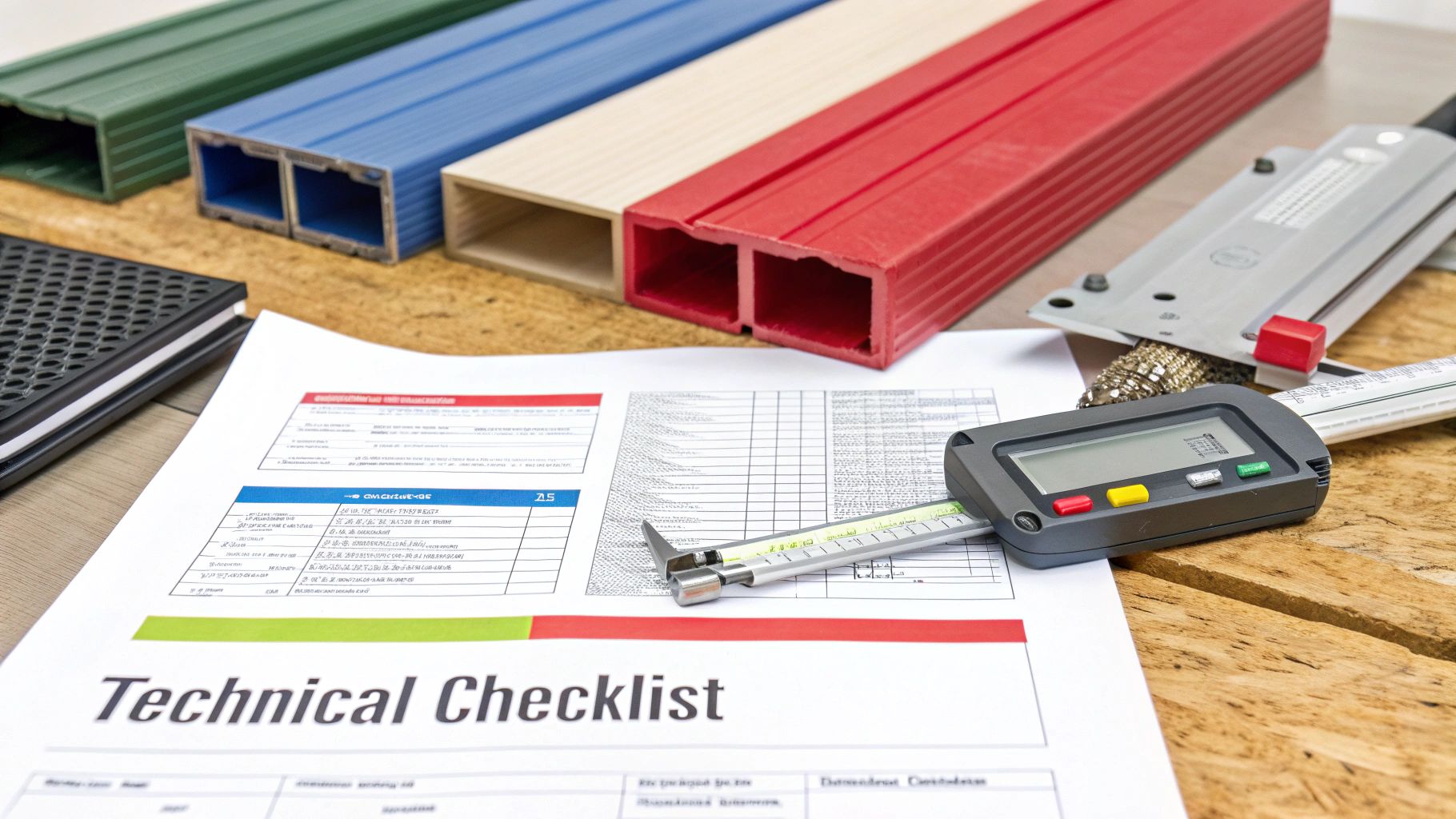
This technical checklist serves as a blueprint for drafting precise specifications, avoiding common procurement errors, and selecting a panel perfectly suited to its intended environment.
Material Science: Durability in the GCC Climate
The choice of material is the first line of defence against the region's high heat, humidity, and dust.
- Galvanised Steel: This is the industry standard due to its excellent corrosion resistance from its zinc coating. It is a durable and cost-effective choice for most interior applications, especially for fire-rated models.
- Aluminium: Lightweight and inherently corrosion-resistant, aluminium is ideal for high-moisture environments or for large, custom-sized panels where weight is a consideration. Its clean finish also makes it suitable for architectural applications.
- Gypsum (Glass Fibre Reinforced Gypsum - GRG): Designed for a seamless, concealed finish, GRG panels can be taped, mudded, and painted to match the surrounding drywall. They are ideal for non-rated applications where aesthetics are the primary objective.
Deciphering Locks and Latch Mechanisms
The security of a ceiling access panel is determined by its latching system, which must match the security requirements of the area it protects.
Standard Latches:
- Budget Lock (Screwdriver Operated): A simple cam lock suitable for general, low-security zones.
- Push-Latch (Touch Latch): A hardware-free option that provides a clean, uninterrupted surface, ideal for residential or low-traffic commercial spaces.
High-Security Locks:
- Keyed Cylinder Lock: Restricts access to authorised personnel only, making it essential for electrical rooms, IT closets, and other sensitive areas.
- Tamper-Resistant Locks: For public spaces or high-security facilities, these locks provide an additional layer of protection against unauthorised entry.
Essential Performance Ratings Explained
Understanding performance ratings is critical for compliance and safety, as these specifications are often mandated by local building codes.
Fire Ratings: A non-negotiable life-safety requirement for any panel installed in a fire-rated ceiling. Panels must be certified to standards such as BS 476 or EN 1634-1 and carry a specific rating (e.g., 60 or 120 minutes) matching the surrounding assembly.
IP Ratings (Ingress Protection): This two-digit code is crucial for panels protecting electrical components from dust and moisture. An IP65-rated panel, for example, is dust-tight and protected against water jets. For further details on its importance, refer to our guide on IP-rated switches and sockets in the UAE.
Acoustic Performance (STC Rating): The Sound Transmission Class (STC) rating indicates how effectively a panel blocks sound. A higher STC rating signifies better sound insulation, which is vital for privacy in boardrooms, healthcare facilities, and offices.
The increasing sophistication of building projects across the Middle East is driving demand for high-performance components. The MEA ceiling panels market, valued at USD 172.29 million in 2024, is projected to grow at a 9.4% CAGR through 2031. This growth is fueled by major infrastructure development and a focus on high-specification, compliant building materials, underscoring the importance of specifying panels that meet stringent local demands.
Navigating UAE and KSA Compliance Standards
Specifying a ceiling access panel in the UAE and Saudi Arabia involves navigating a complex regulatory landscape where compliance is a legal mandate. For project managers and procurement teams, errors can lead to significant project delays, compromise occupant safety, and create liability issues.
Local authorities, such as the UAE Civil Defence, govern fire safety and building codes. Their approval is mandatory, and they enforce strict performance standards for all life-safety components, including fire-rated access panels. The rule is absolute: a panel installed in a fire-rated ceiling must carry the same rating as the ceiling assembly to maintain the integrity of the building's fire compartments.
The Role of International and Local Standards
To achieve local approval, products must often demonstrate compliance with internationally recognised standards, creating a multi-layered validation process. Key standards frequently cited in regional project specifications include:
- British Standards (BS 476): A widely accepted benchmark for fire testing of building materials, commonly referenced in UAE and KSA specifications.
- European Norms (EN 1634): This standard details fire resistance and smoke control test methods relevant to fire-rated access panels.
- Underwriters Laboratories (UL): Though originating in the US, UL certification is globally respected and often required for electrical and safety equipment in the GCC.
Partnering with a supplier like GoSwitchgear, who possesses deep knowledge of these local and international requirements, ensures that the products you source are not only technically sound but fully compliant from the outset.
Third-Party Certification The Mark of Trust
While a manufacturer can claim compliance, independent verification is the definitive proof. Third-party certifications from accredited laboratories are the gold standard for validating a product's performance. This certification guarantees that a fire-rated panel will perform as specified in a real-world fire scenario.
In the UAE and KSA, strict safety protocols are standard, including practices like regular fire door drop testing to ensure the functionality of fire-rated access points. The same principle of verified performance applies to ceiling access panels. For engineers, insisting on third-party certification is the most reliable method to mitigate risk. Compliant components are also critical during a detailed electrical panel inspection, where every part of an electrical system is scrutinised.
The Kingdom of Saudi Arabia (KSA) is currently leading the Middle East and Africa's ceiling market, driven by large-scale commercial construction and Vision 2030 projects. This rapid growth fuels demand for high-quality, compliant building materials, including the essential ceiling access panel.
Installation Best Practices and Mistakes to Avoid
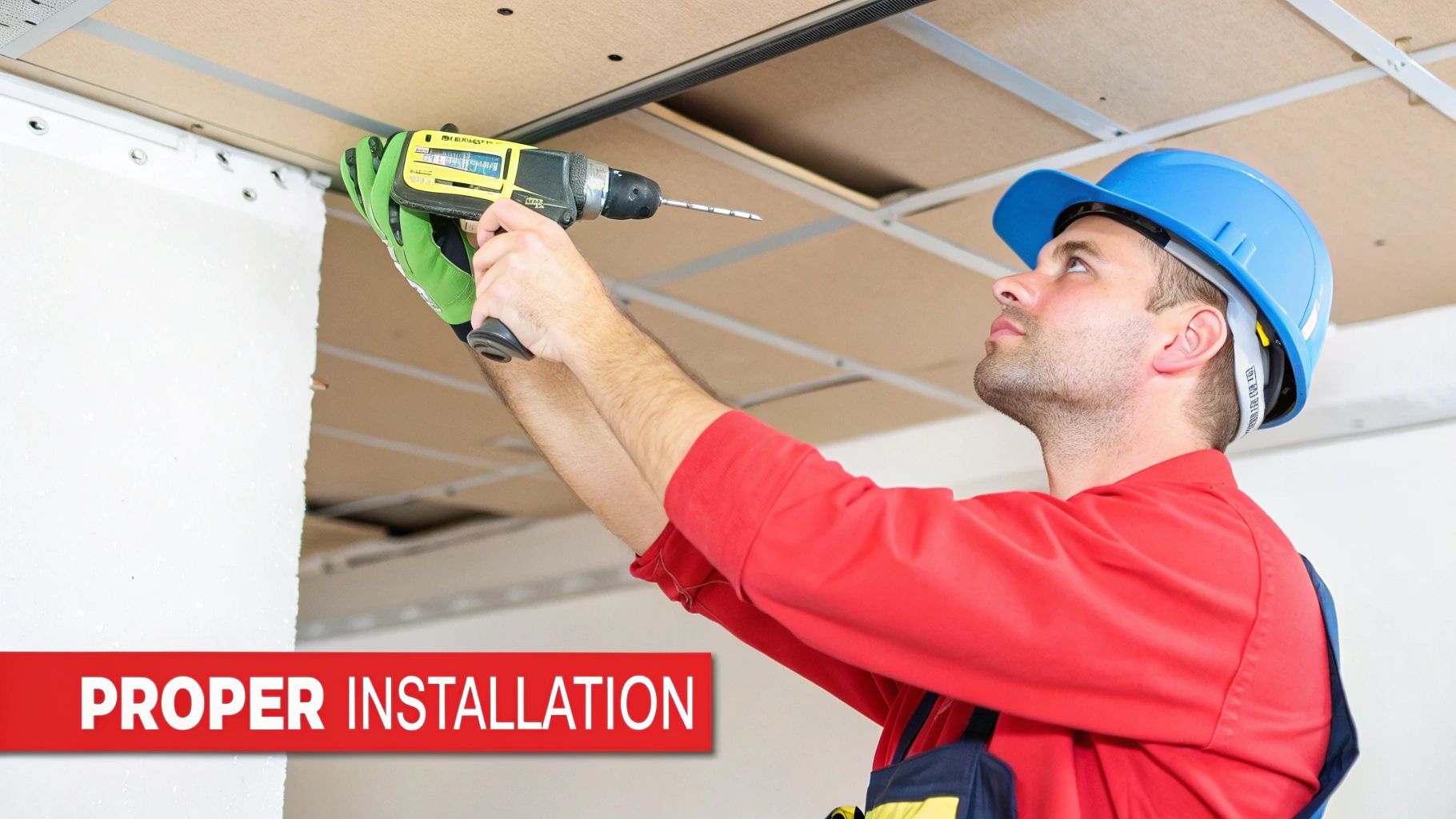
A premium ceiling access panel is only as effective as its installation. For electricians and installation teams across the GCC, a correct first-time installation is crucial. It not only ensures a clean, professional finish but also guarantees the panel performs to its specified rating for fire resistance and acoustic integrity.
A flawless installation results in a perfectly flush finish, maintained ceiling integrity, and smooth latch operation—the critical final step that brings an architect's specification to life.
Core Installation Steps for a Perfect Finish
While specific instructions vary by panel type and ceiling system, the core principles of framing, securing, and finishing remain constant.
- Prepare the Rough Opening: The opening requires a rigid support frame. Use cross-members or blocking to create a solid structure, particularly for heavier fire-rated panels. A flimsy frame is the primary cause of future sagging.
- Ensure Proper Frame Alignment: The panel's outer frame must be mounted perfectly square within the opening. Misalignment will prevent the door from fitting correctly and cause the latch to bind.
- Secure the Frame Correctly: Fasten the outer frame to the ceiling structure at intervals of 10cm (4 inches) or less. Do not omit fasteners, especially near corners and latch brackets, to prevent stress cracks in the surrounding plaster.
- Finish for a Seamless Look: When working with plasterboard ceilings, apply filler compound flush with the panel's frame. Overfilling is a common error that leads to chipping and compromises the aesthetic. Tapered-edge panels are designed for clean tape joints, facilitating a truly integrated finish.
Common Mistakes That Compromise Performance
Knowing what to avoid is as important as following the correct procedures. A single installation error can void a panel's performance ratings.
Mistake 1: Inadequate Structural Support
The most frequent error is failing to construct a rigid frame around the opening. Without solid support, the panel's weight—especially a heavy fire-rated model—will cause the surrounding ceiling to sag, creating gaps and stressing the frame.
A ceiling access panel is an operational component, not a static cover. The framing must support its long-term function and withstand repeated opening and closing.
Mistake 2: Compromising the Seal
For fire-rated and acoustic panels, the seal is paramount. Careless filler application, painting over intumescent strips, or leaving gaps between the frame and ceiling creates a pathway for fire, smoke, and sound, undermining the panel's certification and posing a significant safety risk.
Mistake 3: Incorrect Latch and Hinge Adjustment
Installers often neglect to test and adjust the latch mechanism post-installation. A misaligned latch may not engage securely or may be too tight, impeding access. This is especially true for touch-latch systems requiring precise alignment. Smooth operation is vital for maintenance teams who need quick access to critical systems, such as the network of cables in trunking concealed within the ceiling void.
Need the Right Access Solution for Your GCC Project? Let's Talk.
Selecting the right ceiling access panel is a critical decision that impacts building safety, maintenance efficiency, and regulatory compliance. From materials and performance ratings to the specific standards of the UAE and KSA, a well-chosen panel is a smart investment in a building’s operational longevity.
When you require expert guidance tailored to the demands of your project, the GoSwitchgear team offers local expertise. We are more than a supplier; we are your project partner, providing high-quality, compliant components and robust technical support for projects across Dubai, Abu Dhabi, and the entire GCC.
Why Work with GoSwitchgear?
Navigating regional building codes and climate-specific challenges requires more than a product catalogue—it demands a partner with deep local knowledge.
- Stocked and Ready in the UAE: Our warehouses in Dubai and Abu Dhabi are stocked with a comprehensive range of ceiling access panels—standard, fire-rated, and moisture-resistant—to keep your project on schedule.
- Get Your Specs Right the First Time: Our engineers understand the technical nuances. We assist in selecting the precise panel with the required certifications (BS, EN, UL) to meet UAE Civil Defence and other local authority regulations, avoiding costly compliance issues.
- Solutions Built for Your Project: We provide solutions that match the specific technical and aesthetic needs of your project, including custom sizes and configurations for commercial towers and specialised industrial facilities.
- We Deliver Across the GCC: Our robust logistics network ensures reliable delivery to your site, whether in the UAE, Saudi Arabia, Oman, or the wider GCC region.
GoSwitchgear is your single source for compliant, high-performance access solutions designed to help you build safer, more efficient, and more reliable buildings in the GCC.
Got Questions? We've Got Answers.
During the specification phase of a project, practical questions about a component like a ceiling access panel can impact procurement and final sign-off. For engineers, electricians, and project managers in the UAE, clear answers are essential for maintaining project momentum and compliance.
Here are answers to some of the most common queries from professionals in Dubai, Abu Dhabi, and across the GCC.
What Is the Standard Size for a Ceiling Access Panel?
While common off-the-shelf sizes like 300x300mm and 600x600mm are prevalent in the UAE market, there is no single "standard" size. The correct size is always dictated by the application.
For instance, a small electrical junction box requires only a compact panel. However, servicing a large HVAC unit or valve assembly necessitates a much larger opening to allow technicians and their tools safe and effective access. The guiding principle is to determine the access requirement first, then size the panel accordingly.
The objective is to provide ample, unobstructed access. Specifying a panel that is too small leads to operational difficulties and unsafe maintenance practices.
For unique or oversized equipment, a custom-sized panel is often the most practical solution. Working with a knowledgeable supplier like GoSwitchgear ensures you specify the exact dimensions—standard or custom—your project requires for both functionality and a clean aesthetic.
When Do I Need a Fire-Rated Ceiling Access Panel in the UAE?
A fire-rated access panel is mandatory whenever it is installed into a fire-rated ceiling assembly. This is a strict rule enforced by authorities like the UAE Civil Defence to maintain the integrity of a building's fire compartments.
If you create an opening in a fire-rated ceiling, the access panel must have a fire rating equivalent to the surrounding structure, typically specified as 1-hour or 2-hour resistance.
This requirement is common in locations such as:
- Electrical and Switchgear Rooms: Protecting critical infrastructure is essential.
- Service Corridors and Shafts: These areas can act as conduits for fire and smoke between floors.
- Designated Fire Compartments: Any wall or ceiling designed to contain a fire cannot have a non-compliant penetration.
Using a non-rated panel in these locations creates a critical vulnerability, violates building codes, and compromises the building's life safety systems. Always verify the fire-resistance requirements for each specific location in your project plans.
Can I Paint a Ceiling Access Panel to Match My Ceiling?
Yes. Most metal access panels are supplied with a paint-ready, powder-coated finish, facilitating a seamless integration with your ceiling. Proper preparation is key to a professional result.
To ensure proper paint adhesion and a durable finish, follow these steps:
- Lightly Sand the Surface: A light scuffing of the factory finish creates a key for the primer to adhere to.
- Clean It Up: Wipe the panel with a clean, dry cloth to remove any sanding dust.
- Apply a Quality Primer: A suitable primer is essential before applying the final topcoat.
Crucially, avoid clogging the latch mechanism or the gap between the door and frame with paint, as this can impede operation. For fire-rated panels, it is essential to consult the manufacturer’s guidelines before painting. An incompatible paint could interfere with the intumescent seals and void the panel's fire certification.
For expert guidance and a full range of compliant access solutions for your projects in Dubai, Abu Dhabi, and across the GCC, trust GoSwitchgear. See our extensive selection of electrical components and instruments built for the regional market at https://goswitchgear.ae.
Share this post

Related
Posts
A Guide to Choosing AC to DC Converters for UAE & GCC Electrical Systems
Master AC to DC converters with this comprehensive guide for engineers in the UAE & GCC. Learn selection, installation, and...
A Guide to Drill Machine Prices in the UAE for Technical Professionals
Find the best drill machine price in UAE. Our 2026 guide helps contractors and engineers choose the right corded, cordless,...
A Professional’s Guide to Choosing AGM VRLA Batteries in the UAE Climate
Discover why AGM VRLA batteries are the superior power solution for UPS, solar, and industrial systems in the UAE. Get...
How to Choose the Right Lithium Ion Battery Charger for UAE & GCC Projects
Discover how to select the right lithium ion battery charger for UAE projects. This guide covers specs, BMS integration, and...
.jpg)