.jpg)



Posted by:
Category:
Comments:
Post Date:
DEWA Regulations for Solar PV Installations: Selecting the Right DC Isolators & Fuses
30 Second Summary
- Safety First: Compliance with dewa solar regulations ensures system longevity and prevents hazardous rooftop fires in the UAE’s extreme heat.
- Standards Matter: All DC isolators must meet the IEC 60947-3 standards and utilize the DC-PV2 utilization category for safety.
- Fuse Precision: Use only Photovoltaic String Fuses (gPV fuses) to handle DC arcs; standard AC breakers are a major violation and a safety risk.
- Climate Adaptation: Equipment must be rated for 50°C+ with UV-resistant, IP66 enclosures to survive Dubai’s humidity and dust.
Solar Power is Booming in Dubai
Dubai is rapidly becoming a global leader in solar energy, with the city embracing sustainable, renewable energy solutions to power its future. The government’s Shams Dubai initiative, which encourages residents and businesses to install solar panels, has transformed the skyline by promoting solar energy generation on rooftops. With abundant sunshine throughout the year, solar power offers a cost-effective and eco-friendly solution to meet Dubai’s energy demands.
The increasing adoption of solar power in Dubai is a reflection of both environmental goals and the economic benefits of harnessing solar energy. By tapping into the sun’s unlimited energy, Dubai aims to reduce its reliance on fossil fuels and achieve its goal of generating 75% of its energy from clean sources by 2050, as outlined in the Dubai Clean Energy Strategy.
However, the path to successful solar power installation in Dubai is not without challenges. Extreme heat, humidity, and dust require special care when selecting components to ensure they perform reliably over time. DEWA solar regulations provide a strict framework to ensure safety, efficiency, and long-term performance, ensuring that systems are installed in a way that supports grid stability and reduces the risk of hazards, such as electrical fires.
As the demand for solar power continues to rise, understanding DEWA’s regulations and selecting the right components is essential for a successful solar installation in Dubai.
What is DEWA Solar?
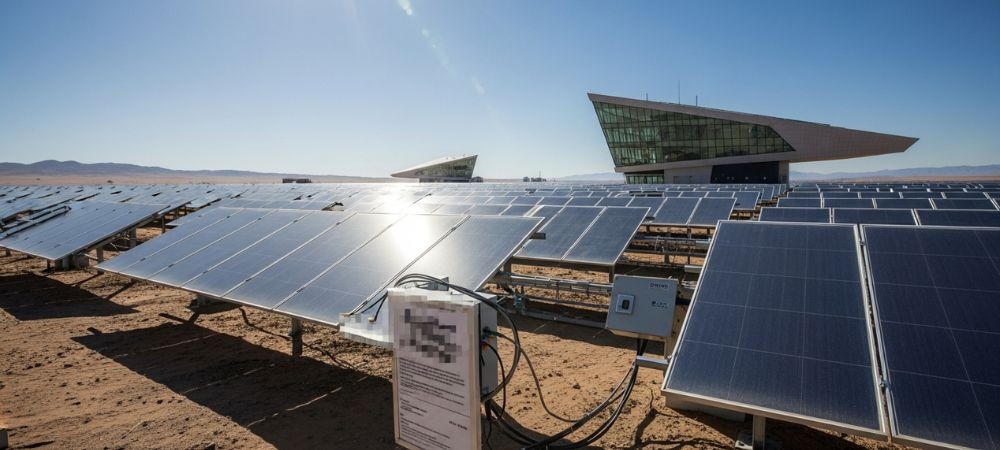
You might be wondering, what is Dewa Solar? DEWA Solar refers to the framework established by the Dubai Electricity and Water Authority to regulate distributed renewable energy systems, primarily solar power. The initiative allows residents and businesses in Dubai to install solar panels and connect their systems to the grid, enabling them to export excess power back to DEWA. This helps to create a more sustainable and diversified energy grid, reducing reliance on traditional fossil fuels.
To ensure the safety, efficiency, and performance of solar installations, DEWA enforces strict equipment standards under the Shams Dubai equipment standards. Every piece of equipment, from solar panels to the smallest component like DC isolators, must meet DEWA’s approval and comply with international standards. These regulations help prevent safety risks, such as electrical fires, and ensure the solar system operates smoothly without compromising grid stability.
Before starting any solar installation, DEWA requires customers to register their projects on the DRRG (Distributed Renewable Resources Generation) portal. This portal is the first step toward getting approval for the installation and ensuring compliance with all safety and regulatory requirements. By following these procedures, individuals and businesses can successfully contribute to Dubai’s ambitious clean energy goals and harness the power of the sun to reduce their carbon footprint.
DEWA & IEC 60947-3: The Standard You Cannot Ignore
In the world of electrical safety, numbers tell the story. For DC isolators, the only story that matters is the IEC 60947-3 standards. This is the core benchmark DEWA uses to evaluate switchgear.
A standard switch isn’t enough. You need a “Switch Disconnector.” It must be capable of breaking the circuit under full load without exploding.
But wait, there’s more. DEWA requires a “Lockable Rotary Handle.” This is for LOTO (Lock-Out, Tag-Out) compliance. It ensures a technician’s safety during maintenance by preventing accidental power-ups.
The “Utilization Category” Trap (DC-21 vs. DC-PV2)
Here is a secret many contractors miss. Not all DC switches are created equal. Many cheap products use the DC-21 rating, which is meant for resistive loads like heaters.
Is an external DC isolator mandatory for Shams Dubai projects? Yes, and it must be rated correctly. Solar panels are not resistive; they are constant current sources. This creates a massive arc when you try to disconnect them.
You must use a DC-PV2 utilization category switch. These are specifically engineered to quench the high-energy arcs generated by PV strings. Using a DC-21 switch is a fire hazard and a direct violation of dewa solar regulations.
Selecting the Right DC Isolator Switch
Choosing a DC isolator switch for solar installations involves more than just checking a box. You need to look at the Voc (Open Circuit Voltage) and Isc (Short Circuit Current) calculation for your specific array.
Most modern systems require a 1000V or even 1500V rating. Using a 500V switch on a 1000V string is a recipe for a rooftop disaster.
Then, there is the question of polarity. While polarized switches exist, “Non-Polarized” switches are generally safer for installers. They eliminate the risk of wiring errors, which are a leading cause of DC switch failures.
Why You Must Use gPV Fuses (Not AC MCBs)
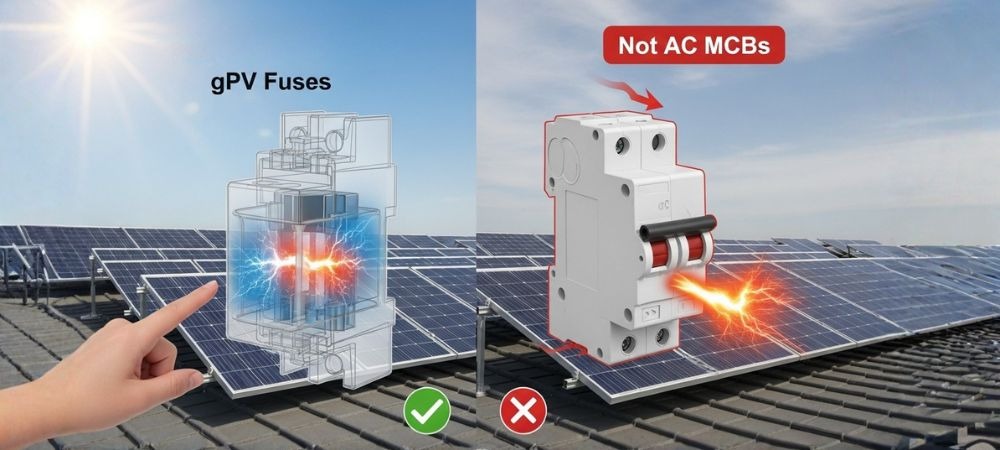
Can you use a standard AC breaker for a solar string? The answer is a hard NO. This is one of the most dangerous mistakes a contractor can make in the UAE.
The Difference between AC and DC isolators in UAE solar installations lies in the arc. AC current has a “zero crossing” point where the voltage hits zero twice every cycle, naturally extinguishing arcs. DC current is a continuous, relentless flow.
You must use Photovoltaic String Fuses (gPV fuses). These fuses meet the IEC 60269-6 standard. They contain special sand fillings that melt and quench the DC arc instantly when the fuse blows.
When Selecting the Right Fuse and Fuse Holder, ensure they are specifically rated for “gPV.” A standard fuse will simply melt into a puddle of plastic while the electricity continues to jump the gap.
For the pros out there, here is the golden rule for Solar PV fuse requirements UAE:
Pro Tip:
This ensures the fuse doesn’t blow prematurely due to high irradiance, while still providing PV string protection. Don’t forget a high-quality solar pv fuse holder to keep everything secure.
The “Temperature Derating” Factor: Surviving the Heat
Dubai is hot. We all know it. But did you know that heat changes how electricity flows? This is known as Ambient temperature derating for Dubai.
An isolator rated for 32A at 25°C might only handle 18A when it’s 50°C outside. On a rooftop in July, the temperature inside a plastic box can hit 70°C.
You must check the “Derating Curve” in the product datasheet. To stay safe and comply with dewa solar regulations, always oversize your isolator by at least 20%. If your string is 25A, don’t use a 25A switch, go higher.
The Hidden Killer: Condensation & Breather Valves
Humidity is the silent enemy of DEWA approved DC switchgear. In Dubai, the nights can be incredibly humid. When the air inside the isolator cools, it turns into water droplets.
This moisture leads to corrosion and short circuits. It is the primary cause of “unexplained” inverter tripping. How do you stop it?
Look for UV-resistant enclosures with a high IP rating for DC isolators. Specifically, you want an IP66 outdoor isolator Dubai rating. This keeps dust out and water at bay.
However, the best way to fight condensation is a Breather Valve. These tiny vents allow pressure to equalize without letting sand or rain inside. It’s a small detail that saves thousands in repair costs.
power.
How to Choose DEWA-compliant PV Fuses?
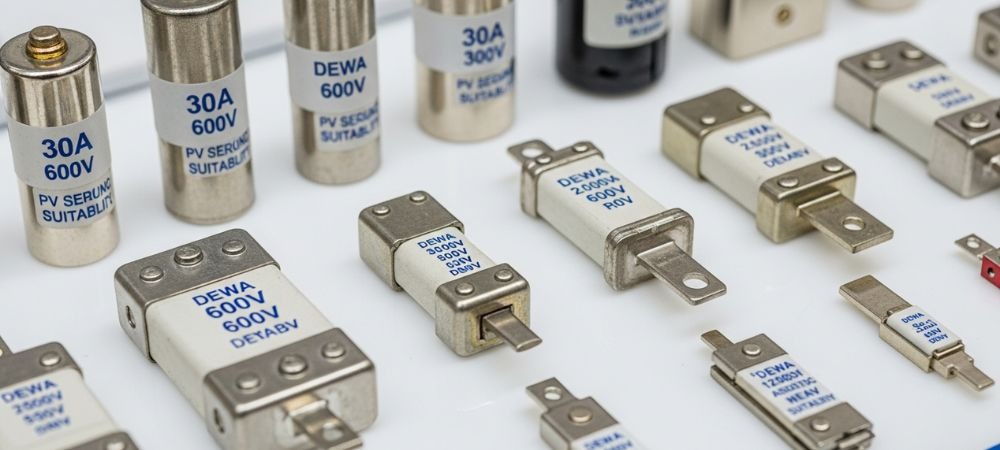
So, how to choose DEWA-compliant PV fuses? It starts with the manufacturer. Choosing the right Photovoltaic (PV) fuses for your solar installation in Dubai is critical for both safety and system performance. Dewa solar regulations require that all solar system components meet specific standards to ensure reliability and safety, especially given the harsh desert conditions. The right fuse not only protects your system but also ensures you comply with DEWA’s stringent requirements for connecting to the grid.
Look for features like arc suppression in DC circuits and high-grade ceramic bodies. If the fuse feels light or “cheap,” it probably isn’t up to the task of handling 1000V of raw solar power.
1. Start with a Reputable Manufacturer
The first step in selecting a DEWA-compliant PV fuse is choosing a trusted manufacturer. Only purchase from brands that provide full laboratory test reports for their products. This documentation is crucial as it verifies the fuse’s compliance with the necessary safety standards. DEWA requires all solar components to be “pre-qualified” and listed on the DRRG (Distributed Renewable Resources Generation) portal, ensuring that only certified equipment is used in solar installations.
When selecting a fuse, ask for the manufacturer’s test certificates to ensure it is fully compliant with DEWA and international standards, such as IEC 60269-6. A fuse that hasn’t been tested properly could fail in critical situations, leading to severe damage, or worse, fires.
2. Look for Key Features in the Fuse
PV fuses need to meet specific technical criteria to ensure they operate effectively in a solar system. Here are some features to look for:
- Arc Suppression: One of the primary differences between standard fuses and PV fuses is the need for arc suppression. DC arcs, which occur in solar systems when the circuit is interrupted, can be extremely dangerous. A proper PV fuse will have an arc suppression mechanism, often using sand, which quickly extinguishes the arc when the fuse blows. Fuses that lack this feature can cause serious safety risks in the event of a fault.
- High-Grade Ceramic Body: PV fuses are subject to extremely high temperatures and voltages, so their materials must be durable. High-grade ceramic bodies ensure that the fuse can withstand the intense heat and pressure in a solar system, maintaining its integrity over time.
- Correct Voltage Rating: Ensure the fuse is rated for the appropriate voltage, especially since solar systems can operate at high voltages (typically 1000V to 1500V). A fuse rated too low for the system can blow prematurely or fail to provide the necessary protection in the event of a fault.
- Current Rating and Capacity: Check the fuse’s current rating to ensure it matches the expected short-circuit current (Isc) of your solar array. Use the formula: $Fuse\ Rating \ge 1.56 \times I_{sc}$ to make sure your fuse won’t blow prematurely under high irradiance conditions. This calculation ensures the fuse is adequately sized for the system’s peak current, while still offering protection from overloads.
- Certifications: The fuse must meet the IEC 60269-6 standard, specifically designed for DC circuits and PV applications. This standard ensures that the fuse can handle DC arcs effectively, offering superior protection for your solar system.
3. Check for DEWA Approval
All solar components, including fuses, must be pre-approved by DEWA before they can be used in a Shams Dubai installation. You can check whether a fuse is approved by visiting the DRRG portal, where a list of pre-qualified products is published. Ensuring that the fuse you choose is on this list guarantees that it meets DEWA’s stringent safety and operational standards. Using non-approved equipment can lead to delays, fines, or rejection of your project during inspection.
4. Enclosure Rating
The harsh Dubai climate demands that all solar components, including fuses, be able to withstand high temperatures, dust, and humidity. The fuse must come in a UV-resistant enclosure with a minimum IP66 rating. This rating means that the fuse is dust-tight and can withstand powerful water jets, which are important when cleaning solar panels or during rare heavy rain. Additionally, the UV resistance protects the fuse from the sun’s damaging rays, ensuring it operates efficiently throughout its lifespan.
5. Fuse Holder Compatibility
Ensure that the fuse holder is specifically designed for gPV fuses and can handle high-voltage DC circuits. Using the wrong fuse holder can lead to overheating, fuse failure, or even catastrophic short circuits. The fuse holder should be securely mounted and allow for easy replacement of the fuse if necessary.
Safety Isn’t an Option, It’s a Necessity
Compliance with DEWA solar regulations is about more than passing inspection—it’s about protecting your home, business, and life. In Dubai’s harsh desert climate, selecting the right solar protection devices ensures your system lasts 25 years, not just 25 days. Go Switchgear offers DEWA-compliant, high-quality components, including DC isolators, fuses, and enclosures, designed to withstand extreme heat and weather. Secure your solar investment with Go Switchgear for reliable, long-lasting performance.
FAQs
What are the DEWA requirements for DC isolators in solar systems?
DEWA requires isolators to be IEC 60947-3 compliant, rated for DC-PV2 utilization, and house a lockable handle. They must also be rated for the high ambient temperatures of the UAE.
Can I use a standard AC isolator for my solar panels?
No. AC isolators cannot safely break a DC arc. Doing so will likely result in a fire and will definitely fail a DEWA inspection.
What is the best IP rating for Dubai’s weather?
An IP66 rating is recommended. This ensures the device is “dust-tight” and protected against powerful jets of water (useful during panel cleaning) and heavy humidity.
Is a fuse required for every solar string?
Generally, if you have three or more strings in parallel, fuses are mandatory to prevent “reverse current” from damaging the panels. Always refer to the manufacturer’s specific guidelines.
How do I know if a component is DEWA approved?
You can check the approved equipment list on the DEWA DRRG portal or ask your contractor for the DEWA approval certificate for that specific model.
Share this post

Related
Posts
A Guide to Choosing AC to DC Converters for UAE & GCC Electrical Systems
Master AC to DC converters with this comprehensive guide for engineers in the UAE & GCC. Learn selection, installation, and...
A Guide to Drill Machine Prices in the UAE for Technical Professionals
Find the best drill machine price in UAE. Our 2026 guide helps contractors and engineers choose the right corded, cordless,...
A Professional’s Guide to Choosing AGM VRLA Batteries in the UAE Climate
Discover why AGM VRLA batteries are the superior power solution for UPS, solar, and industrial systems in the UAE. Get...
How to Choose the Right Lithium Ion Battery Charger for UAE & GCC Projects
Discover how to select the right lithium ion battery charger for UAE projects. This guide covers specs, BMS integration, and...
.jpg)