.jpg)


Posted by:
Category:
Comments:
Post Date:
RCD vs ELCB: Choosing the Right Protection for UAE & GCC Projects
For engineers and panel builders in the UAE, the difference between an RCD and an ELCB is critical. The modern RCD (Residual Current Device) detects current imbalances between live and neutral wires, offering direct personal protection. The older, voltage-operated ELCB (Earth Leakage Circuit Breaker) simply detects voltage on an earth wire, a method now considered obsolete and non-compliant for new projects in the GCC.
Understanding the Core Differences
For any professional specifying electrical components in the UAE, selecting the correct safety device is a matter of regulatory compliance and fundamental safety. While both RCDs and ELCBs aim to prevent electric shock, their operational principles are vastly different. This functional gap is precisely why modern standards, enforced by authorities like DEWA, mandate RCDs for all new electrical installations.
To fully grasp the importance, it helps to understand what a Residual Current Device is and how it functions.
The ELCB is a legacy, voltage-operated device that is no longer permitted in new builds. Its entire function relies on a solid physical connection to an earth rod, tripping only when it senses a significant voltage (e.g., 50V) on the earth conductor. This mechanism is notoriously unreliable, especially in the harsh environmental conditions of the GCC (heat, dust, humidity), where the integrity of an earth connection can easily be compromised by corrosion or physical damage.
Contrast this with a modern RCD. As a current-operated device, it meticulously measures the current flowing into a circuit and compares it to the current flowing out.
If it detects any imbalance—even a minuscule one as low as 30mA—it signifies that current is leaking to earth, potentially through a person. The RCD identifies this leakage and trips in milliseconds. This self-contained monitoring system makes it a vastly superior and more reliable energy management solution in Dubai and across the region.
You can explore the nuances between various current-operated devices in our detailed guide on the differences between RCCB, ELCB, and RCBO.
For a direct comparison, this table breaks down the essential differences.
Quick Comparison RCD vs ELCB at a Glance
This table provides a clear, at-a-glance summary of the key functional differences between the modern RCD and the obsolete ELCB, tailored for decision-makers in the GCC.
| Attribute | Residual Current Device (RCD) | Earth Leakage Circuit Breaker (ELCB) |
|---|---|---|
| Operating Principle | Senses current imbalance between live and neutral. | Senses voltage on the earth wire. |
| Connection | Does not require a direct earth connection to function. | Requires a dedicated connection to an earth rod. |
| Sensitivity | Highly sensitive (e.g., 10mA, 30mA, 100mA). | Less sensitive (e.g., 50V threshold). |
| Reliability in GCC Climate | High; unaffected by dust or corrosion on earth path. | Low; reliability depends on the integrity of the earth connection. |
| Application | Universal; mandatory for modern personal and equipment protection. | Obsolete; not compliant for new installations in the UAE. |
| Fault Detection | Detects leakage from live to any earthed object, including a person. | Only detects faults that flow back through the main earth wire. |
The RCD offers a far more reliable and sensitive method of protection, making it the undisputed standard for electrical safety in today's systems.
How Each Device Detects Electrical Faults
To understand why one device is a modern safety essential and the other is a relic, we must examine their fault detection methods. An RCD uses a precise, internal mechanism, while the old ELCB depends on an external, often unreliable setup. This core difference is paramount for engineers and technicians on projects in the UAE, as it dictates compliance and safety.
RCD: The Current Balancing Principle
A modern Residual Current Device (RCD) operates on a simple principle of physics: what goes in must come out. The RCD continuously monitors the live and neutral wires to ensure this balance is maintained.
At the heart of an RCD is a core balance current transformer (CBCT), which encompasses the live and neutral conductors.
- During Normal Operation: The current flowing through the live wire is equal and opposite to the current returning via the neutral wire. Their magnetic fields within the CBCT cancel each other out, and the RCD remains on.
- When a Fault Occurs: If a person touches a live part or insulation fails, some current "leaks" to earth, creating an imbalance. The current flowing out no longer matches the current returning. The CBCT instantly detects this "residual current," inducing a current in its secondary coil that trips the breaker.
This process is entirely self-contained, making it exceptionally reliable and independent of external factors.
Key Takeaway for UAE Projects: An RCD’s internal current-sensing design provides consistent protection, even in challenging site conditions. It detects the actual leakage current that causes electric shock, tripping in as little as 25-40 milliseconds—a critical factor in preventing serious injury.
ELCB: An Outdated Voltage Sensing Method
The voltage-operated Earth Leakage Circuit Breaker (ELCB) functions in a completely different—and far less dependable—manner. It is designed to monitor for a voltage rise on the earth wire, not the circuit current.
The ELCB's operation depends on a physical connection from the protected appliance's metal casing, through the ELCB's trip coil, to an external earth rod. If a fault makes the casing live, current flows to the earth rod, creating a voltage potential in the surrounding ground. If this voltage reaches a preset limit (typically 50V), the ELCB trips.
This method presents several critical points of failure:
- If the connection to the earth rod is broken or corrodes, the ELCB becomes completely ineffective.
- It offers no protection if a person provides the path to earth, as this leakage current bypasses the ELCB's designated earth wire entirely.
- The 50V trip threshold is dangerously high and often too slow to prevent a fatal shock compared to an RCD's sensitivity.
This complete reliance on a vulnerable external earth connection makes the ELCB an obsolete and unsafe choice, especially in the demanding environments of the GCC.
Comparing Technical Performance in GCC Environments
Moving from theory to practice, the performance difference between an RCD and ELCB becomes stark under the demanding conditions of the GCC. For engineers and panel builders in the UAE, these technical specs define the critical safety thresholds for modern electrical protection and project compliance.
Sensitivity and Trip Thresholds
A modern RCD is engineered to detect minuscule leakage currents, measured in milliamps (mA). The 30mA RCD is the standard for personal protection in Dubai and Abu Dhabi because it trips fast enough to prevent a fatal electric shock. Its high sensitivity ensures the circuit is de-energized long before a fault becomes life-threatening.
In contrast, a voltage-operated ELCB is far less sensitive, tripping only when the voltage on the earth connection reaches a much higher level, often 50V. This is a dangerously high threshold; by the time an ELCB detects a fault, a severe shock may have already occurred.
Response Time: A Critical Safety Factor
Disconnection speed during a fault is as crucial as sensitivity. Here, the performance gap is significant.
A direct technical comparison shows why UAE regulations favor RCDs. Current-operated RCDs trip within 25–40 milliseconds during a major leakage fault. In contrast, voltage-operated ELCBs have slower response times, typically 0.2–0.5 seconds—an order of magnitude slower and often insufficient to prevent serious injury. You can find more insights on the technical specifications driving these safety standards here.
GCC Project Insight: In high-risk environments like construction sites or industrial facilities, the rapid trip time of an RCD provides an essential layer of protection that an ELCB cannot match. This speed is a non-negotiable requirement for modern safety compliance.
This infographic highlights the core difference in fault detection methods.
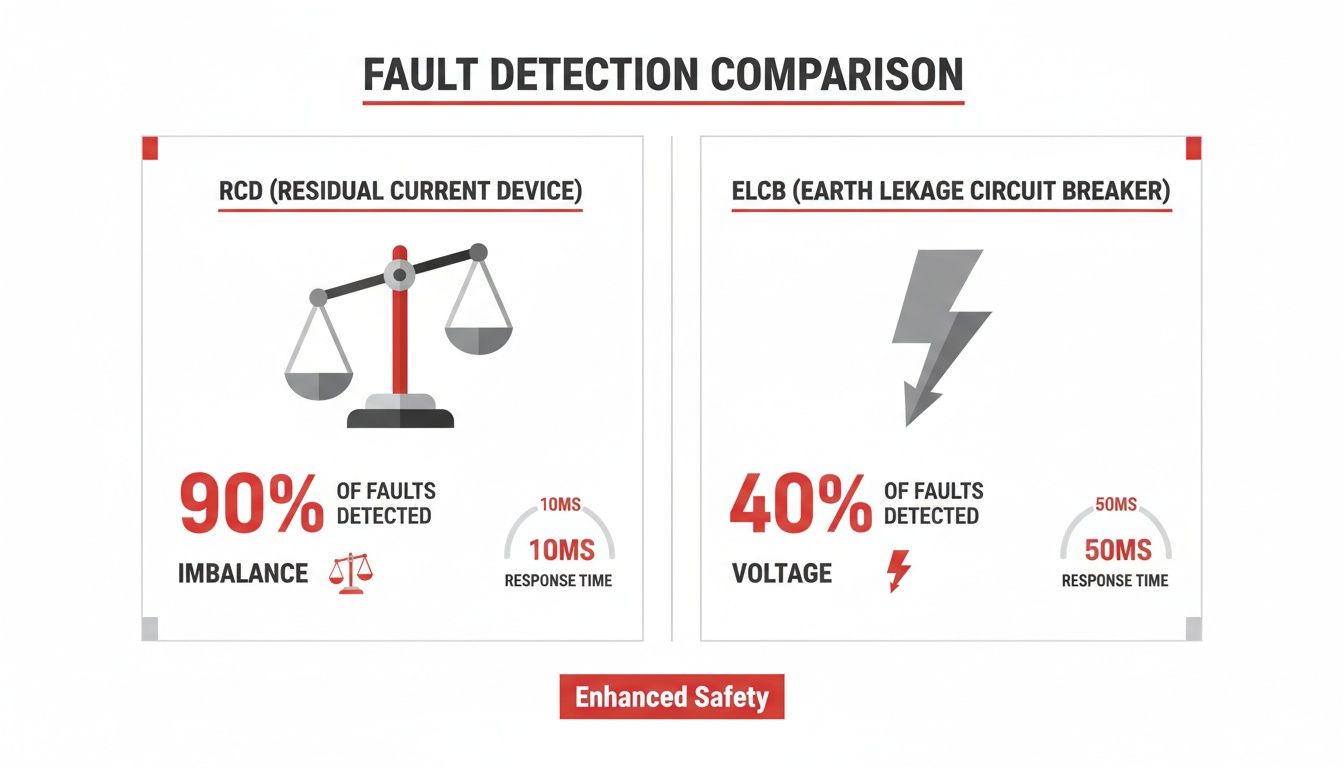
As the graphic illustrates, the RCD uses a direct, reliable current-sensing method, whereas the ELCB relies on an indirect and less dependable voltage-sensing mechanism.
Reliability in Harsh Environments
The GCC climate—with its high heat, humidity, and dust—adds another critical factor: the integrity of the earth connection.
- ELCBs are vulnerable: Their operation depends on a solid, low-resistance connection to an external earth rod. Dust, moisture, and corrosion can easily compromise this connection, rendering the ELCB useless without warning. The required IP ratings for enclosures in this region are a testament to these challenges.
- RCDs are self-reliant: Because an RCD monitors current balance internally, its performance is independent of the external earth path's quality. This makes it a robust and reliable choice for electrical components in the UAE and other demanding regional climates.
This table provides a side-by-side comparison of key specifications.
Detailed Specification Showdown: RCD vs. Voltage-Operated ELCB
| Parameter | Residual Current Device (RCD/RCCB) | Voltage-Operated ELCB |
|---|---|---|
| Operating Principle | Senses current imbalance between live and neutral | Senses voltage rise on the earth conductor |
| Sensitivity (Trip Current) | High (10mA, 30mA, 100mA, 300mA) | Low (Trips at a specific voltage, e.g., 50V) |
| Response Time | Very fast (<40 milliseconds) | Slow (200-500 milliseconds) |
| Dependency on Earth | Independent of earth connection quality | Highly dependent on a reliable earth connection |
| Fault Detection | Detects leakage to earth and through a person | Only detects leakage to the main earth connection |
| Reliability in GCC | High (Unaffected by poor earth path) | Low (Vulnerable to environmental degradation) |
| Compliance (UAE/KSA) | Mandatory (IEC 61008/61009) | Obsolete (Not compliant for new installations) |
| Safety Level | Superior personal and fire protection | Basic, outdated equipment protection |
The RCD consistently outperforms in every critical metric, reinforcing its status as the mandatory standard for safety in modern electrical systems.
Meeting UAE Regulatory Standards and Market Demands
For project managers and panel builders in the UAE, compliance is a strict requirement. Authorities like the Dubai Electricity and Water Authority (DEWA) and Abu Dhabi Distribution Company (ADDC) mandate current-operated RCDs for nearly all new projects. This reflects a decisive shift away from obsolete ELCBs, driven by the demands of modern infrastructure in the region.
Modern buildings in Dubai are filled with sensitive electronics, EV charging infrastructure, and solar systems. These loads can introduce pulsating DC components that voltage-operated ELCBs are not designed to detect. Specifying an ELCB for a new build today is a direct violation of current regulations.
Adhering to Modern Electrical Codes
This regulatory push is supported by significant market trends. The Middle East & Africa circuit breaker market is valued at USD 2.11 billion in 2024 and is projected to grow substantially. A significant portion of this investment is directed at replacing older ELCB installations with modern RCDs that meet current IEC and local standards. You can see a more detailed breakdown of these regional market dynamics for circuit protection devices.
This growth underscores the industry's recognition of the critical difference between RCD and ELCB technology. Modern safety standards require devices that protect against a wider range of fault conditions—a task only current-operated RCDs can perform.
Key Compliance Insight: Submitting a project plan with an ELCB in Dubai or Abu Dhabi will result in an immediate red flag during regulatory review. Modern electrical codes, aligned with IEC standards, mandate the use of current-operated RCDs for protecting both people and equipment.
Selecting the Right RCD Type for the Application
Compliance extends beyond simply choosing an RCD; it involves selecting the right type for the application. A thoughtful approach to electrical risk management is non-negotiable.
Different RCD types are designed for specific residual currents:
- Type AC: Detects pure AC leakage currents only. Insufficient for most modern applications.
- Type A: The standard for most common applications. It detects both AC and pulsating DC leakage currents from common electronic devices.
- Type B: Essential for three-phase applications with VFDs, solar inverters, and EV chargers. It detects AC, pulsating DC, and smooth DC leakage currents, which other types miss.
By stocking a comprehensive range of high-quality, regulation-compliant RCDs, GoSwitchgear ensures that panel builders and contractors across the UAE have the electrical components needed to meet today’s stringent safety and performance standards.
Practical Guidance for Installation and Retrofitting
For electricians and engineers in the UAE, understanding the practical difference between RCD and ELCB installation is key to a safe, compliant project. Correct installation and retrofitting guarantee that you meet DEWA and ADDC standards and ensure the safety of the entire electrical system.
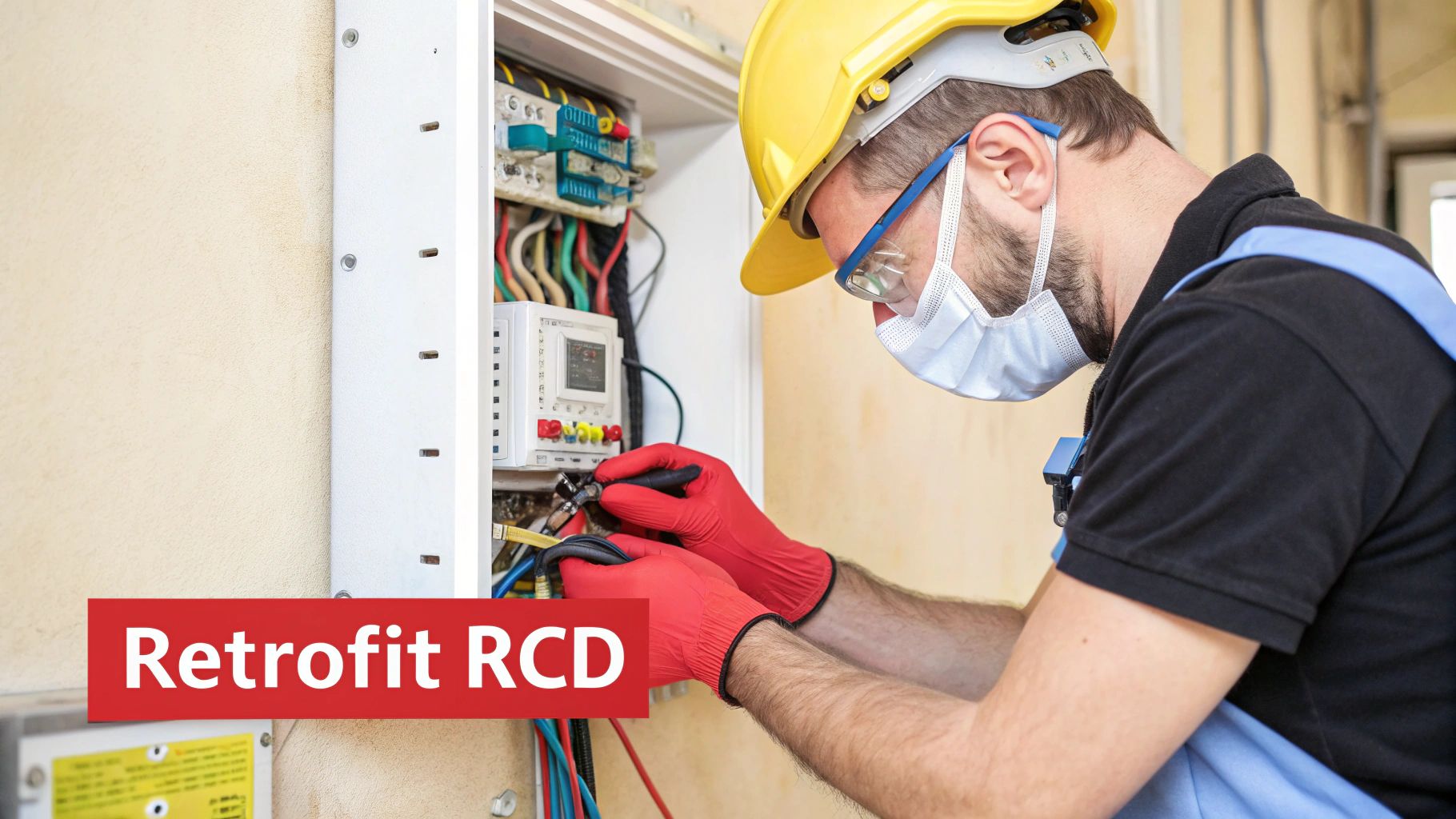
Whether wiring a new tower in Dubai or upgrading an older facility in Abu Dhabi, precision is crucial.
Best Practices for New RCD Installations
For new builds, installing RCDs is straightforward. The primary consideration is selecting the appropriate sensitivity for the application.
- 10mA Sensitivity: Used in high-risk environments like hospitals or labs, where even minimal leakage current can be hazardous to sensitive equipment or personnel.
- 30mA Sensitivity: The mandated standard across the GCC for personal protection in residential and commercial settings, designed to prevent fatal electric shock.
- 100mA and 300mA Sensitivity: Primarily for equipment protection and to provide discrimination, preventing a localized fault from tripping the main power supply.
Correct wiring is non-negotiable. The RCD must monitor both the live and neutral conductors of the protected circuit.
Challenges in Retrofitting from ELCB to RCD
Replacing an old ELCB with a new RCD in an older UAE building often presents challenges. It is rarely a simple swap. Frequently, the new RCD will trip immediately.
Do not blame the RCD—this tripping indicates it is working perfectly. It has uncovered a pre-existing, hidden earth fault that the old, less sensitive ELCB was unable to detect.
These hidden faults are often caused by insulation that has degraded over time due to the region's intense heat or by minor, persistent leaks from older appliances. Identifying and rectifying these root causes is the critical first step. This diagnostic process is a core part of any proper residual current device testing and commissioning protocol.
The Importance of Regular Testing
Whether a new installation or a retrofit, the job is not complete without establishing a regular testing schedule. Every RCD includes a test button that simulates a small fault current to verify the tripping mechanism.
This simple check is vital in the demanding GCC climate, where dust and humidity can affect mechanical components. Regular testing is the only way to ensure the RCD will provide its life-saving protection when needed.
So, Which One is Right for Your GCC Project?
After reviewing the technical specifications, local regulations, and performance data, the choice for any new project in the UAE or wider GCC is clear. For all modern installations and major retrofits, the current-operated Residual Current Device (RCD) is the only acceptable and safe option. This is a non-negotiable standard based on providing superior protection.
The decision hinges on three critical advantages that obsolete ELCB technology cannot offer:
- Unmatched Sensitivity: RCDs detect minute leakage currents (e.g., 30mA), far below the level that could cause fatal electric shock, offering genuine life-saving protection.
- Rapid Response: An RCD trips in under 40 milliseconds, disconnecting the power before a dangerous electric shock can cause serious harm.
- Environmental Reliability: Its operation is independent of external earth connections, a crucial advantage in the GCC, ensuring reliable performance despite heat, dust, and humidity.
For engineers and procurement teams, this makes the decision straightforward. Specifying an RCD is a commitment to regulatory compliance and the highest standards of electrical safety. Obsolete ELCBs introduce unacceptable risks and fail to meet today's demands.
If you require expert support in selecting the correct RCD type and sensitivity for your project in Dubai, Abu Dhabi, or anywhere in the GCC, the GoSwitchgear technical team is ready to assist. Contact us to ensure your project’s electrical components are fully compliant and perfectly suited to local standards.
Frequently Asked Questions About RCDs and ELCBs
Even with a clear understanding of the technical differences, practical questions often arise on-site. This section addresses common queries from electrical professionals across the UAE.
Can I Still Use an ELCB for a New Project in Dubai?
No. For any new electrical installation in Dubai, Abu Dhabi, or elsewhere in the UAE, installing a voltage-operated ELCB is a direct violation of regulations.
Local authorities like DEWA and ADDC explicitly require modern, current-operated devices like RCDs for all new systems. ELCBs are obsolete and do not meet the safety standards for modern electrical infrastructure.
Why Does My New RCD Trip When the Old ELCB Never Did?
This is a common issue during retrofits. If a new RCD trips repeatedly, it is a sign that it is functioning correctly.
The RCD's high sensitivity is detecting a small but real earth leakage current that the old, insensitive ELCB was blind to. This indicates an existing problem in the wiring, such as degraded insulation. The RCD is not faulty; it is exposing a hidden hazard. You must trace and repair the underlying issue to ensure the system is safe.
A constantly tripping new RCD is a diagnostic tool flagging a hidden danger. Investigating the root cause is essential for safety and compliance.
What is the Difference Between an RCCB and an RCBO?
Both are types of RCDs with distinct roles, a crucial distinction when specifying electrical components for UAE projects where panel space is a premium.
- RCCB (Residual Current Circuit Breaker): A specialist device providing only earth leakage protection. It must be paired with a separate Miniature Circuit Breaker (MCB) for overload and short-circuit protection.
- RCBO (Residual Current Breaker with Over-Current protection): An all-in-one solution combining the functions of an RCCB and an MCB in a single unit. It protects against earth leakage, overcurrents, and short circuits.
Choosing an RCBO is an efficient, space-saving energy management solution in Dubai, ideal for modern, compact distribution boards.
For expert help picking the right RCDs, RCCBs, or RCBOs for your next project, check out the massive selection at GoSwitchgear. Find compliant and reliable circuit protection solutions at https://goswitchgear.ae.
Share this post

Related
Posts
A Guide to Choosing AC to DC Converters for UAE & GCC Electrical Systems
Master AC to DC converters with this comprehensive guide for engineers in the UAE & GCC. Learn selection, installation, and...
A Guide to Drill Machine Prices in the UAE for Technical Professionals
Find the best drill machine price in UAE. Our 2026 guide helps contractors and engineers choose the right corded, cordless,...
A Professional’s Guide to Choosing AGM VRLA Batteries in the UAE Climate
Discover why AGM VRLA batteries are the superior power solution for UPS, solar, and industrial systems in the UAE. Get...
How to Choose the Right Lithium Ion Battery Charger for UAE & GCC Projects
Discover how to select the right lithium ion battery charger for UAE projects. This guide covers specs, BMS integration, and...
.jpg)