.jpg)


Posted by:
Category:
Comments:
Post Date:
A Professional Guide to Selecting the Right Electrical Isolator Switch in the UAE
For engineers, panel builders, and maintenance teams in the UAE and wider GCC, ensuring absolute electrical safety is paramount. An electrical isolator switch is a critical, manually operated safety device designed to completely disconnect a circuit from its power source. By creating a visible air gap, it provides an unmistakable guarantee that a circuit is de-energized and safe for maintenance, protecting personnel and high-value assets.
The Critical Role of Electrical Isolator Switches in the UAE
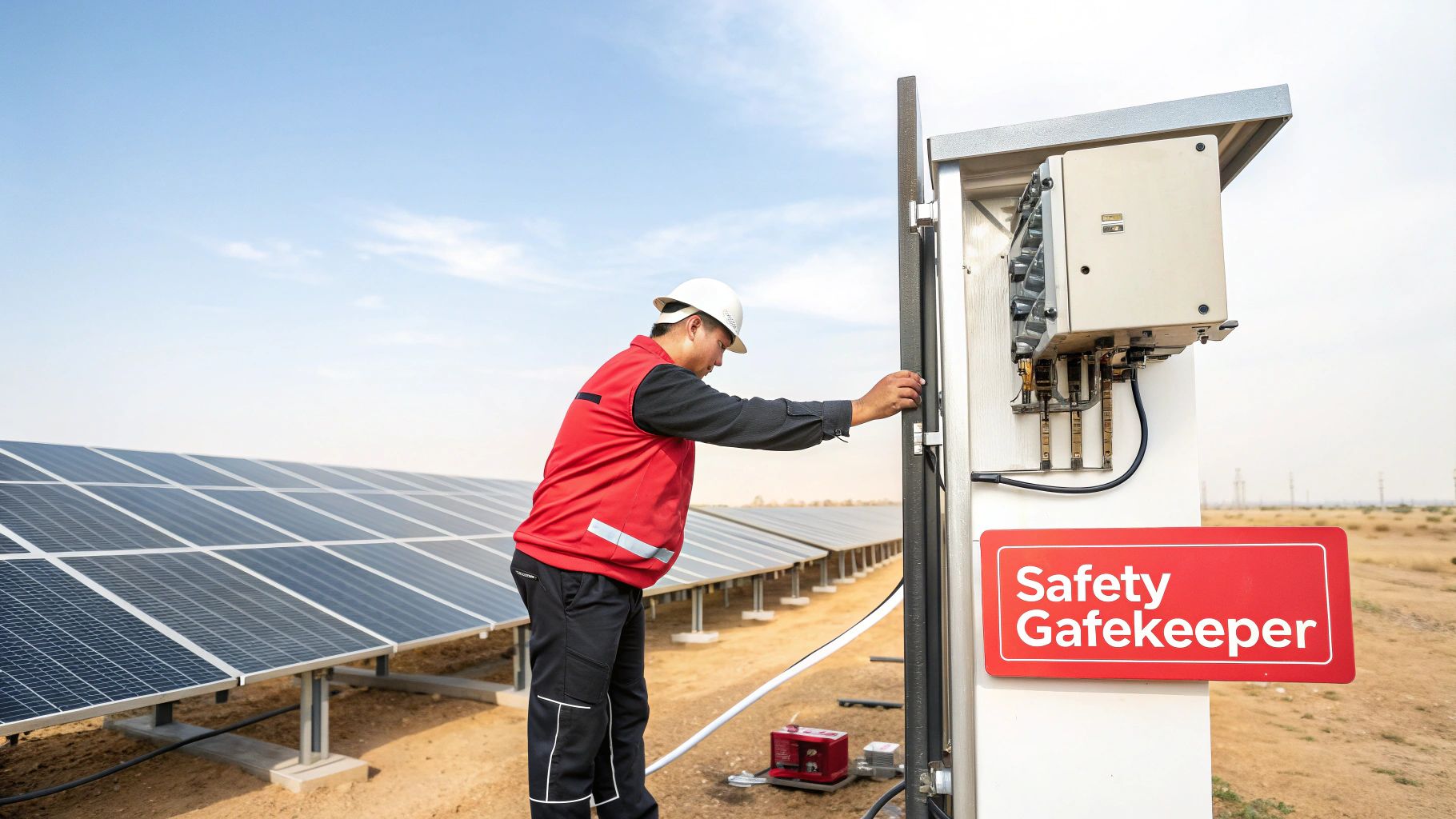
In the high-stakes industrial and renewable energy sectors across the UAE and the wider GCC, electrical safety isn't just a goal—it's a non-negotiable part of every project. Professionals in Dubai, Abu Dhabi, and beyond face unique challenges, from maintaining complex systems in punishing climates to ensuring every worker is safe during critical maintenance. This is a key concern for any energy management solution in Dubai.
This is where the electrical isolator switch proves its worth. It acts as the definitive safety gatekeeper for any electrical circuit. Forget digital signals or complex relays; this device provides an undeniable, physical break in the line that anyone can see.
Why Isolation is Paramount in the GCC
For engineers, panel builders, and facility managers, the correct selection and application of these electrical components in the UAE is absolutely critical. Here’s why it matters so much in this region:
- Worker Safety: An isolator provides a clear, verifiable method to de-energize equipment. It is the physical backbone of any robust Lockout-Tagout (LOTO) procedure, essential for preventing devastating electrical accidents on site.
- Equipment Protection: By ensuring a circuit is truly de-energized, safe isolation prevents accidental power-ups that could damage sensitive machinery during servicing, troubleshooting, or component replacements.
- Regulatory Compliance: Local utility authorities throughout the UAE and KSA have stringent isolation protocols. Using the correct, certified isolators isn't just good practice; it's required to meet regional safety standards and local utility regulations.
- Climate Resilience: The intense heat, humidity, and dust common in the GCC can destroy lesser components. Isolators here require high IP ratings and durable construction to avoid failure when needed most.
This guide provides a practical walkthrough of the types, standards, and best practices for using an electrical isolator switch. We’ll break down how selecting the right device from a trusted supplier like GoSwitchgear is a foundational step in building electrical systems that are not just powerful, but robust and safe enough for the demands of the region.
What Exactly Is an Electrical Isolator Switch?
An electrical isolator switch functions as a manual drawbridge for a power circuit. While a circuit breaker acts like an automated guard, tripping instantly on fault detection, an isolator requires manual operation to create a definite, visible air gap in the line.
That physical gap is your absolute guarantee that a part of the system is fully de-energized. The isolator's sole mission is safety; it does not protect against overcurrents or short circuits. For anyone from a procurement manager in Dubai to a field technician in Saudi Arabia, understanding this distinction is non-negotiable.
The Core Function: Safety Through Isolation
The primary purpose of an isolator switch is to make a circuit safe for maintenance. It is what we call an 'off-load' device, a critical point: you should only ever operate it when there's no current flowing through the circuit. Attempting to open an isolator under load can create a dangerous electrical arc, as it lacks the internal mechanisms to extinguish it like a circuit breaker.
An electrical isolator switch provides positive mechanical isolation. This visible break ensures that even if a control system fails or a breaker is mistakenly closed, the isolated section remains safely disconnected from the power source.
This simple function is the bedrock of safe maintenance. Before anyone services motors, pumps, or control panels, the standard procedure is to first open the upstream circuit breaker to interrupt the current, then open the isolator switch to create a guaranteed separation from the power source.
Lockout-Tagout (LOTO) and the Isolator's Role
Across the UAE and the wider GCC, strict workplace safety regulations make Lockout-Tagout (LOTO) procedures a legal requirement. The electrical isolator switch is the central component in any LOTO plan for electrical work.
Here’s how it works in practice:
- Isolate: The isolator is manually switched to the 'OFF' position, creating the physical break.
- Lock: A physical padlock is applied to the isolator's handle, making it impossible for another person to re-energize the circuit.
- Tag: A tag is attached, clearly identifying who is working on the equipment and the reason for the lockout.
This straightforward process makes it physically impossible for the circuit to be accidentally re-energized while a technician is working downstream. Using a robust, lockable electrical isolator switch is a fundamental requirement for protecting lives and avoiding catastrophic equipment failure during servicing.
Exploring Different Types of Isolator Switches
Not all isolators are created equal. Choosing the right one is absolutely critical for safety and reliability, especially when dealing with the demanding industrial and solar projects common across the UAE and GCC.
You must match the specific type of electrical isolator switch to its application. A compact control panel has completely different needs than a large-scale outdoor solar farm, so each environment demands a tailored solution. A DIN rail isolator, for example, is ideal for panel builders, while enclosed DC isolators are essential for solar installations.
In the fast-paced electrical markets here, these switches are the unsung heroes of safety in high-stakes power distribution. This is truer than ever as the region pushes aggressively towards its renewable energy goals. The Middle East & Africa isolator switch market is a key player in a segment valued at roughly USD 0.335 billion for 2024 (MEA and Latin America combined). Countries like the UAE and Saudi Arabia are driving this growth with massive infrastructure projects.
To put it in perspective, local industry reports show DEWA installed over 15,000 isolator switches in its low-voltage networks just between 2020 and 2024. That effort contributed to a 25% reduction in electrical faults that occurred during maintenance. You can discover more insights about the isolator switch market from recent analysis.
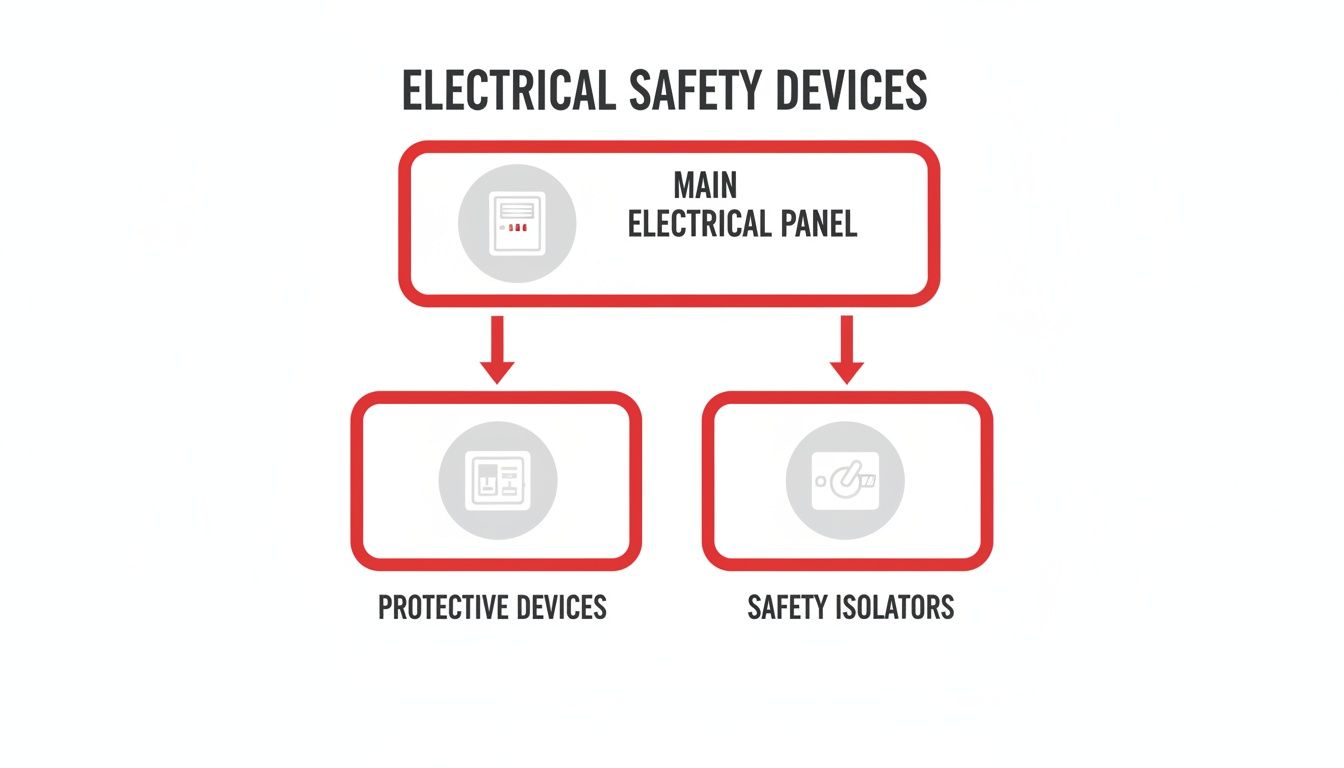
The diagram above clearly shows where the isolator fits in. While devices like circuit breakers are there to automatically protect against faults, the electrical isolator switch has a different job: it's for the manual, deliberate act of making a workspace completely safe for personnel.
Fused vs Non-Fused Isolators
One of the first decisions is whether to use a fused or non-fused isolator, depending on whether overcurrent protection is needed at the point of isolation.
- Fused Isolator: This type serves a dual purpose, integrating fuses to provide both isolation and short-circuit protection in a single device. It is an excellent choice for simplifying a circuit design.
- Non-Fused Isolator: This is purely a disconnecting switch. It offers no overcurrent protection and must be paired with an upstream protective device, like a circuit breaker or a separate fuse.
Enclosed Isolators for Harsh Environments
For outdoor applications, enclosed isolators are essential. Think of solar PV installations in the desert sun or equipment in dusty industrial yards. They are housed in robust, sealed enclosures, typically made from polycarbonate or other UV-resistant materials.
The key feature is a high Ingress Protection (IP) rating, often IP65 or better, guaranteeing protection against dust and water jets. This makes them a perfect fit for the harsh climates in the UAE and Saudi Arabia. When selecting one, always verify the IP rating and enclosure material for long-term reliability.
Rotary Isolators for Panel Mounting
Also known as cam switches, rotary isolators are a fixture inside control panels and switchboards. Their compact design is perfect for panel mounting to isolate specific motor circuits or sections of a control system.
Operated with a simple twist handle, which can often be locked in the 'OFF' position for LOTO compliance, they are found in:
- Motor control centers (MCCs)
- HVAC control panels
- Industrial machinery control circuits
Their versatility makes them a favorite for panel builders across Dubai and the entire GCC.
DIN Rail Mounted Isolators for Compact Setups
When space is limited, such as in smaller control cabinets or distribution boards, a DIN rail isolator is the solution. These modular devices snap onto a standard DIN rail, sitting alongside other components like circuit breakers and SMPS power supply units.
While they may have lower current ratings, they are ideal for isolating individual circuits within a larger panel. Their modular design enables quick installation and a clean, organized layout.
DC Isolators for the Solar Sector
With the explosive growth of renewable energy in the GCC, DC isolators have become essential. Standard AC isolators are not suitable, as DC isolators are specifically engineered to handle the unique physics of interrupting direct current, which lacks the natural zero-crossing point of AC, making arc extinction more difficult.
Using a correctly rated DC electrical isolator switch is a non-negotiable safety requirement for every solar PV installation, ensuring the DC side can be safely isolated from inverters for maintenance.
Comparison of Isolator Switch Types for UAE and GCC Projects
This table compares common isolator types, their applications, features, and suitability for local environmental conditions.
| Isolator Type | Primary Application | Key Feature | Ideal Environment (UAE/GCC) | Relevant Standard |
|---|---|---|---|---|
| Enclosed Isolator | Outdoor equipment, solar PV, industrial sites | High IP rating (e.g., IP65/66), UV resistance | Excellent for high dust, humidity, and sun exposure | IEC 60947-3 |
| Rotary Isolator | Control panels, motor control centers (MCCs) | Compact, panel-mounted, often lockable handle | Indoor control rooms, protected environments | IEC 60947-3 |
| DIN Rail Mounted | Small distribution boards, control cabinets | Modular, space-saving, easy installation | Indoor panels where component density is high | IEC 60947-3 |
| DC Isolator | Solar PV systems (DC side), battery storage | Designed to break DC current safely | Essential for all solar installations, outdoor rated | IEC 60947-3, UL 98B |
| Fused Isolator | Combined isolation and protection points | Integrates fuses for overcurrent protection | Indoor/Outdoor (enclosure dependent), simplifies circuits | IEC 60947-3 |
Choosing the right isolator is a critical safety decision. Understanding the strengths of each type ensures your electrical systems are compliant and safe.
How to Select and Size an Isolator Switch for Your Project
Selecting an incorrectly sized or rated electrical isolator switch is a critical safety failure. For any engineer or panel builder in the UAE, a methodical approach to selection is essential for reliability and compliance, involving a deep dive into electrical ratings and mechanical specifications tailored to our demanding local environment.
This process goes beyond matching the current; it requires considering how the switch will be used, its location, and the environmental conditions it will face.
Decoding Essential Electrical Ratings
First, a forensic analysis of the circuit's electrical characteristics is necessary. The isolator must handle everything the system throws at it.
- Voltage Rating (AC/DC): The isolator's rated voltage must exceed the system's operating voltage. With numerous solar projects in the GCC, distinguishing between AC and DC ratings is crucial. An AC switch will fail dangerously in a DC application.
- Current Rating: The isolator must be rated for at least 125% of the circuit's full load current as a safety buffer, preventing overheating during normal operation.
- Utilisation Category (e.g., AC-22A, AC-23A): This IEC 60947-3 classification is critical. AC-22A is suitable for resistive or slightly inductive loads. For frequently switching highly inductive loads like motors, AC-23A is required. Using an AC-22A switch on a motor circuit is a common and dangerous error.
The utilisation category defines the switch's ability to safely make and break a circuit under specific load conditions. Choosing a lower category than required risks welded contacts or catastrophic failure.
Mechanical Specifications for the GCC Climate
In Dubai, Abu Dhabi, or anywhere in the region, an isolator’s mechanical build is as important as its electrical ratings. The relentless heat, humidity, and dust demand robust components.
Key mechanical points to check:
- IP (Ingress Protection) Rating: For outdoor or dusty industrial environments, IP65 is the minimum standard, guaranteeing the enclosure is sealed against dust and low-pressure water jets.
- Operating Temperature Range: The switch must perform reliably in ambient temperatures exceeding 50°C. Always check the manufacturer's datasheet for temperature derating factors, as high heat can reduce a switch's safe current-carrying capacity.
- Enclosure Material: Look for enclosures made from tough, UV-resistant materials like polycarbonate to prevent brittleness and cracking from prolonged sun exposure.
Sizing Example: A Motor Isolator
Let’s apply this to a real-world scenario: sizing an electrical isolator switch for a 15 kW, 400V three-phase induction motor.
- Calculate Full Load Current (FLC): The FLC is approximately 28A.
- Apply Safety Factor: The isolator’s current rating should be at least 1.25 x 28A = 35A. The next standard size up, 40A, should be chosen.
- Determine Utilisation Category: As a motor is an inductive load, an AC-23A category is mandatory.
- Verify Voltage Rating: The switch must be rated for 415V AC or higher.
- Select Mechanical Specs: If the motor is outdoors, an IP65 rated enclosed isolator made of UV-stabilised polycarbonate is the only correct choice.
This step-by-step method ensures the selection of a component that is both safe and durable.
The push for greater grid resilience in the GCC makes robust electrical components in the UAE more critical than ever. Market data shows strong growth for isolator switches in the region, tracking a 5.66% global CAGR for rotary types. In the UAE alone, over 10,000 isolators were traded on digital platforms in 2024. You can learn more about these regional market trends and forecasts to understand the demand.
Installation Best Practices and Common Mistakes to Avoid
Selecting the right electrical isolator switch is only half the battle; proper installation is equally crucial. A top-spec switch can become a hazard if not fitted correctly. For electricians and facility managers in the UAE, correct installation ensures a system that is safe, compliant, and durable enough for local conditions.
Pre-Installation Checks and Mounting
First, conduct a thorough visual inspection for shipping damage or defects. A compromised enclosure can nullify its IP rating, exposing it to dust and moisture—a serious risk in the GCC climate.
Mount the switch on a flat, rigid surface to avoid twisting the enclosure, which can stress internal parts and misalign contacts, leading to overheating and failure.
Ensure adequate clearance around the switch for ventilation, especially in high ambient temperatures. Jamming components together creates thermal stress, shortening the isolator's lifespan.
When installing an enclosed isolator outdoors in Dubai, use corrosion-resistant fixings to prevent rust from compromising the mounting over time.
Cabling and Terminal Connections
Proper cable management and termination are vital for a safe installation. Using undersized cables is a dangerous mistake that can cause overheating and fire risks.
- Terminal Torque: Use a calibrated torque wrench to tighten terminal screws to the manufacturer's specifications. Incorrect torque can lead to high resistance, heat, or damage.
- Cable Glands: Use correctly sized cable glands to maintain the IP rating, keeping out dust and moisture that can cause corrosion and short circuits.
- Conductor Preparation: Ensure conductor ends are clean and stripped to the correct length for a solid connection that minimizes resistance and prevents hotspots.
Common Installation Mistakes to Avoid
Even experienced professionals can make mistakes that compromise the safety and performance of an electrical isolator switch.
| Mistake | Consequence | How to Avoid |
|---|---|---|
| Ignoring Torque Specs | Overheating connections, arcing, and potential fire hazard. | Always use a calibrated torque wrench and follow the datasheet. |
| Using Incorrect Glands | Compromised IP rating, allowing ingress of dust and water. | Match the gland to the cable diameter and enclosure entry point. |
| Mounting on Uneven Surfaces | A warped enclosure, misaligned contacts, and mechanical stress. | Ensure the mounting surface is completely flat and stable. |
| Inadequate Clearance | Poor heat dissipation, leading to component overheating and early failure. | Leave sufficient space around the isolator for air circulation. |
| Failing to Verify Phasing | Incorrect operation in three-phase systems, potentially damaging equipment. | Always double-check phase rotation and connections before energizing. |
Navigating Safety Standards and Compliance in the GCC
In the electrical sectors of the UAE and GCC, compliance is the bedrock of every safe and reliable project. Adhering to the right standards for an electrical isolator switch is non-negotiable for project approval, operational safety, and long-term performance.
For engineers and procurement teams, understanding these standards is essential to mitigate risks and ensure installations pass local safety inspections.
The Cornerstone Standard: IEC 60947-3
The primary standard for low-voltage switchgear is IEC 60947, with IEC 60947-3 specifically covering switches, disconnectors, and switch-disconnectors.
An electrical isolator switch certified to this standard has been rigorously tested for:
- Making and breaking capacity: Ability to handle the electrical stress of switching.
- Durability: Mechanical and electrical lifespan under real-world conditions.
- Dielectric properties: Insulation quality to prevent electrical breakdowns.
- Temperature rise: Ability to operate at full load without overheating.
Sourcing components compliant with IEC 60947-3 is the first and most critical step.
Local Authority Approvals: DEWA and SASO
While international standards are the foundation, local approvals are essential for project completion in the UAE or Saudi Arabia. Authorities like the Dubai Electricity and Water Authority (DEWA) and the Saudi Standards, Metrology and Quality Organization (SASO) have their own strict requirements.
For any project in Dubai connecting to the grid, using DEWA-approved components is mandatory. This approval confirms the product is suitable for the unique demands of Dubai's local power network.
Similarly, projects in Saudi Arabia require components that meet SASO regulations. These local certifications are a guarantee of legal compliance and safety.
Verifying Compliance During Procurement
To ensure you are getting genuine, compliant products, follow these steps during procurement:
- Request Certificates of Conformity: Ask your supplier, like GoSwitchgear, for official documents proving compliance with IEC 60947-3.
- Check for Markings: A legitimate product will have clear, permanent markings indicating the standard, manufacturer, and key ratings.
- Confirm Local Approvals: If your project is in Dubai, verify that the specific model is on DEWA’s approved vendor list.
This due diligence is crucial to avoid substandard or counterfeit parts that could jeopardize your entire installation.
The region’s rapid industrial growth has driven the evolution of safety standards. Following the 2020 Dubai Expo, regulations were tightened to mandate IP65 enclosures for 100% of new installations, causing a 22% year-over-year increase in imports of compliant isolators. You can explore the Middle East's electrical component market trends here.
Wrapping It Up: Sourcing the Right Isolator Switch
The right electrical isolator switch is the bedrock of electrical safety, protecting both personnel and equipment.
Correct selection involves choosing the right type, sizing it properly, ensuring meticulous installation, and verifying compliance with all local GCC standards. This is an investment in the long-term safety and operational integrity of your facility.
For engineers, panel builders, and procurement teams in Dubai, Abu Dhabi, and across the UAE, the path is clear. We invite you to explore the wide range of certified isolator switches on the GoSwitchgear platform. For project-specific support, contact our expert team in Dubai.
Still Have Questions About Isolator Switches?
Here are answers to common questions from professionals across the UAE and GCC.
What's the Real Difference Between an Isolator and a Circuit Breaker?
A circuit breaker is an automatic protection device. It constantly monitors for faults like short circuits or overloads and instantly trips to cut power. Its function is protection.
An electrical isolator switch is a manual safety tool. It is operated manually—and only when the circuit is already de-energized—to create a physical, visible air gap. This guarantees the circuit is safe for maintenance. Its function is deliberate isolation.
Why Is It So Dangerous to Operate an Isolator Under Load?
An isolator is not designed to handle the energy of a live circuit. It lacks internal arc-extinguishing mechanisms.
Attempting to open an isolator under load will create a massive, dangerous arc flash, which can cause severe burns, destroy the switch, and start a fire. The golden rule is: always use the upstream circuit breaker to interrupt the current first.
Why Do High IP Ratings Matter So Much in the UAE Climate?
The UAE's environment of fine dust, high humidity, and salty air makes a high IP (Ingress Protection) rating, like IP65, a critical feature for an electrical isolator switch.
- Beating the Dust: A high IP rating prevents fine sand and dust from entering the enclosure, which can cause jamming, overheating, and failure.
- Fighting Moisture: It also protects against humidity and condensation, preventing internal corrosion and potential short circuits.
In the GCC climate, an inadequate IP rating leads to premature failure, compromising both reliability and safety.
How Can I Be Sure a Switch Meets Local DEWA Regulations?
For any project in Dubai, DEWA approval is mandatory. Here’s how to verify compliance for an electrical isolator switch:
- Get the Paperwork: Request a Certificate of Conformity from your supplier, proving the switch meets standards like IEC 60947-3.
- Check the Official List: Verify that the brand and model are on DEWA’s Approved Vendor List.
- Inspect the Switch: A compliant switch will be clearly marked with manufacturer details, ratings, and standards. Unclear or missing markings are a major red flag.
For a complete range of certified and locally approved isolator switches engineered for the tough conditions of the GCC, check out the GoSwitchgear catalogue.
Find the right IEC-compliant electrical isolator switch for your project today on GoSwitchgear.
Share this post

Related
Posts
A Guide to Choosing AC to DC Converters for UAE & GCC Electrical Systems
Master AC to DC converters with this comprehensive guide for engineers in the UAE & GCC. Learn selection, installation, and...
A Guide to Drill Machine Prices in the UAE for Technical Professionals
Find the best drill machine price in UAE. Our 2026 guide helps contractors and engineers choose the right corded, cordless,...
A Professional’s Guide to Choosing AGM VRLA Batteries in the UAE Climate
Discover why AGM VRLA batteries are the superior power solution for UPS, solar, and industrial systems in the UAE. Get...
How to Choose the Right Lithium Ion Battery Charger for UAE & GCC Projects
Discover how to select the right lithium ion battery charger for UAE projects. This guide covers specs, BMS integration, and...
.jpg)