.jpg)


Posted by:
Category:
Comments:
Post Date:
How to Choose the Right Energy Meter for UAE & GCC Projects
Selecting the right energy meter for projects in the UAE and GCC is a critical decision. In a region defined by extreme heat, dust, and stringent regulations, a high-performance meter is the foundation of any reliable energy management solution in Dubai. This guide provides practical insights for engineers, panel builders, and procurement teams to make informed choices.
Why Your Project Needs More Than Just a Standard Energy Meter
In the demanding climate of the UAE and the wider GCC, "standard" electrical components often fail to perform. The combination of intense ambient heat, high humidity, and fine dust creates a uniquely challenging environment for sensitive electronics. For engineers, panel builders, and procurement teams in Dubai, Abu Dhabi, and Riyadh, selecting an off-the-shelf energy meter is a gamble that can lead to premature failure, inaccurate billing, and costly operational downtime.
A modern, high-performance energy meter is more than just a component; it is the cornerstone of an efficient, dependable, and intelligent electrical system. It provides the detailed data necessary for superior operational control, moving far beyond simple kilowatt-hour tracking.
The Strategic Value of Advanced Energy Monitoring
Investing in a superior energy meter GCC projects demand delivers tangible benefits that extend beyond basic measurement. These devices are pivotal for gaining control over operational costs and stability in any commercial or industrial facility.
Key advantages include:
- Operational Stability: Advanced meters provide crucial power quality insights. They detect issues like voltage sags or harmonic distortions before they damage sensitive equipment, ensuring operational continuity in critical facilities.
- Cost Control and Allocation: Precise sub-metering enables facility managers to identify exactly where energy is consumed. This allows for accurate cost allocation to specific departments or tenants and empowers data-driven efficiency improvements.
- Regulatory Adherence: Projects in the UAE must comply with regulations from local authorities like DEWA. A certified, high-quality meter ensures your installation meets these stringent requirements, preventing project delays and maintaining grid compliance.
- Durability in Harsh Conditions: Meters engineered for the GCC, like those from GoSwitchgear, are designed for resilience. They feature high IP ratings and wide operating temperature ranges, guaranteeing reliable performance in harsh environmental conditions.
Ultimately, selecting the right electrical components UAE standards require is a strategic decision. A top-tier energy meter provides the data-driven foundation for a resilient, cost-effective, and compliant electrical infrastructure, enabling smarter energy management across your entire operation.
From Basic to Smart: Understanding Energy Meter Types
Navigating the various types of energy meters is a critical first step for any project in the UAE. The correct choice not only ensures accurate billing but also unlocks advanced energy management capabilities. The primary distinctions come down to technology, electrical system configuration, and connection method.
The traditional electromechanical meters, with their characteristic spinning disc, are robust but offer only basic total energy measurement. They lack the granularity needed for modern analysis.
Today, digital or electronic meters are standard. Using solid-state technology, they provide a significant leap in accuracy and functionality. With no moving parts, they are more durable and feature a clear digital display that eliminates reading errors.
The Leap to Smart Meters
The true evolution is the smart meter, which integrates two-way communication capabilities. This is an essential feature for any serious energy management solution Dubai projects require. Instead of manual readings, a smart meter transmits real-time data to the utility or your building management system.
This functionality delivers powerful advantages:
- Remote Monitoring: Automates data collection, reducing labor costs and eliminating human error.
- Deep Usage Insights: Provides granular, real-time consumption data, enabling facility managers to identify and address energy waste.
- Demand Response: Helps utilities maintain grid stability and allows consumers to shift loads to off-peak hours, reducing electricity costs.
- Instant Fault Alerts: Immediately flags power outages or quality issues, enabling faster response and resolution.
Single-Phase vs. Three-Phase Power
The choice of meter is dictated by the electrical system—a fundamental detail for any panel builder or electrician in the GCC.
Single-Phase Meters: Designed for circuits with one live and one neutral wire. These are common in residential buildings, small commercial spaces, and lighting circuits. Sub-metering individual apartments in a Dubai tower, for instance, requires single-phase energy meters.
Three-Phase Meters: Essential for industrial and large commercial applications found in zones like JAFZA or KIZAD. They are built to measure power across three live conductors, necessary for running large motors, HVAC systems, and heavy machinery.
A common and critical error is attempting to use three separate single-phase meters on a three-phase system. This method is highly inaccurate, non-compliant, and fails to capture vital data like power factor and phase balance, which are essential for system health.
Direct Connection vs. CT-Operated Meters
The final consideration is how the meter connects to the circuit, which is determined by the current load.
Direct Connection Meters are wired directly into the circuit, with supply cables passing through the meter. This is suitable for lower-current applications, typically up to 100-120 Amps. They are simpler to install and ideal for residential or small business use.
Current Transformer (CT) Operated Meters are the standard for high-current systems exceeding 120 Amps. Instead of routing heavy cables through the meter, CTs are clamped around the main conductors. These transformers "step down" the high current to a smaller, measurable signal (typically 1A or 5A). The meter then applies the CT ratio to calculate the true consumption.
For industrial panels, large distribution boards, or main building incomers, a CT-operated energy meter GCC standard is the only safe and accurate solution. This approach is fundamental for any high-power electrical components UAE projects utilize. Mastering these distinctions ensures you specify the right device every time.
Decoding the Technical Specs That Matter in the GCC
An energy meter's datasheet is a performance contract. For engineers and panel builders operating in the UAE's demanding environment, interpreting these specifications correctly is crucial for designing a reliable installation and avoiding premature failures or inaccurate billing.
In a region known for its punishing climate, several key parameters are non-negotiable for project success.
Accuracy Class: The Foundation of Trustworthy Data
The Accuracy Class, defined by standards like IEC 62053, indicates the meter's margin of error. Counterintuitively, a lower class number signifies higher accuracy.
For basic sub-metering, a Class 1.0 meter (±1% error) is often sufficient. However, for high-stakes applications like tenant billing in a Dubai high-rise or monitoring a main industrial incomer, a Class 0.5S or Class 0.2S meter is the professional standard.
This level of precision is critical for any credible energy management solution Dubai projects demand. A seemingly minor 0.5% inaccuracy can result in significant billing disputes over a year on a large load.
Built to Survive the GCC Climate
Accuracy is meaningless if the meter cannot withstand the local environment. Two datasheet specifications are vital for durability in the GCC.
Operating Temperature Range: A standard meter rated up to 55°C is inadequate for a panelboard exposed to the Abu Dhabi summer sun. Specify energy meters with a higher rating, ideally up to +70°C, to ensure electronic stability and prevent long-term degradation.
IP (Ingress Protection) Rating: This two-digit code defines the enclosure's resistance to solids (like dust) and liquids. Dust is a primary threat to electronics in the GCC. A minimum rating of IP51 is a starting point, but for exposed or industrial environments, IP54 provides superior protection against dust and water splashes, ensuring long-term reliability.
Certifications and Compliance
Certifications are proof of independent testing and adherence to global safety and performance benchmarks. When sourcing electrical components UAE projects depend on, this verification is essential.
Look for these key certifications:
- IEC Standards: Compliance with standards like IEC 62053-22 (for Class 0.2S and 0.5S static active energy meters) confirms accuracy and build quality.
- CE Marking: This mark indicates compliance with European health, safety, and environmental standards and is a globally recognized benchmark for quality.
- UL Listing: While a North American standard, UL certification is a respected global seal of approval for product safety.
To illustrate, this table compares different meter types against these critical GCC requirements.
Energy Meter Feature Comparison For GCC Applications
This table breaks down the features of different energy meter types, helping you pinpoint the best fit for your projects in the UAE and the wider GCC region.
| Feature | Electromechanical Meter | Basic Digital Meter | Advanced Smart Meter (e.g., GoSwitchgear models) |
|---|---|---|---|
| Accuracy Class | Typically Class 2.0 (±2% error) | Class 1.0 (±1% error) | Class 0.5S or 0.2S (±0.5% to ±0.2% error), ideal for billing and critical monitoring. |
| Operating Temperature | Generally robust but can be affected by extreme heat. | Standard range (e.g., up to 55°C). | High-temperature rated, often up to +70°C, ensuring reliability in GCC climates. |
| IP Rating | Often low (e.g., IP20), not suitable for dusty environments. | Basic protection, typically IP51. | Enhanced protection, often IP54, for superior dust and moisture resistance. |
| Data & Communication | No communication capabilities; manual reading only. | May have a basic pulse output. | Advanced communication protocols (Modbus, BACnet), enabling integration with BMS and IoT platforms. |
| Certifications | May lack modern certifications. | Basic CE marking. | Comprehensive certifications, including IEC 62053-22, CE, and sometimes UL, ensuring global standards are met. |
| Best Use Case | Legacy installations where replacement is not feasible. | Simple sub-metering for non-critical loads. | Commercial billing, industrial process monitoring, solar PV plants, and any application requiring high accuracy and data. |
While basic meters serve a purpose, the demands of modern GCC projects consistently point toward advanced smart meters. By carefully analyzing these specifications, you can select an energy meter GCC conditions require. Products from suppliers like GoSwitchgear are engineered with these regional challenges in mind, delivering the durability and precision needed for professional applications in the UAE and beyond.
Integrating Your Meter into Smart Building Systems
In today's connected facilities across the UAE, an advanced energy meter functions as a vital data hub. Its true potential is unlocked when integrated with Building Management Systems (BMS) or SCADA networks. This integration transforms raw electrical data into actionable intelligence for facility managers, forming the core of a smart and efficient building.
The key to seamless integration lies in communication protocols—the languages devices use to exchange data. Understanding the practical differences is crucial for designing a robust, future-proof energy management solution Dubai projects demand. The right protocol ensures reliable data flow from the meter to the central control system.
How to Install: A Practical Guide
A top-tier energy meter is only as good as its installation. For electricians and panel builders across the UAE, correct setup is non-negotiable for ensuring accuracy, safety, and compliance. Even a minor error can lead to skewed data, safety hazards, and costly rework.
Common Installation Mistakes to Avoid:
- Incorrect CT Orientation: Current transformers are directional (marked with an arrow P1 -> P2). Installing them backward will cause significant reading errors. The arrow must always point toward the load.
- Mismatched Phase Sequencing: In a three-phase system, ensure the CT on Phase A is wired to the corresponding Phase A voltage terminal on the meter. Mismatched phases will render power factor and other measurements useless.
- Loose Terminations: Use a calibrated torque wrench to tighten all terminals to manufacturer specifications. Loose connections are a fire hazard and a source of inaccurate data. Always use ferrules on stranded wires.
- Open-Circuited CT Secondary: An open-circuited CT on an energized system can generate dangerously high voltages. Always ensure CT secondary terminals are shorted or connected to the meter before the primary circuit is energized.
Commissioning and Verification Checklist
After installation, a final verification sweep is essential to catch any issues before they impact operations.
- Visual Inspection: Compare wiring against the schematic, confirming CT orientation and phase association.
- Continuity Checks: Use a multimeter to verify continuity from CT secondary terminals to the meter.
- Voltage Verification: Once energized, measure phase-to-phase and phase-to-neutral voltages at the meter terminals to confirm they match expectations.
- Communication Check: For a smart meter, verify a stable connection and data flow to the BMS or gateway.
The infographic below illustrates the data flow from meter to management system.
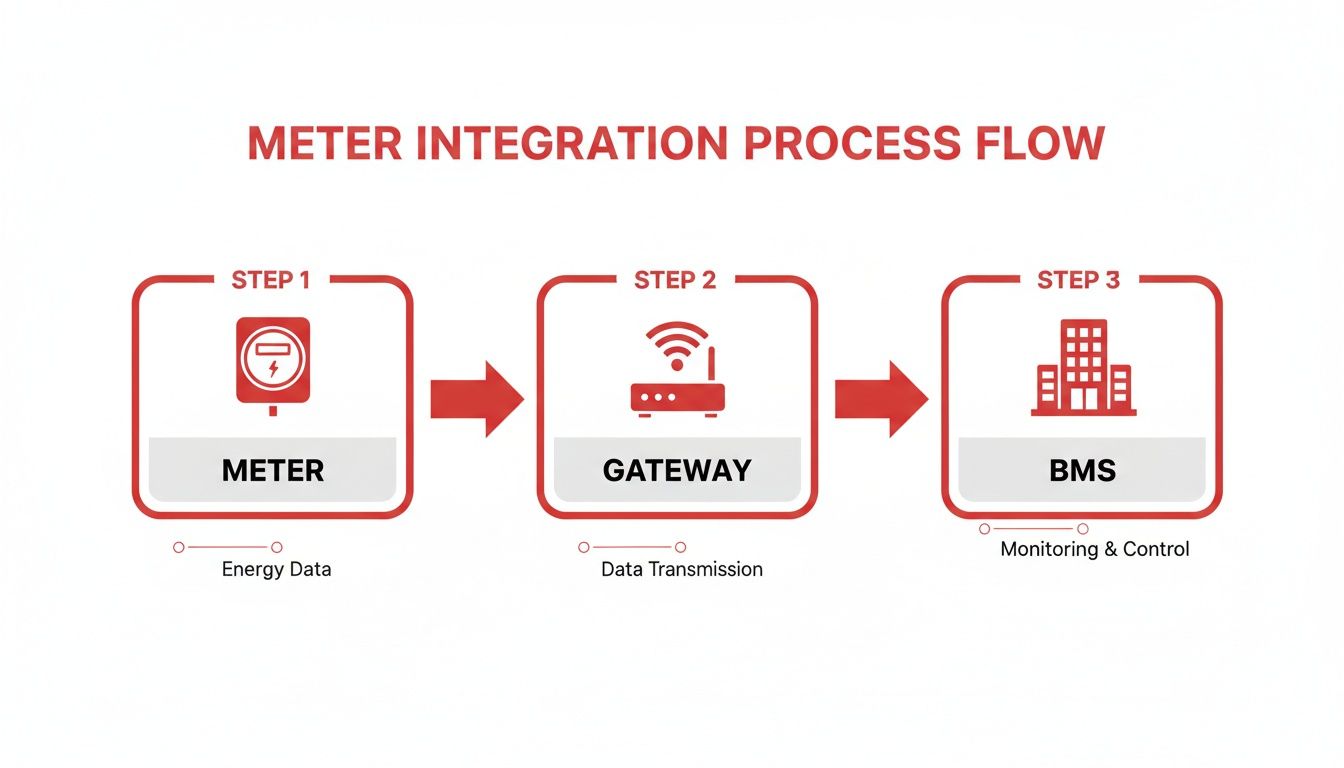
This process visualizes how physical measurements are translated into actionable data for the kind of energy management solution Dubai requires. Adhering to these best practices ensures every energy meter installed in the GCC delivers reliable, accurate data for years.
Meeting Local Compliance and Utility Standards in the UAE/KSA
In the UAE and the wider GCC, regulatory compliance is the critical gateway to project success. Specifying an energy meter that fails to meet local standards will lead to rejected installations, project delays, and safety risks. Engineers and procurement teams must ensure compliance with both international benchmarks and local utility mandates.
These regulations ensure that any component connected to the grid performs reliably, communicates correctly, and bills accurately. It is a non-negotiable aspect of delivering professional electrical systems in the region.
International and Regional Certifications
Compliance begins with internationally recognized standards, which serve as a third-party guarantee of quality and safety. When evaluating an energy meter GCC projects require, look for these key certifications:
- IEC 62053: The global benchmark for static energy meters. IEC 62053-22 is specific to high-accuracy meters (Class 0.2S & 0.5S) suitable for commercial billing.
- CE Marking: A widely respected mark indicating compliance with high European safety, health, and environmental protection requirements.
- GCC Conformity Marking (G-Mark): An increasingly important mark for low-voltage electrical equipment sold in the GCC, confirming compliance with regional technical regulations.
These certifications prove the meter is not only accurate but also built to operate safely within an electrical panel.
Adhering to Local Utility Requirements
Beyond global standards, each utility provider in the UAE and KSA has its own approved vendor list and specific rulebook. An energy meter must be approved by the local authority to be commissioned.
For instance, a project in Dubai requires a DEWA-approved meter, while an installation in Abu Dhabi must use an ADDC-approved device. These approvals are not interchangeable. Using a non-approved meter will result in immediate rejection during inspection, halting the project.
Local utilities have strict requirements for:
- Accuracy Class: Mandating minimum accuracy levels for billing.
- Communication Protocols: Ensuring seamless integration with their grid management systems.
- Security Features: Preventing tampering and protecting billing data integrity.
Always verify that the chosen GoSwitchgear products and other electrical components UAE projects require are explicitly approved by the relevant local authority. This multi-layered approach to compliance, as detailed in general compliance audits, is the only way to guarantee a smooth and successful project delivery.
Frequently Asked Questions About Energy Meters
When specifying or installing an energy meter in the GCC, several key questions frequently arise. Here are answers to common queries from engineers, panel builders, and procurement teams in the UAE.
What is the most important specification for a meter in Dubai's climate?
While accuracy and IP rating are vital, the operating temperature range is arguably the most critical factor for the local climate. A panelboard in direct sun can reach temperatures far exceeding the ambient air. An energy meter must function accurately in conditions that can easily surpass 50°C. Selecting a device rated for a wide range, such as -25°C to +70°C, is non-negotiable to prevent premature failure and ensure long-term reliability.
Can a single-phase meter be used in a three-phase system?
No. Attempting to measure a three-phase system with a single-phase meter will produce inaccurate and useless data. This is a critical error that leads to compliance issues and undermines any energy management strategy. A three-phase system requires a dedicated three-phase energy meter to accurately monitor total energy consumption, power factor, and phase balance.
Why is a DEWA-approved meter necessary for projects in Dubai?
Using a DEWA (Dubai Electricity and Water Authority) approved energy meter is a mandatory requirement for any installation connecting to their grid. DEWA approval guarantees the meter has passed their rigorous testing for accuracy, safety, communication protocols, and tamper-proofing. Installing a non-approved meter will lead to a failed inspection, significant project delays, and the costly process of replacement. This requirement applies to all system components, from a DIN rail isolator to an SMPS power supply, ensuring they meet the high standards set by local utilities.
For expert guidance in selecting certified and compliant electrical components for your next project in the UAE, explore the extensive catalog at GoSwitchgear. Our Dubai-based team is ready to provide the technical support you need.
Browse our full range of certified energy meters at GoSwitchgear
Share this post

Related
Posts
A Guide to Choosing AC to DC Converters for UAE & GCC Electrical Systems
Master AC to DC converters with this comprehensive guide for engineers in the UAE & GCC. Learn selection, installation, and...
A Guide to Drill Machine Prices in the UAE for Technical Professionals
Find the best drill machine price in UAE. Our 2026 guide helps contractors and engineers choose the right corded, cordless,...
A Professional’s Guide to Choosing AGM VRLA Batteries in the UAE Climate
Discover why AGM VRLA batteries are the superior power solution for UPS, solar, and industrial systems in the UAE. Get...
How to Choose the Right Lithium Ion Battery Charger for UAE & GCC Projects
Discover how to select the right lithium ion battery charger for UAE projects. This guide covers specs, BMS integration, and...
.jpg)