.jpg)


Posted by:
Category:
Comments:
Post Date:
Choosing the Right Industrial Exhaust Fan for UAE & GCC Climates
Selecting the right exhaust fan for industrial applications in the UAE and GCC is a critical engineering decision. It’s a vital component for ensuring operational safety, equipment longevity, and energy efficiency in facilities facing extreme heat, humidity, and airborne contaminants. This guide offers practical insights for engineers, panel builders, and procurement teams.
Why the Right Industrial Exhaust Fan is Non-Negotiable in the GCC
In the industrial heartlands of the UAE and KSA, ambient heat, relentless humidity, and pervasive dust are not minor inconveniences; they are direct threats to operational continuity. An inadequate ventilation strategy can trigger a domino effect of costly problems, from equipment failure to regulatory non-compliance.
Without effective air exchange, facilities face:
- Equipment Overheating: Trapped hot air elevates the operating temperature of motors, drives, and control panels, leading to premature failure and unplanned downtime.
- Productivity Losses: High temperatures and poor air quality impair worker concentration and safety, resulting in lower output and increased accident risks.
- Safety and Compliance Breaches: The accumulation of hazardous fumes, vapours, or combustible dust can create a hazardous atmosphere, violating local health and safety regulations.
- Accelerated Corrosion: High humidity, a constant challenge in coastal industrial zones like Jebel Ali or Dammam, accelerates corrosion on metal structures and sensitive electronics.
A high-performance exhaust fan for industrial use is the cornerstone of a ventilation strategy designed to mitigate these regional challenges. It actively removes stale, contaminated air and introduces cooler, cleaner air, creating a balanced and safe indoor environment. This proactive approach is increasingly critical, with the Middle East industrial fan market projected for significant growth. Discover more insights about the industrial fan market growth.
Axial vs. Centrifugal Fans: Matching the Technology to the Task
When selecting an exhaust fan for industrial applications, the primary decision is between axial and centrifugal designs. Understanding their fundamental differences is key to engineering an efficient and cost-effective ventilation system for facilities in the UAE and KSA.
An axial fan functions like a propeller. Its blades rotate around a central axis, moving large volumes of air in a straight line at low pressure. It is the ideal solution for general ventilation in large, open spaces where the primary objective is to exchange a high volume of air without significant resistance from ductwork.
A centrifugal fan (or blower) operates by drawing air into the centre of an impeller and discharging it at a 90-degree angle. This design generates significantly higher pressure, making it the required choice for systems with high resistance, such as long duct runs, filters, or fume scrubbers. Here, the focus is on generating the force needed to overcome system impediments.
This flowchart illustrates how regional environmental challenges can lead to systemic failures without a proper ventilation strategy.
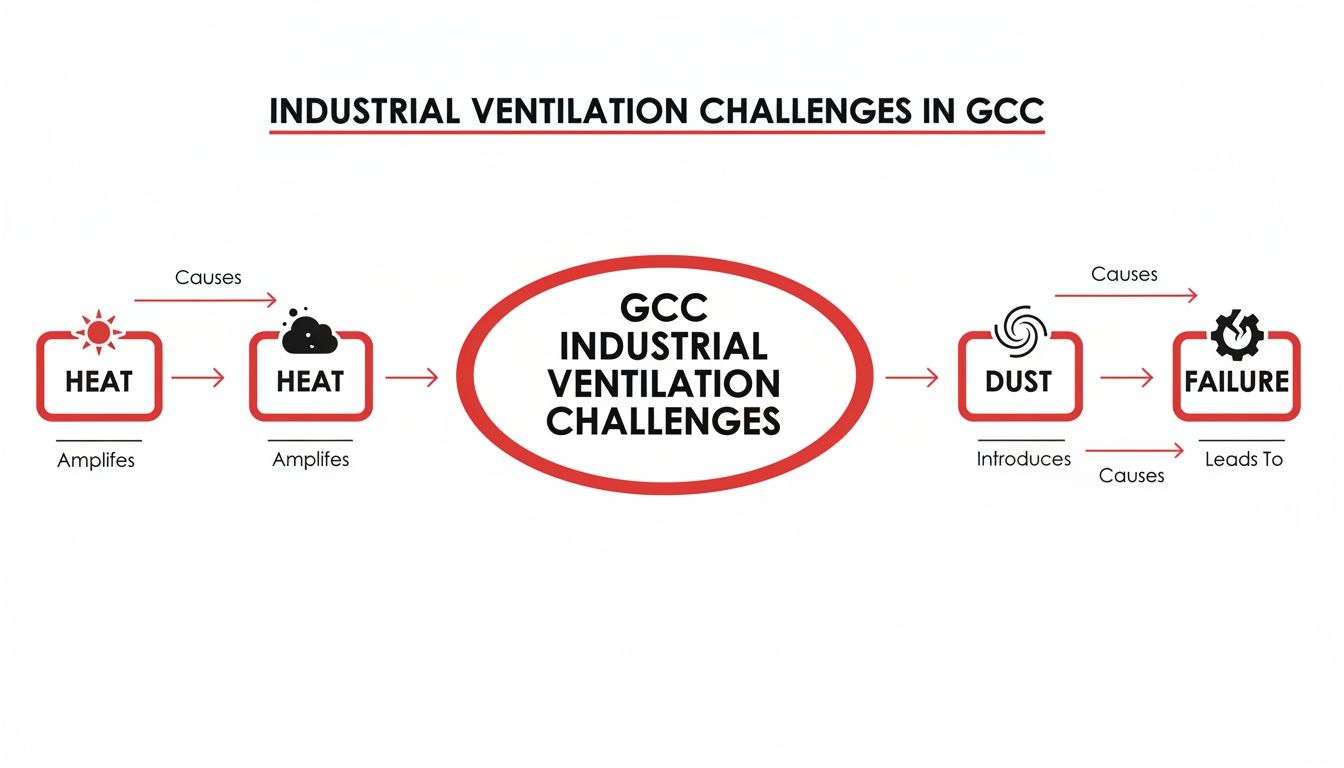
The combination of intense ambient heat and airborne dust directly contributes to premature equipment failure, a significant operational expense for industrial facilities throughout the GCC.
Technical Comparison for GCC Applications
This table provides a clear comparison to guide selection for industrial projects in the Gulf region.
| Characteristic | Axial Fans (High Volume) | Centrifugal Fans (High Pressure) | Best for GCC Application |
|---|---|---|---|
| Airflow Direction | Parallel to the axis | Perpendicular (90-degree angle) | Dependent on system layout. |
| Air Volume (CFM) | High. Ideal for moving large quantities of air. | Lower. Focused on pressure generation. | Axial for large space cooling. |
| Air Pressure | Low. Not suitable for high-resistance systems. | High. Designed to overcome system resistance. | Centrifugal for ducted/filtered systems. |
| Typical Use | General factory ventilation, warehouse cooling. | Ducted systems, fume extraction, dust collection. | Match fan type to the system's resistance. |
| Energy Efficiency | Most efficient in low-pressure applications. | More efficient in high-pressure systems. | Efficiency is determined by correct application. |
The optimal choice depends entirely on the specific application's requirements.
Axial Fan Applications in the UAE & KSA
Axial fans excel in high-volume, low-resistance ventilation, making them ideal for cooling and circulating air in large, open environments.
- Warehouse Cooling in Dubai: Wall-mounted axial fans effectively exhaust hot air from near the ceiling of logistics hubs in Jebel Ali, drawing in cooler ambient air at lower levels.
- Factory Ventilation in Abu Dhabi: Large axial fans maintain a specified number of air changes per hour (ACH) across manufacturing floors, ensuring a safe and productive environment.
- HVAC Condenser Cooling: Powerful axial fans are critical for dissipating heat from condenser coils in large-scale HVAC systems across the GCC, ensuring their operational efficiency.
Centrifugal Fan Applications in the UAE & KSA
Centrifugal fans are essential when the system presents significant resistance, providing the high pressure needed for targeted air movement.
- Fume Extraction in Sharjah Workshops: A ducted hood system connected to a centrifugal fan provides the powerful suction required to capture welding fumes at the source and move them through filters.
- Dust Collection in Ras Al Khaimah Cement Plants: Centrifugal fans provide the high static pressure necessary to pull dust-laden air through complex filtration units like baghouses.
- Cleanroom Pressurisation in KSA: In pharmaceutical facilities, centrifugal fans force air through high-efficiency particulate air (HEPA) filters to create positive pressure, preventing contaminant ingress.
Key Principle: Axial fans are for moving high volumes of air in open spaces (high flow, low pressure). Centrifugal fans are for pushing air through restrictive systems (high pressure, lower flow). Matching the fan to the system's resistance is the first step toward an effective ventilation solution.
Key Technical Selection Criteria for Engineers
After determining the fan type, engineers and procurement teams in the UAE must analyse the technical specifications to ensure system performance, reliability, and safety under demanding GCC conditions.
Calculating Required Airflow Rate (CFM/CMH)
The Airflow Rate, measured in Cubic Feet per Minute (CFM) or Cubic Metres per Hour (CMH), quantifies the volume of air a fan moves over time. It is calculated based on the space's volume and the required Air Changes per Hour (ACH).
The ACH value varies by application. A storage warehouse in Dubai may require only 6-10 ACH, while a fabrication workshop in Sharjah with welding fumes might demand 20-30 ACH or more to maintain safe air quality.
Sample Calculation:
For a workshop measuring 20m (L) x 15m (W) x 5m (H):
- Volume: 20m x 15m x 5m = 1,500 m³
- Required ACH: 20 (for a high-fume area)
- Required Airflow: 1,500 m³ x 20 ACH = 30,000 CMH
The selected fan(s) must be capable of moving 30,000 cubic metres of air per hour.
Understanding Static Pressure (Pa)
Static Pressure, measured in Pascals (Pa), represents the total resistance the fan must overcome from components like ductwork, filters, and louvres. An axial fan will fail to perform in a high-resistance system, as its airflow will drop significantly. A centrifugal fan is designed to operate against high static pressure, making it the correct choice for such applications. Accurate calculation of total system pressure loss is essential for proper fan selection.
Specifying for the Harsh GCC Environment
Equipment durability is paramount in the UAE and KSA. Two specifications are non-negotiable for ensuring fan longevity.
1. Ingress Protection (IP) Rating
The IP rating defines an enclosure's protection against dust and moisture. For industrial exhaust fans in this region, IP55 is the minimum acceptable standard.
- The first '5' denotes dust protection, preventing harmful ingress that can damage motor windings.
- The second '5' indicates protection against low-pressure water jets, essential for wash-down procedures and exposure to humidity.
Specifying a lower IP rating risks premature motor failure. Learn more by reading our guide on panel cooling fans and their requirements.
2. Material and Coating Selection
Corrosion from humidity and salinity is a major threat in coastal industrial zones.
- For High Humidity/Saline Areas: Specify fans constructed from galvanized steel, stainless steel, or finished with marine-grade epoxy coatings to resist corrosion.
- For Chemical Environments: For applications involving corrosive fumes, materials like fiberglass-reinforced plastic (FRP) or other specialised alloys may be necessary.
By meticulously evaluating airflow, pressure, IP ratings, and materials, you make a strategic investment in your facility's operational resilience.
Optimizing Fan Performance for Efficiency and Cost Savings
Specifying a powerful exhaust fan for industrial use is only the first step. True value is realised through operational efficiency, which reduces long-term costs and ensures the ventilation system is a sustainable asset.

This requires a deeper analysis of performance curves, motor technology, and intelligent control systems that adapt to real-time facility demands.
Interpreting the Fan Performance Curve
The fan performance curve, provided by the manufacturer, is an essential selection tool. This graph illustrates the relationship between airflow, static pressure, and brake horsepower (BHP). The most critical point on this curve is the Best Efficiency Point (BEP).
The BEP represents the operating point where the fan moves the most air for the least amount of energy. The engineering goal is to select a fan where the system's requirements align closely with this point. Operating far from the BEP results in:
- Wasted Energy: The motor works harder than necessary, increasing electricity costs.
- Increased Noise and Vibration: Inefficient operation creates turbulence and mechanical stress.
- Reduced Lifespan: Increased strain leads to premature failure of components like bearings.
The Impact of High-Efficiency Motors
The fan motor's efficiency rating directly impacts energy consumption. In the UAE and GCC, specifying high-efficiency motors is a sound financial decision.
- IE3 (Premium Efficiency): The current standard, offering significant energy savings over older IE1/IE2 models.
- IE4 (Super Premium Efficiency): The next level of efficiency, ideal for continuous-duty applications where the fan runs 24/7.
While high-efficiency motors have a higher initial cost, the return on investment through reduced energy bills is often rapid. Explore our comprehensive energy efficiency solutions tailored for the GCC market.
Unlocking Savings with Variable Frequency Drives (VFDs)
For facilities with variable ventilation demands, a Variable Frequency Drive (VFD) offers unparalleled control and efficiency. A VFD modulates the fan motor's speed to precisely match airflow with real-time demand.
By slowing the motor down instead of using inefficient dampers, a VFD leverages fan affinity laws to achieve substantial energy savings. Reducing fan speed by just 20% can decrease energy consumption by nearly 50%.
Maximising VFD energy savings is a key strategy for reducing the long-term operational costs of an industrial ventilation system.
Managing Noise Levels for Workplace Safety
Operational efficiency also encompasses creating a safe work environment. Industrial fans can be a significant source of noise pollution. Noise levels, measured in decibels (dB), must be managed to comply with occupational safety regulations. Always consult the manufacturer's datasheet for sound ratings at your specified operating point. A fan operating near its BEP is not only more energy-efficient but also quieter.
Best Practices for Installation to Avoid Costly Errors
A technically superior exhaust fan for industrial use will underperform if installed incorrectly. Proper installation by qualified electricians and technicians in the UAE is critical for performance, safety, and longevity.
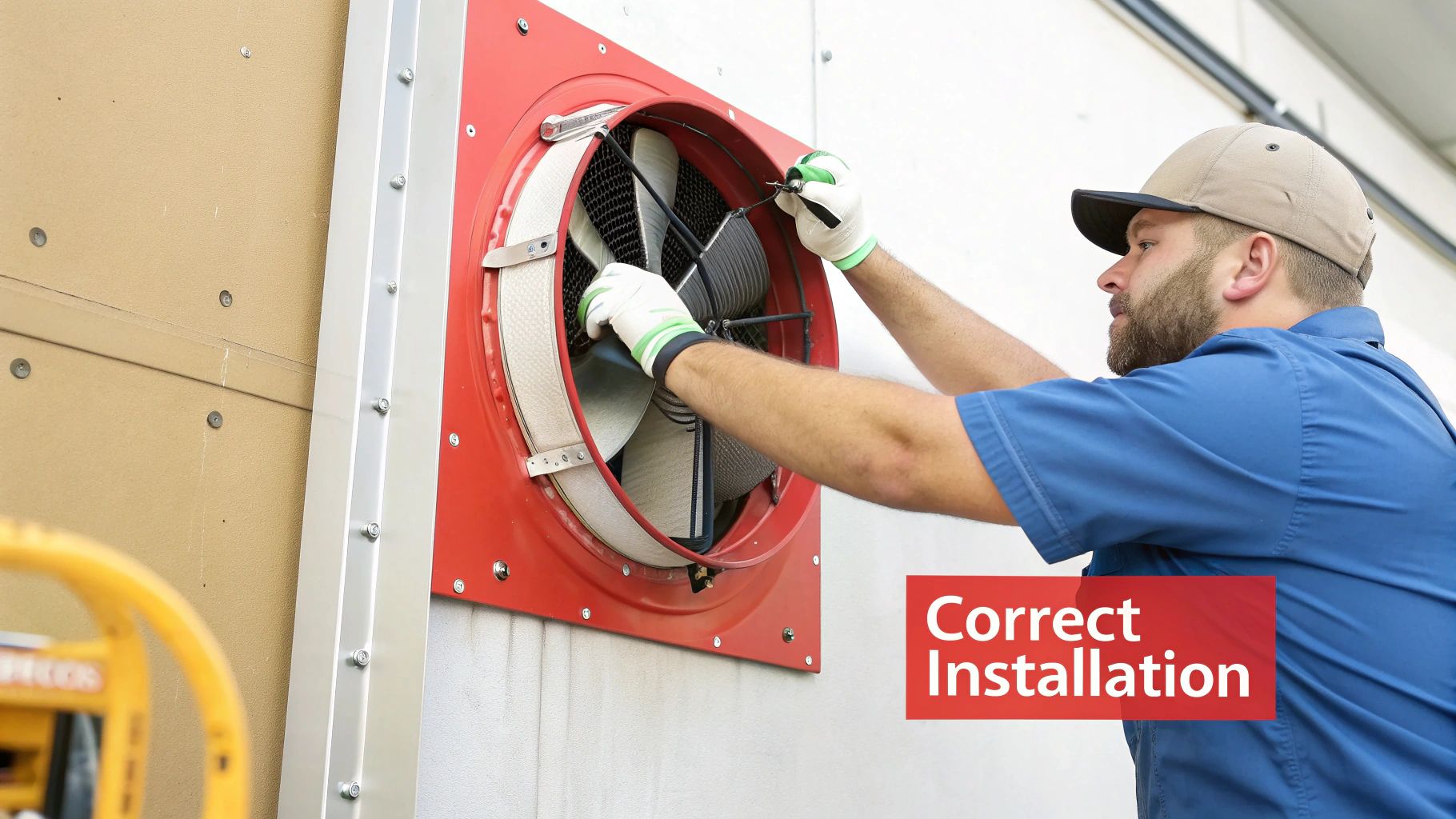
Adhering to best practices for structural mounting, electrical connections, and ductwork design is essential for reliable, long-term operation.
Structural Mounting and Vibration Control
Industrial fans generate significant vibration. If not properly managed, this vibration can transfer to the building structure, causing noise and leading to mechanical failure.
- Secure Anchoring: Use manufacturer-specified anchor bolts and hardware to fasten the fan to a solid structural element.
- Vibration Dampeners: Install anti-vibration mounts or spring isolators between the fan and the mounting surface. This is a non-negotiable step to absorb vibration.
- Level Installation: Ensure the fan is perfectly level. An imbalanced installation places extreme stress on bearings and the motor shaft, drastically reducing their operational life.
Safe Electrical Connections and Local Compliance
All electrical work must comply with local regulations from authorities like DEWA (Dubai) or SEC (Saudi Arabia).
- Correct Motor Wiring: Adhere strictly to the manufacturer's wiring diagram. Use correctly sized conductors and ensure all terminal connections are secure to prevent motor overheating.
- Proper Grounding: A reliable earth connection is mandatory for protection against electrical shock and faults.
- Overload Protection: The motor must be protected by a correctly sized thermal overload relay, typically integrated within a motor control centre. Learn more about specifying the right motor control centre for HVAC systems to ensure robust protection.
Airflow Obstructions and Ductwork Design
The fan's placement and ductwork connections are critical for performance.
- Correct Duct Sizing: Undersized ductwork creates high static pressure, forcing the motor to work harder and reducing airflow.
- Avoid Inlet/Outlet Obstructions: Fans require unobstructed space at their inlet and outlet to prevent efficiency-killing turbulence.
- Use Gradual Bends: Sharp 90-degree bends in ductwork create significant pressure loss. Use gradual, sweeping bends to maintain smooth airflow and allow the fan to operate efficiently.
A Preventive Maintenance Plan for Maximum Fan Longevity
In the demanding conditions of the GCC, a proactive maintenance strategy is essential to protect your investment in any exhaust fan for industrial use. A structured preventive maintenance plan mitigates the impact of heat, dust, and humidity, preventing costly downtime and extending the equipment's operational lifespan.
A consistent schedule empowers facility teams to identify and address minor issues before they escalate into major failures.
Core Preventive Maintenance Checklist
This checklist focuses on components most vulnerable to the local climate. A quarterly or bi-annual schedule is recommended.
- Blade Cleaning and Inspection: Accumulated dust and debris can unbalance the fan, causing vibration and reducing airflow. Regular cleaning is critical.
- Bearing Lubrication: In high ambient temperatures, proper lubrication is vital to prevent bearings from overheating and seizing. Adhere to manufacturer specifications for grease type and frequency.
- Belt Tension and Condition (for belt-driven fans): Regularly inspect belts for proper tension and signs of wear (cracking, fraying). Replace worn belts to prevent slippage and performance loss.
Electrical and Structural Integrity Checks
The electrical and mounting systems also require regular inspection.
- Inspect Electrical Connections: Check for tightness and signs of corrosion at terminals, as high humidity can accelerate degradation.
- Verify Structural Mountings: Ensure all mounting bolts are secure and that vibration isolators are intact and functioning correctly to prevent mechanical stress.
These maintenance principles are universal. Regularly cleaning your exhaust fan is a simple yet crucial task that prevents a cascade of mechanical problems.
Your Partner for Industrial Ventilation Solutions in the UAE
Choosing the right exhaust fan for industrial applications in the UAE is a strategic decision that balances airflow, pressure, durability, and efficiency against our region's demanding climate. From selecting the correct fan type to ensuring proper installation and maintenance, every step is critical.
At GoSwitchgear, we are more than a supplier; we are a technical partner for projects in Dubai, Abu Dhabi, and across the GCC. Our engineering team possesses deep local expertise and is committed to helping you specify a ventilation solution engineered for performance and longevity in the most challenging environments.
The right fan is an investment in operational resilience. We help you make that investment with confidence.
Ready to discuss your project requirements? Contact our Dubai team for expert support and explore our extensive range of industrial ventilation systems.
Frequently Asked Questions
Our engineering team addresses common questions from clients in the UAE and GCC regarding the selection of an exhaust fan for industrial use.
What is the most important specification for a fan in a dusty UAE factory?
The single most critical factor is the Ingress Protection (IP) rating. For dusty industrial environments in this region, an IP55 rating should be considered the absolute minimum. This ensures the fan's motor and electrical components are protected against harmful dust ingress and can withstand low-pressure water jets, safeguarding the equipment's longevity and operational safety.
How do I calculate the correct fan size (CFM) for my facility?
A preliminary calculation can be made using the space's volume (Length x Width x Height) and the required air changes per hour (ACH). The ACH target depends on the application; a warehouse may need 6-10 ACH, while a workshop with fumes could require 20 ACH or more.
Formula: CFM = (Room Volume in cubic feet x ACH) / 60. For mission-critical applications, we strongly recommend consulting an HVAC engineer to perform detailed calculations that account for all system variables.
Can I use a VFD with any industrial exhaust fan?
While most modern three-phase industrial fan motors are compatible with a Variable Frequency Drive (VFD), it is essential to verify that the motor is 'inverter-duty' rated. This rating confirms the motor's insulation and construction are designed to withstand the unique electrical stresses imposed by a VFD without overheating or failing prematurely. Pairing a VFD with a compatible fan is an excellent strategy for achieving precise control and significant energy savings.
Share this post

Related
Posts
A Guide to Choosing AC to DC Converters for UAE & GCC Electrical Systems
Master AC to DC converters with this comprehensive guide for engineers in the UAE & GCC. Learn selection, installation, and...
A Guide to Drill Machine Prices in the UAE for Technical Professionals
Find the best drill machine price in UAE. Our 2026 guide helps contractors and engineers choose the right corded, cordless,...
A Professional’s Guide to Choosing AGM VRLA Batteries in the UAE Climate
Discover why AGM VRLA batteries are the superior power solution for UPS, solar, and industrial systems in the UAE. Get...
How to Choose the Right Lithium Ion Battery Charger for UAE & GCC Projects
Discover how to select the right lithium ion battery charger for UAE projects. This guide covers specs, BMS integration, and...
.jpg)