.jpg)


Posted by:
Category:
Comments:
Post Date:
A Professional Guide to Selecting the Right RCBO Circuit Breaker in the UAE
An RCBO circuit breaker is a critical safety device combining a Miniature Circuit Breaker (MCB) and a Residual Current Device (RCD) into one compact unit. It offers complete protection from overcurrents (overloads and short circuits) and dangerous earth fault currents, making it an essential component for any modern electrical system in the UAE and GCC.
Why the RCBO Is Essential for Electrical Safety in the UAE

In the demanding environmental conditions of the UAE and wider GCC, superior electrical safety is not just best practice—it is a regulatory requirement. The combination of high heat, humidity, and dust can accelerate the degradation of wiring insulation, creating conditions ripe for subtle but dangerous earth faults that a standard MCB would miss. This is precisely the scenario an RCBO circuit breaker is engineered to prevent.
An RCBO provides a superior, all-in-one safety solution by detecting two distinct electrical hazards:
- Overcurrent Protection: It trips instantly during an overload or short circuit, protecting valuable equipment and preventing potential fires.
- Residual Current (Earth Fault) Protection: It senses minute leakage currents—the type that can cause severe electric shock—and disconnects the power in milliseconds to ensure personnel safety.
This dual-protection capability is crucial for both regulatory compliance and operational reliability. The rapid industrial growth, particularly in areas focusing on electrical safety in Dubai's growing manufacturing sector, underscores the critical need for advanced protective devices like RCBOs. Their adoption is mandated by stringent local regulations, ensuring robust safety standards across all new installations.
Understanding How an RCBO Delivers Dual Protection
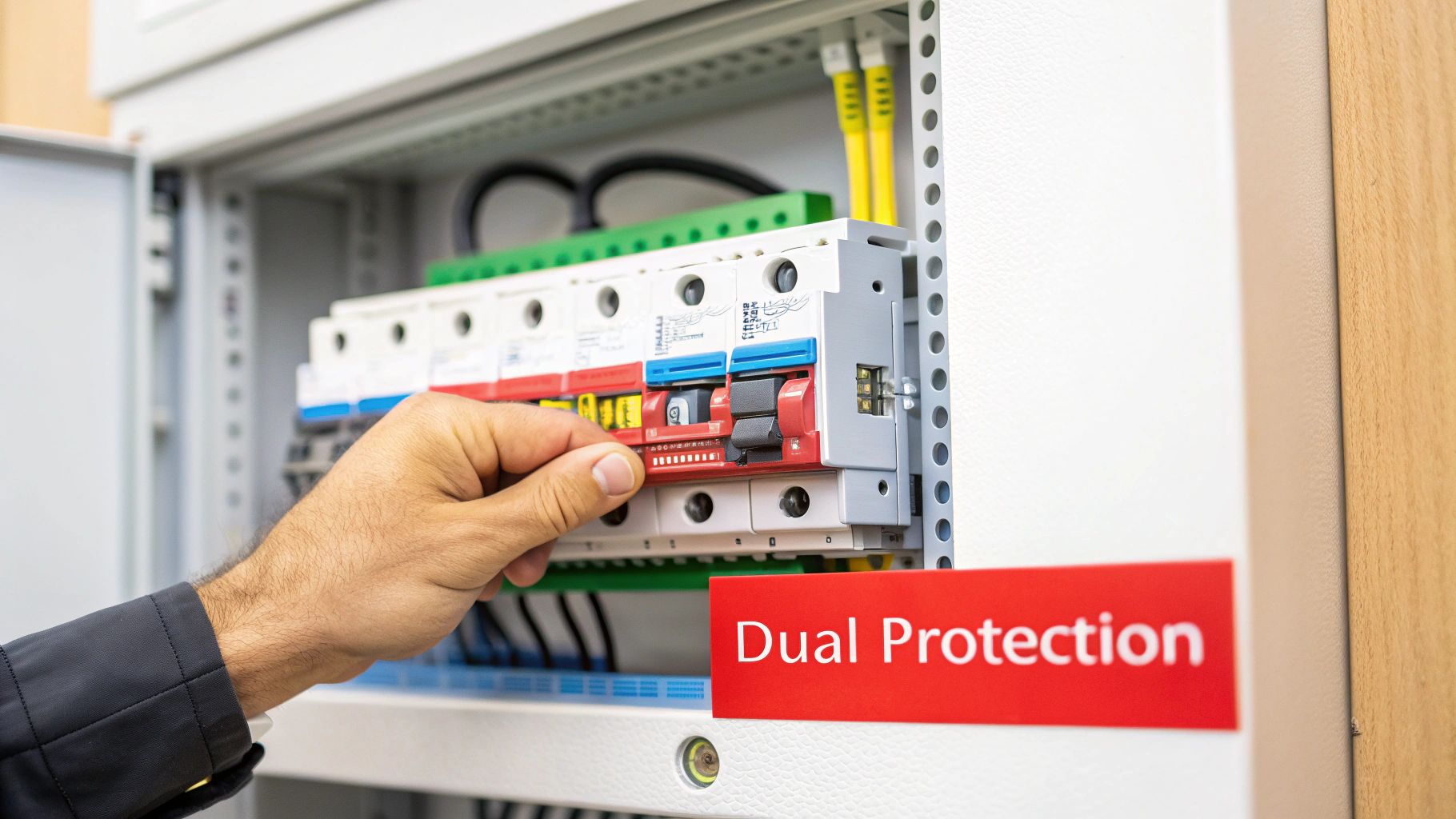
The RCBO integrates two distinct protective mechanisms into a single, DIN-rail mountable housing. This compact, all-in-one design is what makes the RCBO an indispensable energy management solution in Dubai and across the GCC. By combining the functions of an MCB and an RCD, it saves valuable panel space, reduces wiring complexity, and simplifies installation.
The Overcurrent Protection Mechanism
The first function of an RCBO circuit breaker is to act as a standard Miniature Circuit Breaker (MCB). Its internal thermal-magnetic trip unit is designed to detect and interrupt overcurrents.
This mechanism addresses two primary fault conditions:
- Thermal Protection (Overloads): An overload occurs when a circuit draws more current than it is designed to handle, causing wiring to heat up. A bimetallic strip inside the RCBO heats and bends, eventually tripping the mechanical latch to interrupt the circuit. This prevents cable insulation from melting and reduces fire risk.
- Magnetic Protection (Short Circuits): A short circuit is a sudden, high-magnitude surge of current. The RCBO’s electromagnetic coil detects this instantaneous spike, generating a magnetic field that forces the contacts apart in milliseconds. This rapid response prevents catastrophic damage to equipment and infrastructure.
This element of the RCBO is dedicated to protecting the installation's hardware—cables, busbars, and connected appliances—from the destructive force of overcurrents.
The Residual Current Protection Mechanism
The second, and arguably more critical, function is what protects human life. The residual current device (RCD) component of the RCBO is engineered to prevent electric shock by detecting minute, hidden earth fault currents that an MCB cannot see. It operates on the principle of current balance.
An internal current transformer continuously compares the current flowing out on the live conductor with the current returning on the neutral conductor.
In a healthy circuit, the current flowing to an appliance is identical to the current flowing back. The RCBO detects this equilibrium and remains closed.
However, if a person touches a faulty appliance, a small amount of current will leak through their body to earth instead of returning via the neutral wire. This creates an imbalance. The RCBO's high-sensitivity sensor instantly detects this discrepancy—even a leakage as low as 30 milliamperes (0.03A)—and trips the circuit.
This occurs in a fraction of a second, long before the electric shock can cause serious injury or fatality. It is this life-saving response that makes the RCBO a mandatory component for ensuring personnel safety on projects throughout the UAE.
Choosing the Right Protection: RCBO vs. MCB and RCCB
For panel builders, electrical contractors, and engineers in the UAE, selecting the appropriate protective device is a critical decision that impacts project safety, compliance, installation time, panel space, and overall cost. A clear understanding of the distinct roles of an MCB, RCCB, and an RCBO circuit breaker is essential for making an informed choice that meets local regulatory standards.
Incorrect device selection can result in incomplete protection, exposing personnel and equipment to significant risks. A common misconception is that these devices are interchangeable, which often leads to non-compliant or unnecessarily complex installations.
Defining the Roles of Each Device
Let's clarify the specific function of each component. A Miniature Circuit Breaker (MCB) provides the most basic level of protection, exclusively against overcurrents. It trips during an overload or short circuit to protect wiring and appliances from thermal and magnetic damage.
An RCCB (Residual Current Circuit Breaker) has a completely different purpose. It offers no protection against overloads or short circuits. Its sole function is to detect small earth leakage currents that could cause a dangerous electric shock.
To achieve complete protection against both fault types using these separate components, an MCB must be installed in series with an RCCB. While effective, this two-device configuration consumes more DIN rail space and complicates wiring, increasing labour time and the potential for connection errors.
The RCBO: The Integrated Solution
This is where the RCBO circuit breaker serves as the superior, modern alternative. It integrates the full functionality of both an MCB and an RCCB into a single, compact device.
An RCBO provides comprehensive protection in one housing. It protects equipment against overloads and short circuits while simultaneously protecting people from electric shocks caused by earth faults.
For projects in Dubai and Abu Dhabi, this all-in-one approach is highly advantageous. It simplifies panel design, reduces wiring complexity, and conserves valuable DIN rail space. Furthermore, it enhances troubleshooting efficiency. Since each final circuit is protected by its own RCBO, a fault will only trip the affected circuit, leaving the rest of the installation powered. This provides far better operational continuity than a single upstream RCCB protecting multiple MCBs, where one fault can de-energize an entire section of the building. This streamlined approach also simplifies compliance with local utility regulations from authorities like DEWA and ADDC.
This comparative table clarifies the key differences, helping you specify the correct device for every application.
Comparing Circuit Protection Devices: MCB vs. RCCB vs. RCBO
| Feature | MCB (Miniature Circuit Breaker) | RCCB (Residual Current Circuit Breaker) | RCBO (Residual Current Circuit Breaker with Overcurrent Protection) |
|---|---|---|---|
| Primary Function | Protects against overloads and short circuits. | Protects against earth leakage currents (electric shock). | Provides all-in-one protection against overloads, short circuits, and earth leakage. |
| Personnel Safety | No protection against electric shock. | Excellent protection against electric shock. | Excellent protection against electric shock. |
| Equipment Safety | Excellent protection for wiring and appliances. | No protection against overloads or short circuits. | Excellent protection for wiring and appliances. |
| DIN Rail Space | Single module width. | Two module widths. | Typically one or two module widths. |
| Wiring Complexity | Simple (Line and Neutral). | Requires series connection with downstream MCBs. | Simple, self-contained wiring. |
| Best For | Basic circuit protection where shock risk is managed separately. | Upstream group protection for several circuits fed by individual MCBs. | Complete, individual protection for final circuits, especially socket outlets. |
While all three devices contribute to electrical safety, the RCBO offers the most comprehensive and efficient solution for modern installations in the GCC, where both personnel safety and equipment protection are paramount.
How to Select the Correct RCBO for Your GCC Application
Selecting the correct RCBO circuit breaker is a critical engineering decision that ensures the safety and reliability of an electrical installation. For engineers and panel builders in the UAE and GCC, this choice involves specifying key technical parameters that are suitable for our demanding local climate. An incorrect specification can lead to nuisance tripping, inadequate protection, or premature device failure, compromising the entire system.
This guide outlines the essential criteria for specifying the right RCBO, ensuring your projects are safe, compliant, and robust.
Decoding Trip Sensitivity (IΔn)
Trip sensitivity, measured in milliamps (mA), defines the magnitude of leakage current required to trip the RCBO. This is the most critical parameter for personnel protection.
- 30mA Sensitivity: This is the mandatory standard for the protection of personnel in the UAE. It is required for most socket outlets in residential, commercial, and industrial applications. A 30mA trip is fast enough to prevent a potentially fatal electric shock.
- 10mA Sensitivity: Specified for high-risk locations where the probability of electric shock is increased, such as medical facilities or special wet areas. The higher sensitivity provides an enhanced level of protection.
- 100mA and 300mA Sensitivity: These ratings are not intended for direct shock protection. They are used upstream for equipment protection or to provide fire protection against sustained low-level earth faults that could cause overheating.
Matching Current Rating (In) and Breaking Capacity (Icn)
The current rating (in Amps) of the RCBO must be selected based on the circuit's design load and the current-carrying capacity of the cable it protects. Oversizing the RCBO is a dangerous error, as it may fail to trip during a sustained overload, leading to cable damage.
Equally important is the breaking capacity (kA). This value indicates the maximum prospective short-circuit current the RCBO can safely interrupt without failing. For most commercial and residential installations in the UAE, a 6kA or 10kA rated device is sufficient. However, for industrial sites or installations near a main transformer, a higher breaking capacity may be required. Always verify the prospective short circuit current (PSCC) at the point of installation.
Selecting the Correct RCBO Type
Modern electronic loads generate complex current waveforms. RCBOs are classified into different "Types" based on their ability to detect these various waveforms. Selecting the correct type is essential to prevent nuisance tripping and ensure reliable fault detection.
The IEC 61009 standard governs RCBOs and classifies them based on the fault current waveforms they can detect. Using the wrong type—for example, a Type AC on a circuit powering a VFD or EV charger—can result in a failure to trip during a fault.
Common types include:
- Type AC: Suitable only for purely sinusoidal AC residual currents, typically from simple resistive loads. This type is largely obsolete for modern installations in the GCC.
- Type A: The new standard for most general-purpose circuits. It detects both AC and pulsating DC residual currents generated by modern electronic equipment like PCs, LED drivers, and inverters.
- Type B: A specialist device that detects AC, pulsating DC, and smooth DC fault currents. A Type B RCBO is essential for applications involving three-phase rectifiers, solar PV inverters, variable speed drives (VFDs), and EV charging stations, where smooth DC leakage is a credible risk.
RCBO Installation and Maintenance Best Practices
Correct installation is fundamental to the reliable performance of an RCBO. For electricians and maintenance professionals working in the challenging UAE climate, proper wiring is non-negotiable to prevent issues like nuisance tripping and ensure safety. A structured installation approach guarantees that every RCBO circuit breaker delivers the life-saving protection it was designed for.
Equally important is a disciplined maintenance routine. Although robust, an RCBO's mechanical trip function requires periodic verification to ensure it remains operational. A simple, scheduled maintenance plan ensures IEC compliance and reliable performance throughout the device's service life.
Correct Wiring: A Step-by-Step Guide
The most critical aspect of installing an RCBO circuit breaker is the neutral connection. Unlike an MCB, an RCBO monitors both the live and neutral conductors. Therefore, each protected circuit requires its own dedicated neutral.
- Isolate Power: Before starting work, ensure the main supply to the distribution board is de-energized and locked out.
- Connect Incoming Line: Securely connect the incoming line (live) conductor to the top 'L' terminal of the RCBO.
- Connect Incoming Neutral: Connect the incoming neutral conductor to the top 'N' terminal.
- Connect Outgoing Load: Connect the outgoing live and neutral conductors for the final circuit to the corresponding bottom terminals ('L' and 'N').
- Torque Terminals: Use a calibrated torque screwdriver to tighten all terminal screws to the manufacturer's specified torque. Loose connections are a primary cause of overheating and device failure.
Common Installation Mistakes to Avoid
A few common errors account for the majority of post-installation RCBO issues. Avoiding these mistakes ensures a reliable and safe installation.
- Shared Neutrals: Never share a single neutral conductor across multiple circuits protected by different RCBOs. This is the number one cause of nuisance tripping, as it creates an immediate current imbalance that the RCBO interprets as a fault.
- Incorrect Torquing: Under-tightened terminals create high-resistance points, leading to heat generation. Conversely, over-tightening can damage the terminal block. Always adhere to the manufacturer's datasheet.
- Reversed Connections: Swapping incoming and outgoing connections can prevent the RCBO from functioning correctly. Always double-check wiring before energizing the circuit.
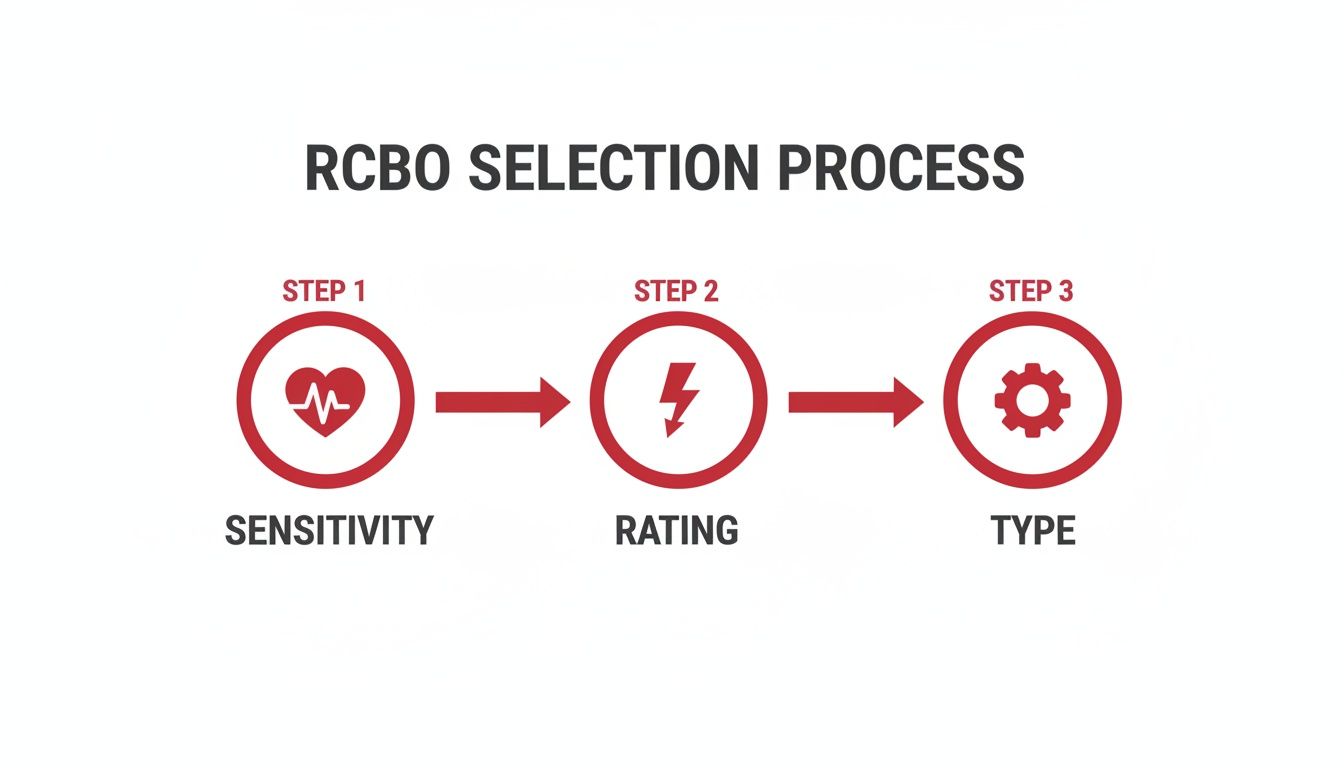
This flowchart illustrates the systematic process for selecting the correct RCBO. By addressing sensitivity, rating, and type, you ensure comprehensive protection for both personnel and equipment.
Simple Maintenance and Troubleshooting
Maintaining an RCBO is straightforward but essential. The primary task is the periodic manual test, which verifies the integrity of the mechanical trip mechanism.
As mandated by IEC standards, the 'Test' button on every RCBO should be operated at least every six months. This simulates a fault and confirms the device trips correctly, a crucial check in dusty GCC environments where mechanical parts can be affected.
When troubleshooting nuisance tripping, first determine if it is due to a genuine fault, an installation error, or a faulty appliance. Isolate the circuit and unplug all connected equipment. If the RCBO resets, plug in appliances one by one until it trips again to identify the faulty device.
If the RCBO still trips with no load connected, inspect the installation wiring for shared neutrals or signs of moisture ingress. For a comprehensive selection of high-quality electrical components in the UAE, explore the GoSwitchgear product catalogue.
RCBOs: The Unsung Heroes of Smart Buildings
As the UAE and GCC advance towards a future of smart, sustainable infrastructure, the underlying electrical safety technologies must evolve accordingly. The conventional distribution board is no longer sufficient for the complex demands of today's smart buildings. Here, the RCBO circuit breaker emerges as an indispensable component for ensuring these sophisticated environments operate safely and efficiently.
This represents a fundamental shift in circuit protection philosophy. The backbone of a smart building—sensitive IoT sensors, control systems, and advanced electronics—is highly vulnerable to both overcurrents and subtle earth faults. An RCBO provides the comprehensive, all-in-one protection these critical systems require.
Powering the Future of Sustainable and Smart Infrastructure
The need for advanced RCBOs is evident in projects aligned with the region's technological and environmental ambitions.
Renewable Energy Projects: In large-scale solar installations, specialized Type B RCBOs are essential. They are specifically designed to protect solar PV inverters, which can produce smooth DC residual currents that a standard Type A RCBO would fail to detect.
EV Charging Infrastructure: The rapid deployment of electric vehicle charging stations across Dubai and Abu Dhabi introduces new electrical load profiles. Type A and Type B RCBOs are required to protect these chargers and their users from the complex fault currents they can generate.
Automated Industrial Panels: In modern factories and automated facilities, RCBOs protect sensitive PLCs, VFDs, and control systems. They prevent equipment damage and costly operational downtime.
The market reflects this trend. The renewables sector in the MENA region is a significant driver, with market share from solar applications projected to grow substantially. Today, the majority of panel integrators in the UAE specify RCBOs over separate MCB/RCCB combinations for final circuits requiring combined protection.
For a deeper analysis of market dynamics, you can read the full research about the RCBO market.
Your Partner for Compliant and Safe Electrical Systems
The RCBO circuit breaker is more than a component—it is a complete safety solution for modern electrical systems. By integrating dual protection into a single device, it saves panel space and simplifies installation, ensuring compliance with stringent UAE electrical codes.
Proper selection is critical, especially in our demanding local climate. Choosing the correct type, sensitivity, and rating is essential for reliable, long-term protection. This is where we provide value. Leveraging our M&E Engineering expertise, we assist clients in flawlessly integrating critical components like RCBOs, with a focus on safety, sustainability, and compliance.
For engineers, contractors, and procurement managers across Dubai, Abu Dhabi, and the wider GCC, GoSwitchgear is more than a supplier. We are your dedicated technical partner, committed to the safety and success of your projects.
Your Questions, Answered
Practical questions often arise when working with RCBO circuit breakers in the field. We have compiled clear, concise answers to the most common queries from engineers and electricians across the UAE and GCC.
What Is the Primary Cause of Nuisance Tripping?
In over 90% of cases, nuisance tripping is caused by a wiring error—specifically, a shared neutral between different circuits protected by separate RCBOs. An RCBO circuit breaker is designed to monitor a single circuit and requires its own dedicated neutral to maintain current balance.
Other causes include cumulative leakage currents from multiple electronic devices on a single circuit or moisture ingress in outdoor wiring, which can create a persistent earth leakage path.
Can One RCBO Protect Multiple Circuits?
No. An RCBO is designed to provide all-in-one protection for a single final circuit. Its core function is to combine overcurrent and residual current protection for that specific line within one housing.
For group protection, the standard design is an upstream RCCB feeding multiple individual MCBs. However, using a dedicated RCBO for each final circuit is the superior modern practice. It provides better fault discrimination—a fault on one circuit does not disconnect power to others—which is a significant advantage for operational continuity.
Are RCBOs Mandatory for All Circuits in the UAE?
According to the latest UAE Electricity Wiring Regulations and DEWA guidelines, RCBOs with 30mA protection are now mandatory for most socket outlet circuits in new installations. This applies to residential, commercial, and industrial projects, particularly in high-risk areas like kitchens, bathrooms, and all outdoor sockets.
While not required for every single circuit (e.g., some dedicated lighting circuits may be exempt), they have become the industry standard for best practice. For ensuring complete personnel safety and full regulatory compliance, installing RCBOs is the professional standard.
At GoSwitchgear, we supply the high-quality electrical components needed to build systems that are safe, compliant, and durable. Browse our catalogue to find the optimal RCBO solution for your next project in the UAE or GCC.
Discover our range of circuit protection devices at GoSwitchgear
Share this post

Related
Posts
A Guide to Choosing AC to DC Converters for UAE & GCC Electrical Systems
Master AC to DC converters with this comprehensive guide for engineers in the UAE & GCC. Learn selection, installation, and...
A Guide to Drill Machine Prices in the UAE for Technical Professionals
Find the best drill machine price in UAE. Our 2026 guide helps contractors and engineers choose the right corded, cordless,...
A Professional’s Guide to Choosing AGM VRLA Batteries in the UAE Climate
Discover why AGM VRLA batteries are the superior power solution for UPS, solar, and industrial systems in the UAE. Get...
How to Choose the Right Lithium Ion Battery Charger for UAE & GCC Projects
Discover how to select the right lithium ion battery charger for UAE projects. This guide covers specs, BMS integration, and...
.jpg)