.jpg)


Posted by:
Category:
Comments:
Post Date:
Choosing the Right SMPS for Automation in the UAE’s Climate
In any modern industrial control panel, the Switched-Mode Power Supply (SMPS) is the hardworking core. It takes raw AC mains voltage and converts it into the stable, low-voltage DC power that automation components need. It’s the unsung hero that delivers the steady 12V or 24V DC your entire system relies on, from PLCs to sensors.
Why the Right SMPS Is Your Panel's Heartbeat
In the demanding industrial environments of the UAE and wider GCC, every component must perform flawlessly under extreme heat. While PLCs and VFDs get the attention, none can function without a reliable power source. The SMPS is that source—the dependable heartbeat of your control panel.
The advantage of an SMPS becomes clear when compared to older, linear power supplies. Linear models were notoriously inefficient, often converting over 50% of energy into waste heat. In a hot climate like Dubai, adding extra heat inside a sealed control cabinet is a recipe for premature component failure.
The Efficiency Advantage in the UAE Climate
A modern SMPS, in contrast, boasts efficiency ratings often exceeding 90%. This means minimal energy is wasted as heat, a critical operational advantage for panel builders in our region.
- Cooler Operations: Less waste heat lowers the ambient temperature inside the enclosure, extending the life of all sensitive electronics. This is a key benefit for any energy management solution in Dubai.
- Reduced Costs: Higher efficiency translates directly to lower electricity bills over the system's lifespan.
- Compact Design: SMPS units are significantly smaller and lighter than their linear counterparts, freeing up valuable DIN rail space in increasingly crowded panels.
The market reflects this shift. As infrastructure projects expand across the Gulf, the demand for high-performance components is rising. The Middle East & Africa (MEA) SMPS transformer market is projected to hit USD 237.7 million by 2030, driven by growth in renewables and automation in the UAE and Saudi Arabia. You can dive deeper into the market trends driving this regional expansion.
At GoSwitchgear, we understand a power supply is the foundation of reliability. Our full range of 12V and 24V SMPS solutions is engineered to handle these tough local conditions, giving your automation systems the stable power they need.
How an SMPS Powers Control and Automation Systems
An SMPS works using a principle called high-frequency switching. Instead of burning off excess energy as heat like old linear supplies, it switches power on and off thousands of times per second. By precisely controlling the timing of these pulses, it delivers the exact amount of energy needed and no more.
This rapid switching is why an SMPS is so much smaller, lighter, and more efficient—often achieving 90% efficiency or higher. In the tight, heat-sensitive environment of an industrial control panel in the UAE, this is a mission-critical advantage for powering 24V supply devices reliably.
Understanding Core SMPS Designs
Not all SMPS units are the same. Different designs, or topologies, are engineered for specific tasks. For panel builders and system integrators in the GCC, understanding these basic types is key to selecting the right tool.
The SMPS acts as the central hub, conditioning and distributing power to all critical components.
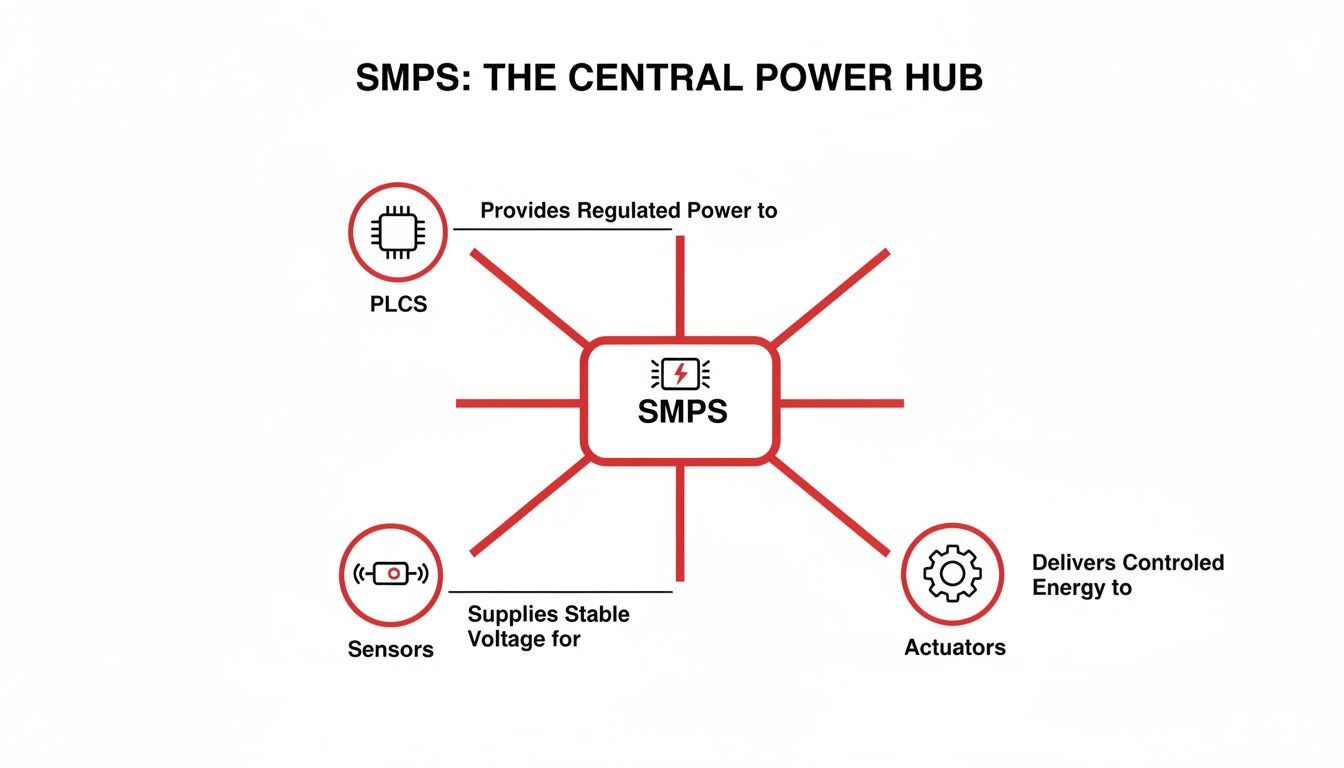
As the diagram shows, it takes an AC input and provides stable, regulated DC power to everything from PLCs and sensors to actuators and HMIs—the heart of the automation system.
Different applications require different SMPS topologies. While many complex designs exist, most in industrial automation fall into a few key categories.
SMPS Topology Comparison for Industrial Applications
This table breaks down common SMPS topologies and their typical applications in the UAE's industrial sector.
| Topology | Primary Function | Common UAE Application | Key Advantage |
|---|---|---|---|
| Buck | Steps down a higher DC voltage to a lower one. | Powering 5V logic circuits or sensors from a 24V DC bus. | Simple, highly efficient, and cost-effective for voltage reduction. |
| Boost | Steps up a lower DC voltage to a higher one. | Driving a 24V component from a 12V battery backup system. | Ideal for applications needing a higher voltage than the source provides. |
| Flyback | Provides isolated step-up or step-down conversion. | Powering auxiliary circuits or isolated communication interfaces. | Cost-effective isolation, providing safety and preventing ground loops. |
| Forward | Isolated step-down conversion, higher power than Flyback. | Powering multi-output systems in medium-power (100-500W) applications. | More efficient and better performance for higher power needs than Flyback. |
| Bridge | High-power AC-DC or DC-DC conversion. | Main power supplies for large VFDs, servo drives, or entire systems. | Capable of handling very high power levels with excellent efficiency. |
Understanding these differences is the first step toward selecting a power supply that meets your project's specific demands.
Why Isolation and Filtering Are Non-Negotiable
The high-frequency switching that makes an SMPS efficient also generates high-frequency electrical noise, or Electromagnetic Interference (EMI). This noise can disrupt sensitive components like PLCs, communication modules, and analog sensors.
An effective SMPS is not just a power converter; it is a complete power management system. Its internal filtering and isolation are just as critical as its efficiency, ensuring it delivers clean, stable power without interfering with the devices it supports.
This is where quality becomes paramount. Reputable SMPS units from trusted suppliers like GoSwitchgear include robust internal filtering circuits to suppress EMI. Topologies like Flyback also provide galvanic isolation, physically separating the input and output circuits. This is crucial for preventing ground loops and protecting expensive electronics from power faults.
To learn more, understanding the importance of EMI shielding in critical power systems will help you specify the right SMPS power supply for your application in the demanding GCC market.
Choosing the Right SMPS for the GCC Climate
Selecting the right SMPS for a control panel in the UAE involves more than just matching voltage. It’s about ensuring reliability in a climate of extreme heat. Focusing on a few key specifications separates a system that runs smoothly from one destined for failure. Let's review what truly matters for the demanding GCC environment.
First, you must size the power supply correctly through a proper load calculation, accounting for every component the SMPS will power.
How to Calculate Your Total Power Load
To ensure your SMPS isn’t constantly running at its limit, calculate the total current draw of all connected devices.
- List All Components: Create a complete list of every device the SMPS will power (PLCs, HMIs, sensors, relays, contactor coils, etc.).
- Find the Current Draw: Check the datasheet for each component to find its maximum current consumption (in Amperes, A) at the operating voltage (typically 24V DC).
- Sum the Currents: Add the current draw of all devices to get your total load.
- Add a Safety Margin: Never run a power supply at 100% capacity. Best practice is to add a safety buffer of 20-25%. For example, if your total load is 8A, select an SMPS with at least a 10A rating (8A + 2A buffer).
This buffer is non-negotiable. It accommodates inrush currents during power-on and allows the SMPS to operate without stress, significantly extending its service life.
Efficiency: The Critical Factor for Heat Management
In the GCC, efficiency is a core strategy for heat management. An SMPS with 94% efficiency converts 94% of incoming power into useful DC output, wasting only 6% as heat. A cheaper, 85% efficient model wastes 15%—more than double the heat pumped into your control panel.
This extra heat raises the ambient temperature, stressing all components. Investing in higher efficiency is a direct investment in system reliability. This trend is evident in the regional growth of data centers and EV charging infrastructure, where SMPS market growth is projected between 2.9% and 4.6%. You can learn more about these regional SMPS market drivers.
Understanding Derating Curves for High Temperatures
The temperature derating curve is perhaps the single most important specification for an SMPS installed in Dubai or Abu Dhabi. Manufacturers rate their power supplies for maximum output at an ideal ambient temperature (e.g., 25°C or 40°C). Inside an electrical enclosure under the GCC sun, temperatures can easily exceed 50°C.
The derating curve on a datasheet isn't just optional guidance; it's a mandatory instruction for safe operation in hot climates. Ignoring it is a recipe for system failure.
A derating curve shows how much you must reduce the maximum load as the temperature rises. For example, a 10A SMPS might only safely deliver 8A at 60°C. You must select an SMPS that can provide your required current after applying the derating factor for your worst-case operating temperature.
GoSwitchgear offers a full range of SMPS power supply units with clear derating data, allowing you to specify with confidence for any project in the UAE.
Mastering SMPS Installation in Control Panels
Even the best SMPS will underperform if installed incorrectly. For panel builders and electricians in the UAE, proper installation is critical for ensuring a long service life in a challenging climate. Getting it right from the start prevents costly failures and system downtime.
This section provides actionable steps for installing your SMPS power supply, focusing on the unique demands of the GCC environment.
Best Practices for Mounting and Ventilation
Heat is the primary enemy of electronic components. Inside a crowded control panel, effective heat dissipation is non-negotiable, especially with the high ambient temperatures in Dubai.
Proper mounting is your first line of defense. Most DIN rail SMPS units cool via natural convection, meaning they need free-flowing air.
- Respect Clearance Zones: Check the manufacturer's datasheet for minimum clearance requirements, typically 20-50mm of open space above and below the unit. This gap allows hot air to rise and escape.
- Avoid Heat Traps: Do not mount an SMPS directly above another major heat source like a VFD or transformer. The rising heat will drastically reduce its performance and lifespan.
- Prioritize Airflow: In densely packed panels, natural airflow may be insufficient. Installing reliable panel cooling fans is a smart investment to maintain a stable internal temperature.
Wiring, Grounding, and Protection
Once the SMPS is securely mounted, focus on wiring. This stage is about delivering clean, stable power and ensuring system safety.
Wire Gauge Selection
Using undersized wires is a dangerous shortcut. An undersized wire heats up under load, causing voltage drop and creating a fire risk.
Always use a wire gauge chart to select the right conductor size based on the SMPS’s maximum output current and wire length. When in doubt, go one size up.
Proper Grounding (Earthing)
A solid ground connection is crucial for safety and performance. It provides a safe path for fault currents and helps suppress electrical noise.
- Connect the protective earth (PE) terminal on the SMPS directly to the main earthing bar in the panel using a short, correctly sized green-and-yellow wire.
- Ensure all grounding connections are tight and secure.
Fuse and Circuit Breaker Sizing
Every SMPS requires input-side protection, typically a fuse or a miniature circuit breaker (MCB). This device protects the power supply from overcurrents and short circuits.
Refer to the SMPS datasheet for the recommended fuse rating or MCB type (e.g., Type C). This ensures protection for your electrical components UAE without nuisance tripping during normal operation.
SMPS Installation Checklist for UAE Environments
This checklist outlines key steps for installing an SMPS in a control panel, with tips for the high ambient temperatures common in the GCC.
| Check Point | Best Practice | Reasoning for GCC Climate |
|---|---|---|
| Verify Clearances | Ensure at least 20-50mm of clear space above and below the SMPS. | High ambient temperatures reduce the efficiency of natural convection. Maximum clearance is essential to prevent overheating. |
| Check Airflow Path | Mount away from heat sources like VFDs or large contactors. Position near panel vents or fans if possible. | Hot spots in a panel are more extreme in a warm climate. Placing the SMPS in a cooler zone is critical for longevity. |
| Select Wire Gauge | Use a wire gauge chart based on max current and derate for high temperatures as per local standards. | Heat increases wire resistance, leading to greater voltage drop. Slightly upsizing the wire gauge compensates for this effect. |
| Confirm Grounding | Use a dedicated, short, and correctly sized wire from the PE terminal to the panel's main earth bar. | A solid ground is non-negotiable for safety and noise suppression, which can be affected by temperature-induced stress on connections. |
| Size Protection Correctly | Install a fuse or MCB on the input line, strictly following the SMPS datasheet recommendations. | Prevents catastrophic failure during a fault and protects downstream components, ensuring system integrity in demanding conditions. |
| Torque All Connections | Use a torque screwdriver to tighten all input, output, and ground terminals to the manufacturer's specification. | Temperature cycles (hot days, cooler nights) can cause terminals to loosen over time. Proper torque ensures a secure connection. |
| Final Power-On Check | After installation, power on and measure the output voltage under no-load and full-load conditions to verify it's within spec. | Confirms the unit is performing as expected before it's put into full service, preventing unexpected downtime. |
Following this checklist builds a foundation for a reliable and safe control system ready for the region's demands.
Ensuring Reliability in Harsh UAE Environments
In mission-critical industrial applications across the UAE, system failure is not an option. A high-quality SMPS is more than a power converter; it’s an insurance policy for your entire control panel. This reliability comes from built-in safeguards and internationally recognized certifications that protect your components from power grid instability.
These features act as silent guardians, monitoring for dangerous conditions and reacting in milliseconds to prevent costly damage, making a professional-grade power supply a dependable asset for any GCC project.
Your Internal Insurance Policy
Think of these protection features as an automated safety system for your valuable downstream equipment.
Over-Voltage Protection (OVP): Shuts down the SMPS if the output voltage spikes, protecting connected devices from being destroyed by a surge.
Over-Current Protection (OCP): If a connected component draws too much current (a sign of a short circuit or malfunction), OCP limits the output or shuts it down, preventing damage to the power supply and the load.
Short-Circuit Protection (SCP): In a direct short circuit, SCP instantly cuts power output, preventing overheating and potential fire hazards.
These protections are non-negotiable for any industrial-grade SMPS power supply. For high-availability systems, you can enhance reliability further. Solutions like a decoupling module for power supplies enable you to build redundant power systems for an extra layer of security.
Understanding Key Quality Certifications
Certifications on a datasheet are your guarantee of safety and quality, signifying that the SMPS has been independently tested to meet rigorous international standards.
A certified SMPS isn't just a component; it's a promise of performance and safety. For procurement teams in Dubai and Abu Dhabi, verifying these certifications is a crucial step in mitigating project risk and ensuring long-term operational integrity.
- CE Marking: Indicates conformity with health, safety, and environmental protection standards within the European Economic Area.
- UL Recognition: A mark from Underwriters Laboratories signifying the component has been tested for safety and is suitable for use within larger equipment.
- IEC Standards: The International Electrotechnical Commission sets global standards for electrical equipment, ensuring your SMPS meets international benchmarks for performance and reliability.
Built for the Demanding GCC Environment
Certifications must be paired with physical resilience to survive the local climate. The constant heat, humidity, and dust in the UAE demand environmentally hardened components.
Look for a high maximum operating temperature (often 60°C or higher) and a clear derating curve. A robust IP rating, such as IP20, is also essential to protect against solid objects and dust.
The need for resilient power solutions is growing with the expansion of telecommunications and renewable energy in the region. The AC-to-DC transformer segment—the core of most industrial SMPS units—recently accounted for nearly half of the market's revenue share in the Middle East and Saudi Arabia. You can read the full research on regional SMPS market drivers.
Investing in a certified, high-quality SMPS from GoSwitchgear ensures your systems have the resilience to thrive.
Your Partner for Power Supply Solutions in the UAE
Choosing the right SMPS is simpler with a dedicated partner. This guide has covered the essentials for reliability in the GCC—from prioritizing efficiency to beat the heat, to using derating curves and mastering proper installation. These are the foundations of a robust control system.
At GoSwitchgear, we provide practical, on-the-ground solutions. We offer a curated portfolio of industrial-grade SMPS units built for the regional climate. Our deep stock of DIN rail models, especially our core 12V and 24V SMPS solutions, is specifically selected for automation and control panel applications.
Your Local Technical Support Team
Specifying the right power supply is more than matching numbers on a datasheet. Our UAE-based technical team is ready to support your projects. We work daily with engineers and panel builders to select the ideal SMPS power supply that balances performance, efficiency, and cost, whether you're in Dubai, Abu Dhabi, or across the GCC.
We are proud to support the growing manufacturing industry in the UAE by ensuring local access to reliable and efficient electrical components UAE.
A correctly specified SMPS is the bedrock of system reliability. Our goal is to provide both the high-quality products and the expert guidance needed to ensure every control panel you build performs flawlessly from day one.
Find Your SMPS Solution with GoSwitchgear
Our inventory is stocked and ready for any project. We have everything from standard single-phase units to high-performance three-phase models. Our full range of SMPS solutions, including 12V and 24V models for control and automation, is available in our store. We invite you to explore our comprehensive catalogue.
Ready to specify the power supply for your next build? Our team is here to provide personalized guidance.
Contact our Dubai team today for expert project support or to request a quote for your upcoming requirements.
Got Questions About SMPS? We've Got Answers
Here are answers to common questions from engineers and procurement managers across the UAE.
What's the Real Difference Between a Linear Power Supply and an SMPS?
It all comes down to efficiency. A linear power supply regulates voltage by burning off excess energy as heat, making it simple but highly inefficient (30-60% efficiency).
An SMPS uses high-frequency switching to manage power, achieving efficiencies of 80-95% or higher. For industrial panels in the UAE, this means an SMPS runs cooler, is smaller and lighter, and reduces long-term energy costs. It is the superior choice for any modern system.
Should I Use a 12V or 24V SMPS for My Control Panel?
The choice is determined by your equipment. In industrial automation, 24V DC is the standard. It handles longer cable runs with less voltage drop, making it ideal for PLCs, sensors, and other 24V supply devices.
12V DC is more common for smaller electronics, some LED lighting, and security systems. Always check component datasheets first. At GoSwitchgear, we stock a full range of both 12V and 24V SMPS models to meet any project requirement.
Why Is Derating for Temperature a Big Deal in Dubai?
In a climate like Dubai's, derating is essential. An SMPS is rated for maximum power output under ideal conditions (e.g., 25°C). Inside a hot, sealed control panel, the temperature soars, and the SMPS cannot cool itself effectively.
The derating curve on the datasheet tells you how much to reduce the load as the temperature climbs to keep the unit operating safely. Ignoring this leads to overheating, random shutdowns, and premature failure.
Can I Wire Multiple SMPS Units in Parallel to Get More Power?
You can, but only if the SMPS model is specifically designed for it with a "parallel function" or "current sharing" feature. Attempting to parallel standard SMPS units will cause one unit to take most of the load, leading to overload and failure.
For more power, the safest solution is to use a single, larger SMPS rated for the total load. If a parallel setup is necessary, confirm the model explicitly supports it in the manufacturer's documentation. This is key to ensuring stable power for all your electrical components in the UAE.
Share this post

Related
Posts
A Guide to Choosing AC to DC Converters for UAE & GCC Electrical Systems
Master AC to DC converters with this comprehensive guide for engineers in the UAE & GCC. Learn selection, installation, and...
A Guide to Drill Machine Prices in the UAE for Technical Professionals
Find the best drill machine price in UAE. Our 2026 guide helps contractors and engineers choose the right corded, cordless,...
A Professional’s Guide to Choosing AGM VRLA Batteries in the UAE Climate
Discover why AGM VRLA batteries are the superior power solution for UPS, solar, and industrial systems in the UAE. Get...
How to Choose the Right Lithium Ion Battery Charger for UAE & GCC Projects
Discover how to select the right lithium ion battery charger for UAE projects. This guide covers specs, BMS integration, and...
.jpg)