.jpg)


Posted by:
Category:
Comments:
Post Date:
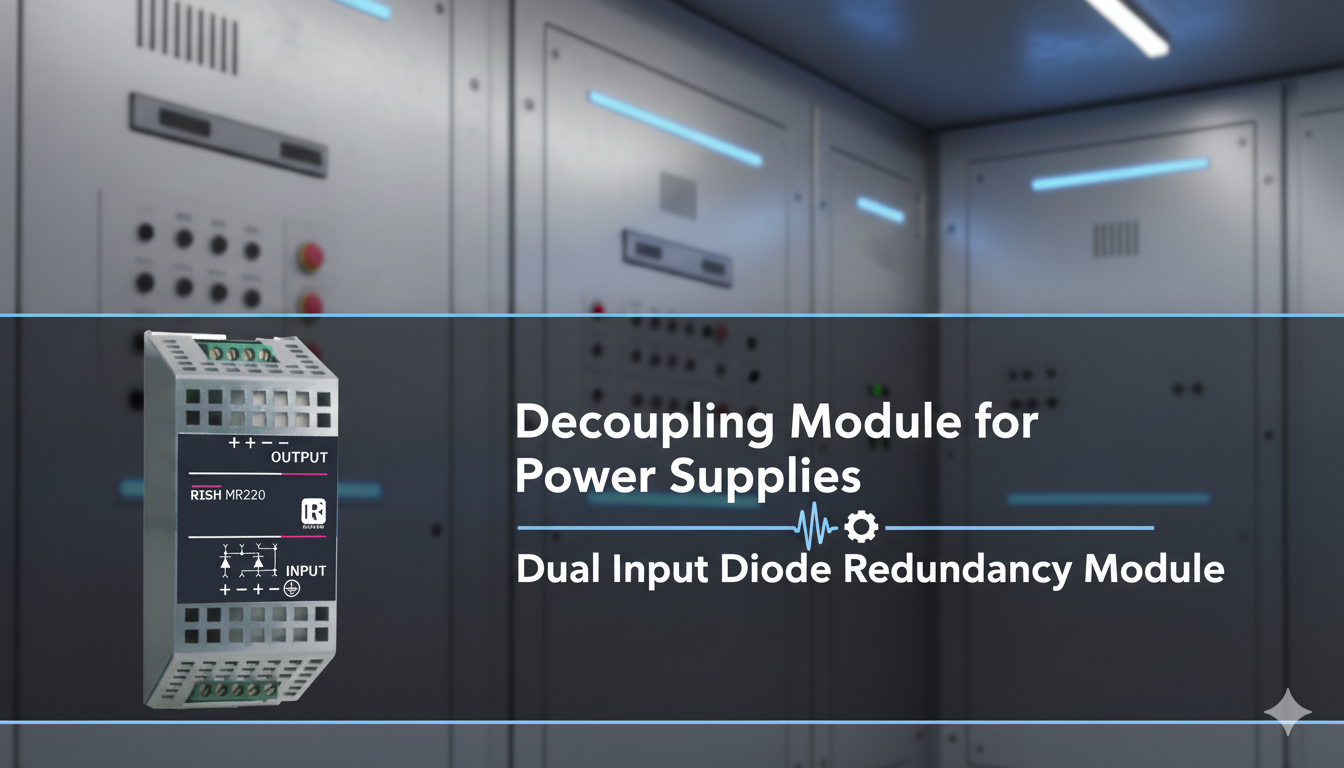
Decoupling Module for Power Supplies – Dual Input Diode Redundancy Module
In modern automation and control panel systems, reliability is everything. When a control system fails due to a single power supply fault, the cost of downtime—both in production and safety—can be substantial. This is exactly where Decoupling Modules come in.
What is a Decoupling Module?
A Decoupling Module, also known as a redundancy or diode module, is a device designed to isolate and combine multiple power supplies to achieve a redundant power system. It prevents the failure of one supply from affecting the other and ensures uninterrupted power to critical loads.
In simple terms:
It acts as a “safety buffer” between two DC power supplies, allowing one to seamlessly take over if the other fails.
Why Does It Exist?
Power supplies, no matter how robust, can fail due to overloads, surges, or component degradation. In automation systems—like PLC panels, SCADA nodes, or relay banks—such a failure could stop entire operations.
A decoupling module ensures that:
- Load continuity is maintained even if one power supply fails.
- No backfeeding occurs between supplies.
- Voltage drop and thermal stress are minimized using efficient Schottky or MOSFET diode circuits.
This makes it a vital component in 24V DC control circuits, PLC systems, industrial machines, and critical process automation panels across industries.
Applications in Automation & Control Panel Building
You’ll find decoupling modules widely used in:
- Redundant power supply setups in PLC and DCS systems
- Machine automation control panels to ensure 24V DC reliability
- Building management and fire alarm systems
- Process industries where power stability is mission-critical
- Safety circuits in robotics and conveyor systems
Example configuration:
Two 24V DC power supplies → Decoupling Module → Common 24V DC load bus
If one power supply drops, the other instantly supports the entire load without any manual intervention.
Types of Decoupling Modules
Depending on design and application, decoupling modules are categorized as:
- Diode-based Modules
- Use Schottky diodes or power MOSFETs to isolate inputs.
- Simple and reliable; suitable for most control applications.
- Active Redundancy Modules
- Include electronic balancing circuits to minimize voltage drop.
- Provide LED status indicators, alarms, and load-sharing features.
- Dual-input Modules
- Accept two DC sources (e.g., two 24V DC SMPS units).
- Deliver a single stable output with automatic failover.
Spotlight: RISH MR220 – 10–60V DC, 25A Dual Input Diode Module
The RISH MR220 Decoupling Module from Rishabh Instruments is a premium industrial-grade diode module designed for redundancy in DC systems.
Key Highlights:
- Dual Input, Single Output – Supports two power supplies in parallel.
- Wide Voltage Range: 10–60V DC
- High Current Capacity: Up to 25A continuous load
- Diode Isolation: Prevents reverse current flow and backfeeding
- Compact & DIN Rail Mountable: Ideal for control panels and machine cabinets
The MR220 is a reliable choice for panel builders and system integrators aiming for zero downtime power reliability in automation systems.
Why Choose a Decoupling Module in Your Design?
Including a decoupling module in your control panel adds a small cost but prevents massive losses caused by power interruptions. It helps:
- Extend power supply life by load sharing
- Provide uninterrupted operation of critical controllers and sensors
- Improve system redundancy and safety compliance
- Simplify maintenance with modular replacement design
In Summary
In the world of industrial automation, power redundancy equals reliability. A Decoupling Module like the RISH MR220 is a simple yet powerful tool that ensures your control system stays operational, even in the event of a power supply failure.
Explore the full details and specifications here:
👉 Decoupling Module 10–60V DC, 25A Dual Input Diode Module – RISH MR220
Share this post

Related
Posts
A Guide to Choosing AC to DC Converters for UAE & GCC Electrical Systems
Master AC to DC converters with this comprehensive guide for engineers in the UAE & GCC. Learn selection, installation, and...
A Guide to Drill Machine Prices in the UAE for Technical Professionals
Find the best drill machine price in UAE. Our 2026 guide helps contractors and engineers choose the right corded, cordless,...
A Professional’s Guide to Choosing AGM VRLA Batteries in the UAE Climate
Discover why AGM VRLA batteries are the superior power solution for UPS, solar, and industrial systems in the UAE. Get...
How to Choose the Right Lithium Ion Battery Charger for UAE & GCC Projects
Discover how to select the right lithium ion battery charger for UAE projects. This guide covers specs, BMS integration, and...
.jpg)