.jpg)


Posted by:
Category:
Comments:
Post Date:
A Guide to UAE Power Sockets for Engineers and Panel Builders
Engineers, panel builders, and procurement teams working on electrical projects in the UAE and wider GCC region know that precision is non-negotiable. The UAE's electrical infrastructure is standardized on the Type G (BS 1363) three-pin rectangular plug system, complemented by a stable 230V voltage and 50Hz frequency. Understanding this standard is crucial for ensuring safety, compliance, and operational efficiency.
Why Type G Power Sockets are the Mandated Standard in the UAE
Standardisation is the bedrock of electrical safety and efficiency in the UAE. For professionals, the mandated use of a single socket type eliminates compatibility issues, streamlining every project phase from design and procurement to final installation and commissioning. This universal approach ensures that electrical components UAE sourced for a high-rise in Dubai integrate seamlessly with systems in an industrial plant in Abu Dhabi.
This framework is more than a matter of convenience; it is a critical safety protocol. The Type G design incorporates several built-in features that are mandatory for local compliance, setting it apart from other international plug types.
Key Benefits of Standardization for Professionals
- Simplified Procurement: Procurement teams can source components with confidence, knowing that Type G sockets from trusted suppliers like GoSwitchgear will meet project specifications without requiring last-minute modifications.
- Enhanced Safety: The BS 1363 system is inherently safer. Integrated features like fused plugs and shuttered socket contacts provide superior protection against common electrical hazards.
- Guaranteed Compatibility: Electricians and installation teams can operate more efficiently, confident that appliances, tools, and systems will connect correctly without resorting to non-compliant adapters or unsafe wiring.
- Regulatory Compliance: Adherence to the Type G standard is mandatory. It ensures every installation meets the stringent requirements of local utility authorities, preventing costly rework and project delays.
This uniform standard acts as a universal language for electrical professionals in the GCC. It removes guesswork, allowing teams to focus on quality installation rather than solving hardware compatibility puzzles, ultimately leading to a more reliable electrical infrastructure.
Technical Specifications of Type G Sockets: A Closer Look
Beyond its physical shape, the true value of a Type G UAE power socket lies in its engineering. Its safety and performance specifications are not arbitrary design choices; they are mission-critical features engineered to protect personnel and high-value equipment.
The most critical feature is the mandatory fuse integrated within the plug. Unlike systems where overcurrent protection is located at the distribution board, the BS 1363 standard requires a fuse (3A, 5A, or 13A) in the plug itself. This provides precise, localised protection for the appliance cord, preventing overheating and significantly reducing fire risk.
Another non-negotiable feature is the shutter mechanism inside the socket. The live and neutral apertures are physically blocked by protective shutters, which only retract when the longer earth pin is inserted first. This simple yet effective system prevents accidental contact with live components.
Critical Safety and Design Distinctions
For engineers and facility managers, understanding why other socket types are prohibited for permanent UAE installations is vital. Using uncertified adapters or incorrect fittings compromises the entire safety chain built into the Type G system. This underscores the importance of specifying components from a trusted supplier like GoSwitchgear, guaranteeing every part meets these rigorous standards.
The table below highlights the key differences and clarifies why Type G is the sole mandated choice for UAE power sockets.
Technical Comparison of Type G vs. Other Global Sockets
While sockets may appear similar, their technical differences are profound. This comparison illustrates the fundamental safety and design principles that distinguish the UAE's Type G standard from other common international types.
| Feature | Type G (UAE Standard) | Type C (Europlug) | Type F (Schuko) |
|---|---|---|---|
| Earthing | Mandatory, dedicated pin | None (unearthed) | Side clips |
| Internal Fuse | Mandatory in plug (BS 1363) | None | None |
| Polarity | Fixed (Live/Neutral) | Non-polarised (reversible) | Non-polarised (reversible) |
| Safety Shutters | Mandatory in socket | Optional, not required | Optional, not required |
| Max Current | 13A | 2.5A | 16A |
As demonstrated, adhering to the Type G standard is not merely about plug compatibility; it is about committing to an integrated system of safety features that collectively create a secure electrical environment.
Meeting Electrical Regulations in the UAE
In the UAE's dynamic construction sector, regulatory compliance is the foundation of every successful project. Approval from authorities like the Dubai Electricity and Water Authority (DEWA), Abu Dhabi Distribution Company (ADDC), and Sharjah Electricity, Water and Gas Authority (SEWA) is non-negotiable.
This means every component must have the correct certifications. Key credentials for UAE power sockets include BS 1363, IEC conformity, and the G-Mark. Sourcing certified parts from a reputable supplier like GoSwitchgear is a critical step to avoid failed inspections, rework, and project delays.
The Foundation of a Reliable National Grid
The Emirates National Grid exemplifies how stringent local standards build a world-class power system. The universal adoption of Type G sockets, standardised at 230V/50Hz, is a core component of a grid that has provided 100% population access to electricity since 1990. This consistency is vital for panel builders who depend on predictable, safe components for control panels and switchgear assemblies. You can explore the forces shaping the UAE's energy sector in this detailed analysis.
This diagram illustrates the multi-layered safety hierarchy of the Type G standard.
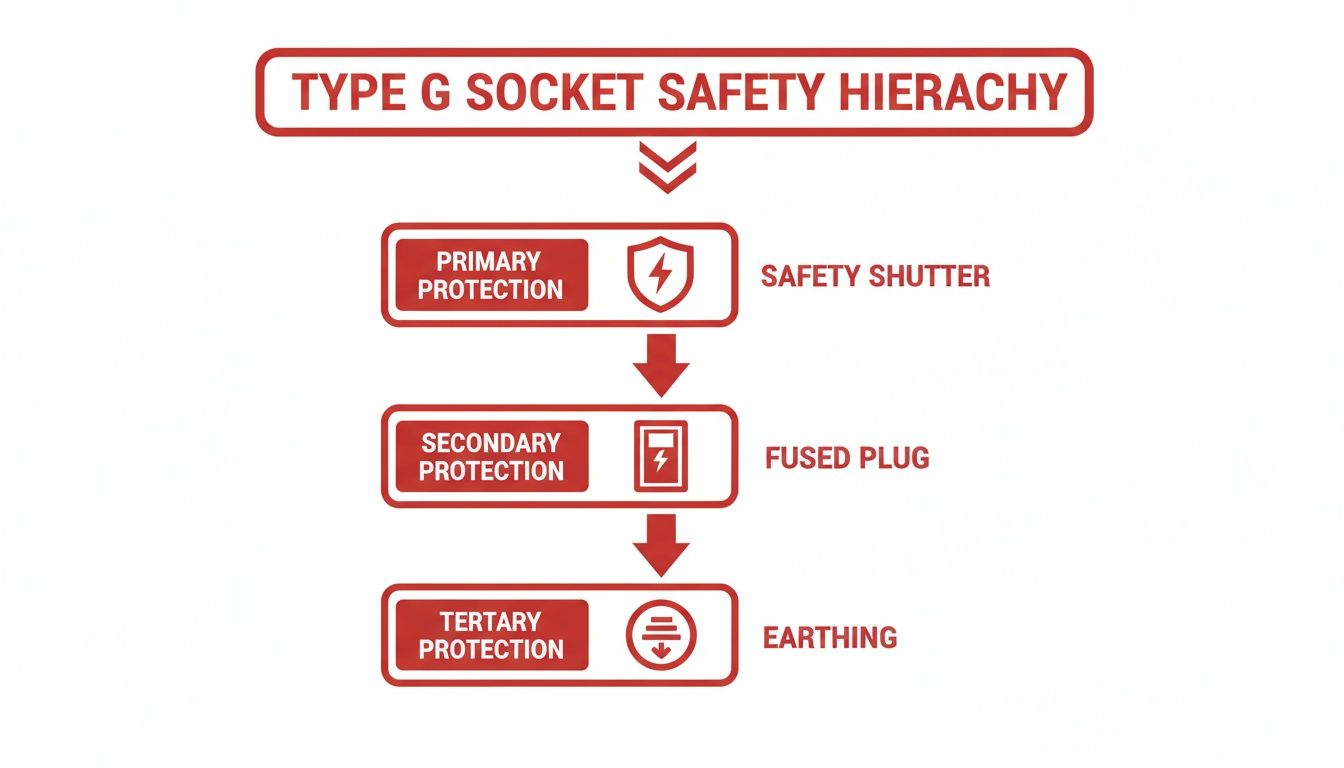
Each feature builds upon the others, creating a comprehensive defence system that protects both personnel and equipment from electrical faults.
Selecting Sockets for the UAE's Demanding Climate
The UAE environment—characterized by extreme heat, high humidity, and airborne dust—is exceptionally harsh on electrical components. Standard-grade parts are prone to degradation and premature failure, posing significant safety risks. For outdoor, industrial, or coastal installations, specifying the correct uae power sockets and enclosures is a critical engineering requirement.
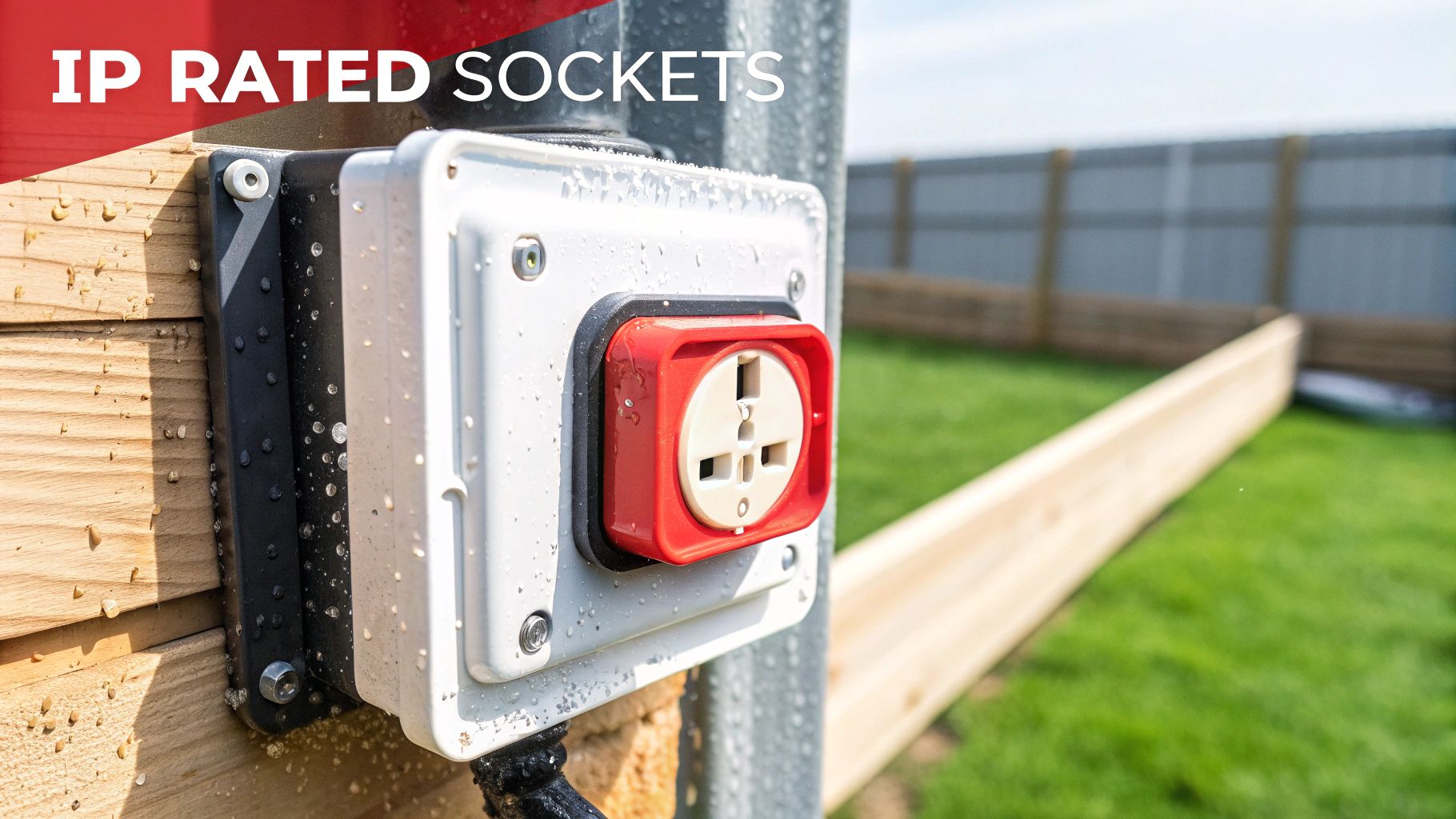
Ingress Protection (IP) ratings are essential for ensuring long-term reliability. An IP rating defines a component's level of protection against the intrusion of solids (like dust) and liquids (like water).
Understanding IP Ratings for GCC Conditions
A higher IP rating signifies more robust protection. This is vital for maintaining the integrity of the UAE’s electrical grid, which has grown to a capacity of 45 GW with 150 TWh in annual generation. For facility managers in Dubai and Abu Dhabi, this infrastructure is central to their energy management solution Dubai strategies. You can explore the full market report for more details.
For exposed applications in the UAE, consider these minimum ratings:
- IP55: Offers protection against limited dust ingress and low-pressure water jets. Suitable for semi-sheltered locations not exposed to direct rain or heavy dust.
- IP66: Provides complete dust-tight protection and withstands powerful water jets. This is the standard for fully exposed outdoor installations, industrial wash-down areas, and coastal environments with salt spray.
Specifying the correct IP rating is a direct investment in operational continuity. An IP66 socket constructed from UV-stabilised polycarbonate will resist cracking or fading under intense sun, ensuring its protective seal remains effective for years.
Partnering with a specialist supplier like GoSwitchgear provides access to a curated portfolio of industrial-grade components proven to perform in the challenging GCC climate.
Best Practices for Safe Socket Installation and Maintenance
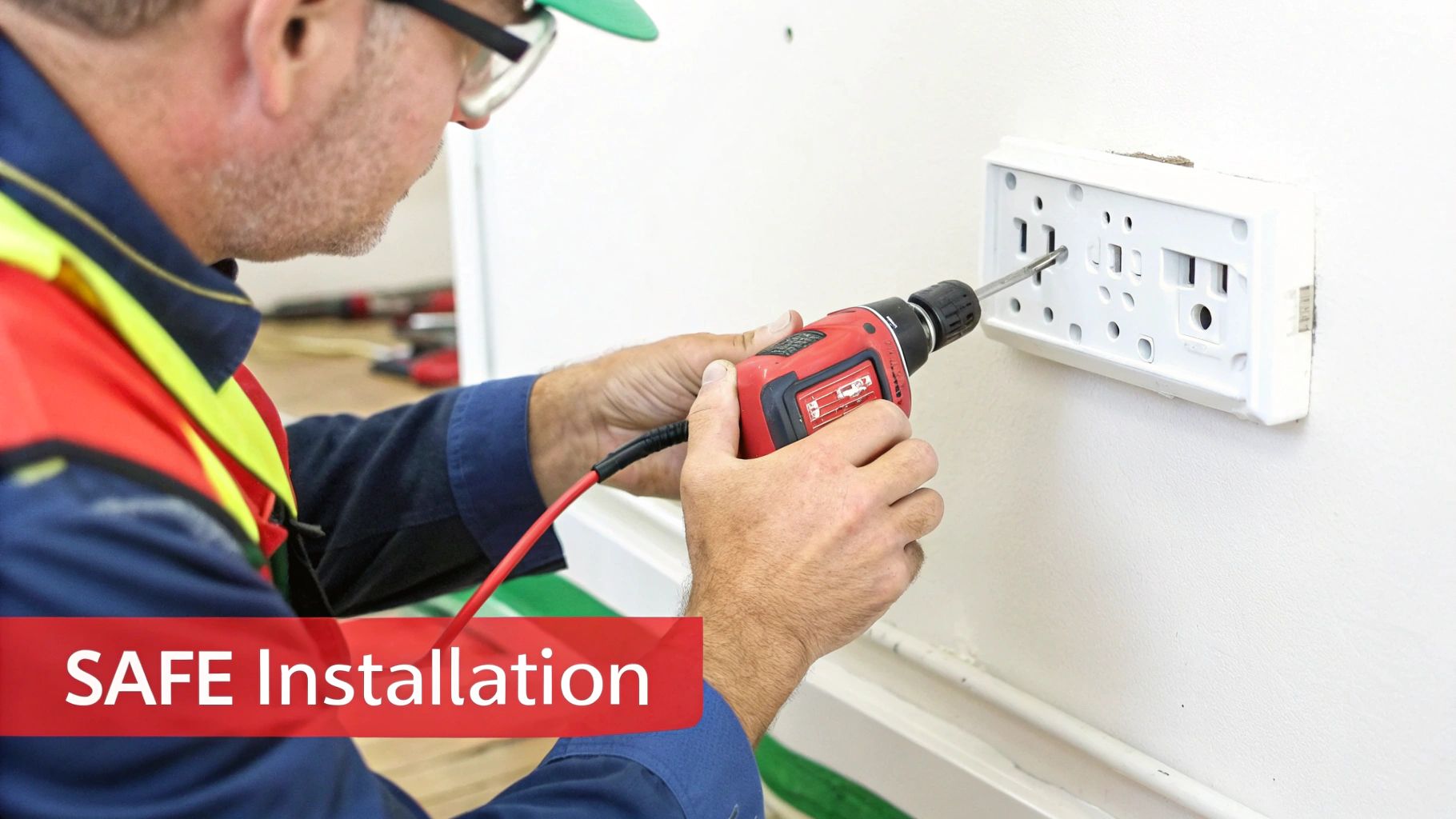
Proper installation translates technical standards into real-world safety and longevity. For electricians and panel builders working with Type G sockets, following a precise installation protocol is essential for compliance and client safety.
How to Install for Maximum Safety
Two key techniques ensure the long-term integrity of an installation:
- Correct Torque: Apply the manufacturer-specified torque to terminal screws. Insufficient torque can cause arcing, while over-tightening can damage the component.
- Earth Continuity Verification: Use a multimeter to verify earth continuity immediately after installation. This simple check confirms a safe path to ground, a cornerstone of the Type G system's safety.
Common Installation Mistakes to Avoid
Even experienced professionals must remain vigilant to avoid common errors that can compromise safety.
- Overloading Circuits: Never connect heavy-duty equipment to circuits designed for standard commercial use. Always verify the circuit's total load capacity.
- Incorrect Wire Gauges: Using undersized wiring is a severe fire hazard. Ensure all wiring meets or exceeds the specifications for the circuit's amperage.
- Insufficient Back Box Space: Avoid forcing wires into a cramped back box, which can damage insulation and place stress on terminals.
While focusing on sockets, it's beneficial to review broader safe electrical installation practices, as the core principles of safety and wiring apply universally.
Maintenance Schedule: For facility managers, a proactive maintenance schedule is the best defence against electrical faults. Conduct regular visual inspections for signs of overheating (discolouration) or physical damage (cracks) to identify potential failures before they occur.
This practical guidance is central to our mission at GoSwitchgear. We don't just supply quality electrical components UAE; we provide the technical knowledge to ensure they are used correctly and safely.
How Sockets Support the UAE's Future Energy Vision
While seemingly basic, the power socket is a critical component in achieving the UAE's National Energy Strategy 2050. As industrial growth and mega-projects place greater demand on the national grid, every connection point's efficiency matters. High-quality uae power sockets are engineered to minimize energy loss, ensuring power is delivered effectively.
This focus on component-level efficiency is vital. The UAE's electricity capacity has grown substantially; between 2008 and 2012 alone, it increased by 37%. The power market is projected to expand from 183.67 TWh in 2024 to 240.86 TWh by 2033, driven by solar initiatives that require robust supporting infrastructure. To understand the national energy landscape, you can review details on its electricity services.
Integrating Advanced Technologies
Future-proofing infrastructure means preparing for emerging technologies. High-specification sockets are crucial for safely integrating new systems, such as EV charging solutions, into buildings. As the UAE advances its sustainability goals, understanding the benefits of investing in EV charging infrastructure becomes increasingly relevant for industry professionals.
For project developers and procurement teams, specifying superior components is a strategic decision. It aligns projects with national sustainability targets and protects assets against future technological demands.
Choosing certified, high-performance sockets from a dedicated partner like GoSwitchgear ensures every installation supports the nation's energy vision. This approach ensures projects are not just compliant today but are built for the demands of tomorrow, contributing to a resilient and efficient electrical ecosystem across the GCC.
Frequently Asked Questions About UAE Power Sockets
For complex projects across the UAE and GCC, clarifying electrical standards is essential. Here are direct answers to common questions from engineers, electricians, and procurement managers regarding UAE power sockets.
Can I Use European or US Plugs in the UAE?
For permanent or professional installations, the answer is an unequivocal no. The UAE exclusively mandates the Type G socket standard.
While temporary travel adapters exist for personal use, they are non-compliant and unsafe for professional applications. All equipment must be fitted with a fused, three-pin Type G plug to meet local safety regulations and ensure proper earthing.
What Are the Essential Safety Features of Type G Sockets?
The Type G standard's safety is built on three core, interlocking features:
- Safety Shutters: These mechanisms block access to the live and neutral contacts. The shutters only open when the longer earth pin is inserted, preventing accidental contact.
- Fused Plugs: Each Type G plug contains a fuse (typically 3A, 5A, or 13A), providing localised overcurrent protection for the appliance cord—a critical defence against overheating and fire.
- Fixed Polarity: The design ensures that live, neutral, and earth connections cannot be accidentally reversed during wiring, eliminating a common and dangerous electrical hazard.
How Do I Ensure Compliance for a Dubai Project?
To guarantee compliance for projects in Dubai, Abu Dhabi, or elsewhere in the UAE, you must source components with complete and verifiable documentation.
Always specify products with clear markings for BS 1363, IEC, and G-Mark certifications. The most efficient way to ensure compliance is to partner with a reputable local supplier who understands regional requirements.
Are Special Sockets Needed for Outdoor Use?
Yes, absolutely. Standard indoor sockets are unsuitable for outdoor environments and will fail, creating a safety hazard.
For any installation exposed to dust, humidity, or rain, you must use sockets with an appropriate Ingress Protection (IP) rating, such as IP66. These units are purpose-built with robust seals and durable materials to withstand dust and powerful water jets, ensuring safety and longevity in the challenging GCC climate.
For projects that demand fully compliant and climate-resilient electrical components, explore the extensive catalogue at GoSwitchgear. Find everything you need for your next installation in the UAE at https://goswitchgear.ae.
Share this post

Related
Posts
A Guide to Choosing AC to DC Converters for UAE & GCC Electrical Systems
Master AC to DC converters with this comprehensive guide for engineers in the UAE & GCC. Learn selection, installation, and...
A Guide to Drill Machine Prices in the UAE for Technical Professionals
Find the best drill machine price in UAE. Our 2026 guide helps contractors and engineers choose the right corded, cordless,...
A Professional’s Guide to Choosing AGM VRLA Batteries in the UAE Climate
Discover why AGM VRLA batteries are the superior power solution for UPS, solar, and industrial systems in the UAE. Get...
How to Choose the Right Lithium Ion Battery Charger for UAE & GCC Projects
Discover how to select the right lithium ion battery charger for UAE projects. This guide covers specs, BMS integration, and...
.jpg)