


Posted by:
Category:
Comments:
Post Date:
How to Choose the Right Panel Cooling Fan for UAE & GCC Heat
In the demanding climate of the UAE and GCC, a panel cooling fan is not just an accessory—it's an essential component for system reliability. Designed to dissipate heat from electrical enclosures, these fans are the critical defence between smooth operations and costly shutdowns, safeguarding sensitive components like VFDs, PLCs, and any SMPS power supply from thermal damage.
Why Panel Cooling is a Necessity in the GCC Climate
For engineers, panel builders, and electricians in Dubai, Abu Dhabi, and across the GCC, managing heat is a daily operational challenge. Scorching ambient temperatures combined with the internal heat generated by powerful electrical components creates a perfect storm for equipment failure. Without a robust thermal management strategy, you risk significant operational disruption.
This constant thermal stress is a primary cause of malfunctions that can halt an entire facility. Neglecting proper cooling opens the door to severe problems:
- Nuisance Tripping: Overheating is a common cause of unexplained breaker and protection device trips, leading to intermittent shutdowns that are difficult to troubleshoot.
- Component Degradation: The operational lifespan of expensive VFDs, transformers, and power supplies is drastically reduced when they operate above their recommended temperature range.
- Catastrophic Failure: In the worst-case scenario, accumulated heat leads to a complete meltdown of control systems, resulting in major downtime and expensive repairs.
The Fan: Your First Line of Defense Against Heat
A panel cooling fan provides an active solution by physically extracting hot, stale air from the enclosure while introducing cooler ambient air. This forced circulation maintains a stable internal environment that natural convection alone cannot achieve in modern, densely packed control panels.
For any project in the UAE or Saudi Arabia, a reliable panel cooling fan is a cornerstone of system design. When ambient temperatures frequently exceed 45°C, these fans become indispensable in preventing the thermal stress that leads to component failure.
Market data supports this need. The Middle East's industrial fans market is projected to reach USD 501.1 million by 2033, with the UAE's infrastructure projects being a key driver. For a deeper look, see this detailed industry analysis. Ultimately, investing in the right panel cooling solution is a critical investment in operational reliability.
Calculating Your Enclosure Cooling Needs Accurately
Guesswork has no place in thermal management. Selecting the right panel cooling fan requires a precise heat load calculation to ensure your specified solution can handle the harsh conditions of the UAE and wider GCC. This straightforward process matches the fan's performance to your enclosure's specific needs.
The first step is to quantify all heat sources—both the heat dissipated by internal components and the heat absorbed from the external environment. Getting this calculation wrong creates a direct path from heat generation to system failure.
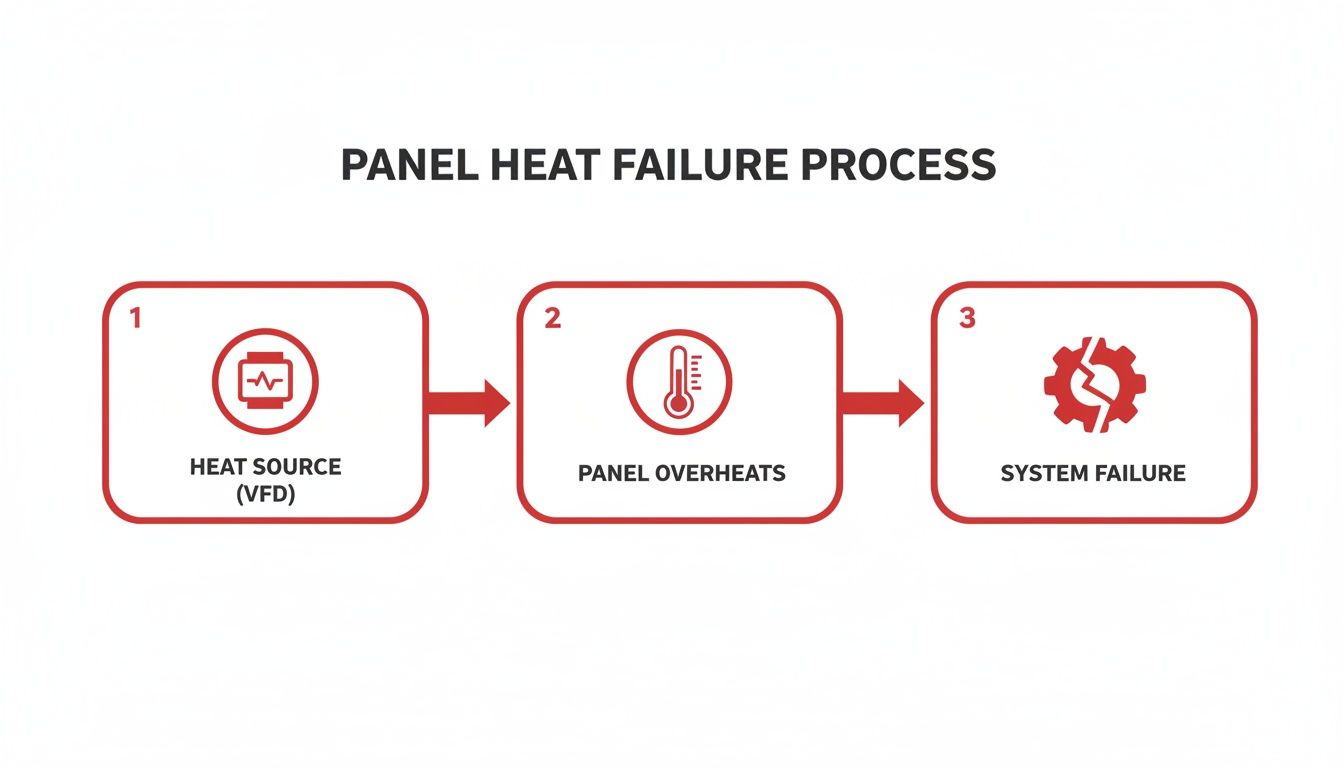
As shown, components like VFDs are primary heat sources. Without an effective fan, this heat leads directly to overheating and eventual system collapse.
Step 1: Identify Internal Heat Sources
Sum the heat dissipated by every component inside your electrical enclosure. This value, typically provided in watts on manufacturer datasheets, is your internal heat load.
Key heat-generating components include:
- Variable Frequency Drives (VFDs): Often the single largest heat source in a control panel.
- Power Supplies (SMPS): Essential for converting energy, they inevitably generate heat.
- Transformers and Reactors: These magnetic components produce significant thermal energy.
- PLCs, Relays, and Contactors: Their combined heat load in a compact panel is substantial.
Add the wattage of all components to determine your total internal heat load (Qi). For example, a VFD (150W), an SMPS power supply (30W), and relays (20W) result in a Qi of 200W.
Step 2: Calculate External Heat Gain
Next, account for heat transferring into the enclosure from the surrounding environment. This is a critical factor for panels located outdoors or in non-air-conditioned facilities in Dubai, where ambient temperatures can surpass 45°C.
The key metric here is Delta T (ΔT)—the difference between the maximum allowable internal panel temperature and the maximum external ambient temperature. A realistic ΔT is crucial for an accurate calculation in the GCC climate.
Step 3: Determine Required Airflow (CFM)
With your total heat load and target ΔT, you can calculate the required airflow, measured in Cubic Feet per Minute (CFM).
The industry-standard formula is:
CFM = (1.76 x Heat Load in Watts) / ΔT in °C
Let’s apply this to a real-world Dubai project:
- Internal Heat Load (Qi): 200 Watts
- Maximum Ambient Temperature: 45°C
- Desired Internal Temperature: 35°C (a safe target for sensitive electronics)
- Delta T (ΔT): 45°C – 35°C = 10°C
Plugging these values into the formula:
CFM = (1.76 x 200W) / 10°C = 35.2 CFM.
This calculation indicates you need a fan rated for at least 35.2 CFM. As a best practice, select a fan with a slightly higher CFM rating to create a safety margin for filter resistance and age-related performance decline. This data-driven approach ensures your panel cooling fan protects valuable electrical components in the UAE from premature failure.
Choosing The Right Fan Technology For Your Application
Once your required airflow (CFM) is determined, the next step is selecting the appropriate fan technology. This decision impacts upfront cost, energy consumption, service life, and noise levels. For projects in the UAE and GCC, this choice is fundamental to designing a reliable and cost-effective panel.
The primary choice is between AC (Alternating Current) and DC (Direct Current) fans. While both move air, their operational differences make them suitable for different applications.
AC Fans: The Workhorse Solution
AC fans are the traditional choice for many industrial applications. They are robust, simple, and connect directly to the mains power supply, making installation straightforward. Their simplicity often translates to a lower initial cost, which is beneficial for budget-conscious projects. AC fans are known for their ruggedness, making them suitable for the harsh, dusty conditions found on sites in Dubai and Abu Dhabi.
The main limitation is their fixed-speed operation, which is tied to the power line frequency. Speed control requires additional external hardware, leading to potential energy waste and higher noise levels.
DC Fans: The Efficient and Controllable Choice
DC fans represent the modern approach to intelligent panel cooling. An integrated inverter converts AC to DC power, enabling superior efficiency and control.
- Energy Efficiency: DC fans consume significantly less power than AC models—often up to 70% less. For a large facility, this translates into substantial long-term utility savings.
- Variable Speed Control: Speed is easily adjusted via a PWM (Pulse Width Modulation) signal, allowing the fan to match the enclosure's real-time cooling demand. This reduces noise and conserves energy.
- Longer Lifespan: Advanced motor technology and cooler operation contribute to a longer service life, reducing maintenance and replacement costs.
While a DC fan may have a higher initial cost, its lower Total Cost of Ownership (TCO) makes it a superior investment for most modern systems. For any energy management solution in Dubai, the long-term savings are a critical factor.
AC vs. DC Panel Cooling Fan Comparison
| Feature | AC Fans | DC Fans |
|---|---|---|
| Power Source | Direct connection to AC mains | Requires internal AC-to-DC conversion |
| Energy Efficiency | Lower efficiency, higher power consumption | High efficiency, up to 70% less power |
| Speed Control | Fixed speed, requires external VFD | Standard variable speed control (PWM) |
| Initial Cost | Generally lower | Often slightly higher |
| Lifespan | Good, but can be shorter | Typically longer |
| Noise Level | Louder (constant full speed) | Quieter (speed adjusts to demand) |
| EMI | Higher electromagnetic interference | Lower EMI, better for sensitive electronics |
| Best For | Simple, cost-sensitive, "always-on" uses | Energy-efficient, quiet, smart control systems |
Axial Fans vs. Centrifugal Blowers
The fan's physical design—axial versus centrifugal—depends on your enclosure's internal layout.
Axial Fans:
These are the standard panel cooling fan design. They move a high volume of air in a straight line, parallel to the motor shaft. They are ideal for enclosures with a clear, unobstructed path for airflow.
Centrifugal Blowers:
These units draw air in at the center and discharge it at a 90-degree angle, creating much higher static pressure. If your panel is densely packed with components and wiring that restricts airflow, a centrifugal blower provides the necessary force to ensure adequate cooling.
In a larger facility context, solutions like industrial ceiling fans can support the overall ambient air management strategy. By matching the fan technology (AC/DC) and type (axial/centrifugal) to your specific application, you create a cooling system optimized for performance and efficiency in the demanding GCC climate.
Decoding IP Ratings For Harsh Gulf Environments
In the UAE and across the GCC, electrical enclosures face a constant battle against dust, sand, and humidity. These environmental hazards can quickly disable unprotected electrical components. This is why the Ingress Protection (IP) rating of a panel cooling fan is not just a technical detail—it is the most critical factor determining its long-term reliability.
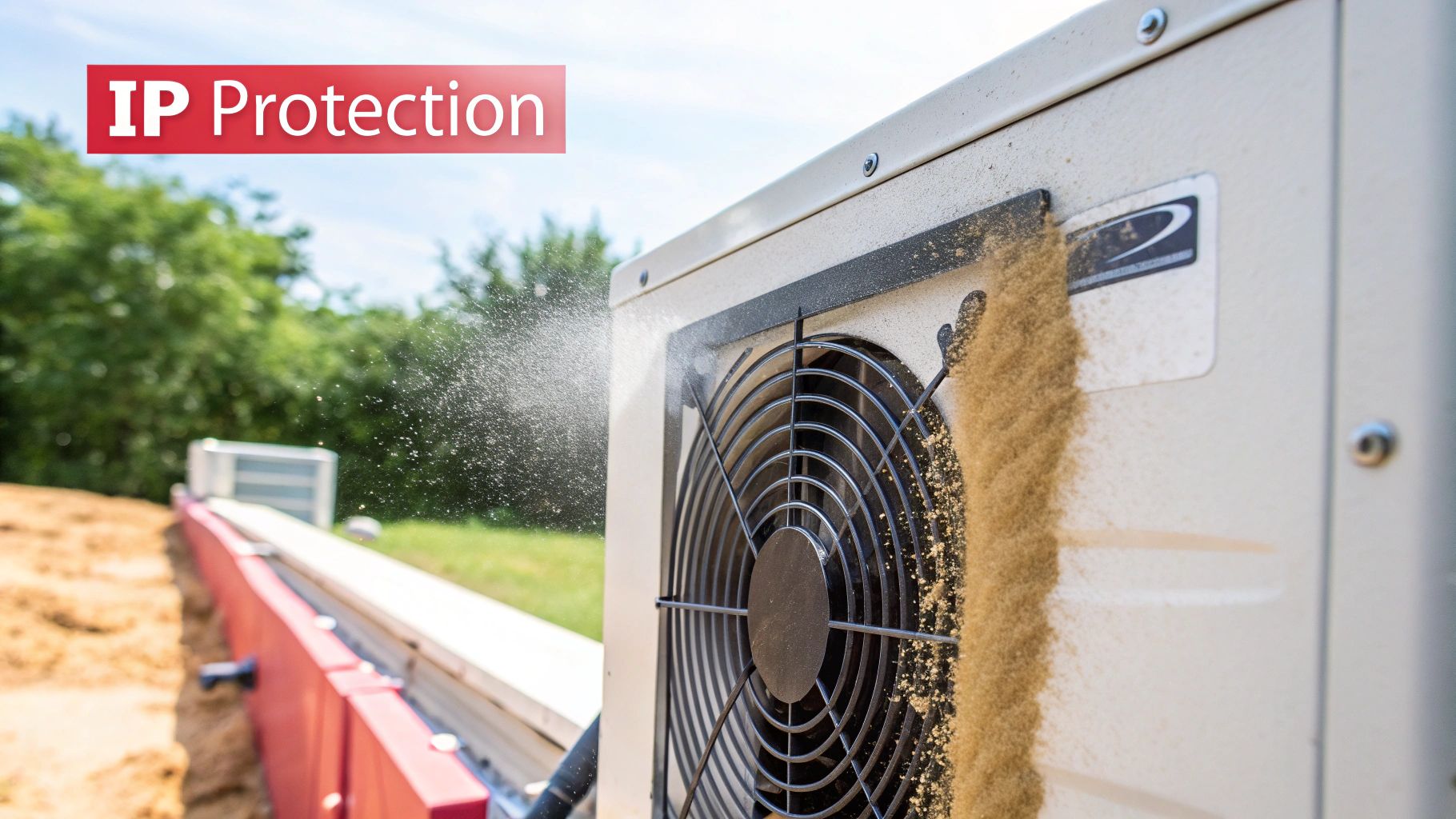
Selecting a fan with an inadequate IP rating is a direct path to premature failure. A standard, unprotected fan installed on a dusty industrial site in Dubai may not survive a single season.
Breaking Down The IP Code
The IP rating, defined by the IEC 60529 standard, is a two-digit code that clearly defines a product's resistance to solids and liquids. It provides a standardized measure of durability, allowing engineers to specify components with confidence.
For anyone specifying electrical components UAE, understanding this code is non-negotiable. It cuts through marketing claims and ensures the chosen panel cooling fan is fit for the punishing conditions of the GCC.
The First Digit: Solids Protection
This digit (0-6) indicates the level of protection against solid objects, from fingers to microscopic dust.
- IP2X: Protection against objects >12.5mm.
- IP4X: Protection against objects >1mm.
- IP5X: Dust-protected. Limited ingress of dust is permitted but will not interfere with operation. This is a minimum standard for our region.
- IP6X: Dust-tight. No ingress of dust is permitted.
For most industrial applications in the GCC, a minimum rating of IP5X is essential.
The Second Digit: Liquids Protection
This digit (0-9) measures resilience against moisture, from drips to high-pressure jets.
- IPX2: Protection against dripping water (enclosure tilted up to 15°).
- IPX4: Protection against water splashing from any direction.
- IPX5: Protection against low-pressure water jets.
- IPX6: Protection against high-pressure water jets.
Why IP54 is the Go-To Standard in the GCC
For most industrial and outdoor applications in Abu Dhabi, Dubai, and across the Gulf, an IP54 rating is the recommended baseline for a panel cooling fan.
- IP5_: The fan is protected against harmful dust ingress, crucial for preventing abrasive sand from damaging motor bearings and windings.
- IP_4: The fan is protected from splashing water, providing a defence against rain, wash-downs, and condensation from high humidity.
A fan without this level of protection will inevitably fail. Dust clogs will restrict airflow and strain the motor, while moisture ingress can cause short circuits and corrosion. By specifying IP54-rated fans with high-quality filter mats, you build a resilient cooling system designed to withstand the harsh realities of our local environment.
Mastering Fan Installation And Airflow Management
A high-performance panel cooling fan is only as effective as its installation. For electricians and panel builders in the UAE, proper placement and airflow management are fundamental to reliable thermal control. A flawed installation renders even the most powerful fan useless, leaving sensitive electrical components vulnerable to the region's heat.
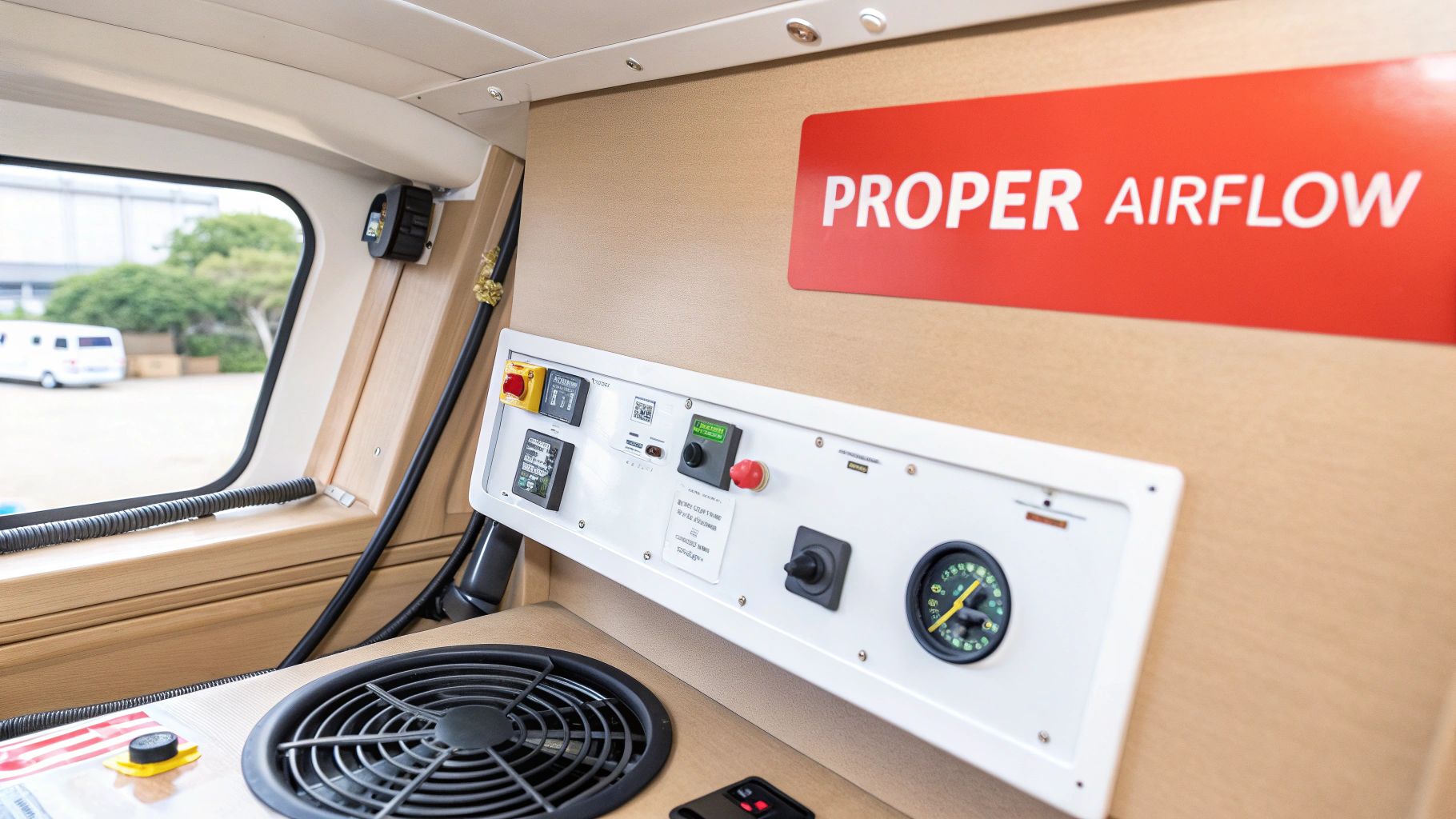
The guiding principle is to work with physics. Hot air rises naturally through convection. An intelligent cooling design leverages this principle to create an efficient airflow path that continuously removes heat.
Optimal Placement Strategy
The most effective configuration is a push-pull system that capitalizes on natural convection.
- Intake Fan Placement: The primary fan (with filter) should be mounted as low as possible on the enclosure to draw in the coolest available ambient air.
- Exhaust Filter Placement: The exhaust outlet or grille should be placed as high as possible on the opposite side, providing a natural escape route for hot air that has risen to the top of the panel.
This bottom-to-top airflow path ensures a constant, cooling draft across critical components like VFDs, transformers, and any installed SMPS power supply. This systematic heat removal is the foundation of dependable panel cooling in a climate like Dubai's.
Common Installation Mistakes To Avoid
Simple installation errors can severely compromise cooling performance. Panel builders in the GCC must avoid these common mistakes.
A critical error is creating an "air short circuit," where the intake and exhaust are too close together. The fan ends up circulating the same air without cooling the components.
Other common issues to avoid:
- Obstructed Airflow: Poor cable management or component placement can block the air's path. Ensure a clear channel from intake to exhaust.
- Incorrect Fan Direction: Always verify that the fan is pushing air into the enclosure. This creates positive pressure, which helps prevent dust ingress.
- Forgetting the Exhaust: An enclosure requires an outlet for hot air to escape. Without an exhaust point, the cooling circuit is incomplete.
Wiring For Smarter and More Efficient Cooling
For maximum efficiency, a panel cooling fan should not run continuously. Integrating a thermostat into the circuit creates an intelligent, on-demand cooling system. The thermostat acts as a temperature-activated switch, turning the fan on only when a preset temperature (e.g., 35°C) is reached.
This on-demand operation significantly reduces energy consumption and extends the fan's service life by minimizing unnecessary wear. This simple addition is a key feature of any modern energy management solution in Dubai.
A Practical Guide To Fan Maintenance And Troubleshooting
A "set and forget" approach to a panel cooling fan is a direct invitation to system failure, especially in the industrial environments of the UAE and GCC. A proactive maintenance plan is critical to preventing unexpected and costly shutdowns. This guide provides a straightforward strategy for keeping these vital cooling systems operating reliably.
Preventative Maintenance Schedule
Regular, scheduled maintenance is the best way to extend fan life and ensure optimal performance.
Monthly Checks (For Harsh Environments):
- Inspect Filter Mats: A clogged filter is the number one cause of reduced airflow and motor burnout. Check for heavy dust and sand buildup.
- Clean Fan Blades: A layer of dust can create an imbalance, causing vibration that wears out bearings. Wipe blades with a dry cloth.
Quarterly Checks (For Standard Environments):
- Listen for Abnormal Noises: Grinding, whining, or rattling sounds are early indicators of bearing failure and signal that a replacement is needed.
- Check for Vibration: Excessive vibration points to an imbalance or failing bearings.
- Verify Airflow: Weak airflow from the exhaust indicates a clogged filter or a failing motor.
Many principles from broader system maintenance, such as those in an ultimate HVAC maintenance checklist for the UAE, are applicable here, especially given our region’s challenging conditions.
Common Troubleshooting Steps
A systematic approach to troubleshooting can quickly identify the root cause of a fan problem.
The goal of troubleshooting is not just to fix the problem but to understand why it occurred. Was it component failure, an environmental issue like excessive dust, or an installation error? Answering this prevents recurrence.
Use this guide for common fan issues:
| Symptom | Possible Cause | Solution |
|---|---|---|
| Fan Not Starting | No power supply | Check wiring, terminals, and the circuit breaker. Verify thermostat functionality. |
| Seized motor/bearings | With power OFF, attempt to spin the blades manually. If they do not move freely, the fan requires replacement. | |
| Reduced Airflow | Clogged filter mat | This is the most common cause. Replace the filter mat immediately. Keep spares on-site in Dubai. |
| Obstruction in airflow path | Inspect intake/exhaust grilles and internal cabling for blockages. | |
| Excessive Noise | Failing bearings | A distinct grinding or whining noise is a clear sign of failure. Schedule a replacement. |
| Debris hitting blades | Power down and inspect the fan guard for loose wires or foreign objects. |
Got Questions About Panel Cooling Fans? We've Got Answers.
When specifying a panel cooling fan, engineers, panel builders, and procurement teams across the UAE and GCC frequently encounter the same key questions. Answering them correctly is crucial for ensuring the reliability of your electrical systems. Here are the most common queries we receive.
What’s the Magic Number for Temperature Inside an Electrical Panel?
The industry rule of thumb is to maintain an internal temperature below 40°C (104°F). Exceeding this limit significantly shortens the lifespan of sensitive electronics like VFDs, PLCs, and any SMPS power supply.
Given the high ambient temperatures in the GCC, we recommend a more conservative target. Setting your thermostat to maintain an internal temperature of around 35°C provides a safe, energy-efficient buffer against the external heat.
Should I Push Air In or Pull Air Out of the Panel?
For the dusty environments common in the UAE, the best practice is to push filtered air into the enclosure. This creates positive pressure, which actively prevents dust and sand from infiltrating through small gaps and unsealed joints. The correct setup involves mounting the fan and filter low on the panel to draw in cool air, with an exhaust grille positioned high to allow hot air to escape.
How Often Do I Need to Swap Out the Fan Filter Mat?
The replacement frequency depends entirely on the operating environment. In a clean, climate-controlled space, a visual inspection every three to six months may be sufficient.
However, for dusty industrial sites or outdoor installations common in the GCC, you must inspect filters monthly. Replace the filter mat as soon as significant dust buildup is visible. A clogged filter suffocates airflow and renders the cooling system ineffective.
Can I Just Use a Regular Computer Fan for My Panel?
Absolutely not. Using a standard computer fan is a major reliability risk. These fans are designed for clean, office environments and are not built to withstand the heat, dust, and continuous operation of an industrial electrical enclosure.
A proper panel cooling fan is engineered with durable materials, superior bearings (e.g., long-life ball bearings), and is certified to meet industrial safety standards. Attempting to save money with a consumer-grade fan is a false economy that will almost certainly lead to premature failure and costly downtime for critical electrical components in the UAE.
For expert assistance in selecting the ideal panel cooling fan or other electrical components for your project in Dubai or Abu Dhabi, explore the comprehensive offerings at GoSwitchgear. Our technical team is ready to provide the support you need.
Browse our full range of panel cooling solutions at GoSwitchgear
Share this post

Related
Posts
The Ultimate Guide to Industrial Panel Sockets and Wall Sockets for UAE Workspaces & Heavy-Duty Sites
A socket that works in a clean office may fail quickly on a workshop floor, generator panel, warehouse loading bay,...
Energy Data Loggers Explained: How to Pick a Meter That Actually Records Your Consumption (UAE Buyer’s Guide 2026)
Looking for an energy meter with data logging? Compare three proven data-logging meters — Multispan PQM16+M1, RISH ML 1410 and...
Wire Connectors for Downlights & LED Strips: A UAE Fit-Out Guide (2026)
Which KableKonnect PCT connector for downlight chains, driver-fed clusters, LED strip runs and ceiling roses. Featuring the SPL deconcentrator range...
Choosing the Right Solar PV Connector: A Complete Buyer’s Guide
Why a Small Solar Connector Deserves Serious Attention Solar modules may be the most visible part of a photovoltaic installation, but...
.jpg)