


Posted by:
Category:
Comments:
Post Date:
Selecting the Right Switches and Sockets for UAE & GCC Projects
For engineers, panel builders, and electricians across the UAE, selecting switches and sockets is a critical decision that impacts a building's long-term safety and operational integrity. In the demanding GCC climate, specifying the right electrical components is essential for ensuring reliability, compliance, and performance. This guide provides practical insights for making informed decisions.
Why Your Choice of Switches and Sockets Matters in the UAE
Standard, off-the-shelf wiring devices often fail to withstand the unique environmental challenges in Dubai, Abu Dhabi, and the wider GCC. The combination of extreme heat, high humidity, and airborne dust creates a punishing environment where only high-quality materials and robust engineering can prevent premature failure. An incorrect choice can lead to significant safety hazards, increased maintenance costs, and project delays.
For professionals specifying electrical components UAE, the choice of switches and sockets is foundational to building a resilient electrical infrastructure. This guide is designed to provide the practical, solution-focused insights needed to select components that not only meet but exceed the high construction standards prevalent across the region.
Key Considerations for GCC Projects
Selecting wiring devices for the GCC requires a focus on materials and designs proven to handle the harsh local climate.
- Material Durability: Intense UV exposure and high ambient temperatures can cause inferior plastics to become brittle and connections to loosen. Components must be engineered to resist this degradation.
- Corrosion Resistance: High humidity, especially in coastal cities like Dubai, accelerates corrosion of internal metal parts, leading to poor connections and creating significant fire risks.
- Dust Ingress: Fine dust from construction and the environment can penetrate poorly sealed units, jamming mechanisms and potentially causing short circuits. A high IP rating is crucial.
A project’s long-term success often hinges on the quality of its most basic electrical components. Insisting on superior materials and certified performance from the start protects the entire electrical system and ensures an effective energy management solution Dubai.
This is not about over-engineering; it's about smart engineering to ensure every switch and socket performs safely and reliably for years. At GoSwitchgear, we provide a curated selection of wiring devices specifically chosen to meet these demanding regional requirements.
Getting to Know the Core Types of Wiring Devices
On any project in the UAE, selecting the right wiring devices is a critical decision. A clear understanding of the available switches and sockets ensures that every commercial, residential, or industrial space is safe, functional, and compliant. Getting this specification right from the start is paramount.
Let's begin with the most common component: light switches. While seemingly simple, the choice can significantly impact a space's functionality and user experience.
Core Switching Solutions
The primary distinction is between one-way and two-way control, which dictates user interaction with lighting systems.
- One-Way Switches: The basic on/off switch, controlling a light or group of lights from a single location. Ideal for smaller rooms such as offices, bathrooms, or storage areas.
- Two-Way Switches: Enable control of a single light fixture from two different locations, such as at the top and bottom of a staircase. Essential for long corridors, large open-plan offices, and master bedrooms in Dubai villas.
Beyond basic control, advanced options can improve functionality and energy management.
For procurement teams, specifying two-way switches in appropriate locations enhances building usability and contributes to energy savings by making it easier to turn off lights.
Specialised Control Devices
Devices like dimmers and fan regulators offer precise environmental control, a highly sought-after feature in both commercial and high-end residential projects across the GCC.
Dimmer switches allow for adjustable light brightness, perfect for setting ambiance, reducing glare, and lowering energy consumption in boardrooms, hotel rooms, and living spaces. Fan regulators provide precise control over ceiling fan speeds—a necessity for comfort in the UAE's climate.
A Look at Essential Socket Types
Sockets provide the direct connection for powering equipment, and their specifications must align with the load and comply with local standards.
The market for these components is expanding rapidly, particularly in high-growth regions. Saudi Arabia’s wiring devices market is projected to grow at a CAGR of approximately 7.1% between 2024 and 2030, driven by large-scale construction projects. In 2023, sockets and receptacles dominated this market, with new housing projects increasing the average number of outlets per home by an estimated 20–35% due to multi-gang plates and sockets with integrated USB ports. You can find out more about the KSA wiring devices market growth here.
Common and Industrial Sockets in the UAE
For any project in the UAE, the following socket types are essential:
- 13A Switched Sockets (BS 1363): The standard "Type G" outlet, mandatory across the UAE. Its integrated safety features, such as shutters and a fused plug, make it the standard for most residential and commercial applications.
- Industrial Sockets (IEC 60309 / BS 4343): Designed for heavy machinery on construction sites, workshops, and factories. These durable, color-coded sockets handle higher currents and voltages and offer robust protection against dust and water (high IP ratings), making them indispensable in the UAE's industrial zones.
- Sockets with USB-A/C Ports: A modern requirement for new builds and retrofits. These integrated sockets eliminate the need for adapters and are becoming a standard feature in new hotels, offices, and residential developments across Dubai and Abu Dhabi.
Choosing the right mix of these switches and sockets from a trusted supplier like GoSwitchgear is fundamental to creating a safe, functional, and modern electrical system built for the unique demands of the energy meter GCC region.
Decoding Technical Specs for the GCC Climate
For engineers, panel builders, and procurement teams, a component's true quality lies within its datasheet. When selecting switches and sockets for projects in the UAE, it is essential to decode technical specifications to ensure each device can withstand the harsh realities of the GCC climate.
This infographic outlines the main categories of wiring devices.
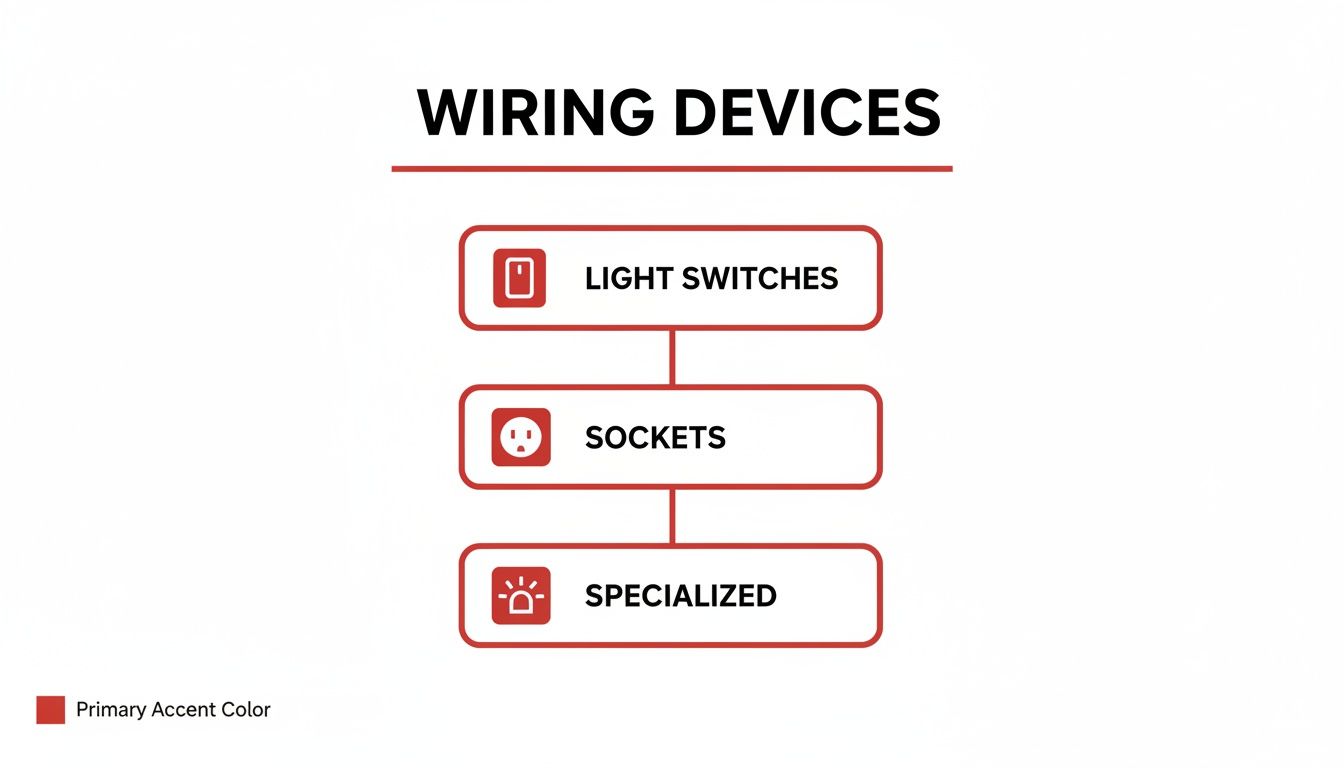
Standard switches, various socket types, and specialized controls all play distinct roles in a modern electrical installation.
Core Electrical Ratings
Before considering environmental factors, the basic electrical ratings must be correct for the application. These values are non-negotiable for safety and performance.
- Amperage (A): The maximum current a switch or socket can safely handle. Exceeding this limit causes overheating, which can melt components and create a serious fire hazard. In the UAE, standard power circuits use 13A sockets, while lighting circuits are typically managed by 10A or 16A switches.
- Voltage (V): The maximum voltage the device is designed for. The standard single-phase voltage in the UAE is 230V. Using components not rated for this voltage can lead to insulation breakdown and catastrophic failure.
Always verify that the ratings of your chosen switches and sockets align with the circuit's design to prevent overloads and ensure safe operation.
Material Science in High-Heat Environments
In a region with high ambient temperatures, the physical materials of a wiring device are as critical as its electrical ratings. Inferior plastics can become brittle and crack under relentless UV exposure and heat, compromising safety.
High-quality polycarbonate is the material of choice for durable faceplates, offering excellent resistance to impact, UV degradation, and high temperatures. This ensures the device maintains its shape, color, and structural integrity, separating products built for the demanding GCC market.
In the extreme heat of the UAE, material choice is a critical safety specification. A switch made from high-grade, heat-resistant polycarbonate will maintain its integrity, whereas a cheaper alternative can become a point of failure.
IP Ratings: The Shield Against Dust and Moisture
The Ingress Protection (IP) rating is a critical specification for any electrical component installed in the GCC. This two-digit code provides a standardized measure of a device's sealing against solids (like dust) and liquids (like humidity or water).
The first digit rates protection against solids (0-6), and the second against liquids (0-8). A high IP rating is essential for dusty construction sites in Dubai or humid coastal installations.
IP Rating Selection Guide for Different Environments in the UAE
Matching the IP rating to the environment is key. This table provides guidance for common scenarios across the UAE and GCC.
| Installation Area | Common Environmental Challenges | Recommended Minimum IP Rating | Example Application |
|---|---|---|---|
| Indoor Dry Areas | Minimal dust, no moisture | IP20 | Living rooms, bedrooms, and internal office spaces |
| Kitchens & Bathrooms | Splashing water, humidity | IP44 | Sockets near sinks or in non-direct spray zones |
| Outdoor Sheltered Areas | Windblown dust, indirect rain | IP55 | Covered balconies, workshops, or parking garages |
| Exposed Outdoor Locations | Direct rain, dust storms, jet washing | IP66 | External building walls, industrial yards, pool areas |
| Industrial Wash-down Areas | High-pressure water jets, dust, debris | IP67 | Food processing plants, heavy industrial facilities |
Selecting an appropriately IP-rated device, like the weatherproof options from GoSwitchgear, is fundamental to preventing short circuits and ensuring a long service life.
Navigating Local Compliance and Certifications
All switches and sockets installed in the UAE and GCC must comply with local and regional regulations. These certifications are a guarantee of safety, quality, and performance verified by independent bodies.
Key certifications to look for include:
- ESMA (Emirates Authority for Standardization and Metrology): This mandatory certification for many electrical products in the UAE confirms they meet national safety and performance standards.
- G-Mark: The GCC Conformity Mark is required for low-voltage electrical equipment sold in any GCC member state, signifying compliance with regional health, safety, and environmental requirements.
Specifying products with these marks ensures you are installing legally compliant components that have been rigorously tested for local conditions.
Bringing Smart Switches and Sockets into Modern Buildings
In the UAE's advanced construction sector, smart technology is no longer an option but a core expectation. Integrating smart switches and sockets is the new standard for modern commercial and residential buildings, driven by demands for greater efficiency, convenience, and control. This shift transforms simple components into active participants in a building's management ecosystem.
The benefits extend beyond remote control. When properly integrated, smart devices enable real-time energy monitoring, automated scheduling, and seamless integration with voice assistants and Building Management Systems (BMS). This empowers facility managers and occupants to reduce energy waste, enhance security, and create responsive environments.
This trend is part of a broader regional push for smarter infrastructure. Between 2015 and 2024, the UAE and GCC saw significant modernization in building electrical standards. By 2023, the UAE held the largest share of the Middle East's light-control switches market, fueled by new construction, smart-city initiatives, and energy-efficiency retrofits. You can learn more about the evolving MEA light-control market here.
Choosing the Right Communication Protocol
Selecting the right communication protocol is a critical decision when planning a smart device deployment. Wi-Fi, Zigbee, and Z-Wave each have distinct advantages suitable for different project types across the UAE.
Wi-Fi:
- Pros: Simple to set up, as devices connect directly to an existing router without a hub. A great choice for small-scale projects or single-room upgrades.
- Cons: Can congest the network with many devices, creating potential security vulnerabilities and performance issues in larger buildings.
Zigbee:
- Pros: Creates a "mesh network" where devices relay signals, enhancing reliability and range. Operates on a frequency that reduces interference with most Wi-Fi networks.
- Cons: Requires a central hub or gateway to connect the Zigbee network to the local network and the internet.
Z-Wave:
- Pros: Also a mesh network technology, known for its reliability and low power consumption. Operates on a lower frequency band, avoiding interference from Wi-Fi and Bluetooth.
- Cons: Requires a dedicated hub, and the device selection can be more limited compared to Wi-Fi products.
For large-scale projects, such as a high-rise in Dubai or a villa compound in Abu Dhabi, a mesh network like Zigbee or Z-Wave is superior due to its scalability and reliable performance across hundreds of devices.
Practical Integration and Wiring Considerations
For electricians and system integrators, installing smart switches and sockets requires attention to specific details beyond traditional installations. Proper planning is key to a smooth deployment.
Key installation considerations include:
- Neutral Wire Requirement: Many smart switches, particularly Wi-Fi models, require a constant power supply to remain connected to the network. This necessitates a neutral wire in the switch box. In older buildings undergoing retrofits, this may require an electrician to pull a new wire.
- BMS Integration: In commercial projects, seamless communication with the central Building Management System is essential. This integration is typically achieved using protocols like BACnet or Modbus. Ensure your smart hub or gateway is compatible with the building's control system.
- Pairing and Commissioning: The final step involves pairing each device to the network. Following the manufacturer’s instructions precisely is crucial for establishing a secure and stable connection. This step is where a robust system is truly realized.
By carefully selecting the communication protocol and adhering to these installation best practices, you can successfully deploy smart switches and sockets that deliver the efficiency and advanced functionality demanded by modern buildings in the UAE.
Getting the Installation Right and Dodging Common Pitfalls
Even the highest-quality switches and sockets will fail if installed incorrectly. For electricians and panel builders across the GCC, achieving a flawless installation is a necessity. This section serves as a field guide to best practices that prevent callbacks, mitigate safety risks, and ensure long-term durability. Every detail, from wire termination to back box selection, is critical.
This practical advice reflects our commitment at GoSwitchgear to safety and building robust electrical systems.
The Foundations of a Flawless Installation
A professional installation is defined by attention to detail. A single loose connection or improperly mounted box can compromise the entire system, creating latent faults and hazards.
Focus on these key areas for every installation:
- Correct Wire Termination: Strip the precise amount of insulation. Too little exposed copper results in a poor connection, while too much exposes live wire, creating a shock hazard.
- Proper Torque: Overtightening terminal screws can damage the wire and terminal, while undertightening creates a high-resistance connection. Use a calibrated torque screwdriver to adhere to manufacturer specifications to prevent overheating.
- Appropriate Back Box Selection: For the masonry walls common in the UAE, galvanized steel boxes are the standard. For plasterboard partitions, use PVC dry-lining boxes.
A secure, correctly torqued connection is the cornerstone of a safe electrical installation. It eliminates the primary cause of overheating in switches and sockets: high-resistance points from loose terminations.
Sidestepping Common Mistakes on UAE Job Sites
Even experienced professionals can make common errors under tight project deadlines. Awareness of these pitfalls is the first step toward avoiding them and ensuring every installation meets the high standards expected in Dubai and Abu Dhabi.
Here is a checklist of common mistakes to avoid:
- Using Incorrect Wire Gauge: A wire too thin for the circuit's amperage will overheat, melting insulation and creating a fire risk. Always ensure the wire gauge matches the circuit breaker's rating.
- Ignoring Location-Specific IP Ratings: Installing an indoor-rated socket (e.g., IP20) in an outdoor or wet location leads to rapid corrosion, short circuits, and device failure.
- Overcrowding the Back Box: Forcing too many wires into a back box can damage insulation and create a heat pocket. Always select a box with adequate depth and volume for the number of conductors.
- Incorrect Polarity: Reversing live and neutral wires creates a serious shock hazard and can damage sensitive electronics. Always double-check connections before energizing the circuit.
By mastering these installation fundamentals and avoiding common pitfalls, you ensure the safety and reliability of the switches and sockets you install, defining your work as that of a true professional in the GCC.
Keeping Everything Running: Smart Maintenance for Long-Term Reliability
For facility managers and maintenance engineers in the UAE, the installation of switches and sockets is only the beginning. A proactive maintenance plan is essential for ensuring the long-term health of a building's electrical systems. This approach maximizes the service life of components, prevents costly downtime, and protects the initial investment.
In the GCC, environmental factors like dust and humidity continuously stress electrical components, making a scheduled maintenance routine indispensable.
A Practical Maintenance Schedule
Regular inspections are the core of an effective electrical maintenance strategy. A consistent schedule helps identify minor issues before they escalate into major failures, which is critical for maintaining operations in commercial and industrial facilities across Dubai. For a broader perspective on property care, this guide to managing building maintenance offers valuable insights.
A simple yet effective routine includes:
- Quarterly Visual Inspections: Every three months, conduct a walkthrough to inspect accessible switches and sockets for signs of physical damage, such as cracked faceplates, discoloration from overheating, or loose fittings.
- Bi-Annual Cleaning: Clean all units twice a year, especially following sandstorms or nearby construction. A wipe with a dry, soft cloth removes dust that can interfere with internal mechanisms.
- Annual Functionality Test: Once a year, test infrequently used sockets to ensure they remain functional. In critical areas, consider thermal imaging to detect hotspots in connections, which are early indicators of potential failure.
Proactive maintenance is an investment in safety and reliability. A simple visual inspection today can prevent a major electrical fault tomorrow, protecting both personnel and property.
Common Problems and Simple Fixes
Even with high-quality components, issues can arise. This table provides a quick troubleshooting guide for common problems with switches and sockets.
| Problem | Potential Cause | Recommended Solution |
|---|---|---|
| Flickering Lights | Loose wire at the switch terminal or a failing switch mechanism. | De-energize the circuit at the breaker, then check and tighten terminal screws. If the problem persists, replace the switch. |
| Unresponsive Socket | Tripped circuit breaker, loose internal wiring, or a failed socket. | First, check the main distribution board for a tripped breaker. If the breaker is fine, a qualified electrician should inspect the socket's wiring. |
| Switch Feels Warm | The circuit may be overloaded, or a poor internal connection is creating resistance. This is a significant warning sign. | Immediately reduce the load on the circuit by unplugging devices. If the switch remains warm, it requires immediate inspection and likely replacement by a professional. |
Finding the Right Partner for Your GCC Projects
Selecting switches and sockets is a critical decision that directly impacts the safety, reliability, and longevity of any project in the GCC. It requires a deep understanding of technical specifications, environmental challenges, and local compliance. This attention to detail is what distinguishes a superior installation.
When sourcing high-performance wiring devices engineered for the demands of the GCC, it is vital to partner with suppliers who possess deep market knowledge. Companies like Yasu Trading are specialists in this field.
Here at GoSwitchgear, our experts are ready to provide technical consultations and project support to engineers and contractors across the UAE. We encourage you to reach out to our team in Dubai to discuss how our solutions can meet your project's specific needs.
Got Questions? We've Got Answers
When dealing with electrical components for projects in the UAE and GCC, several key questions frequently arise. Here are direct, practical answers to help engineers, electricians, and procurement teams make the right decisions.
What’s the Standard Socket Type in the UAE, and Why That One?
Throughout the UAE, the BS 1363 'Type G' 13A socket is the mandatory standard. This is a strict regulatory requirement driven by its unparalleled safety features, making it essential for residential and commercial applications in Dubai, Abu Dhabi, and beyond.
Key safety features include:
- Protective Shutters: These cover the live and neutral contacts, preventing the insertion of foreign objects and reducing the risk of electric shock.
- Built-in Fuse: The plug top contains an integrated fuse, providing a primary line of defense against power surges at the appliance level.
These features make the Type G socket exceptionally robust and safe, explaining its adoption as the uniform standard across the region.
How Do I Choose Between Modular and Non-Modular Switches?
The decision between modular and non-modular switches and sockets depends on flexibility, aesthetics, and budget.
Modular switches are the custom-tailored solution, ideal for projects where a high-end finish and personalization are priorities. They are commonly specified for hotels, modern offices, and luxury residences, allowing for the combination of different functions—such as light switches, dimmers, data ports, and USB chargers—on a single faceplate.
Non-modular switches are the reliable workhorses. They offer a durable, cost-effective solution for standard applications where functionality and robustness are key, such as in utility areas, back-of-house zones, or large-scale housing developments where budget is a primary consideration.
Are Smart Switches a Pain to Install in Older Buildings?
Generally, no. Most modern smart switches are designed as direct replacements for traditional mechanical switches, making them well-suited for retrofits. The installation process is often a simple swap.
The most critical requirement for most smart switches is a neutral wire in the wall box. This wire provides the continuous power the switch needs to stay connected to the network.
While nearly all modern buildings in the UAE include a neutral wire in switch boxes, it may be absent in older properties. If a neutral wire is missing, an electrician will need to run a new one. However, for the majority of upgrade projects, the installation is straightforward.
For expert advice and a full lineup of wiring devices built for the unique demands of the GCC, check out the GoSwitchgear catalog or contact our technical team for direct project support in Dubai.
Share this post

Related
Posts
The Ultimate Guide to Industrial Panel Sockets and Wall Sockets for UAE Workspaces & Heavy-Duty Sites
A socket that works in a clean office may fail quickly on a workshop floor, generator panel, warehouse loading bay,...
Energy Data Loggers Explained: How to Pick a Meter That Actually Records Your Consumption (UAE Buyer’s Guide 2026)
Looking for an energy meter with data logging? Compare three proven data-logging meters — Multispan PQM16+M1, RISH ML 1410 and...
Wire Connectors for Downlights & LED Strips: A UAE Fit-Out Guide (2026)
Which KableKonnect PCT connector for downlight chains, driver-fed clusters, LED strip runs and ceiling roses. Featuring the SPL deconcentrator range...
Choosing the Right Solar PV Connector: A Complete Buyer’s Guide
Why a Small Solar Connector Deserves Serious Attention Solar modules may be the most visible part of a photovoltaic installation, but...
.jpg)