


Posted by:
Category:
Comments:
Post Date:
A Technical Guide to UAE Electrical Sockets for Engineers & Panel Builders
For engineers, panel builders, and procurement teams operating in the UAE, specifying the correct electrical socket is a foundational requirement for compliance and safety. The regional standard, Type G (BS 1363), is not merely a preference but a mandatory specification for all new installations. Mastering its technical nuances is critical for delivering safe, reliable, and regulation-compliant electrical systems in Dubai, Abu Dhabi, and the wider GCC.
The Foundation of UAE Electrical Installations
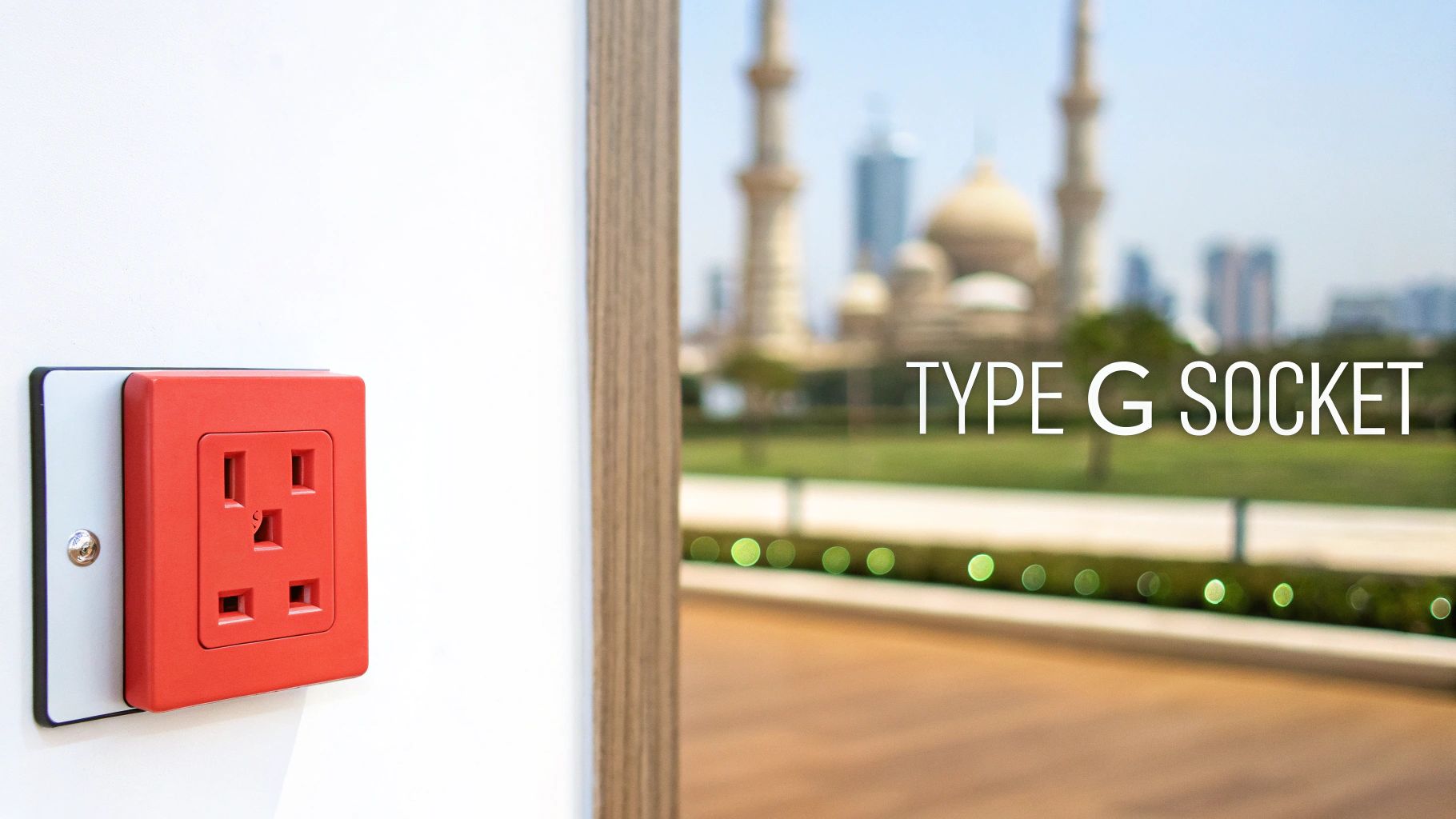
A robust understanding of local standards is non-negotiable for any electrical professional in the UAE. The strict specification for UAE electrical sockets is derived from British standards, creating a highly safe and stable framework. This consistency simplifies everything from sourcing electrical components in the UAE to installation and maintenance, whether the project is in Dubai or elsewhere in the GCC.
The core of the UAE's electrical infrastructure is the Type G socket, designed for the country's 230V, 50Hz mains supply. This uniformity streamlines project execution for contractors and panel builders, fostering an efficient and predictable work environment. The following technical parameters are essential knowledge for any professional operating in the region.
UAE Electrical System At A Glance
This table breaks down the fundamental electrical parameters and socket standards essential for any project in the UAE.
| Parameter | Standard Specification | Significance For Professionals |
|---|---|---|
| Nominal Voltage | 230V (+/- 6%) | Equipment must be rated for 230V to ensure performance and avoid damage. |
| Frequency | 50 Hz | Critical for motors and timed devices; incompatible frequency can lead to failure. |
| Socket Type | Type G (BS 1363) | The only approved standard for new installations, ensuring universal compatibility. |
| Earthing System | Mandatory via the third pin | A non-negotiable safety feature required for all installations to prevent shock. |
| Plug Fuse | Required in all appliance plugs | Provides localised overcurrent protection for the appliance cord. |
Understanding these basics is the bedrock of compliance and safety on any job site.
Core Technical Specifications
Every Type G socket installed in the UAE must adhere to specific technical and safety requirements enforced by local authorities to protect both people and property.
Here’s what you need to look for:
- Voltage and Frequency: All systems are designed for a nominal voltage of 230V (+/- 6%) at a 50Hz frequency. Deviations can cause equipment damage or significantly shorten its operational lifespan.
- Three-Pin Configuration: The socket includes dedicated pins for Line, Neutral, and Earth. The Earth pin is slightly longer, ensuring it connects first and disconnects last, grounding the appliance before power flows.
- Built-in Safety Shutters: This critical safety mechanism physically blocks the live and neutral contacts. The shutters only retract when the longer Earth pin is inserted, preventing accidental contact with live terminals.
- Fused Plugs: Every plug compatible with a Type G socket must contain an internal fuse, typically rated at 3A, 5A, or 13A. This provides localized overcurrent protection for the appliance’s flexible cord.
Adherence to the BS 1363 standard is the absolute minimum for any compliant electrical work in the UAE. Specifying non-compliant sockets risks failed inspections, project delays, and introduces serious safety hazards.
Mastering these fundamentals ensures that every component, from the socket to the final appliance plug, integrates seamlessly into a safe and reliable electrical system. For procurement teams, verifying that all electrical components UAE suppliers provide meet this standard is a crucial first step in quality assurance.
Selecting Materials For The Demanding GCC Climate
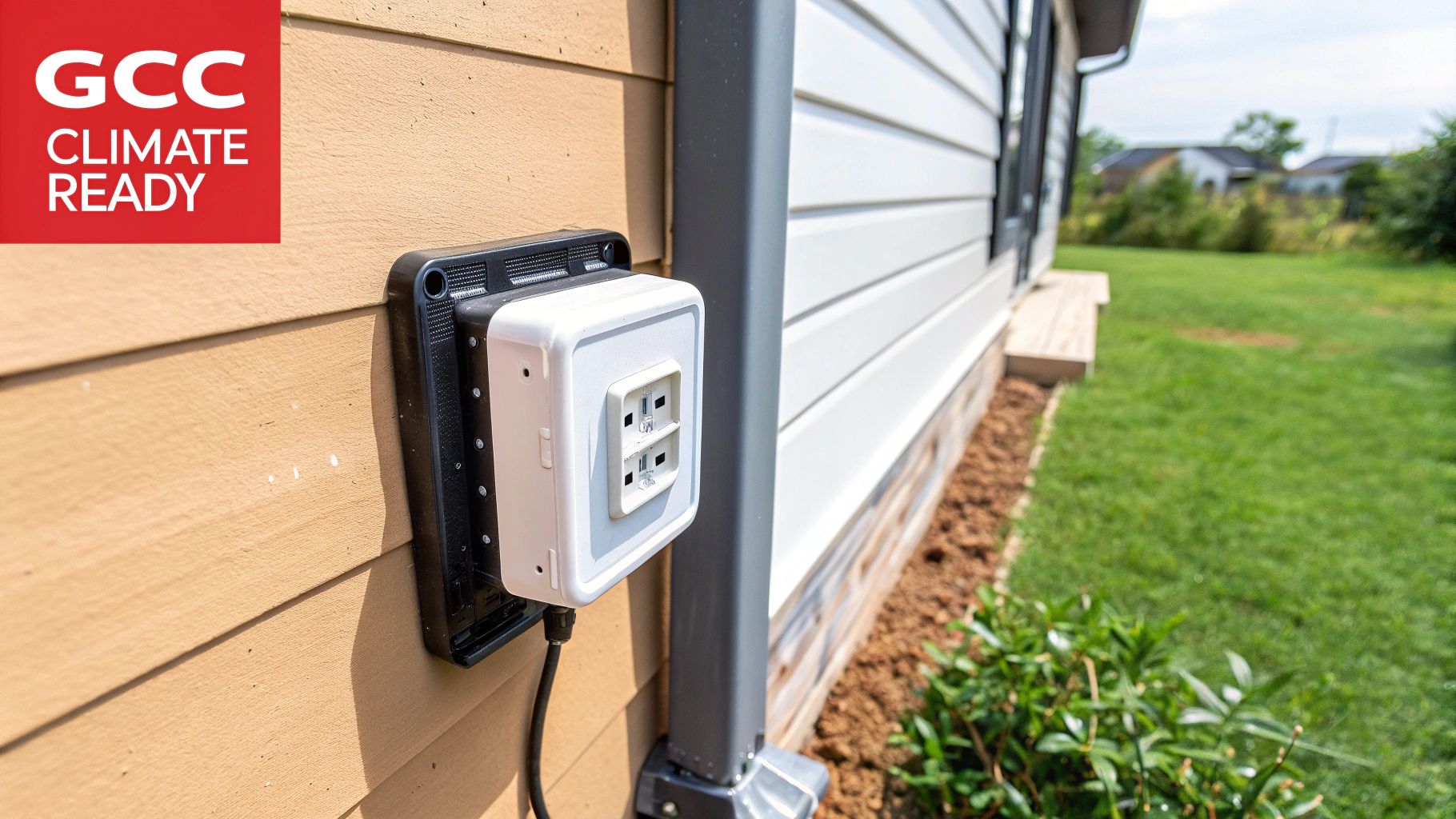
Electrical installations in the GCC face extreme environmental challenges, including intense heat, pervasive dust, and high humidity. When specifying components for projects in Dubai or Abu Dhabi, it is crucial to consider factors beyond standard electrical ratings. These environmental forces can rapidly degrade inferior materials, leading to premature failures, significant safety hazards, and costly replacements.
Choosing the right materials is not a minor detail; it is fundamental to ensuring long-term safety and operational reliability in the region's harsh climate.
The Importance Of High-Grade Polycarbonate
In the UAE's sun-drenched environment, ultraviolet (UV) radiation is a constant threat. Standard thermoplastics become brittle, discolour, and lose structural integrity under prolonged sun exposure.
This is why high-grade, UV-stabilised polycarbonate is the superior material for the faceplates and enclosures of UAE electrical sockets. This engineered material is designed to resist UV degradation, preventing the yellowing and cracking seen in lower-quality plastics. Its inherent toughness also provides excellent impact resistance, which is essential in high-traffic commercial or industrial environments. For any outdoor or sun-exposed application, specifying UV-stabilised polycarbonate is a non-negotiable requirement for durability.
Understanding Ingress Protection (IP) Ratings
The combination of coastal humidity and desert dust in the GCC makes Ingress Protection (IP) ratings a critical specification. An IP rating defines how well an enclosure protects internal electrical components from solids (like dust) and liquids (like water). The rating consists of two digits.
- First Digit (Solids): Ranges from 0 (no protection) to 6 (completely dust-tight). A minimum rating of 4 is recommended for most UAE applications to protect against particles larger than 1mm.
- Second Digit (Liquids): Ranges from 0 (no protection) to 8 (protection against continuous submersion). The required level depends on the installation location.
Here’s a quick-glance guide to IP ratings for projects in the GCC.
| IP Rating | Protection Against Solids | Protection Against Liquids | Typical GCC Application |
|---|---|---|---|
| IP20 | Fingers or large objects (>12.5mm) | No protection | Standard indoor use in dry, clean areas (offices, homes). |
| IP44 | Solid objects >1mm (e.g., tools, wires) | Splashing water from any direction | Sheltered outdoor areas, workshops, garages. |
| IP66 | Completely dust-tight | Powerful water jets from any direction | Unprotected outdoor areas, industrial wash-down zones, coastal facilities. |
Specifying an IP66-rated socket for an exterior power point on a coastal villa or in a dusty industrial workshop is a necessary safety protocol. It ensures that fine sand and moisture cannot compromise internal connections, preventing short circuits and corrosion. Maintaining the IP rating also requires correct cable entry; our electrical cable gland chart is an essential tool for selecting the right component to ensure a proper seal.
Terminal Integrity and Current Handling
The internal components of a socket are equally important, especially given the standard 13A current rating. High ambient temperatures in the UAE can cause connection points to overheat, making a robust terminal design essential.
Look for terminals made from high-quality brass or a similar copper alloy, which offer excellent conductivity and corrosion resistance—a critical feature in humid coastal areas. The terminal screws must be designed to clamp conductors firmly without causing damage, ensuring a solid, low-resistance connection that can withstand a sustained heavy load without overheating.
Navigating DEWA, ADDC, and ESMA Compliance
For project managers and procurement teams in the UAE, specifying and installing electrical components involves navigating a strict regulatory framework designed to ensure public safety and grid stability. Compliance is non-negotiable for project approval and long-term reliability.
The primary regulatory bodies are the Emirates Authority for Standardization & Metrology (ESMA), the Dubai Electricity and Water Authority (DEWA), and the Abu Dhabi Distribution Company (ADDC). Each plays a crucial role in regulating UAE electrical sockets and all other grid-connected components.
Understanding The Key Regulatory Authorities
ESMA functions as the national authority for quality and safety, setting federal standards and conformity assessment schemes for a wide range of products, including electrical equipment.
Local utilities, such as DEWA in Dubai and ADDC in Abu Dhabi, enforce ESMA’s standards while often adding their own specific technical requirements for components connecting to their grids. Their approval is mandatory for any new installation or major renovation project within their respective emirates.
For any project, the first critical step is ensuring your chosen components are approved by both ESMA and the relevant local utility. Sourcing non-compliant products is a surefire way to fail inspections, leading to expensive rework and serious project delays.
The Significance of ECAS and The G-Mark
Product compliance is verified through two key certifications: the Emirates Conformity Assessment Scheme (ECAS) certificate and the GCC Conformity Mark (G-Mark).
- ECAS Certificate: Issued by ESMA, this is mandatory for regulated products sold in the UAE. It confirms that the product has been tested in an accredited laboratory and meets all national safety and quality standards.
- GCC Conformity Mark (G-Mark): This mark indicates compliance with the technical regulations of the Gulf Cooperation Council (GCC). For low-voltage electrical equipment, the G-Mark is essential for market access in all GCC member states, including the UAE and KSA.
When sourcing electrical components UAE suppliers offer, always request valid ECAS and G-Mark certificates. This is your primary guarantee that the product is legal to install and sell in the region.
A History of Evolving Safety Standards
The UAE’s commitment to electrical safety is dynamic, with standards continuously evolving to address new technologies and risks. A prime example is ESMA's regulation of plug adaptors.
In 2012, ESMA mandated that all non-removable plug adaptors must comply with UAE standards based on BS 1363-5:2010. This was a direct response to the proliferation of cheap, uncertified adaptors that posed significant safety risks, demonstrating the authorities' meticulous attention to every link in the electrical chain.
Verifying Compliance and Avoiding Pitfalls
Verifying a product's compliance is an essential due diligence step. Always request copies of ECAS and G-Mark certificates from your supplier. These can often be cross-verified on the regulators' online portals.
A common mistake is accepting products that claim compliance without official documentation. This carries immense risk, as using uncertified components can void project insurance, create liability issues, and necessitate costly replacement of all installed items. It also compromises the integrity of your entire protection system. For more on this, refer to our detailed guide on testing an RCD.
Ultimately, strict compliance is the foundation of every safe and successful electrical project in the GCC.
Getting Socket Installation Right: Best Practices on the Ground
Properly installing UAE electrical sockets is a craft that underpins the safety, reliability, and compliance of the entire electrical system. For electricians and technicians in the GCC, mastering these best practices is essential for delivering a professional, durable installation.
A flawless installation not only ensures regulatory approval but also prevents dangerous faults, avoids costly rework, and guarantees long-term system integrity. This guide covers essential steps, from wire termination to final checks.
Nailing the Wire Termination
The terminal connection is a common point of failure. A loose or improper connection can lead to overheating, arcing, and significant fire risk.
- Strip It Just Right: Strip only enough insulation to allow the copper conductor to sit fully within the terminal. No bare copper should be visible outside the clamp. Insufficient stripping results in a weak, high-resistance connection, while over-stripping exposes live parts.
- The Right Tool for the Job: Use a quality wire stripper. The wrong tool can nick or damage copper strands, creating a weak point that may fail under load.
- Full Contact is Key: Ensure the entire stripped conductor is firmly clamped within the terminal. This maximizes the contact area, creating a secure, low-resistance connection capable of safely handling the full 13A current.
The Unseen Hero: Earthing Continuity
The earthing system is the most critical safety feature in the UAE's electrical framework. It provides a path for fault current to flow harmlessly to the ground, tripping the circuit breaker and preventing electric shock.
Before energizing a new circuit, a thorough earth continuity test is mandatory. Use a multimeter or installation tester to verify low resistance between the socket's earth pin and the main earthing terminal at the distribution board. This confirms the integrity of the protective earth conductor.
A common and dangerous oversight is failing to connect the earth wire to the metal back box. This connection ensures that if a live wire makes contact with the box, the enclosure will not become live, preventing a simple fault from becoming a serious hazard.
Sidestepping Common Installation Pitfalls
Vigilance against common mistakes can significantly improve the quality and safety of your work.
1. The Dangers of Over-Tightening
Over-tightening terminal screws can strip threads, crush copper conductors, or crack the socket housing. The wire should be tightened until it is secure and cannot be pulled out with a firm tug. For high-precision installations, use a torque screwdriver set to the manufacturer's specified setting.
2. Choosing the Wrong Back Box
The back box must be the correct size and type. A shallow back box forces aggressive bending of wires, stressing terminals and increasing the risk of loose connections or insulation damage. Always select a back box with adequate depth to accommodate the socket and wiring comfortably. For outdoor or industrial settings, an IP-rated enclosure is required.
3. Damaging Insulation on the Final Push
When inserting the socket into the back box, be careful not to scrape or pinch wire insulation against the box's sharp edges. This can create a hidden fault that may lead to a short circuit later. Gently fold the wires into the box in an accordion-like manner to avoid strain on the terminals and protect insulation.
Choosing The Right Sockets For Your Application
Selecting the right UAE electrical sockets requires a detailed assessment of the installation environment. A socket in a climate-controlled Dubai office has different requirements than one in a humid industrial plant in JAFZA. This decision is fundamental to safety, operational uptime, and long-term value.
System designers and procurement managers must balance load requirements, environmental pressures, and durability. While approximately 20 plug types exist globally, the UAE and GCC region exclusively use Type G. The standard 220V to 230V at 50Hz supply aligns with European and Asian standards, simplifying equipment sourcing.
Standard Sockets For Commercial And Residential Use
For most indoor applications—offices, retail spaces, hotels, and homes—a standard Type G socket made from high-quality polycarbonate is the appropriate choice. In these clean, dry, and climate-controlled environments, the priorities are safety, aesthetics, and consistent performance.
Even in these settings, quality is critical. Look for sockets with solid terminal construction and reliable safety shutters. A basic IP20 rating is the minimum standard, confirming protection against objects larger than 12.5mm, such as fingers.
Weatherproof Sockets For Outdoor And Demanding Areas
For outdoor installations, workshops, car parks, and mechanical rooms, a weatherproof socket is essential to withstand intense UV radiation, humidity, and dust.
Key features of these specialized sockets include:
- High IP Ratings: An IP66 rating is the gold standard for exposed outdoor locations, certifying a complete seal against dust and protection from powerful water jets.
- UV-Stabilised Enclosures: The housing is constructed from materials engineered to resist constant sun exposure, preventing the plastic from becoming brittle, cracking, or fading.
- Robust Sealing: Premium gaskets and seals are essential to maintain the integrity of the protective cover over thousands of uses.
For detailed specifications on these products, see our guide on IP-rated switches and sockets for industrial use in the UAE.
This infographic highlights the critical decision points for ensuring socket safety during installation.
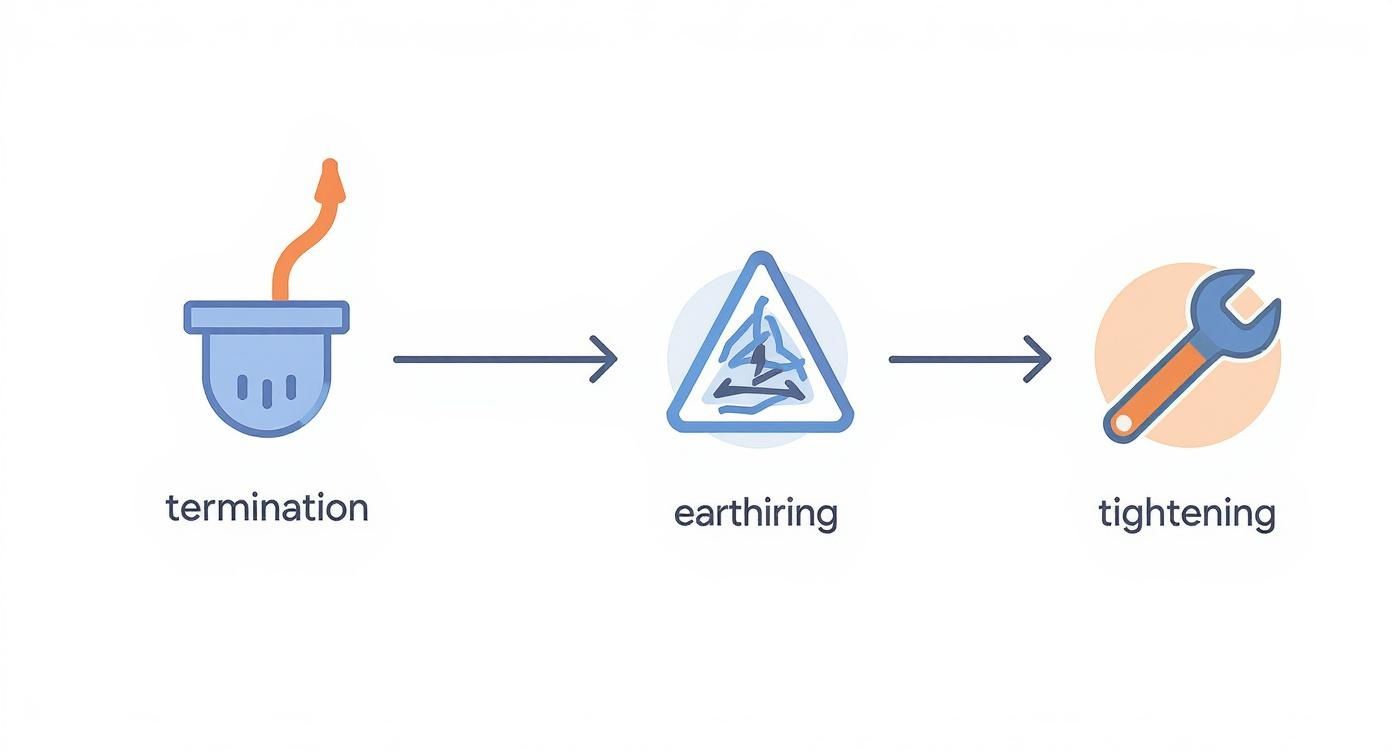
As shown, safety is a comprehensive process where secure terminals and proper earthing are as crucial as the initial wire termination.
To aid in the selection process, the following table matches socket types to common UAE project environments.
Socket Selection Matrix For UAE Projects
| Application Environment | Recommended Socket Type | Key Features (IP Rating, Material) | Typical Use Case |
|---|---|---|---|
| Indoor Commercial/Office | Standard Type G | IP20, Polycarbonate | Office workstations, retail POS systems, hotel rooms |
| Outdoor Uncovered Area | Weatherproof Socket | IP66, UV-Stabilised Polycarbonate | External building lighting, garden power points, pool pumps |
| Industrial Workshop | Weatherproof Socket | IP55 to IP66, High-Impact Thermoplastic | Power tool connections, assembly line stations, maintenance bays |
| Heavy Machinery Connection | Interlocked Socket | IP44 to IP67, Reinforced Thermoplastic | Factory conveyors, large motors, processing plant equipment |
This matrix streamlines the decision-making process, ensuring the correct product is specified for each application.
Interlocked Sockets For Heavy Industrial Machinery
In heavy industrial environments with high-power machinery, interlocked sockets are required. These units integrate a switch that makes it physically impossible to insert or remove the plug while the power is on.
The circuit can only be energized after the plug is fully seated and must be switched off before the plug can be removed.
This mechanical failsafe prevents dangerous electrical arcs that can occur when connecting or disconnecting equipment under heavy load. It is a critical safety feature that protects both operators and machinery, making it a mandatory specification for many industrial applications across the GCC.
Sourcing Compliant Sockets With GoSwitchgear
Sourcing the right UAE electrical sockets reliably and efficiently is as important as specifying them correctly. Partnering with a specialist local supplier like GoSwitchgear streamlines this process, ensuring every product supplied is fully compliant with regional standards.
Our extensive local stock in Dubai and Abu Dhabi significantly reduces lead times compared to international suppliers. This immediate availability of certified electrical components UAE projects require eliminates frustrating delays and keeps your installation teams on schedule.
Your Partner For Technical And Logistical Excellence
The true value of working with GoSwitchgear lies in our technical expertise. Our team serves as an extension of yours, providing the guidance needed to select the ideal, fully compliant products for any application, from commercial fit-outs to complex industrial sites requiring heavy-duty weatherproof solutions.
Our on-the-ground expertise guarantees that every component we sell is certified and approved by relevant authorities like ESMA and DEWA. We remove the guesswork from compliance, providing all necessary documentation to ensure your project passes inspections smoothly.
Choosing a supplier is about finding a partner invested in your project's success. GoSwitchgear delivers the local presence, technical knowledge, and certified inventory needed to execute projects correctly and on time across the UAE and the wider GCC.
By simplifying procurement and guaranteeing compliance, we enable contractors, panel builders, and engineers to focus on delivering high-quality, safe, and reliable electrical installations.
Your Top Questions About UAE Electrical Sockets, Answered
For engineers, electricians, and procurement managers working on projects in the UAE, several common questions arise regarding electrical sockets. Here are practical answers for professionals operating in Dubai, Abu Dhabi, and across the Emirates.
Can I Use Appliances From Europe or the USA in the UAE?
Compatibility depends on the appliance's origin and specifications.
- From the UK: Appliances with a Type G plug are directly compatible with the UAE's system, as they operate on a similar 230V/50Hz supply.
- From Europe (non-UK): Most European equipment is designed for a 230V/50Hz system and is electrically compatible. However, these devices typically have Type C or F plugs and require a high-quality, certified plug adaptor for use with a Type G socket.
- From North America (USA/Canada): These appliances are not directly compatible. They are designed for a 120V/60Hz supply. Plugging one into a 230V UAE socket, even with an adaptor, will destroy the device. A step-down voltage transformer is mandatory for safe operation.
Always check the rating label on any appliance before connecting it to power. Verifying voltage compatibility is a critical step in preventing costly damage and fire hazards.
What Are The Key Safety Features Of A Type G Socket?
The BS 1363 standard for the Type G socket is renowned for its robust safety features, which work together to protect users.
- Shuttered Contacts: The live and neutral pin slots are blocked by protective shutters that only open when the longer earth pin is inserted first. This simple mechanism prevents foreign objects from being inserted into a live connection.
- Polarised Pin Design: The rectangular shape and specific placement of the pins make it physically impossible to insert the plug incorrectly, ensuring the circuit is always correctly polarised.
- Fused Plugs: Every plug designed for a Type G socket must contain an internal fuse (typically 3A or 13A). This component provides dedicated overcurrent protection for the appliance's cable, acting as a crucial last line of defense.
Why Is G-Mark Or ECAS Certification So Important?
In the UAE, the G-Mark (GCC Conformity Mark) and ECAS (Emirates Conformity Assessment Scheme) certifications are mandatory. They serve as proof that a product has been rigorously tested and verified to meet the strict safety and performance standards set by authorities like ESMA.
Using uncertified sockets risks failed inspections, costly rework, and potential legal consequences. More importantly, it introduces a significant safety liability, as non-compliant products have not been proven to withstand local conditions or protect against shock and fire. For any professional, specifying only G-Mark and ECAS-certified components is fundamental to a safe, compliant, and reliable electrical installation.
For a complete range of certified and compliant UAE electrical sockets and components that meet these critical standards, trust GoSwitchgear to support your projects.
Explore our catalogue and get expert advice at https://goswitchgear.ae.
Share this post

Related
Posts
The Ultimate Guide to Industrial Panel Sockets and Wall Sockets for UAE Workspaces & Heavy-Duty Sites
A socket that works in a clean office may fail quickly on a workshop floor, generator panel, warehouse loading bay,...
Energy Data Loggers Explained: How to Pick a Meter That Actually Records Your Consumption (UAE Buyer’s Guide 2026)
Looking for an energy meter with data logging? Compare three proven data-logging meters — Multispan PQM16+M1, RISH ML 1410 and...
Wire Connectors for Downlights & LED Strips: A UAE Fit-Out Guide (2026)
Which KableKonnect PCT connector for downlight chains, driver-fed clusters, LED strip runs and ceiling roses. Featuring the SPL deconcentrator range...
Choosing the Right Solar PV Connector: A Complete Buyer’s Guide
Why a Small Solar Connector Deserves Serious Attention Solar modules may be the most visible part of a photovoltaic installation, but...
.jpg)